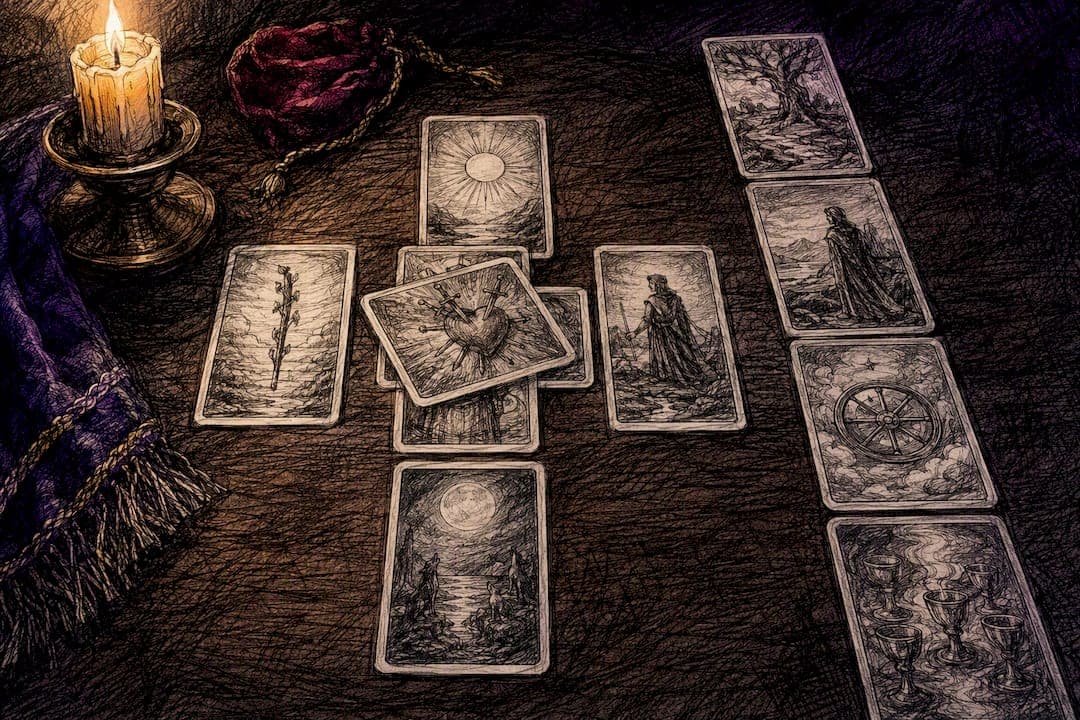
The Celtic Cross spread is a 10-card tarot layout used to map a full situation: past, present, obstacles, and likely outcome, all at once. By the end of this guide, you will know how to lay out all 10 positions, read each card's specific job, connect the cross and staff into one coherent story, and run a short practice reading with your own deck. It works with any traditional deck built on the Major Arcana and Minor Arcana, and tools like Tarosyn can help you track what you learn along the way.
TL;DR:
- Most beginners should focus on mastering the distinct meanings of the 10 positions before relying on intuition for accurate interpretation.
- A full Celtic Cross reading typically takes 20 to 30 minutes, with practice helping to reduce the time and increase confidence.
- The spread divides into a central six-card cross for current situation and challenge, and a four-card staff for self, environment, hopes, and outcome, which should be read as connected parts of a story.
- Recording short summaries immediately after each reading enhances recall and sharpens initial impressions, which are often more accurate than overthought interpretations.
- Using staged practice by gradually adding positions can help beginners develop their skills without feeling overwhelmed by all 10 cards at once.
Table of Contents
- What Does Each Position Mean in the Celtic Cross Layout?
- How Do You Set Up and Deal a Celtic Cross Reading?
- How Do You Read the Celtic Cross as One Story?
- Common Variations, Pitfalls, and When to Skip the Celtic Cross
- A Worked Example: Reading "What Should I Understand About My Career Right Now?"
- Why Structure Comes Before Intuition
- Practice Your Celtic Cross Readings With Tarosyn
- Sources
- FAQ
What Does Each Position Mean in the Celtic Cross Layout?
The Celtic Cross splits into two visual blocks. Six cards form a cross in the middle of your table: one card sits in the center, one lays horizontally across it, and four more surround them in a plus shape. Four more cards stack vertically to the right in a line called the staff. Traditional readers arrange them left to right, bottom to top.
Here is what each numbered position asks, based on the 10-card layout format most teaching resources use:
- Position 1 (the heart): What is the core of the situation right now? Placed first, face up.
- Position 2 (the cross): What is the immediate challenge or tension? Laid horizontally across Card 1.
- Position 3 (the foundation): What underlying cause or past event set this in motion?
- Position 4 (recent past): What is fading out or just occurred?
- Position 5 (the crown): What outcome is the reader consciously aiming for, or what's above the situation?
- Position 6 (near future): What is approaching in the next few weeks?
- Position 7 (self): How does the reader see themselves in this situation?
- Position 8 (environment): How do other people or outside circumstances affect things?
- Position 9 (hopes and fears): What does the reader secretly want or dread?
- Position 10 (outcome): Where is this heading if nothing changes?
Some readers add an eleventh card up front: a significator chosen to represent the person or issue, placed beneath everything else as an anchor. A.E. Waite's original notes describe positions as relational to this significator, calling them things like "above," "below," and "before" it, while most modern teaching relabels them with plainer names like the ones above. Either framework works; pick one and stay consistent.
How Do You Set Up and Deal a Celtic Cross Reading?
Getting the physical process right matters as much as knowing the meanings. Follow these steps in order:
- Set your question first. Open questions ("What should I understand about my job search right now?") give the spread more room to work than yes-or-no questions, which tend to flatten a 10-card layout into a coin flip.
- Decide on a significator. Beginners can skip it. If you use one, pick a court card that resembles the querent or the issue and set it aside before shuffling.
- Shuffle with intent. Overhand shuffle while holding the question in mind, then cut the deck into three piles with your non-dominant hand and reassemble them in any order.
- Deal in the standard order. Place Card 1, then lay Card 2 crosswise directly on top of it. Continue around positions 3 through 6, then stack positions 7 through 10 in the staff.
- Mark orientation as you go. A card that lands upside down isn't automatically reversed. Some readers treat any card at an angle, like Card 2, as upright regardless of how it landed, and decide reversals only for cards dealt straight. Pick a rule and note it in your journal.
- Budget your time. A full first-pass reading takes most beginners 20 to 30 minutes. Don't rush position 10 just to finish.
Three drills build fluency fast: draw only positions 1 and 2 daily for a week, then add 3 through 6 the following week, then bring in the staff. Staged practice like this is a common approach recommended for beginners easing into the full spread without feeling buried by 10 cards on day one.
Pro Tip: Record a 60-second voice memo right after each reading, stating your one-sentence takeaway before you second-guess it. Your first instinct is usually sharper than the interpretation you talk yourself into ten minutes later.
How Do You Read the Celtic Cross as One Story?
Reading position by position gives you 10 disconnected notes. Reading in three passes turns those notes into an actual answer.
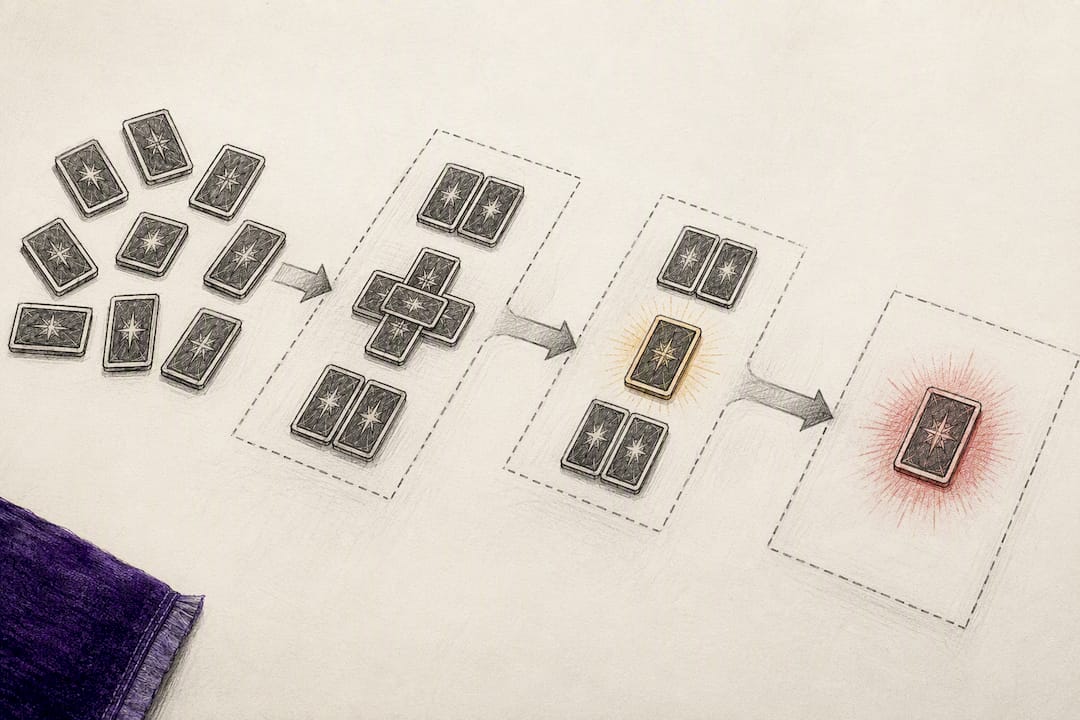
Pass one: position notes. Go card by card and jot a single phrase for each, using the position's question as your prompt. Don't interpret relationships yet.
Pass two: clusters. This is where the spread starts talking. Compare:
- Cards 1 and 2, the core tension driving everything else.
- Card 3 against Card 5, since the root cause and the conscious goal often pull in different directions.
- The timeline running from Card 4 through Card 1 into Card 6, which shows momentum.
- Cards 7 and 8, contrasting self-perception against outside pressure.
This cluster method comes from interactive tarot training tools that teach the spread as an inner cross plus a staff rather than 10 isolated slots.
Pass three: synthesis. Step back and name the pattern. Watch for a suit dominating the layout, three or more Major Arcana cards clustering together (a sign the issue runs deeper than daily circumstance), repeated numbers, or several court cards pointing to specific people involved. Waite's own notes treat the final card as a culmination to weigh against everything before it, not a fixed verdict.
Write your takeaway in one sentence with three parts: the tension, the advice implied by the cards, and the likely direction if nothing changes.
Readers who work through three full spreads before moving to real-life questions tend to report faster, more confident readings, a pattern echoed across beginner tarot training resources that recommend staged, repeated practice over jumping straight into complex questions.
Common Variations, Pitfalls, and When to Skip the Celtic Cross
A few naming and format variations show up across different decks and teachers:
- Significator or none. Some traditions require one; most modern guides treat it as optional.
- Position labels differ. "Crown" versus "conscious goal," or "self" versus "attitude," describe the same slot with different words.
- Time frames shift. Some readers treat position 6 as "next few days" instead of "next few weeks." Set your own convention and stay consistent.
The most common beginner mistake is forcing a yes-or-no answer out of a spread built for nuance. A close second is fixating on one dramatic card, like Death or the Tower, while ignoring the seven cards around it that soften or reframe it. A third is reading each position in isolation and never doing pass two.
Save the Celtic Cross for open-ended situations. A quick daily check-in or a single yes-or-no question calls for a smaller three-card spread instead.
A Worked Example: Reading "What Should I Understand About My Career Right Now?"
Here's a short, annotated reading using that exact question.
- Positions 1 and 2: The Eight of Pentacles (heart) crossed by the Five of Cups (challenge) suggests steady effort at work undercut by disappointment over a past setback, like the situation explored in this Five of Cups Celtic Cross reading.
- Position 3 vs. 5: The Four of Wands (foundation) against the Ten of Wands (crown) shows a stable base built on teamwork, but the conscious goal has drifted toward overload and burnout.
- Timeline, 4 through 1 through 6: The Two of Wands (recent past) moving into the Eight of Pentacles (present) and toward the Six of Wands (near future) traces a shift from planning, similar to this Two of Wands Celtic Cross case, through grinding work and into recognition.
Synthesis: The tension is between disciplined daily effort and an unsustainable definition of success. The advice is to redefine the goal in position 5 before burnout in position 3 catches up. The likely direction, per position 6, points toward visible progress if the pace holds. Try this same three-cluster method on your own next question before reading all 10 positions in full.
Why Structure Comes Before Intuition
Most people want to skip straight to gut-feeling interpretation, and that's backwards. Learn the 10 positions cold first, then let intuition fill the gaps between them. You'll know you're past the beginner stage when you can synthesize a full spread in three passes without checking a reference sheet, and when you've journaled at least three practice readings. The platform is built around exactly that kind of staged practice, pairing each reading with prompts that push you toward synthesis instead of card-by-card guessing.
— Joseph Calitoy
Practice Your Celtic Cross Readings With Tarosyn
This tool gives you a place to run every reading covered in this guide and actually keep it, instead of losing your notes to a random notebook page or a screenshot you never open again. Every reading saves automatically, with AI-generated summaries that help you spot patterns across multiple Celtic Cross spreads over time, reflecting the synthesis skill this guide walks through.

Your birth chart context feeds into how the tool interprets each position, so a reading about career pressure reads differently than the same cards drawn for a relationship question. If you want to compare notes with other learners, browse public readings from the Tarosyn community to see how other people worked through their own 10-card layouts. Ready to run your own? Start with the Annual Circle or Mystic Monthly plan, priced at $59.99 per year or $7.99 per month, or explore the Luna Packs for a lighter starting point.
Sources
For deeper study beyond this guide, three resources stand out. Waite's original Celtic Cross notes explain the historical significator-based framing. Tarotologist's position-by-position breakdown is a solid quick reference. CelticCrossSpread.com's interactive trainer lets you tap through positions to practice cluster reading in real time.
- Celtic Cross Tarot Spread Tutorial: Understanding the 10-Card Layout — Tarotologist
- Celticcrossspread
- The Celtic Cross Tarot Spread: An Easy Guide for Beginners — Tarot of the Fool
FAQ
How Long Does a Celtic Cross Reading Take?
A full 10-card reading takes most beginners 20 to 30 minutes, including notes for each position and a final synthesis sentence. Experienced readers often finish faster once the position meanings are memorized.
Do You Need a Significator for the Celtic Cross?
No. A significator is optional and mainly reflects Waite's original method of anchoring the spread to a specific person or issue. Most modern beginners skip it and get accurate readings without one.
What's the Difference Between the Cross and the Staff?
The cross is the six-card block in the middle covering the present situation, its challenge, foundation, recent past, aim, and near future. The staff is the four-card vertical line covering self-perception, outside environment, hopes and fears, and the final outcome, a structure interactive training tools use to teach the spread in two manageable halves.
Can Tarosyn Help Me Practice the Celtic Cross?
Yes. Tarosyn saves every reading automatically and generates AI summaries that help you track patterns across multiple Celtic Cross spreads, and current subscription pricing is listed on Tarosyn's site.
What Should I Do if a Card Feels Confusing?
Reread the position's core question rather than the card's general meaning, since the same card answers differently depending on where it lands. If it still feels stuck, move to pass two and compare it against its cluster partner instead of interpreting it alone.