
Chakra and astrology connections are defined by a single structural principle: 12 zodiac signs map to 6 main chakras, each governed by one planet expressing two polarities. This is called Energy Astrology, and it gives you a precise framework for understanding why certain astrological seasons leave you feeling drained, anxious, or physically off. Each energy center in your body has a planetary ruler. When that planet moves through a difficult transit, your corresponding chakra feels it first. The system is not symbolic. It is structural, and once you understand it, your approach to both astrology and energy work changes completely.
1. Chakra and astrology connections: the foundational map
The six chakras linked to astrology each govern two zodiac signs. One sign carries solar polarity (active, outward, yang), and the other carries lunar polarity (receptive, inward, yin). Each chakra's planet governs both signs, creating a balanced pair of expressions within the same energy center. This dual structure is why two people with very different sun signs can share the same chakra vulnerability.
| Chakra | Planet | Solar Sign | Lunar Sign |
|---|---|---|---|
| Root (Muladhara) | Saturn | Capricorn | Aquarius |
| Sacral (Svadhisthana) | Jupiter | Sagittarius | Pisces |
| Solar Plexus (Manipura) | Mars | Aries | Scorpio |
| Heart (Anahata) | Venus | Libra | Taurus |
| Throat (Vishuddha) | Mercury | Gemini | Virgo |
| Third Eye (Ajna) | Sun and Moon | Leo | Cancer |
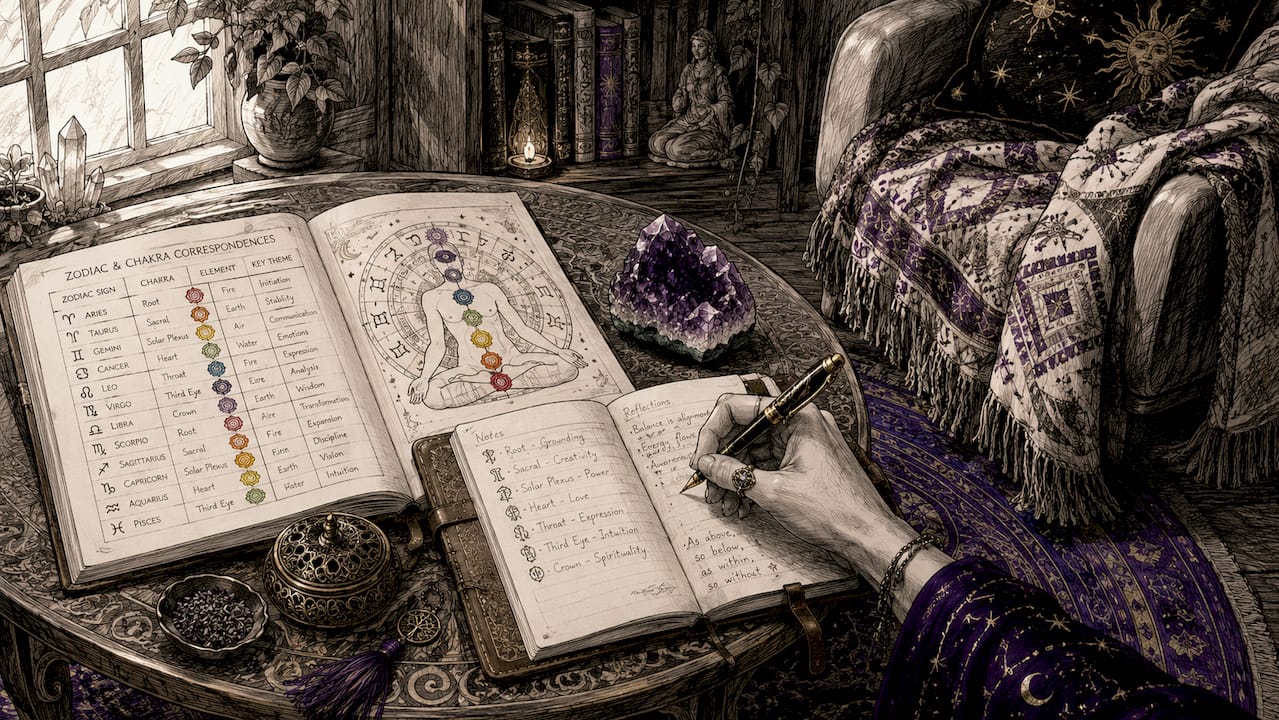
The third eye chakra stands apart. It is ruled by both the Sun and Moon, integrating intuition and spiritual vision into one center. This dual rulership makes it the most sensitive chakra to astrological shifts. The crown chakra is excluded from this planetary map because it sits beyond individual planetary influence.
Understanding this table gives you a working tool. When Venus is under stress in your natal chart or by transit, your heart chakra is the first place to check for imbalance.
2. How zodiac traits create specific chakra blockages
Zodiac sign personality patterns produce predictable chakra vulnerabilities. Aries, ruled by Mars, tends toward impatience and aggression. That behavioral pattern strains the solar plexus chakra, which governs personal power and self-regulation. Taurus, ruled by Venus, can become possessive and resistant to change, creating stagnation in the heart chakra.
These blockages do not stay emotional. Chakra imbalances manifest physically as migraines linked to the third eye, digestive issues tied to the solar plexus, and constipation connected to root chakra disruption. The body keeps score of what the energy system holds.
Common zodiac-linked blockage patterns include:
- Aries and Scorpio (Mars ruled): solar plexus tension, anger suppression, digestive inflammation
- Taurus and Libra (Venus ruled): heart chakra rigidity, difficulty with boundaries or over-giving
- Gemini and Virgo (Mercury ruled): throat chakra anxiety, overthinking, communication shutdown
- Cancer and Leo (Sun/Moon ruled): third eye overwhelm, emotional flooding, intuition distrust
- Sagittarius and Pisces (Jupiter ruled): sacral chakra escapism, boundary dissolution, creative blocks
- Capricorn and Aquarius (Saturn ruled): root chakra fear, chronic tension, disconnection from the body
Pro Tip: Check your natal chart archetypes alongside your sun, moon, and rising signs. Your rising sign often reveals the chakra most prone to blockage, not just your sun sign.
Healing practices vary by sign. Grounding meditation works well for Saturn-ruled signs. Solar-gazing and breathwork suit Mars-ruled types. Affirmation work and journaling help Mercury-ruled individuals release throat chakra tension.
3. How planetary movements shift chakra energy
Planets influence chakra energy flow through their movement and aspects, not just their natal positions. When a planet goes retrograde, the chakra it rules tends to weaken or become erratic. Mars retrograde, for example, correlates directly with solar plexus chakra disruption. You may notice reduced motivation, digestive sensitivity, or difficulty asserting yourself during these periods.
Retrograde planetary phases produce well-documented chakra energy fluctuations, and tailored yoga and mindfulness practices are the most effective tools for restoring balance during these astrological events.
This is not abstract. When Mercury goes retrograde, throat chakra symptoms appear: miscommunication, difficulty expressing ideas clearly, and tension in the neck and shoulders. When Venus retrogrades, heart chakra sensitivity spikes. Relationships feel heavier. Self-worth wavers.
Practical responses to retrograde chakra disruption include:
- Mars retrograde: Warrior pose (Virabhadrasana), core-focused breathwork, and reducing competitive pressure
- Mercury retrograde: Journaling, Mercury Reflection tarot spreads, and throat-opening yoga postures like Fish pose
- Venus retrograde: Heart-opening postures, self-compassion meditation, and rose quartz work
- Saturn retrograde: Grounding practices, walking barefoot, and root chakra affirmations
Astrological houses in your natal chart add another layer. Planets placed in specific houses influence chakra strengths and vulnerabilities in ways unique to each person. A natal Mars in the 12th house behaves very differently from Mars in the 1st, even though both connect to the solar plexus.
4. Solar and lunar polarities in chakra-astrology relationships
Solar and lunar polarities govern how chakras express astrological energy. Solar polarity is active and outward. Lunar polarity is receptive and inward. Every chakra holds both expressions through its two zodiac signs, and imbalance shows up differently depending on which polarity is dominant in your chart.
The balance between solar (pingala) and lunar (ida) energies inside chakras reflects the cosmic duality built into astrology itself. Over-exerting a chakra's solar expression looks like aggression, burnout, or control. Under-utilizing it looks like passivity, avoidance, or numbness.
Here is how polarity imbalance shows up in practice:
- Root chakra, solar (Capricorn): Overwork, rigid structure, inability to rest
- Root chakra, lunar (Aquarius): Detachment, instability, avoidance of commitment
- Heart chakra, solar (Libra): People-pleasing, conflict avoidance, loss of self
- Heart chakra, lunar (Taurus): Possessiveness, emotional withdrawal, stubbornness
- Throat chakra, solar (Gemini): Talking over others, scattered communication, mental overload
- Throat chakra, lunar (Virgo): Self-censorship, perfectionism, fear of being misunderstood
Pro Tip: When you notice a recurring behavioral pattern, identify whether it is an over-expression or under-expression of that chakra's energy. That tells you whether to activate or calm the center during your practice.
Understanding solar versus lunar polarity expressions guides practitioners in assessing energy overdoses or deficits attributable to astrological influence. This makes chakra healing far more precise than a generic "balance your chakras" approach.
5. Practical ways to synchronize chakra and astrology work
Combining astrology readings with chakra practice gives you a timed, personalized energy plan. Each visible celestial body corresponds to a specific chakra, affecting emotional and physical health in measurable ways. You do not need to work on all seven chakras at once. Your current transits tell you which one needs attention right now.
Use these practices to keep your energy aligned with astrological cycles:
- Check your daily horoscope each morning. Note which planet is most active in your chart that day and identify its corresponding chakra. Direct your morning meditation there.
- Track new and full moons. The Moon rules the third eye chakra through Cancer. New moons in water signs call for intuition work. Full moons in earth signs call for grounding.
- Use planetary hours. Each hour of the day is traditionally governed by a planet. Scheduling chakra work during the corresponding planetary hour amplifies the effect.
- Review your natal chart seasonally. When the Sun transits a sign that rules one of your natal planets, that planet's chakra becomes more active. Use that window for focused healing.
- Combine tarot with chakra work. Tarot archetypes map directly onto planetary and chakra energies. Drawing a card during a chakra meditation session gives you a symbolic anchor for the energy you are working with.
Planets and chakras align spiritual and physical energies, and synchronizing them produces more consistent results than working either system in isolation. The astrology tells you what is active. The chakra work tells you where to feel it and what to do about it.
Key Takeaways
The most effective approach to chakra and astrology connections is mapping each energy center to its planetary ruler and zodiac polarity, then using that map to guide targeted healing during active transits.
| Point | Details |
|---|---|
| Six chakras link to astrology | Each of the six main chakras corresponds to a planet governing two zodiac signs with dual polarities. |
| Zodiac traits predict blockages | Your sun, moon, and rising signs reveal which chakras are most prone to imbalance and why. |
| Retrogrades weaken chakras | When a ruling planet retrogrades, its corresponding chakra shows measurable disruption in energy flow. |
| Polarity shapes the imbalance | Solar over-expression and lunar under-expression produce different symptoms in the same chakra. |
| Combine systems for precision | Using astrology transits alongside chakra practice gives you a timed, personalized healing plan. |
What I have learned from working with these systems
The most common mistake I see is treating chakra work and astrology as two separate practices that occasionally overlap. They are not separate. They are the same map drawn in two different languages.
What convinced me was tracking my own energy during planetary retrogrades. Every time Mercury went retrograde, I noticed throat tension and communication breakdowns before I even checked the ephemeris. Once I started treating that as a signal to do throat chakra work, the retrograde periods became useful instead of frustrating.
The polarity framework is where most people stop short. Knowing that Venus rules the heart chakra is useful. Knowing whether your Venus expresses through Libra (solar, relational, outward) or Taurus (lunar, sensory, inward) tells you something completely different about how your heart chakra blocks. That distinction changes the healing approach entirely.
My honest observation after years of working with these systems: the people who get the most out of this framework are the ones who use their natal chart as a diagnostic tool, not just a personality description. Your chart tells you which chakras need regular maintenance and which ones tend to overfire. That is practical information you can act on every week.
The field is also moving. Energy Astrology as a named practice is gaining traction in 2026, with more practitioners integrating natal chart analysis directly into chakra assessment sessions. If you have not explored your chart through this lens yet, now is a good time to start.
— Joseph
Tarosyn's tools for chakra and astrology exploration
Tarosyn brings together personalized astrology, tarot, and numerology in one place, making it straightforward to apply the chakra-astrology framework to your own chart and daily energy work.
You can start with a personalized tarot reading that connects emotional and spiritual energy to your current astrological transits. Tarosyn's AI-powered readings draw on planetary archetypes and tarot symbolism together, so you get insight into both the astrological pattern and the chakra energy it activates. The spirituality topic feed also surfaces daily reflections aligned with current planetary movements. Whether you are tracking a retrograde or working through a specific chakra, Tarosyn gives you the tools to do it with context and clarity.
FAQ
What are chakra and astrology connections based on?
Chakra and astrology connections are based on the principle that each of the six main chakras is governed by a planet that rules two zodiac signs, one with solar polarity and one with lunar polarity. This framework, known as Energy Astrology, links your astrological chart directly to your body's energy centers.
Which chakra is most sensitive to astrological shifts?
The third eye chakra is the most sensitive because it is ruled by both the Sun and Moon, making it responsive to a wider range of planetary movements than any other energy center.
How do planetary retrogrades affect chakras?
Retrograde phases weaken the chakra governed by the retrograding planet. Mars retrograde disrupts the solar plexus, Mercury retrograde affects the throat chakra, and Venus retrograde increases heart chakra sensitivity.
Can chakra blockages show up as physical symptoms?
Yes. Chakra imbalances linked to astrological patterns manifest physically as migraines (third eye), digestive issues (solar plexus), and constipation (root chakra), among other symptoms.
How do I know which chakra to focus on?
Check which planet is most active in your current transits, then identify its corresponding chakra using the planetary rulership map. Your daily horoscope can help you track which planetary energies are strongest on any given day.