Court cards are a hybrid: they represent people, parts of you, or an energy to adopt. Each one carries two layers of meaning, a suit (element) and a rank (maturity and pace), and the fastest way to read one is a simple check: look at the spread position, notice if a real person comes to mind, and if nobody fits, read the card as yourself or as advice.
TL;DR:
- The suit and rank of a court card reveal where the energy manifests and how developed it is, guiding interpretations based on context.
- Reversed court cards usually indicate blocked, overexpressed, or shadow aspects rather than literal people or situations.
- Avoid over-specificity by focusing on suit and rank, and consider surrounding cards or spread positions to clarify whether the card represents a person, self, or advice.
- Deck variations like Rider-Waite, Thoth, and Marseille influence visual clues and symbolic depth, affecting how easily you interpret court cards.
- Practice by observing how court cards function as archetypes and as part of larger spread narratives rather than fixed individuals.
Table of Contents
- What Is the Meaning of Court Cards in Tarot?
- How Do Suits Change the Meaning of a Court Card?
- What Does Rank Mean: Page, Knight, Queen, King?
- Person, Self, or Advice: How Do You Choose?
- What Mistakes Do Beginners Make With Court Cards?
- Three Quick Court Card Walkthroughs You Can Practice
- What Do Reversed Court Cards Mean?
- How Does Tarosyn Apply Court Card Meaning in AI Readings?
- Where Did Tarot Court Cards Come From?
- How Do Rider-Waite, Thoth, and Marseille Court Cards Differ?
- What Do Court Cards Represent Psychologically?
- How Do You Read Court Cards Alongside Major Arcana and Numbered Cards?
- A Practice Note on Learning Court Cards
- Practice Court Card Readings With Tarosyn
- Sources
What Is the Meaning of Court Cards in Tarot?
Court cards confuse beginners because they refuse to sit still. A single card can be your boss, your own stubborn streak, or a nudge to act more decisively this week. The 16 court cards combine four ranks with four suits, and that combination is designed to shift meaning depending on what surrounds it in a spread.
Three lenses cover almost every situation:
- Person: the card points to someone real in the querent's life. A King of Pentacles in a "people around you" position often flags a boss or financial figure.
- Self: the card reflects a trait the querent is embodying or needs to embody. A Queen of Swords in a "current state" slot can mean the querent is thinking with unusual clarity right now.
- Advice/energy: the card names a mood or approach to adopt. A Page of Wands in an "outcome" position can suggest bringing more curiosity to a decision.
That ambiguity is a feature, not a flaw. It forces you to read the whole spread instead of memorizing a fixed dictionary entry. The quickest working method follows a four-step decision sequence: check position, test for a person match, test for self, then default to advice if neither lands.
How Do Suits Change the Meaning of a Court Card?
Suit tells you where the card's energy shows up. Rank tells you how mature that energy is. Together they narrow sixteen possibilities down to one workable sentence.
- Wands (fire): ambition, creativity, action, passion projects. Think career moves, new ventures, bursts of motivation.
- Cups (water): emotion, relationships, intuition, connection. Think love readings, friendships, and inner feelings.
- Swords (air): thought, conflict, communication, truth. Think arguments, decisions, and mental clarity or confusion.
- Pentacles (earth): money, work, body, stability. Think job security, physical health, and material progress.
A Knight of Cups suggests an emotional pursuit in motion. A Queen of Pentacles suggests grounded, practical care. Suit and rank are not separate systems. Some traditions layer a second elemental assignment onto the ranks themselves, so it is worth checking which elemental system your deck follows before you treat any mapping as universal.
What Does Rank Mean: Page, Knight, Queen, King?
Rank is a maturity clock. It tells you how developed the energy is and roughly how fast it's moving.
- Page: beginner energy, a message, or a new idea still forming. Slow, seed-stage timing.
- Knight: action, movement, pursuit. Fast, sometimes reckless timing.
- Queen: internal mastery, emotional intelligence, nurturing depth. Steady, developing timing.
- King: external mastery, authority, established results. Timing has largely arrived.
Build a one-line read by pairing rank with suit before you even look at surrounding cards. "Page of Wands" becomes a raw, untested spark of ambition. "King of Wands" becomes a leader who has already proven that ambition works. The rank shifts tone; the suit shifts subject matter. Once you can name both in a breath, court cards stop feeling like a separate language and start feeling like tarot shorthand.
Person, Self, or Advice: How Do You Choose?
Run this checklist any time a court card lands and you're not sure what to do with it:
- Check the position. Positions like "people around you," "outside influences," or "someone entering your life" lean toward a real person. Positions like "your current state" or "what you need" lean inward.
- Trust flash recognition. If a specific person pops into your head within a few seconds, follow that instinct. Readers rarely force this; it either clicks or it doesn't.
- Test it as self. Ask: what quality does this card describe, and does that quality describe the querent right now? A Knight of Swords showing up as self often means someone is arguing their point too sharply.
- Default to advice. If no person and no self-match feels right, read the card as a suggestion: adopt this energy to move forward. Reading it as advice or as an aspect of the querent is a reliable fallback, not a consolation prize.
Watch two traps here. Don't assume gender from the card's imagery, and don't turn a court card into a diagnosis by pinning an exact age or job title on it. That kind of over-labeling creates anxiety instead of insight.
Pro Tip: When a court card refuses to resolve into a clear person, stop hunting for a name. Ask instead, "What would this card have me do next?" That single reframe unlocks stuck readings faster than anything else.
What Mistakes Do Beginners Make With Court Cards?
The most common error is forcing a literal person onto every court card that appears, even in positions that were never asking for one. A close second is assuming a King must be a man or a Queen must be a woman. Court cards describe energy, not anatomy, and reading them that way limits your accuracy.
Beginners also tend to over-specify. Guessing an exact age, career, or relationship status for the "person" a card represents almost always backfires when the querent corrects you mid-reading.
Practical shortcuts fix most of this fast:
- Say the suit and rank out loud as one phrase before interpreting anything else ("Knight of Swords" as fast, sharp, confrontational).
- Anchor the card against its neighbors. A court card next to The Tower reads very differently than the same card next to The Star.
- Ask the querent a clarifying question rather than guessing. "Does anyone in your life fit an ambitious, fiery personality right now?" often gets an instant yes or no.
Pro Tip: If you've spent more than thirty seconds stuck on whether a card is a person, stop guessing and pivot straight to advice. Stuck readings usually resolve the moment you stop trying to name someone.
Three Quick Court Card Walkthroughs You Can Practice
Short, concrete examples train your eye faster than any chart. Working through brief walkthroughs that combine suit, rank, and position is the fastest path to fluency.
-
Page of Cups as advice in a relationship spread. No obvious person fits the querent's description. Read it as advice: approach the relationship with more openness and emotional curiosity. Follow up by asking, "Where have you been guarding your feelings lately?"
-
Knight of Swords in a future/timing position. This signals fast-moving, direct action headed toward a decision or confrontation. Phrase it with pace in mind: "Expect things to move quickly, possibly through a blunt conversation, within the next few weeks."
-
Queen of Pentacles in a self position. Rather than searching for a nurturing woman in the querent's life, read it as personal development. Say: "You're being asked to bring steady, practical care to your own well-being right now, the way you'd care for someone you love."
Try practicing this flow with something like a Knight of Cups career path reading, where the same person-versus-advice question comes up in a completely different domain.
What Do Reversed Court Cards Mean?
Reversed court cards rarely stay literal. Reversal typically pushes the meaning toward blocked, overexpressed, or shadow behavior rather than describing an actual person walking into the querent's life.
- A reversed Page can mean stalled news or immaturity refusing to grow up.
- A reversed Knight can mean reckless, scattered action, or the opposite: complete inertia.
- A reversed Queen can mean neglected self-care or emotional manipulation.
- A reversed King can mean abused authority or a leader who has lost their grip.
Reversals also affect timing. Since upright rank already signals pace (Pages slow, Knights fast, Queens steady, Kings arrived), a reversal often stretches or stalls that pace rather than reversing the subject entirely. Treat a reversed court card as a signal to look inward or heed a warning, not as proof a specific person is working against the querent.
How Does Tarosyn Apply Court Card Meaning in AI Readings?
Tarosyn's guided AI readings walk through the same suit, rank, and spread-position logic covered here, flagging when a court card likely points to a person versus advice. Readers can test the method directly on the public readings feed, then save results and cross-reference them against astrology and numerology insights to build pattern recognition over time.
Where Did Tarot Court Cards Come From?
Court cards predate modern tarot by centuries. They descend from 14th and 15th century Italian and Mamluk playing card decks, which already featured ranked face cards resembling royal and military hierarchies. Early European tarocchi decks kept this four-rank structure, King, Queen, Knight, and Page (sometimes called Valet or Jack), long before tarot became a divination tool rather than a card game.
The Tarot de Marseille, standardized in France by the 17th and 18th centuries, preserved this traditional four-rank court but rendered the figures with minimal symbolic detail, mostly flat, iconic portraits without the layered scenery later decks would use.
Everything shifted in 1909 with the Rider-Waite-Smith deck. Illustrator Pamela Colman Smith packed each court card with symbolic landscape, gesture, and object, turning the King of Cups or the Queen of Swords into a small narrative scene rather than a static royal portrait. That visual density is exactly why modern readers can pull so much psychological nuance from these cards. Suit and rank stopped being the only information available; posture, background, and object placement all became readable.
The Thoth deck, developed by Aleister Crowley and painted by Frieda Harris in the 1940s, pushed further by renaming ranks entirely (Knight, Queen, Prince, Princess) and layering in astrological and elemental correspondences from ceremonial magic traditions. Each evolution kept the same core skeleton, four ranks, four suits, while changing how much symbolic weight each card was asked to carry.
How Do Rider-Waite, Thoth, and Marseille Court Cards Differ?
Deck choice changes how much extra information a court card offers, and it's worth knowing which system you're holding before you interpret one.
The Rider-Waite-Smith deck remains the most widely taught because its court cards show recognizable body language and scenery. A Queen of Pentacles sits in a garden, comfortable and abundant. A King of Swords sits upright on a stark throne, judgment ready. These visual cues make person-versus-self-versus-advice calls easier for newer readers, since the imagery itself hints at mood.
The Thoth deck renames two ranks (Prince instead of Knight, Princess instead of Page) and folds in astrological decans and elemental sub-associations for each card. This adds precision for readers already comfortable with astrology, but it demands more study upfront. A Thoth Prince of Cups carries elemental nuance a Rider-Waite Knight of Cups simply doesn't display on its face.
The Marseille deck strips symbolism down to formal, static portraits with minimal background detail. Readers working with Marseille decks lean far more heavily on card position, numerology, and surrounding cards, since the court card image itself offers fewer built-in clues.
None of these systems is more "correct." They represent different depths of symbolic layering. A second elemental mapping tied to rank shows up in Golden Dawn-influenced decks like Thoth, so always confirm which convention your deck actually uses before you interpret against it.
What Do Court Cards Represent Psychologically?
Beyond literal people or advice, court cards work well as archetypes, recognizable patterns of behavior that show up across every culture and every life. A King represents the archetype of established authority and responsibility. A Queen represents nurturing mastery turned inward. A Knight represents restless pursuit. A Page represents raw potential not yet tested by experience.
Reading court cards this way turns a spread into a psychological mirror rather than a cast list. A Knight of Pentacles appearing in a career spread might not point to a coworker at all. It might describe the querent's own plodding, methodical work ethic, an archetype of steady grind rather than a person to identify by name. This framing lines up with the broader idea of archetypal patterns in tarot, where each figure carries a recognizable role independent of any specific person's face.
This lens also explains why the same court card can feel wildly different across two readings for two different querents. The archetype stays fixed; the life circumstances wrapping around it change everything. A Queen of Swords for one querent might describe hard-won clarity after a divorce. For another, it might describe a habit of cutting people off before they get too close. Both are the same archetype expressing itself through different personal material, which is exactly why forcing one fixed definition onto every Queen of Swords pull produces flat, generic readings instead of useful ones.
How Do You Read Court Cards Alongside Major Arcana and Numbered Cards?
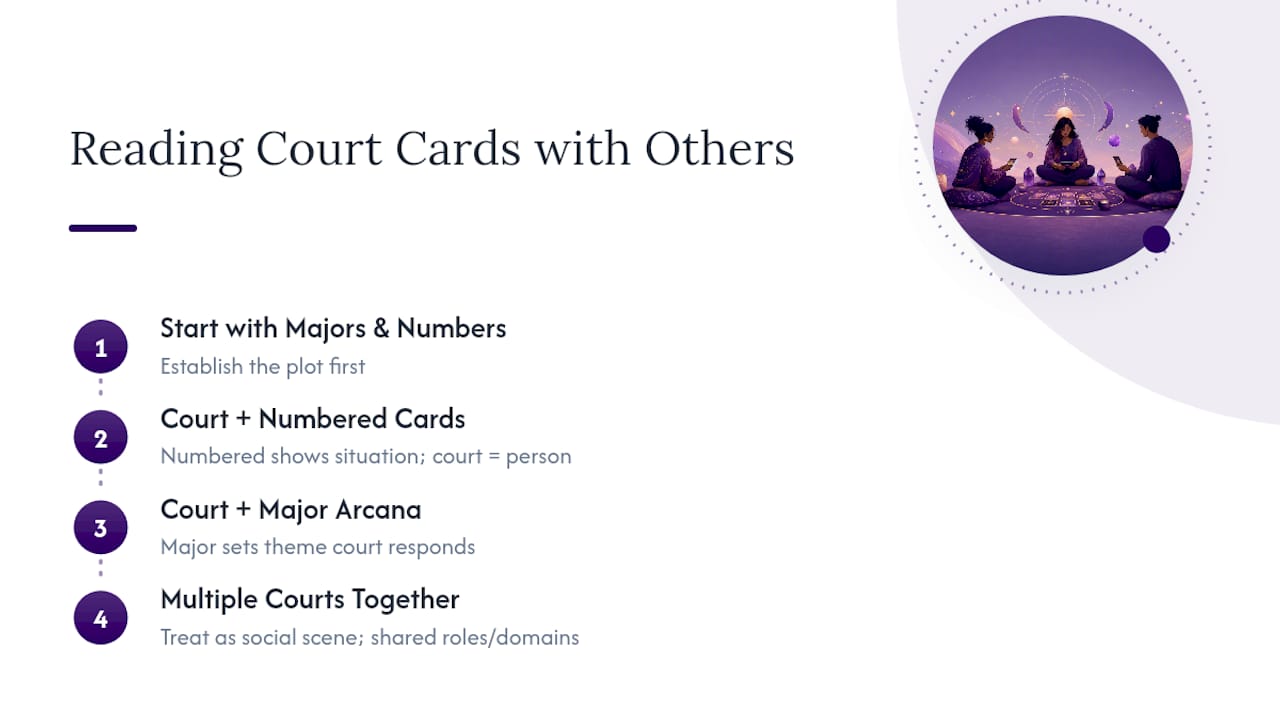
Court cards rarely appear alone, and reading them in isolation is one of the fastest ways to miss what a spread is actually saying. Numbered cards (Ace through Ten) describe events, situations, and stages of a process. Court cards describe the people or energies involved in that process. Major Arcana cards describe the big, structural forces shaping everything else.
When a court card sits beside a numbered card of the same suit, the numbered card usually explains the situation the person or energy is caught in. A Knight of Wands next to the Five of Wands describes someone charging into active conflict or competition. A Queen of Cups next to the Nine of Cups describes emotional contentment guided by someone's steady, caring presence.
When a court card sits beside a Major Arcana card, the Major usually sets the theme the court card is responding to. A King of Swords beside The Tower suggests decisive, even ruthless, action taken during a moment of sudden upheaval. A Page of Pentacles beside The Star suggests a fresh, hopeful start toward material stability.
When multiple court cards cluster together, treat the group as a social scene rather than isolated cards. Shared suits point to a shared domain of concern (several Cups suggest an emotionally charged situation involving multiple people). Shared ranks point to parallel roles (two Knights suggest two people or forces both in active motion, possibly at odds).
The habit worth building: read the numbered and Major Arcana cards first to establish the plot, then drop the court cards in as characters reacting to that plot. It keeps interpretations grounded instead of floating free of the rest of the spread.
A Practice Note on Learning Court Cards
Pull one court card each morning and journal the advice it offers before checking any reference. Trust your instinct first, then confirm it with the suit and rank framework above.
— Joseph Calitoy
Practice Court Card Readings With Tarosyn
Reading court cards well takes repetition, not memorization, and most people plateau because they never get enough live practice with real spreads. Tarosyn's guided AI readings walk you through the same suit, rank, and position logic covered in this article, flagging when a card is likely pointing to a person, a part of you, or advice, so you build that instinct faster than trial and error alone.

Start with a short spread like The World in a three-card layout to see how a single court card shifts meaning depending on where it lands, then browse the full readings library to keep practicing against new combinations. If you want to strengthen your instincts even further, pair a reading session with a look at your daily horoscope to see how astrological timing lines up with the pace a court card is already signaling.
Sources
- Master The Court Cards: Modern RWS Tarot Card Meanings — Tarot Apprenticeship
- Tarot Court Cards: How to Read Them in Any Spread | Drawn Fate
- Tarot court cards made easy — Esoteric Universe
- Learn Tarot — Guide to Court Cards — Kerykeion
- Court Cards: A Primer — The Shuffle / Chelsey Tarot for Creativity