
Tarot reading is defined as a structured practice of drawing symbolic cards to access intuitive insights, self-awareness, and inner guidance. To deepen intuition through tarot readings, you engage your felt sense, not just your memory of card meanings. The cards act as mirrors. They reflect what your conscious mind often overlooks. Practiced readers use techniques like meditative centering, somatic observation, and reflective journaling to build a direct, personal connection with the deck. Platforms like Tarosyn combine AI-powered readings with archetypal symbolism to support this kind of intentional, intuition-focused practice. This guide gives you a clear, step-by-step path to develop that skill.
How to deepen intuition through tarot readings
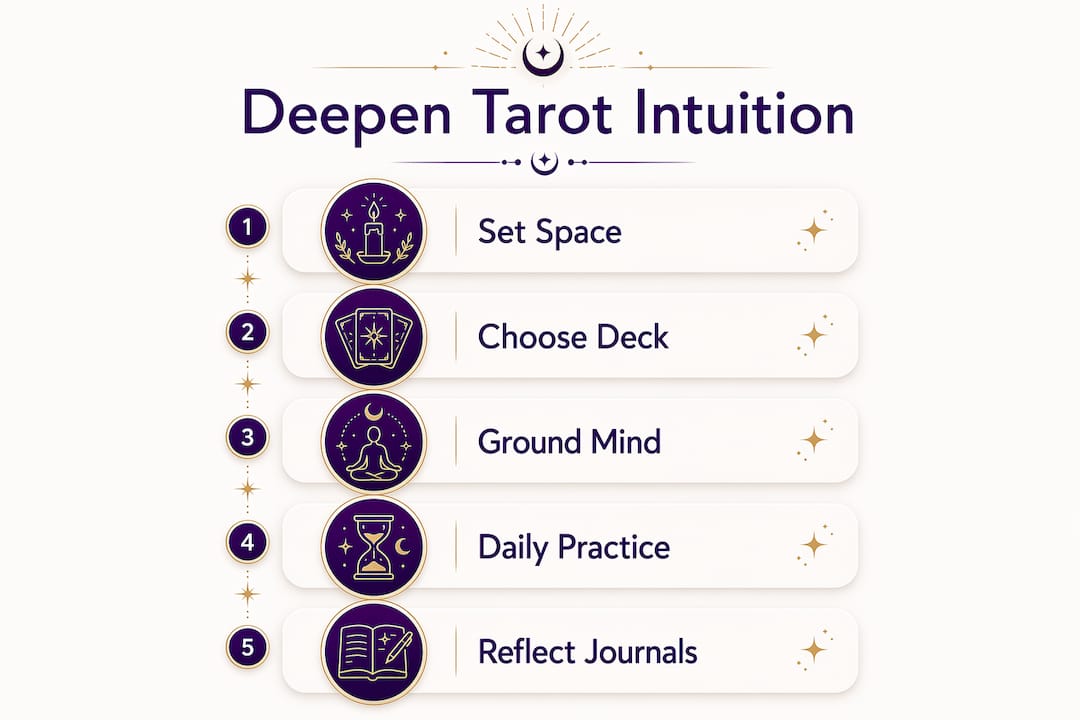
Before you pull a single card, you need the right setup. The environment and your mental state shape how clearly intuitive signals come through.
Choose your deck deliberately. The Rider-Waite-Smith deck is the most widely recommended starting point because its imagery is rich with archetypes and symbols. Those symbols act as intuitive triggers that go beyond memorized meanings. If you already own a deck, stick with it. Familiarity builds connection faster than novelty.
Create a consistent reading space. A quiet, low-distraction environment signals to your nervous system that it is time to slow down and listen inward. This does not require candles or elaborate ritual. A cleared table and five minutes of silence work just as well.
Prepare your mind before reading. Meditative grounding rituals quiet mental overactivity and sharpen emotional clarity. Even a few minutes of slow breathing before a reading measurably improves intuitive perception. The goal is relaxation and openness, not a blank mind.

Here is a quick comparison of common tools readers use to support intuitive practice:
| Tool | Primary purpose | Best for |
|---|---|---|
| Rider-Waite-Smith deck | Archetype-rich imagery | Beginners building symbol literacy |
| Thoth Tarot deck | Esoteric symbolism | Readers with analytical backgrounds |
| Blank journal | Recording impressions | All levels of practice |
| Meditation timer | Consistent pre-reading ritual | Readers prone to rushing |
| Tarosyn spreads | Structured intuitive layouts | Guided practice with feedback |
Daily practice matters more than any single tool. Consistent daily reading builds confidence and intuitive connection to the deck over months, not weeks. Patience is not optional here. It is the method.
How to perform readings that build intuitive insight
The goal of an intuition-focused reading is to feel the card before you think about it. This sequence trains that skill directly.
-
Center yourself. Sit quietly for three to five minutes. Breathe slowly. Let your thoughts settle. This is not meditation for its own sake. It prepares your nervous system to receive subtle signals.
-
Draw your card and look before you think. Place the card face up and observe it without naming anything. Notice colors, figures, and spatial relationships. Ask yourself: what is the first feeling this image produces?
-
Engage all your senses. What does the scene feel like physically? Is there tension, warmth, or stillness? Card imagery and symbolism activate intuitive responses that go well beyond what a guidebook can offer.
-
Ask one open question. Direct a simple question at the image. "What does this figure want?" or "What is happening just outside the frame?" These prompts bypass analytical thinking and pull up non-verbal knowing.
-
Trust your first impression. First gut reactions to cards are often the clearest intuitive messages, even when they contradict traditional meanings. Write down that first impression before you second-guess it.
-
Record everything immediately. Open your journal and write your raw impressions in full sentences. Do not edit. Do not filter. Speed matters here because the analytical mind moves in quickly.
Pro Tip: Set a two-minute timer after drawing a card. Write continuously until it goes off. This forces your intuitive responses onto the page before your inner critic can intervene.
The practice of delaying verbal conceptualization is a recognized training method. Suspending early conceptual interpretations engages non-verbal cognition modes that most people never consciously access. This is the core skill that separates intuitive readers from those who simply recite memorized definitions.
What mistakes block intuition and how to fix them
Most readers hit the same walls. Recognizing them early saves months of frustration.
- Over-reliance on guidebooks. Reaching for a book every time you draw a card trains you to distrust yourself. Use guidebooks as a check after you have recorded your own impressions, not before.
- Dismissing impressions that feel "wrong." If your gut says the Tower card feels peaceful in this context, that is data. Suppressing it because it contradicts the textbook meaning shuts down the intuitive channel.
- Rushing the reading. Speed is the enemy of felt-sense perception. If you are flipping cards quickly, you are in analytical mode, not intuitive mode.
- Treating doubt as a sign of failure. Doubt is a normal part of developing any perceptual skill. It does not mean your intuition is broken. It means you are still calibrating.
- Projecting your own narrative onto the querent. When reading for others, sharing felt-sense impressions aloud before constructing a full narrative prevents projection and keeps the reading grounded in shared reality.
"Intuition leads in interpretation while learned meanings provide a framework for articulation and validation." — Intuitive Tarot Reading CRASH COURSE
The fix for most of these mistakes is the same: slow down and write it down. The role of intuition in tarot reading grows when you give it space to surface before analysis takes over.
How journaling strengthens your intuitive tarot practice
A tarot journal is not a diary. It is a training log. Used consistently, it becomes the clearest evidence you have that your intuition is developing.
- Write raw impressions immediately after each reading. Record the card drawn, your first feeling, any images or words that surfaced, and the question you asked. Keep entries brief and honest.
- Review past entries weekly. Look for patterns. Did a specific card keep appearing before a certain type of event? Did your first impression match what unfolded? These patterns are your intuition speaking in retrospect.
- Track accuracy over time. When you review an entry from three weeks ago, note whether your impression proved accurate. This builds internal validation. You stop needing external confirmation because your own record provides it.
- Use entries to refine your personal card meanings. A personal tarot journal evolves with the reader's intuitive growth. Your meaning for the Five of Cups may differ from the textbook definition, and that is not a flaw. It is a sign of genuine intuitive development.
Reflective journaling also surfaces synchronicities, those moments when a card's theme appears in your waking life shortly after a reading. Noticing these connections reinforces trust in your inner guidance. Over time, that trust becomes the foundation of every reading you do. Tarosyn's personal growth resources offer additional frameworks for tracking this kind of development alongside your tarot practice.
My honest take on balancing intuition and analysis
The debate between intuitive reading and analytical reading is mostly a false choice. In my experience, the readers who develop the fastest are the ones who treat learned card meanings as a second language, not a first language.
Start with what you feel. Then check it against what you know. A balanced reading harmonizes intuitive impressions with analytical knowledge to strengthen both reliability and depth. That balance is not a compromise. It is the actual skill.
The part most guides skip is this: your intuitive clarity will fluctuate. Some days the cards speak loudly. Other days you draw a blank. That fluctuation is not failure. It is the normal rhythm of perceptual training. Sustained practice across both kinds of days is what builds the skill.
When reading for others, I have found that stating a felt-sense impression out loud before elaborating does two things. It keeps me honest, and it gives the querent a chance to confirm or redirect. That moment of mutual calibration is where the most accurate readings happen. It also prevents the common trap of building an elaborate narrative around a projection rather than an actual intuitive signal.
The readers I have seen plateau are almost always the ones who stopped journaling. The journal is not supplementary. It is the feedback loop that makes everything else work.
— Joseph
Tarosyn's tools for building your intuitive practice
Tarosyn brings together AI-powered tarot readings, archetypal symbolism, and a live community of readers in one place. If you want structured support for the practices covered here, it is a practical starting point.

The tarot archetypes library on Tarosyn gives you detailed breakdowns of each card's symbolic layers, which is exactly what you need when you are training yourself to observe before you interpret. The Horseshoe Spread layout is a strong choice for practicing intuitive sequencing across multiple card positions. The community readings feed lets you observe how other readers articulate their impressions, which sharpens your own ability to name what you sense. All three resources work together to support a consistent, intuition-focused practice.
FAQ
What does it mean to read tarot intuitively?
Intuitive tarot reading means responding to a card's imagery and felt sense before consulting memorized meanings. First impressions and gut reactions are treated as primary data, not noise to be corrected.
How long does it take to develop tarot intuition?
Experienced readers report that months of daily practice shift their readings from guidebook-dependent to intuitively guided. Consistent journaling accelerates that timeline.
Do I need to memorize card meanings to read intuitively?
No. Learned meanings serve as a validation framework, not a starting point. Intuition leads interpretation while analytical knowledge helps you articulate and confirm what you already sensed.
Can meditation really improve tarot readings?
Yes. Even brief mindfulness practice before a reading quiets mental overactivity and sharpens emotional clarity, both of which are required for clear intuitive perception.
What is the best way to track intuitive growth in tarot?
Keep a dedicated tarot journal and review it weekly. Tracking the accuracy of your first impressions over time builds internal validation and shows you exactly where your intuition is strongest.
Key takeaways
Developing intuition through tarot readings requires daily practice, deliberate observation, and consistent journaling to build a reliable inner feedback loop.
| Point | Details |
|---|---|
| Observe before you interpret | Look at card imagery and record your felt sense before consulting any guidebook. |
| Ground yourself before reading | A few minutes of slow breathing quiets mental noise and sharpens intuitive clarity. |
| Trust first impressions | Gut reactions to cards are often the clearest intuitive signals, even when they differ from textbook meanings. |
| Journal every reading | A personal tarot journal tracks accuracy over time and builds trust in your inner guidance. |
| Balance intuition with analysis | Use learned card meanings to validate and articulate what your intuition already sensed, not to replace it. |