
Following the astrology calendar for 2026 means tracking planetary movements, lunar phases, and retrograde cycles to align your decisions with cosmic timing. Astrologers call this practice "electional astrology," the art of choosing the right moment for important actions. The year 2026 stands out because of back-to-back structural shifts: Saturn moves into Aries on February 13, Jupiter enters Leo in late June, and two eclipses in August activate a new lunar node axis. These events give the 2026 astrology calendar a density of change that rewards anyone who tracks it closely.
What are the major astrological events to follow in the astrology calendar for 2026?
The 2026 astrological calendar carries more major transits than most years. Knowing the dates in advance lets you plan around them rather than react to them after the fact.
Key planetary shifts
Saturn enters Aries on february 13, 2026. This transit shifts the dominant theme from Pisces-era dissolution to Aries-era personal assertion and boundary-setting. If you have been waiting to commit to a new structure in your career or relationships, Saturn in Aries rewards that commitment directly.

Jupiter enters Leo on June 29, 2026, opening a period of expanded creativity and personal leadership. Jupiter in Leo favors bold moves, public visibility, and creative projects. The second half of 2026 carries this energy forward through the end of the year.
Mercury retrograde occurs three times in 2026, all in water signs. Water sign retrogrades affect emotional communication more than logistical planning. Expect misunderstandings in personal conversations rather than the typical tech failures associated with earth sign retrogrades.
Eclipse season and lunar nodes
The eclipses in august 2026 form a gateway for accelerated change. They activate the Leo-Aquarius lunar node axis, which then runs for 18 months. Eclipses on this axis push themes of individual identity versus collective belonging to the surface. Decisions made near eclipse dates tend to carry outsized consequences.
The lunar nodes shift to the Leo-Aquarius axis on july 26, 2026. This shift marks the start of a new 18-month cycle focused on creative self-expression and community contribution.
July's concentrated energy
July 2026 packs several transits into a short window: Neptune retrograde begins july 7, a New Moon in Cancer falls on july 14, and Saturn retrograde starts july 26. That cluster makes july a month for internal review rather than external launches.
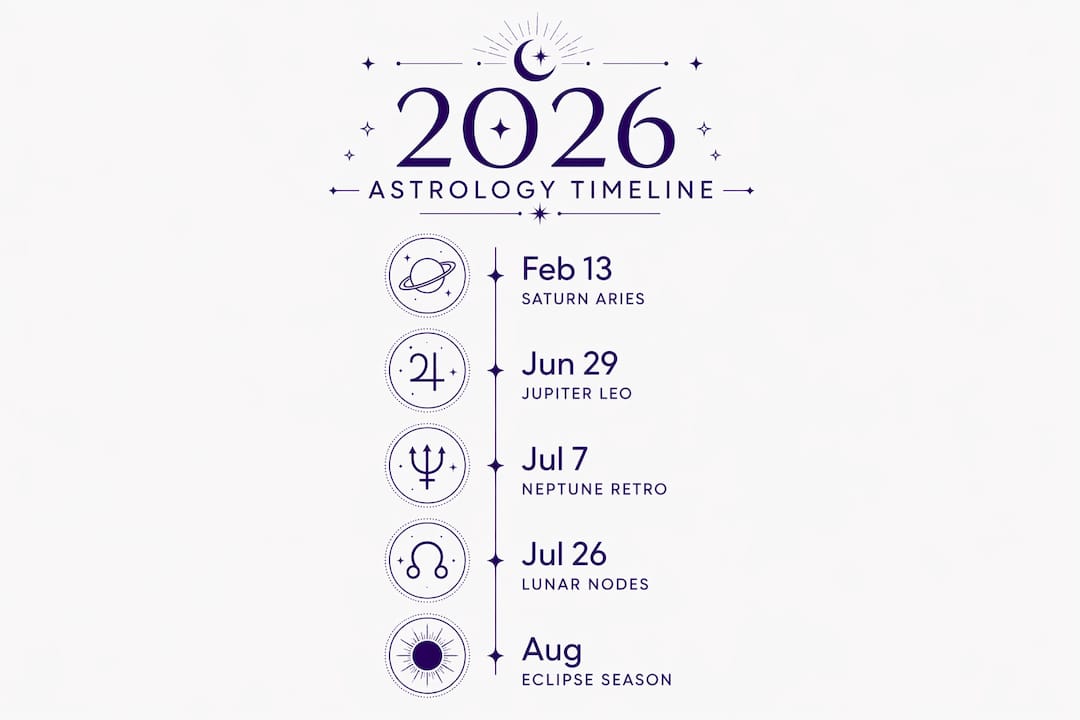
Reference table: critical 2026 dates
| Date | Event | Theme |
|---|---|---|
| February 13 | Saturn enters Aries | Structure, personal goals |
| June 29 | Jupiter enters Leo | Creativity, leadership |
| July 7 | Neptune retrograde begins | Spiritual review |
| July 14 | New Moon in Cancer | Emotional reset |
| July 26 | Lunar nodes shift to Leo-Aquarius | Identity vs. community |
| July 26 | Saturn retrograde begins | Reassess commitments |
| August | Two eclipses (Leo-Aquarius axis) | Accelerated change |
| October–November | Venus retrograde in Scorpio and Libra | Relationships, values |
How to read and interpret the astrology calendar for personal planning
Reading an astrology calendar for 2026 means understanding three layers: planetary sign changes, moon phases, and retrograde periods. Each layer gives you different information for different types of decisions.
Planetary sign changes set the background energy for weeks or months at a time. Saturn in Aries from February onward favors discipline and direct action. Jupiter in Leo from late June favors visibility and risk-taking. You use these as the backdrop when evaluating any major decision.
Moon phases operate on a 29-day cycle and are the most practical scheduling tool. New Moons are for starting things. Full Moons are for completing, releasing, or celebrating. The New Moon in Cancer on july 14 is specifically useful for emotional reset and home-related intentions, given Cancer's connection to domestic life.
Retrograde periods are times to review rather than launch. The three Mercury retrogrades in water signs during 2026 call for reviewing emotional conversations and creative projects, not signing contracts or sending important messages without double-checking.
Here is how to apply these layers to specific life areas:
- Career: Schedule launches and pitches near New Moons. Avoid starting new roles during Mercury retrograde. Use Saturn in Aries energy from february onward to set firm professional boundaries.
- Relationships: The Venus retrograde in october-november is a long window to reassess what you value in partnerships. Use it to reflect, not to make permanent decisions.
- Personal growth: Jupiter in Leo from june 29 supports personal development work tied to creativity and self-expression. This is the best window of the year to invest in skills that put you in front of an audience.
- Spiritual practice: Neptune retrograde in july invites inward focus. Use this period for meditation, journaling, or tarot reflection rather than outward spiritual teaching.
Pro Tip: Track the moon phase for every major decision you make in 2026. After three months, you will notice patterns in which phases produce your best outcomes. That personal data is more useful than any generic calendar.
What tools and methods help you follow the zodiac calendar for 2026?
The format you used to track the 2026 astrology calendar matters as much as the data itself. Different formats serve different planning styles.
Digital calendars and apps
Digital astrology apps let you set alerts for exact transit times. Look for apps that include planetary degree data, not just sign changes. Degree data tells you when a transit is exact, which is when its energy peaks. Features worth prioritizing include daily push notifications for moon phases, retrograde start and end dates, and aspect alerts for major configurations.
Printable planners
Printable astrology planners work well for readers who plan on paper. The best versions include a monthly overview of planetary positions, a lunar phase calendar, and space to write intentions. The limitation is that printed planners cannot update for last-minute timing shifts the way apps can.
Comparison: calendar tool types by feature
| Feature | Digital app | Printable planner | General calendar with notes |
|---|---|---|---|
| Real-time alerts | Yes | No | No |
| Degree-level data | Yes (advanced apps) | Rarely | No |
| Customizable by sign | Yes | Sometimes | No |
| Offline access | Yes | Yes | Yes |
| Cost | Free to paid | Free to low cost | Free |
Integration tips
- Add retrograde start and end dates to your personal calendar at the start of each month.
- Set a weekly review on Sunday to check the upcoming moon phase and any planetary shifts.
- Use the Mercury Reflection Spread on Tarosyn during Mercury retrograde periods to process communication themes.
- Color-code your calendar: one color for New Moons, one for Full Moons, one for retrograde periods.
Pro Tip: Do not try to track every minor transit. Focus on the eight dates in the reference table above. Mastering the major events first builds the habit before you add complexity.
Common mistakes when following the astrology calendar for 2026
Most readers who start using an astrology calendar drop the practice within two months. The reason is almost always one of three mistakes.
Treating retrograde as a total stop sign. Mercury retrograde does not mean nothing works. It means communication and planning benefit from extra review. Businesses run, relationships continue, and decisions get made during retrograde. The adjustment is to slow down and double-check, not to freeze.
Ignoring your own zodiac context. A transit affects each sign differently. Saturn entering Aries hits Aries, Cancer, Libra, and Capricorn most directly because it forms a hard angle to those signs. If you are a Taurus, Saturn in Aries is a background shift, not a personal crisis. Check your daily horoscope to filter general transits through your sign's specific experience.
Overloading on predictions. The 2026 astrological climate rewards small, consistent daily practices overdramatic one-time decisions. Reading every forecast available creates noise. Pick one or two trusted sources and stick with them.
Pro Tip: Keep a one-sentence astrology journal entry each day. Write what transit is active and how your day actually felt. After 30 days, you will have personal evidence of which transits affect you most, and you can prioritize those going forward.
How to customize the 2026 astrology calendar to fit your zodiac sign
The astrology calendar for 2026 is not one-size-fits-all. Your sun sign shapes which events deserve your closest attention.
- Aries: Saturn enters your sign on february 13. This is your most significant personal transit of the decade. Focus on building structure in one key life area before the year ends.
- Leo: Jupiter enters your sign on june 29. The second half of 2026 is your expansion window. The august eclipses on the Leo-Aquarius axis hit your sign directly. Check the Leo daily horoscope regularly from june onward.
- Scorpio and Libra: Venus retrograde in october-november moves through both signs. Relationship reviews and financial reassessments are your priority during this period. The Scorpio horoscope gives daily context for navigating Venus retrograde in your sign.
- Aquarius: The lunar nodes shift to your axis on july 26. The next 18 months ask you to balance personal identity with community roles. The august eclipses accelerate this theme.
- Cancer: The New Moon in Cancer on july 14 is your personal reset point of the year. Use it to set home, family, or emotional intentions.
- Capricorn: Saturn in Aries forms a square to your sign. Expect friction around authority and long-term plans from february onward. Use that friction as feedback, not as failure.
For signs not listed, identify which of the major 2026 transits forms a conjunction, square, or opposition to your sun sign. Those are your high-priority dates.
Key Takeaways
Following the 2026 astrology calendar effectively requires knowing the eight major dates, applying them to your sun sign, and using a consistent tracking tool throughout the year.
| Point | Details |
|---|---|
| Saturn in Aries from february 13 | Prioritize personal structure and boundary-setting for the full year. |
| August eclipses activate Leo-Aquarius axis | Decisions near these dates carry long-term consequences for 18 months. |
| Mercury retrograde in water signs | Review emotional communication; avoid finalizing sensitive conversations. |
| Venus retrograde in october-november | Use this window to reflect on relationships and values, not to end them. |
| Customize by zodiac sign | Identify which transits form hard angles to your sun sign and prioritize those dates. |
Why I think most people use the astrology calendar wrong
Most readers treat the astrology calendar as a prediction machine. They want to know what will happen. That is the wrong question. The calendar tells you what kind of energy is available, not what you will do with it.
I have watched people cancel plans entirely because Mercury was retrograde, then wonder why nothing moved forward. The 2026 cosmic climate specifically calls for "one honest yes, one small daily practice, one brave conversation at a time." That is not a passive stance. It is a call for consistent, intentional action within the available energy.
The readers who get the most from an astrology calendar are the ones who use it as a planning lens, not a permission slip. Saturn in Aries does not give you permission to set boundaries. It gives you structural support when you do. Jupiter in Leo does not guarantee success. It amplifies whatever creative effort you are already making.
My honest advice: pick three dates from the 2026 calendar that matter most to your current life focus. Plan something real around each one. Track what happens. That single practice will teach you more about electional astrology than reading a year's worth of forecasts.
— Joseph
Tarosyn's 2026 astrology readings and daily guidance
Tarosyn brings together daily horoscopes, personalized tarot readings, and a community of readers who track the same cosmic events you do.
For the Venus retrograde period in october-november, the Magician in a Relationship Spread on Tarosyn offers direct tarot insight into relationship dynamics and values. For the Jupiter in Leo window starting june 29, the King of Wands reading connects leadership energy with practical next steps. You can also follow the daily horoscope for all signs on Tarosyn to filter each major 2026 transit through your specific zodiac sign, day by day.
FAQ
What does it mean to follow the astrology calendar for 2026?
Following the astrology calendar for 2026 means tracking major planetary transits, lunar phases, and retrograde periods to time your decisions and activities with the available cosmic energy.
What are the most important dates in the 2026 astrology calendar?
The most critical dates are february 13 (Saturn into Aries), june 29 (Jupiter into Leo), july 26 (lunar nodes shift to Leo-Aquarius), the august eclipses, and the october-november Venus retrograde in Scorpio and Libra.
How does Mercury retrograde in 2026 differ from other years?
Mercury retrograde occurs three times in 2026, all in water signs, meaning the primary disruptions affect emotional communication and intuitive plans rather than technology or logistics.
How do I customize the 2026 astrology calendar for my zodiac sign?
Identify which major 2026 transits form a conjunction, square, or opposition to your sun sign. Those transits carry the most personal weight and deserve the most attention in your planning.
Is the 2026 astrology calendar useful for non-astrologers?
Yes. You do not need deep astrological knowledge to benefit. Tracking the eight key dates in the reference table and checking a daily horoscope for context gives you a practical starting point without requiring years of study.