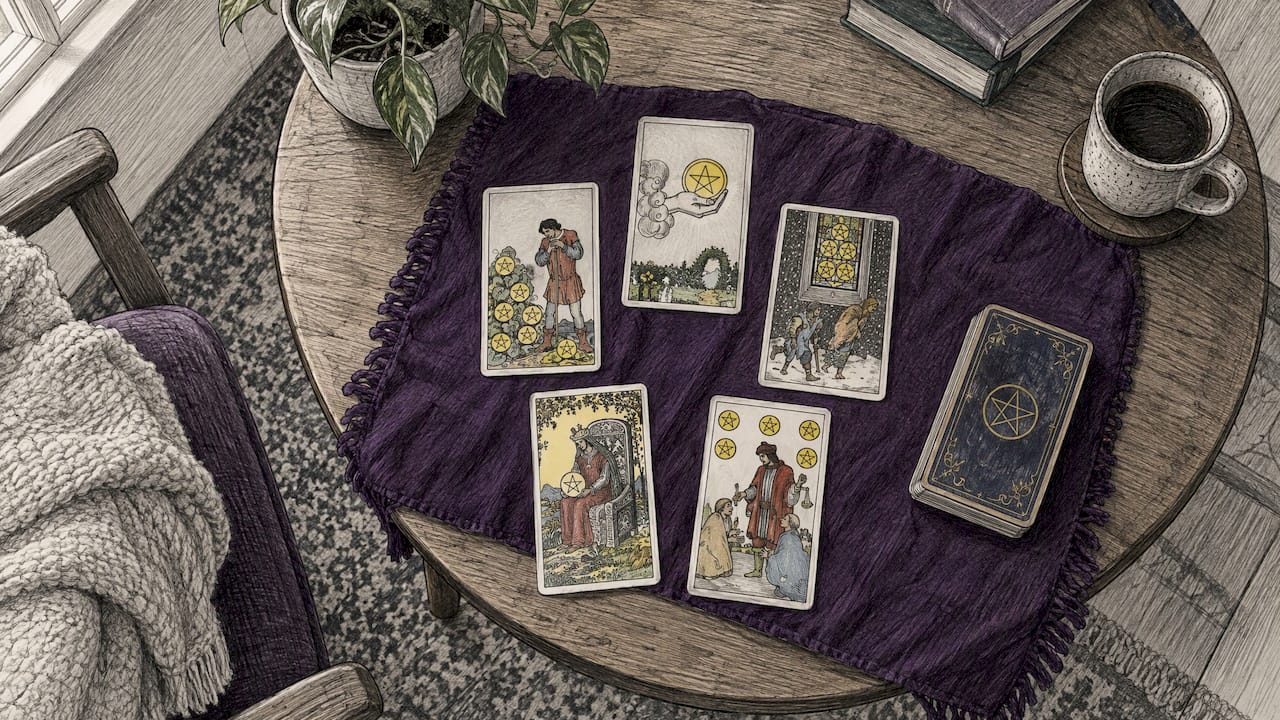
The Suit of Pentacles stands for the physical world: money, work, health, home and the things you build over time. It is linked to the element Earth. When pentacles show up in a reading, the question is usually practical. What are you building, what does it cost, and what do you need to look after?
This guide explains what pentacles represent, where the suit comes from, and what each of the 14 cards means upright and reversed. It is written for readers who are new to tarot or still learning the minor arcana, the 56 suit cards that cover everyday life.
TL;DR
- Pentacles represent the material side of life: money, work, health, home and daily routines.
- The suit belongs to the element Earth, and its signs are Taurus, Virgo and Capricorn.
- Money is only the first association. The suit is also about security, skill, care for the body and patience.
- The cards follow a path from the Ace (a new seed) to the Ten (a lasting legacy), then the four court cards.
- Read reversed cards as a prompt to check your habits, not as a bad result.
Table of Contents
- What the Suit of Pentacles means
- Why it is called Pentacles
- Pentacles and the element Earth
- The suit from Ace to Ten
- The four court cards
- Reading pentacles upright and reversed
- How to use pentacles in your own practice
- Common questions about the suit
- Keep your pentacles readings in one place
- Our view on pentacles
- FAQ
- Sources
What the Suit of Pentacles means
Pentacles are the suit of the tangible. Tarot guides describe the suit as grounded in Earth. It covers the physical realm, including work, finances and material possessions, and it focuses on practical life and results you can see.
A useful way to remember it: Wands are about action, Cups about feeling, Swords about thinking, and Pentacles about having and doing in the physical world. Pentacles ask what is real, what can be measured and what takes steady effort.
The suit covers five areas:
- Money and resources
- Work and craft
- Home and family
- Body and health
- Nature and the seasons
So the answer to "does pentacles mean money?" is yes, and also more. A Waite-based booklet notes that the suit deals with tangible possessions and what we need to take care of ourselves, with money as only the first association. A pentacles card in a reading about your job may point to your skills. In a reading about your health, it may point to sleep, food or rest.
Why it is called Pentacles
A pentacle is a disk marked with a five-pointed star. In the Rider-Waite-Smith deck, each pentacle looks like a golden coin. The star is a symbol of the material world touched by spirit.

The suit has other names. According to Wikipedia, it comes from the coin suits of Italian and Spanish playing cards. "Pentacles" is the name in the Rider-Waite deck and the decks built on it. The Thoth deck calls the suit "Disks." Many decks also say Coins.
The name change is fairly recent. Divinity Atlas notes that Coins is the older name. The Pentacles name and the five-pointed star belong to the nineteenth-century occult reworking. The Waite-Smith deck used the name Pentacles in 1909.
If you read with a deck that shows coins or disks, the meaning is the same. Match the card by its number and rank, not by the name of the suit.
Pentacles and the element Earth
In tarot, each suit is paired with an element. Pentacles take Earth. Tarot Awakenings explains that Earth is the solid, manifested reality that gives life its foundation. Within the mind, it is the realistic part of you that cares about results more than hopes and dreams. The Earth signs are Capricorn, Taurus and Virgo.
This pairing is a convention of Western occultism. Divinity Atlas points out that the links between suits and elements were formalized much later than the card game, mainly by French occultists in the 1800s and by the Hermetic Order of the Golden Dawn from 1888.
What this means for you in practice:
- Taurus: comfort, steady income and enjoying what you have.
- Virgo: skill, detail, service and health routines.
- Capricorn: ambition, discipline and long-term plans.
If your birth chart has strong Earth placements, pentacles may feel familiar when they appear. If your chart is mostly Fire or Air, the suit may point to the area where you need more structure.
The suit from Ace to Ten
The numbered cards trace a material project from first idea to lasting result. Read them as a path.
Ace of Pentacles
Upright: a new opportunity, investment, a start. The card shows a hand offering one pentacle from a cloud above a garden. Wikipedia describes it as a beginning, often a new source of money or better cash flow through better money management.
Reversed: delay, difficulty getting started, a missed chance. Ask what is blocking the first step.
Two of Pentacles
Upright: balance and adaptability. A figure juggles two pentacles. The card is about keeping several demands moving at once. Reversed: overwhelm and imbalance. You may be doing too much with too little time.
Three of Pentacles
Upright: teamwork and craft. In the Waite image, a cleric and a merchant enlist a craftsman, so the card is about skill that others rely on. Wikipedia gives its meaning as mastery of a skill in trade or work. Reversed: sloppy work, a missing skill or poor collaboration.
Four of Pentacles
Upright: security, control and caution. The figure holds tight to what they have. In a healthy reading, this is saving and protecting resources. Reversed: hoarding and miserliness. Holding on has become fear.
Five of Pentacles
Upright: hardship, isolation, worry about money or health. The Waite booklet connects the card with debt and illness. It is one of the harder cards in the suit. If you feel stuck, it can also remind you that help is nearby.
Reversed: recovery and accepting help. This is one of the most hopeful reversals in the suit. The worst is passing.
Six of Pentacles
Upright: generosity and fairness. The scales in the image stand for fairness in giving. The Waite booklet reads the card as shared wealth and a valued role in the community. Reversed: strings attached, debt, uneven exchange.
Seven of Pentacles
Upright: patience and long-term investment. A gardener pauses to look at what has grown. Ask whether the effort so far matches the plan. Reversed: impatience and wasted effort. You may be checking results too early, or putting energy into the wrong plot.
Eight of Pentacles
Upright: diligence and skill development. A craftsperson repeats the same task to improve. Reversed: perfectionism and burnout. Practice has become pressure.
Nine of Pentacles
Upright: self-sufficiency and comfort. You have earned a pleasant, independent life. Reversed: overindulgence or financial dependence. Look at whether your comfort relies on someone else.
Ten of Pentacles
Upright: legacy, family wealth and lasting stability. The card looks beyond one person to the generations. Reversed: family disputes or squandered inheritance. Ask what you want to pass on and what is at risk.
The four court cards
The court cards describe people, or parts of yourself. Tarot Card Guide lists the following keywords.
| Card | Upright | Reversed |
|---|---|---|
| Page | Ambition, study, grounded beginnings | Procrastination, missed opportunity |
| Knight | Hard work, routine, steady progress | Stagnation, boredom, stubbornness |
| Queen | Nurturing, practicality, work-life balance | Overextending, self-neglect, smothering |
| King | Wealth, leadership, discipline, generosity | Greed, control, poor financial judgment |
The Page is a careful apprentice who learns one step at a time. The Knight is the slowest and most reliable of the knights. He finishes what he starts. The Queen cares for people and the home while staying practical. The King has built something solid and shares it.
As with other suits, a court card can be a real person in your life, a role you are playing, or a quality you need.
Reading pentacles upright and reversed
Upright pentacles point to stability, safety and steady growth. Reversed ones show where that foundation is shaky. The same guide describes three patterns:
- Good cards get shakier. The Ace, Three, Nine and Ten show a weaker base when reversed.
- The Five improves. Reversed, it signals recovery and help.
- Court cards get stuck. The Page procrastinates, the Knight falls into a rut, the Queen neglects herself and the King turns greedy or controlling.
Use reversals as a prompt. They are not a verdict. Ask a simple question: what part of my daily life needs attention?
Count the suits in your spread
A quick way to find the focus of a reading is to count how many cards of each suit appear. Many pentacles suggest the matter is practical: money, work, health or home. Few or none can mean the question is more about feelings or ideas than about concrete steps.
How to use pentacles in your own practice
Pentacles work best when you turn them into one small action. Try this routine.
- Pick one area. Choose money, work, health or home.
- Draw one card. Pull from the pentacles only, or from the full deck.
- Name the card's theme. Is it a start, a balance, a limit, a reward?
- Write one action. Make it small and measurable, such as one budget review or one rest day.
- Return in a week. Check what changed.
This fits well with a journal. Writing down the card, the date and what you did lets you see patterns over months. If the Four or Eight of Pentacles keeps appearing, that is useful information about how you handle security or effort.
Yoga practitioners may link the suit to the body. Pentacles can prompt questions about sleep, food, posture and routine. Content creators may read it as a question about the business side of their work: pricing, consistency, skill. Community builders may find the Three and Six useful for thinking about shared work and fair exchange.
Common questions about the suit
Tarot is a tool for reflection. It does not predict outcomes, and it does not replace a financial adviser, a doctor or a lawyer. If a pentacles card comes up in a question about debt, a health symptom or a legal matter, use it to organize your thoughts, then take the real decision to the right professional.
Keep your pentacles readings in one place
Pentacles themes build slowly, so a single reading rarely tells the whole story. Tarosyn is an AI-powered spiritual app that combines tarot, astrology and numerology. Our readings remember your history and bring in your birth chart context. You can save readings, keep a journal and track your growth over time.
The Mystic monthly plan is 7.99 $ per month. The Annual circle plan is 59.99 $ per year. Both start after a free trial period.
To save your first pentacles reading and add a journal entry, start at Tarosyn.
Our view on pentacles
Pentacles are the suit people skip when they want something exciting. We think they are the suit that rewards attention most.
A single card is a snapshot. A pattern is more useful. If the Seven of Pentacles appears in March and again in June, that tells you something about patience that one reading cannot.
This is why we built Tarosyn around readings that remember your history and use your birth chart as context. We aim for guidance that is thoughtful and reflective, not generic or predictive. Journaling and saved readings let you see how the suit shows up in your life over time. Privacy is part of the design, and you choose whether to share your practice with a community or keep it personal.
Start with one card, one question and one small action. Then come back and look at what changed.
Joseph Calitoy
FAQ
What do pentacles mean in tarot?
Pentacles represent the physical world: money, work, health, home and daily routines. The suit is tied to the element Earth. It points to practical matters and results you can see and measure.
Does the Suit of Pentacles mean money?
Often, yes, but money is only the first association. The suit also covers skills, security, the body, family and long-term effort. In a health question, a pentacles card may point to rest or routine rather than cash.
Which zodiac signs go with Pentacles?
The suit is linked to the Earth signs: Taurus, Virgo and Capricorn. Taurus relates to comfort and steady resources, Virgo to skill and service, and Capricorn to discipline and long-term goals.
Are Pentacles and Coins the same suit?
Yes. Coins is the older name from Italian and Spanish playing cards. Pentacles is the name used in the Rider-Waite deck, and Thoth decks call it Disks. The card meanings are the same.
Is a reversed pentacles card bad?
No. A reversed card shows where your foundation needs attention. The reversed Five, for example, signals recovery and accepting help. Treat reversals as a prompt for one practical step.