
Community moderation means overseeing user behavior in a shared online space to enforce safety rules and shape the culture people experience there. It covers two jobs at once: regulatory enforcement (removing spam, banning bad actors, applying rules) and cultural stewardship (guiding tone, coaching members, keeping conversations useful). Community moderation exists on forums, social apps, and chat servers alike.
What moderators do, in practice:
- Review flagged posts and messages, then decide: warn, remove, or escalate.
- Set the tone of a space by modeling the behavior the guidelines describe.
- Track repeat problems and adjust rules before they become bigger issues.
Standards bodies formalize this work too. RFC 9945 sets up a moderator team with defined goals for the IETF, and Kubernetes requires moderators to act on serious violations and report their actions for review.
Key Takeaways
Community moderation works because it combines consistent rule enforcement with active stewardship, not passive rule-posting or hands-off hosting.
| Point | Details |
|---|---|
| Two core functions | Moderation means both enforcing safety rules and stewarding the culture and tone of a community. |
| Model fits context | Pre-moderation suits sensitive spaces; reactive and AI-assisted moderation suit large, fast-moving feeds. |
| Active presence matters | Research on moderated mental-health conversations links active moderator presence to more civil discussion. |
| Escalation needs structure | A clear ladder from warning to legal escalation, with logging and appeals, keeps enforcement consistent. |
| Metrics reveal gaps | Track report volume, time-to-triage, and appeals rate to catch problems before they grow. |
Table of Contents
- What Does Community Moderation Mean in Practice?
- What Do Community Moderators Actually Do Each Day?
- Best Practices for Healthy Online Communities
- How to Recruit, Train, and Support a Moderation Team
- Writing Rules That Moderators Can Actually Enforce
- What Tools Make Moderation Manageable at Scale?
- Handling Safety Crises: Self-Harm, Doxxing, and Legal Threats
- How Do You Measure If Moderation Is Working?
- How Tarosyn Approaches Community Moderation
- Explore Tarosyn's Community and Readings
- Frequently Asked Questions
- Sources
What Does Community Moderation Mean in Practice?
Community moderation and community management get confused constantly, but they solve different problems. Moderation is about safety and rule compliance. Management is about growth, engagement, and programming. A thriving community needs both, but conflating them leads to weak enforcement dressed up as "keeping things friendly."
The setting shapes how moderation gets applied. A support forum for grief or addiction recovery often uses pre-moderation, where posts get reviewed before they go live. A large open social feed usually can't do that at scale, so it leans on reactive moderation plus automated filters that flag toxicity or spam before a human ever sees it. Discord servers mix both: automated word filters catch the obvious stuff, while human moderators handle judgment calls in real time. Reddit relies heavily on community-driven moderation, where volunteer moderators set and enforce subreddit-specific rules. Platforms like CMX, Bettermode, HigherLogic, and Vanilla build these same models into branded community software for businesses running support forums or customer communities.
| Moderation Model | How It Works | Best Fit |
|---|---|---|
| Pre-moderation | Content is reviewed before publishing | Sensitive support groups, health communities |
| Post-moderation | Content publishes immediately, reviewed after | General discussion forums |
| Reactive | Moderators act only when something is reported | Large, fast-moving social feeds |
| Proactive (AI + human) | Automated filters flag issues for human review | Chat apps, high-volume platforms |
| Community-driven | Volunteer moderators set and enforce local rules | Reddit-style subcommunities |
Each model trades speed for safety differently. Pre-moderation catches problems early but slows down conversation. Reactive moderation keeps things fast but tolerates a lag between harm and response.
What Do Community Moderators Actually Do Each Day?
A moderator's day usually starts with a queue: reports, flags, and pending approvals waiting for a decision. Triage comes first. Not every flag is equal. Spam gets removed immediately with no debate. A heated argument between two members needs judgment. A threat of self-harm needs an entirely different, faster response.
Here's a workflow moderators can adapt for their own community:
- Report: A member flags content or another moderator spots an issue.
- Triage: Assess severity and urgency, then assign priority.
- Action: Remove content, warn the user, or escalate to a senior moderator.
- Notify: Tell the affected parties what happened and why.
- Log: Record the action for audit purposes and consistency checks.
- Appeal: Give the sanctioned user a path to contest the decision.
Decision authority matters here. A first-time rule violation usually gets a warning. Repeat violations or harassment escalate to suspension. Anything touching legal risk, like threats or doxxing, goes straight to staff or platform leadership, skipping the normal escalation ladder entirely.
Volunteer moderators and paid staff operate under different expectations. Volunteers, drawn from active community members, often handle day-to-day triage and light enforcement, while staff moderators typically manage legal escalations, policy updates, and cases requiring platform-level authority. Interviews with volunteer moderators show their work spans a spectrum from friendly facilitation to strict policing, often shifting day to day depending on what the community needs.

Pro Tip: Write your escalation ladder down before you need it. Deciding "warning vs. ban" in the heat of a dispute leads to inconsistent, unfair outcomes.
Best Practices for Healthy Online Communities
Good moderation follows a repeatable process, not a set of instincts applied inconsistently from one moderator to the next.
- Write rules before you need them. A code of conduct drafted after the first major incident always looks reactive and unfair.
- Make guidelines impossible to miss. Pin them, link them in onboarding, and reference them directly when enforcing a rule.
- Set concrete enforcement examples. "Don't be rude" is unenforceable. "No personal insults, even in jokes" gives moderators something specific to point to.
- Combine automation with human review. Filters catch obvious spam and slurs; humans handle sarcasm, context, and nuance that algorithms miss.
- Keep a log of every action. This protects moderators from accusations of bias and gives new team members a reference for how past cases were handled.
- Coach, don't just remove. A private note explaining why a comment crossed a line often changes future behavior better than a silent deletion.
The instinct to stay hands-off because it feels friendlier is a trap. The "chill host" fallacy assumes a relaxed approach keeps a space welcoming, but it usually lets the loudest or most disruptive members dominate, which quietly drives quieter members away. Active moderation isn't the opposite of a welcoming community. It's the mechanism that keeps one.
There's evidence behind this. A large-scale study of online mental-health conversations found that active moderation correlated with more civil and on-topic discussion and stronger signs of trust between participants, compared to unmoderated or lightly moderated threads.
Pro Tip: Publish a short transparency report each quarter. Even a few lines on how many reports came in and how they were resolved builds trust faster than any single rule change.
How to Recruit, Train, and Support a Moderation Team
Staffing moderation usually comes from three pools: community volunteers, part-time contractors, and full staff members. Volunteers know the culture intimately but have limited hours and no formal authority over legal matters. Contractors bring consistency and availability but need more onboarding to understand community norms. Staff carry the most authority and typically handle escalations that touch policy or law.
Onboarding should never be informal. A solid checklist covers:
- Role scope: what a moderator can decide alone versus what needs escalation.
- The escalation path, named specifically, not just "ask someone."
- Confidentiality expectations for handling sensitive reports.
- Expected availability and response times.
Training needs to go beyond "here are the rules." Cover de-escalation techniques, basic mental-health safety awareness, how to preserve evidence for legal reports, and hands-on practice with the moderation tools themselves. Volunteer moderator research identifies three core processes moderators develop over time: learning the role itself, executing moderation tasks, and shaping community rules as the group evolves. Good onboarding should touch all three, not just the mechanics of removing posts.
Burnout is real for moderators handling constant conflict. Build in rotation schedules so no one person carries the worst reports indefinitely, and set up peer support channels where moderators can debrief difficult cases with each other.
Pro Tip: Pair every new moderator with an experienced one for the first two weeks. Shadowing real decisions teaches judgment faster than any written policy.
Writing Rules That Moderators Can Actually Enforce
A code of conduct only works if it translates cleanly into action. The strongest policies share a structure: a stated purpose, defined scope (does it cover DMs, usernames, profile images?), specific examples of prohibited behavior, a graduated enforcement ladder, and a documented appeals process.
The escalation flow matters as much as the rules themselves:
- Immediate safety action: Remove threats, doxxing, or explicit harm content on sight, no debate.
- Moderator-level sanction: Warnings or short suspensions for standard rule violations.
- Staff or legal escalation: Anything involving threats, minors, or potential criminal activity.
- Appeal: A defined window and process for users to contest a decision.
| Enforcement Stage | Who Acts | Typical Timeline |
|---|---|---|
| Immediate safety removal | Any moderator | Within minutes |
| Standard sanction (warning/suspension) | Moderator on duty | Within hours |
| Staff/legal escalation | Senior staff | Within a day or two |
| Appeal review | Designated appeals reviewer | Per published policy window |
Transparency is what separates a trusted enforcement system from an arbitrary one. Keep audit logs of every action taken, publish periodic summaries of enforcement activity, and use consistent notice templates so users always know why an action happened. RFC 9945 shows how a standards body like the IETF builds this into governance directly, defining a moderator team, consistent enforcement guardrails, and a formal path for reconsidering decisions. Tarosyn applies the same logic through its own content moderation policy and appeals process, giving members a documented path when they disagree with an enforcement decision.
What Tools Make Moderation Manageable at Scale?
Manual review alone breaks down once a community passes a few thousand active members. The tooling layer usually includes:
- Reporting systems that let members flag content directly, tied to a triage dashboard.
- Automated filters for spam, toxicity, and known harassment patterns.
- Moderation queues that sort flagged content by priority and assign it to available moderators.
- Audit logs that timestamp every decision for later review.
A repeatable workflow keeps these tools from becoming noise:
- Set a triage SLA, such as reviewing all urgent flags within one hour.
- Define escalation triggers in advance, so moderators aren't guessing when to hand something up.
- Build response templates for common violations to keep enforcement language consistent.
- Decide clearly which decisions automation can make alone and which always require a human.
Discord's enforcement model, ranging from warnings to permanent bans, illustrates this layered approach in practice, and Discord's own guidelines show how a Trust & Safety team applies escalating actions, including reports to law enforcement in serious cases. Reddit's subreddit-level moderation tools work similarly but hand that authority to volunteer moderators rather than a centralized team. Community platforms like CMX, Bettermode, HigherLogic, and Vanilla package these same triage and automation features for businesses running their own branded forums.
Handling Safety Crises: Self-Harm, Doxxing, and Legal Threats
Some situations demand a different pace than routine rule enforcement. A checklist that separates safety-critical scenarios from standard moderation:
- Remove direct threats or dangerous content immediately, without waiting for a second opinion.
- Preserve evidence (screenshots, timestamps, account details) before removing anything, in case legal or platform escalation follows.
- Contact platform-level Trust & Safety teams or law enforcement when the situation requires it.
- Follow your community's internal escalation steps exactly, even under pressure.
Self-harm disclosures need trained handling, not general volunteer judgment. Peer support helps, but it has real limits, and communities discussing mental health should have moderators specifically trained to recognize when a situation needs to move to emergency services or crisis resources rather than staying inside the platform.
Doxxing and harassment carry their own steps:
- Preserve all logs and evidence before taking any visible action.
- Limit the visibility of the exposed information immediately.
- Notify the affected member directly and explain what's being done.
- Escalate to legal or platform teams if the threat is credible or ongoing.
- Log every step taken for later review and transparency reporting.
How Do You Measure If Moderation Is Working?
Moderation effectiveness shows up in numbers, not just gut feeling. Track report volume over time, time-to-triage on incoming flags, the rate of repeat offenders, and your appeals rate compared to total sanctions issued.
Watch for warning signs specifically:
- A sudden spike in reports, which often signals a coordinated attack or a policy gap.
- Unresolved reports piling up faster than they're closed.
- Participation dropping right after an enforcement wave, which can mean members feel unfairly targeted.
The research on moderated mental-health conversations found civility and trust improved measurably where moderators stayed actively present, not just where rules existed on paper. That's the real signal to track: presence, not just policy.
Run a short post-action review after major escalations. Ask what worked, what took too long, and whether the enforcement ladder needs adjusting before the next incident.
How Tarosyn Approaches Community Moderation
Tarosyn's community runs on the same principles: public guidelines, a clear reporting path, and an appeals process members can actually use. When a member reports a shared reading or comment, it moves through triage, a moderator decision, and a notification back to both parties involved, logged the whole way through.
You can see the guidelines behind that process directly on Tarosyn's community guidelines page, or browse how members engage with shared readings in the community journal.
Explore Tarosyn's Community and Readings
Tarosyn pairs AI-powered tarot, astrology, and numerology with a social space built on the moderation principles covered here: clear guidelines, a working reporting system, and an appeals process members can trust. If you want to see moderation in action rather than just read about it, browse public tarot readings shared by the community, or check your daily horoscope and see how the space works for yourself. Members who want deeper community features can explore the Seer, Creator, and Founder subscription tiers.
Frequently Asked Questions
What does community moderation mean in simple terms? It means overseeing member behavior in an online space to enforce safety rules and shape a respectful, on-topic culture, combining rule enforcement with active guidance.
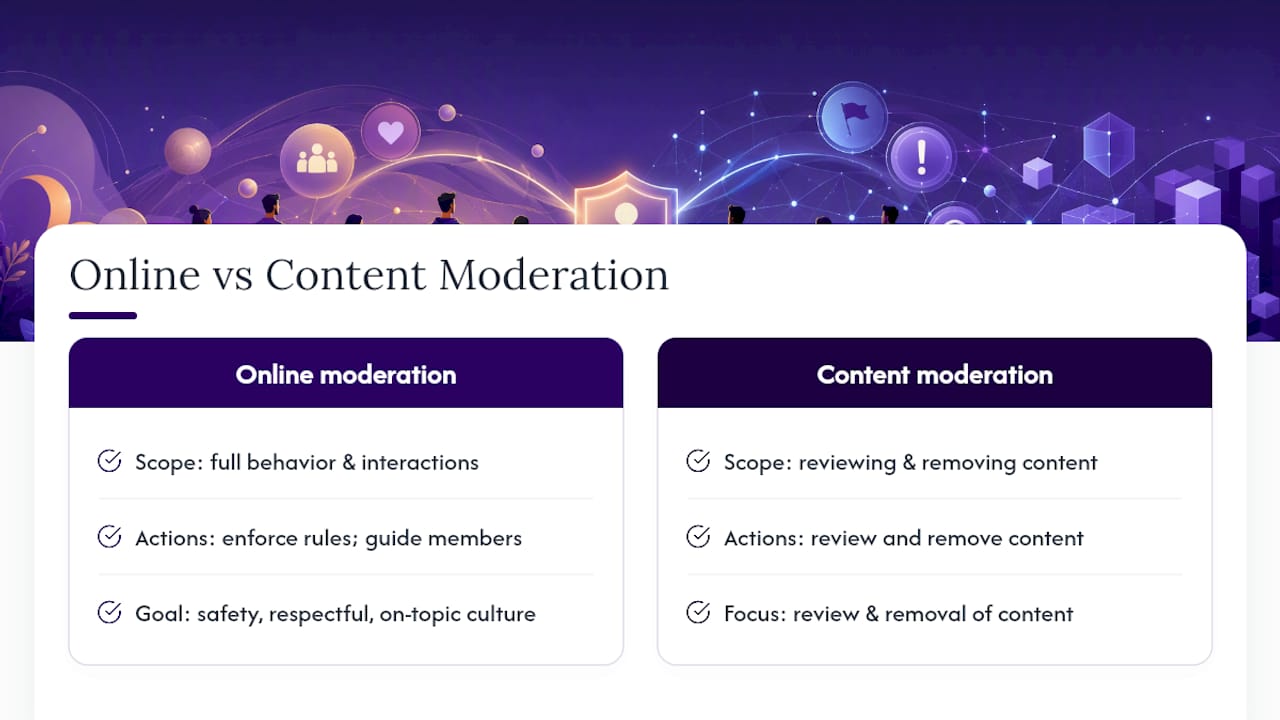
What is online moderation compared to content moderation? Online moderation typically refers to the full scope of managing user behavior and interactions, while content moderation focuses specifically on reviewing and removing individual pieces of content.
What is the role of moderators in a community? Moderators review reports, enforce rules consistently, de-escalate conflicts, and coach members toward better behavior rather than only removing violations after the fact.
How do you moderate a community without alienating members? Publish clear rules, apply them consistently, explain enforcement decisions when possible, and offer a real appeals process so members trust the system even when they disagree with a decision.
What are the benefits of community moderation? Research on moderated mental-health forums shows active moderation correlates with more civil conversation and stronger trust between members, beyond just fewer rule violations.
Sources
- What Is Community Moderation? Roles & Best Practices
- What is community moderation?
- The Effect of Moderation on Online Mental Health Conversations
- Kubernetes moderation guidelines