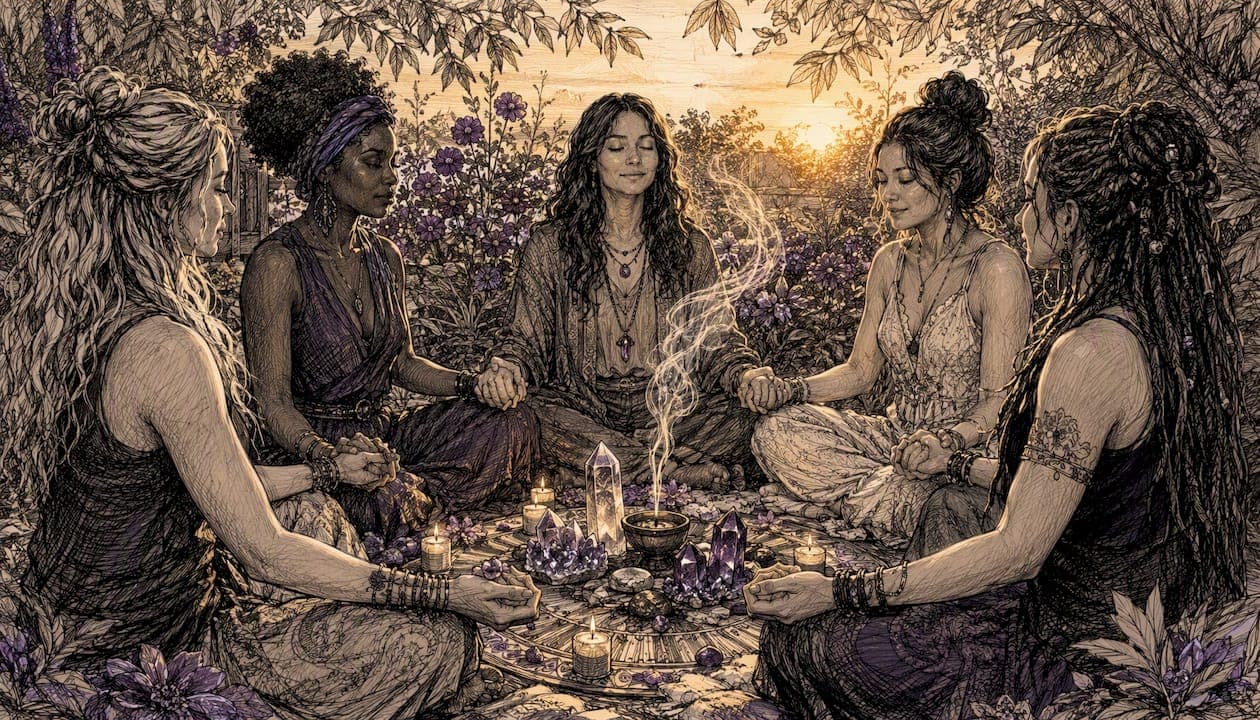
Collective consciousness, in the metaphysical sense, is a shared energetic and group awareness that you can access through meditative, ritual, and synchronous practice. It is not a belief system. It is a field you can tune into, the way you tune a radio to a frequency that was already broadcasting. To feel it right now, sit quietly, close your eyes, and take three slow breaths. On the third exhale, silently ask: What does this group need today? Notice any image, word, or sensation that arises in the next 30 seconds. That is the field responding. Whatever comes through, treat it as advisory. Practitioners caution that collective transmissions require a discernment check before you act on them. You retain full personal responsibility for every decision you make.
Pro Tip: Keep a small notebook nearby when you practice. Write down the first word or image you receive before your analytical mind edits it. Three sessions of notes will show you whether the signal is consistent or shifting.
Key Takeaways
Collective consciousness is a shared energetic field you access through consistent, consent-based group practice, not a single event.
| Point | Details |
|---|---|
| Core definition | Collective consciousness is a shared group awareness accessed through meditative, ritual, and synchronous practice. |
| First practice to try | Use the centering breath exercise with a stated sankalpa for 5 minutes, solo or with one partner. |
| Group amplification | Small groups of 4–7 meeting weekly build the most stable coherent field over time. |
| Discernment is required | Always check whether a received message is consistent, values-aligned, and preserves your personal agency. |
| Tarosyn for group practice | Tarosyn's Chant Feed, guided spreads, and Community Reflections journal support structured, consent-aware group sessions. |
Table of Contents
- What is collective consciousness in spiritual traditions?
- How does group practice amplify the shared field?
- Practical exercises for connecting with the field
- What experiences should you expect?
- Ethics, consent, and integrating collective guidance
- How Tarosyn supports safe collective connection
- A note on persistence in practice
- Tarosyn makes group practice accessible
- Sources
What is collective consciousness in spiritual traditions?
Himalayan and Sankhya teachings describe collective consciousness through the concept of buddhi, pure awareness that underlies individual thought. Buddhi is not personal. It is a source-field that every mind draws from, the way separate rivers draw from the same aquifer. When a group forms a shared sankalpa, a common intention stated clearly before practice, it creates a channel into that field.
The flow looks like this: individual awareness narrows into a focused intention, that intention couples with others holding the same focus, and the result is a group field with properties none of the individuals generated alone.
- Buddhi is the Sanskrit term for pure, non-personal awareness in Sankhya philosophy.
- Sankalpa is a resolve or seed intention planted at the threshold of a meditative state.
- Coupled group field emerges when multiple participants hold the same sankalpa simultaneously.
- Himalayan teachings recommend stating the sankalpa aloud or in writing before any group session begins.
- Vedic and heart-field traditions both emphasize that the field is already present; practice is about removing interference, not generating something new.
The Center for Planetary Management defines collective consciousness as a shared mental, emotional, and spiritual awareness that shapes a larger spiritual atmosphere. That framing aligns closely with what Himalayan teachers describe: the group's combined intentions and values create a kind of weather system that participants both contribute to and are affected by.
How does group practice amplify the shared field?
The mechanism is entrainment. When two or more people breathe together, their nervous systems begin to synchronize. Heart rate variability patterns align. Brainwave frequencies move toward a common rhythm. This is not metaphor; it is a measurable physical process called rhythmic coupling.
Collective coherence research models this as coupled oscillators: when individual coherent fields phase-lock, the group field shows emergent properties that exceed the sum of individuals. Physical presence plus shared rhythm produce the strongest coupling. Digital connection transmits information but not the full physical field.
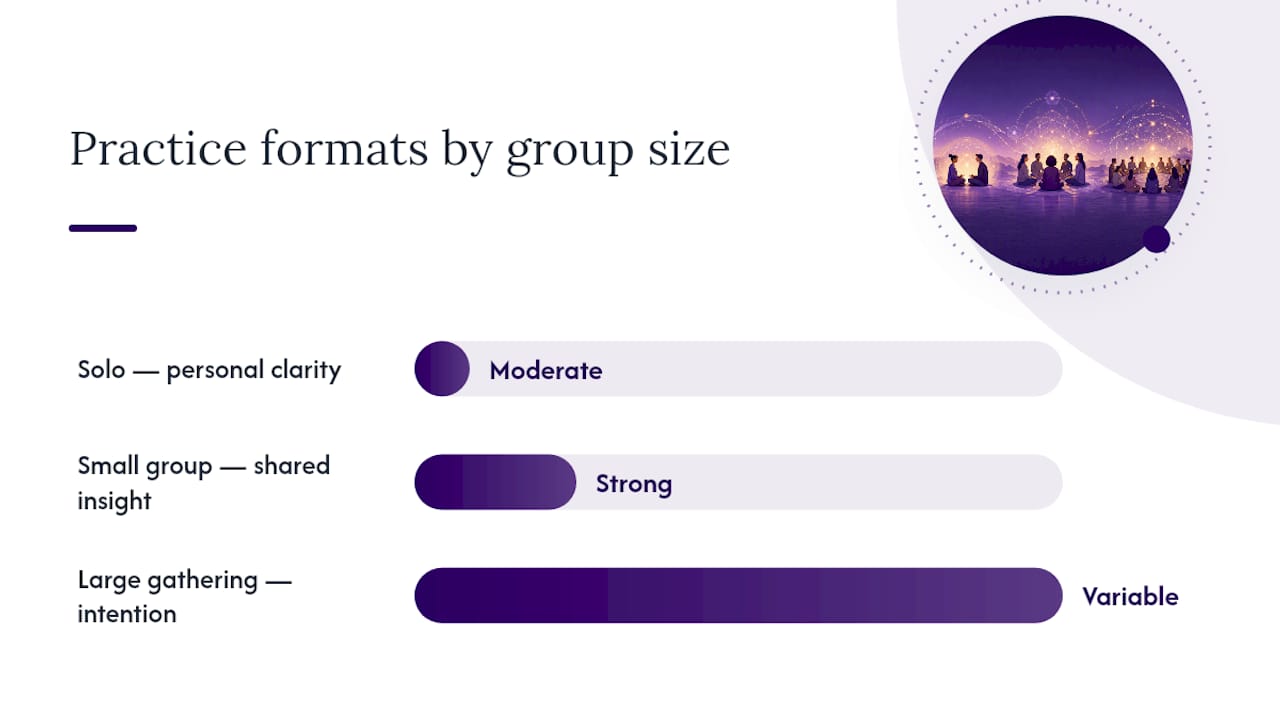
| Practice Format | What It Amplifies | Typical Depth |
|---|---|---|
| Solo practice | Personal clarity, baseline coherence | Moderate |
| Small coherent group (3–7 people) | Shared insight, nervous-system regulation | Strong |
| Large synchronized gathering (20+) | Broad field effects, collective intention | Variable, depends on shared focus |
Experienced facilitators report that consistent group practice forms a "Group Body," a coherent field that amplifies healing and insight across participants over time.
Pro Tip: Groups of 4–7 people meeting weekly for at least four consecutive sessions tend to build the most stable coherent field. One person acts as anchor, holding the sankalpa steady while others explore.
Practical exercises for connecting with the field
Solo: centering breath with a question
Sit comfortably. Set a timer for 5 minutes. Breathe in for 4 counts, hold for 4, out for 6. After 2 minutes, silently state your sankalpa: I am open to what the field offers. Spend the remaining time observing without directing. Write one sentence immediately after.
Solo: web visualization before sleep
Lie down. Visualize a web of light connecting you to every person you have practiced with. Place a question at the center of the web. Sleep. Write whatever you remember upon waking, even fragments.
Paired practice: heart-coherence breath
Sit facing your partner. Synchronize your breath by watching each other's chest rise and fall. After 3 minutes, each person silently holds the same question. After 5 minutes, share one word each. No interpretation yet. Write the words down and compare after a full minute of silence.

Group format: transmission-style sitting
One person reads a shared invocation aloud. All participants close their eyes and offer themselves as receptive instruments, not directors. The practice runs 15–20 minutes in silence. Close with a spoken "thank you" from each person. No one interprets during the session.
- Materials needed: a quiet room, a shared written sankalpa, a timer, and individual journals.
- Boundary checklist: all participants state consent before starting; no one is required to share; the session has a clear end time.
Pro Tip: To adapt a tarot or astrology circle into a coherence practice, pull one card per person using a spread like the Identity Gate and ask everyone to hold the same question before drawing. Share observations without cross-talk for the first two minutes.
What experiences should you expect?
Common reports from people connecting with the field include:
- Warmth or tingling in the chest or hands during synchronized breathing.
- Shared imagery, where two or more participants describe the same symbol or color without prior discussion.
- Synchronized breath, where the group naturally falls into the same rhythm without instruction.
- Spontaneous insight, a clear thought or phrase that arrives without effort.
- Gooseflesh during a moment of shared silence or invocation.
Use this interpretation checklist after any session. Ask: Is the message coherent and internally consistent? Does it repeat across multiple sessions? Does it align with your values? Does it reduce or expand your personal agency? If a message fails the last question, treat it as projection, not transmission.
Safety red flags: dissociation that persists after the session ends, group pressure to accept a single interpretation, absolute prescriptions about major life decisions, and any financial demand tied to receiving guidance. These are signs to step back and consult outside support.
Ethics, consent, and integrating collective guidance
Group hosts carry specific responsibilities. Work through this checklist before leading any session.
- State informed consent clearly. Every participant knows the session's purpose, duration, and what sharing is optional.
- Protect confidentiality. What is shared in the group stays in the group unless participants explicitly agree otherwise.
- Prohibit coercion. No one is pressured to share, stay, or accept a particular interpretation.
- Set boundaries on scope. The group offers perspective, not decisions. No one speaks for another person's path.
- Provide a clear exit. Participants can leave at any point without explanation.
Before joining a group, ask: Who leads this group, and what is their training? How are decisions made about practice direction? What happens if I want to leave? Is there a cost attached to continued participation?
After any session, integrate slowly. Write in your journal before discussing the experience with others. Test any insight with a small, low-stakes action before applying it to a major decision. Consult non-field evidence, a trusted friend, a therapist, a practical plan, before acting on collective guidance in areas like finances, relationships, or health.
How Tarosyn supports safe collective connection
Tarosyn provides a set of community-facing tools that support group coherence work in a structured, consent-aware environment. Joseph Calitoy contributes content and authorship to Tarosyn's spiritual guidance framework, grounding the platform's practice prompts in lineage-informed teaching.
- The Chant Feed lets groups post short invocations and reflections between live sessions, keeping the shared sankalpa active.
- The Community Reflections journal gives participants a public space to document experiences after sessions.
- Guided spreads, including the Identity Gate, provide structured prompts that groups can use as shared entry points.
- Tarosyn's privacy settings let users control what they share publicly and what stays private, supporting the consent principles described above.
A short group flow on Tarosyn looks like this: one person sets a shared intention in the Chant Feed before the session; participants each pull a card from the same guided spread; after the session, everyone posts one reflection in the Community Reflections journal. The group closes with a gratitude note in the feed.
Tarosyn's tarot energies hub and spirituality topic page collect ritual prompts and teachings that organizers can use to shape repeated community practices over time.
A note on persistence in practice
Progress in collective practice is slow at first, and that is normal. Most people notice a clear shift after three to five consistent sessions, not one. Two things help more than anything else: showing up at the same time each week, and writing down what you notice immediately after each session, even when it seems trivial. Consistency builds the field. Intensity alone does not.
- Consistency over intensity: a 15-minute weekly group session maintained for a month outperforms a single 3-hour event.
- Journal after 3–5 sessions: patterns in your notes will show you whether the field is speaking or whether you are projecting.
Tarosyn makes group practice accessible
Tarosyn brings together AI-powered tarot readings, guided spreads, a daily horoscope, and a live community journal in one place, so you can practice collective connection without coordinating a physical gathering from scratch. Start with a three-card community spread as your group's shared prompt, post your sankalpa in the Chant Feed, and invite others to reflect in the Community Reflections journal after the session.

Tarosyn's free tier gives you access to core readings and community tools. A premium subscription unlocks advanced spreads, full journal history, and deeper astrology features. Privacy controls are built in: you choose what to share and what to keep personal. Try it free at Tarosyn and run your first group session this week.
Sources
- Connecting to the Collective Consciousness. | elephant journal
- Connecting with collective consciousness | Himalayan Institute
- The Healing Power of Sacred Community: You Were Never Meant to Do This Alone - Darren Starwynn, O.M.D
- Transmission Meditation: Presence, Peace and Community
- Collective Coherence | Christos™
This article is for general informational purposes only. It is not a substitute for professional mental health, medical, or legal advice. Confirm any practice decisions with a qualified professional when needed.