
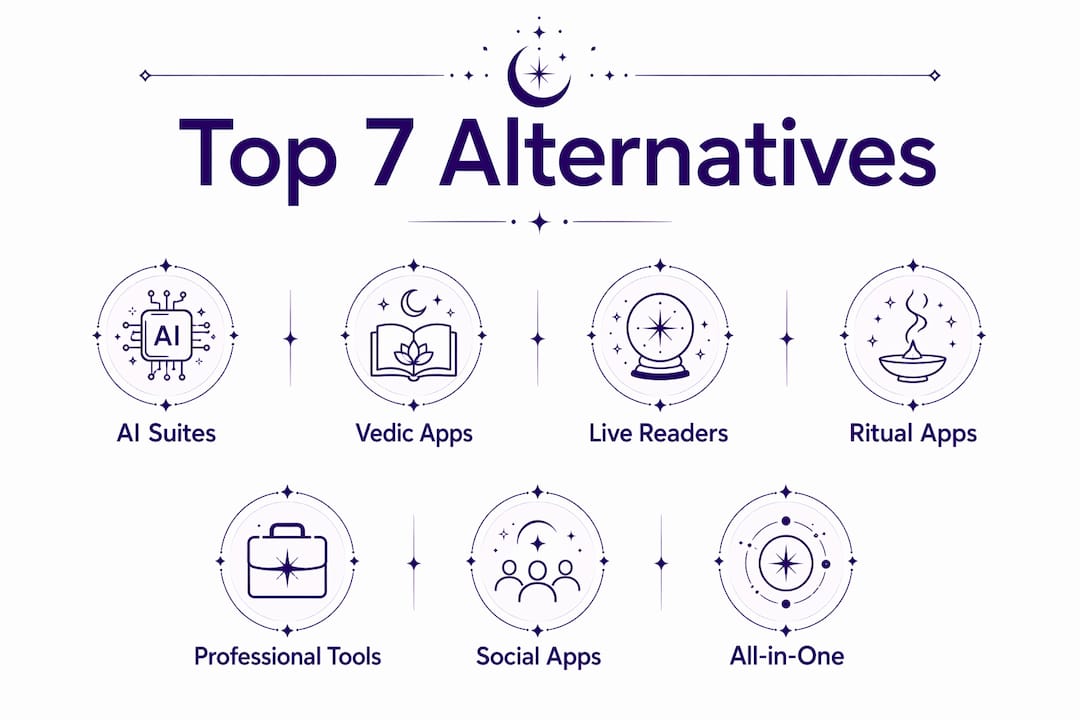
If you want a modern replacement for adiastroapp.com, the best options fall into four clear categories: AI-first spiritual suites, focused Vedic astrology apps, live-reader marketplaces, and ritual or period-sync apps. Among these, Tarosyn is the recommended all-in-one option for cross-discipline seekers who want tarot, astrology, numerology, and social journaling in a single place. All top alternatives are available on the App Store or Google Play, and most offer a free tier or trial before you commit.
Here is a quick look at which category fits which type of user:
- AI-first spiritual suites (like Tarosyn): best for daily ritual users who want tarot, horoscopes, numerology, and journaling without switching apps.
- Vedic / kundli specialist apps: best for users who need kundli generation, dosha analysis, or live astrologer chat in Hindi or regional languages.
- Live-reader marketplaces: best for occasional, deep one-on-one consultations with a human astrologer or tarot reader.
- Ritual and period-sync apps: best for users who want moon-phase tracking tied to daily habits or menstrual cycles.
- Professional charting tools: best for advanced users who need full ephemerides and detailed transit reports.
- Social / notification-first apps: best for casual users who want a quick daily horoscope push notification and a social feed.
Most of these categories are available on iOS and Android, with some offering a web version. Free tiers are common, though depth features typically sit behind a paid subscription.
Table of Contents
- What are the best adiastroapp.com alternatives? Quick comparison
- Profiles of the top adiastroapp.com replacement categories
- How do you pick the right astrology or spiritual app?
- Why Tarosyn is a strong all-in-one alternative
- What should you try first?
- Key Takeaways
- The case for productized spiritual practice
- Tarosyn gives you a full spiritual toolkit in one place
- Useful sources and download links
What are the best adiastroapp.com alternatives? Quick comparison
| Category | Price / free tier | Core features | Tarot / AI / live access | Platform | Best for | Privacy flag | Community |
|---|---|---|---|---|---|---|---|
| AI-first spiritual suite | Free tier + paid subscription | Natal chart, daily horoscope, transits, numerology, journaling | AI tarot readings, AI personalization | iOS, Android, web | Cross-discipline daily users | Check AI training opt-out and data export | Social journaling, friend circles |
| Vedic / kundli specialist | Free tier + per-report or subscription | Kundli, dosha analysis, Navgraha, transit | Live astrologer chat (paid) | iOS, Android | Vedic accuracy seekers | Check PII retention and chat logs | Regional language forums |
| Live-reader marketplace | Free to browse + per-session credits | Astrologer profiles, session booking | Live human readers (per-session) | iOS, Android, web | Occasional deep consultations | Check session recording and data deletion | Rating and review feeds |
| Ritual / period-sync app | Free tier + paid subscription | Moon calendar, cycle tracking, daily rituals | Limited or no tarot | iOS, Android | Habit-based ritual users | Check health data sharing | Small community or none |
| Professional charting tool | Free trial + paid subscription | Full ephemeris, synastry, progressions | No tarot; no AI | iOS, Android, web | Advanced astrologers | Check account deletion | None or forums |
| Social / notification-first | Free + optional premium | Daily horoscope, compatibility, social feed | Basic AI text | iOS, Android | Casual beginners | Check social data sharing | Public social feed |
Statistic callout: Productized healing and AI-driven personalization are now the primary drivers of retention and predictable revenue in modern spiritual apps, according to a 2026 market analysis. Apps that deliver consistent, scalable AI experiences are pulling ahead of those built around one-off manual consultations.
Pro Tip: Before you download any app, search its name plus "data export" and "account deletion." If neither option is clearly documented in the privacy policy, your birth data and reading history may be difficult to retrieve or remove later.
Profiles of the top adiastroapp.com replacement categories
AI-first spiritual suites
This category covers apps that combine multiple spiritual disciplines, such as tarot, astrology, numerology, and journaling, into one product and use AI to personalize the experience. You get a daily horoscope, a natal chart, and an AI-generated tarot reading without opening three separate apps. Pricing typically follows a freemium model: a usable free tier with core features, then a paid subscription for deeper AI personalization, collectible content, and social tools.
Pros: breadth of features; frequent-use design keeps engagement high. Cons: depth in any single discipline may not match a specialist app. Best for: daily ritual users who want one app to cover everything.
Privacy note: check whether the app offers an AI training opt-out and whether you can export your birth chart data. Tarosyn publishes its AI training data policy directly, which is a useful benchmark to compare against other apps in this category.
Vedic / kundli specialist apps
AdiAstro itself sits in this category: its Google Play listing describes kundli generation, dosha analysis, Navgraha Archana, and live astrologer chat with Hindi-language support. If that Vedic depth is what you need, look for apps that explicitly list kundli reports, Dasha periods, and regional language options. Pricing varies: some offer free kundli generation with paid live-chat credits; others charge a flat monthly fee.

Pros: high accuracy for Vedic calculations; live human consultation available. Cons: limited tarot or Western astrology features; AI personalization is minimal. Best for: users who specifically need Vedic chart analysis or regional-language support.
Privacy note: live-chat platforms often retain conversation logs. Check the privacy policy for PII retention periods and whether you can request deletion of chat history.
Live-reader marketplaces
These platforms let you browse profiles of human astrologers, tarot readers, or spiritual advisors and book a session by the minute or hour. You pay per session rather than a flat subscription, which suits occasional deep readings. The industry directory data groups these as a distinct category from app-based tools, and the distinction matters: you are paying for a person's time, not a software license.
Pros: genuine human insight; flexible session length. Cons: cost adds up quickly for frequent use; quality varies by reader. Best for: users who want a one-on-one consultation a few times a year.
Privacy note: check whether sessions are recorded, how long recordings are stored, and whether the platform shares your data with individual readers.
Ritual and period-sync apps
Apps in this category tie spiritual practice to biological or social cycles: moon phases, menstrual cycles, or daily habit stacks. They tend to be lightweight on astrology depth but strong on daily engagement mechanics. Subscriptions are usually lower cost because the feature set is narrower. Apps that connect moon-phase cycles to daily routines see notably higher daily engagement than passive horoscope apps, according to background research on retention patterns.
Pros: strong habit-building design; low cost. Cons: no natal chart depth; no tarot. Best for: users whose primary goal is building a consistent daily spiritual habit.
Privacy note: if the app tracks menstrual or health data, verify whether that data is shared with third parties or used for advertising.
Professional charting tools
These are built for serious astrologers who need detailed ephemerides, secondary progressions, solar arc directions, and synastry grids. They are not designed for casual daily use. A 2026 review of the astrology app market notes the clear split between apps optimized for social notifications and those built for professional astrologers with full chart data. Professional tools sit firmly at the technical end of that split.
Pros: unmatched chart accuracy and depth. Cons: steep learning curve; no tarot, no AI guidance, no community. Best for: practicing astrologers or students of traditional astrology.
Privacy note: these apps typically store birth data locally or in a personal account. Confirm whether cloud sync is optional or mandatory.
Social and notification-first apps
Co-Star, The Pattern, and Sanctuary all belong here. They are built around a daily push notification, a social compatibility feed, and short AI-generated text. They are easy to start and free to use at a basic level. The trade-off is that feature comparison data shows no single app in this group perfectly bundles natal charts, tarot, numerology, and AI guidance without significant gaps. You get breadth of reach but not depth of practice.

Pros: free to start; large user communities; easy onboarding. Cons: shallow features; entertainment decay sets in quickly without journaling or ritual hooks. Best for: beginners who want a low-commitment introduction to astrology.
Privacy note: social apps share data across friend networks by default. Review your visibility settings before connecting with others.
How do you pick the right astrology or spiritual app?
Start with two questions: How often will you use it, and do you need to control your data? Daily ritual users get the most value from subscription-based suites; occasional readers do better with per-session live marketplaces. Data-conscious users should verify export and deletion options before signing up.
Run through this checklist before you commit:
- What features do I actually use daily? If you open a horoscope every morning, you need a frequency-built app, not a one-off chart tool.
- Do I need a live human reader? If yes, a live-reader marketplace fits better than an AI suite for those sessions.
- Does the app store my birth data, and can I delete it? Check the privacy policy for account deletion and data export before entering your birth details.
- How transparent is the pricing? Look for a clear free tier, a published subscription price, and a documented cancellation process. Confusing paywalls are a red flag.
- Is there a free trial, and how long is it? A week or two is usually enough to test daily ritual features. Shorter trials may give you less time to evaluate AI personalization.
Watch for these red flags:
- No privacy policy or no mention of data deletion
- AI-generated outputs that disappear after viewing (not saved to a journal)
- Subscription pricing hidden behind multiple screens
- No cancellation instructions in the app or on the website
- Free tier so limited it is unusable without paying immediately
Three factors should carry the most weight in your decision: frequency of utility (will you open it daily or monthly?), depth versus accessibility (do you need professional-grade charts or a guided daily practice?), and privacy and data ownership (can you export or delete your information?).
Why Tarosyn is a strong all-in-one alternative
Tarosyn delivers what no single category above covers on its own: integrated AI tarot readings, daily horoscopes, synastry compatibility, numerology insights, personal journaling, and a social community in one freemium app. That combination is what makes it the recommended option for users who currently juggle multiple apps to cover the same ground.
Key features at a glance:
- AI tarot readings with personalized AI mechanics that adapt to your birth data and reading history
- Daily horoscopes for every sign, available at the daily horoscope hub, built for high-frequency daily use
- Synastry and relationship compatibility tools for partner-sync and compatibility checks
- Numerology insights alongside astrology, so you do not need a separate app
- Journaling and collectible card features that give readings a place to live after you view them
- Social community tools including friend circles and a public journal for shared reflection
Tarosyn runs on iOS, Android, and web. The freemium model gives you access to core features at no cost, with paid subscription tiers unlocking deeper AI personalization, premium spreads, and additional social tools. You can review the full plan breakdown on the subscription page before committing.
For users who want a cosmic calendar tied to lunar events and planetary transits, Tarosyn's celestial events hub adds a ritual-sync layer that ritual and period-sync apps offer separately. That integration is the practical advantage over using three or four standalone apps.
What should you try first?
For most users replacing adiastroapp.com, start with an AI-first spiritual suite and test it for 7–14 days before deciding. That window is long enough to evaluate daily ritual features, AI personalization quality, and whether the app holds your attention past the first week.
Follow these steps:
- Sign up for a free tier or trial on your chosen app. Do not enter payment details until you have tested the core features.
- Add your birth data and run a natal chart or daily horoscope. Note whether the output feels personalized or generic.
- Test the daily ritual features: open the app each morning for at least seven days and check whether the content changes meaningfully day to day.
If you find the AI suite too broad and you specifically need Vedic kundli analysis or live human consultation, move to the appropriate specialist category after your trial. Do not pay for a subscription until you have confirmed the feature set matches your actual use pattern.
Key Takeaways
Tarosyn is the recommended all-in-one alternative to adiastroapp.com for users who want AI tarot, astrology, numerology, and social journaling in a single freemium app.
| Point | Details |
|---|---|
| Start with an AI-first suite | Daily ritual users get the most value from a subscription suite rather than per-session live readers. |
| Vedic depth needs a specialist | If you need kundli reports, dosha analysis, or regional-language support, choose a dedicated Vedic app. |
| Live readers suit occasional use | Per-session marketplaces cost more over time; use them for deep annual readings, not daily check-ins. |
| Privacy checks matter | Verify data export, AI training opt-out, and account deletion before entering your birth details in any app. |
| Tarosyn covers all disciplines | Tarosyn combines tarot, astrology, numerology, journaling, and social features in one freemium platform. |
The case for productized spiritual practice
The most underrated shift in this market is not the AI itself. It is the move from occasional consultation to daily practice. Apps that treat spiritual guidance as a one-off event lose users within a month. Apps that build a daily ritual loop, whether through journaling, partner sync, or moon-phase reminders, hold attention far longer.
That is why I recommend AI-first suites for most users replacing adiastroapp.com. The breadth-versus-depth trade-off is real: a Vedic specialist will always outperform a suite on kundli accuracy, and a live human reader will always outperform AI on nuance. But for the majority of users who want consistent, daily engagement with their spiritual practice, a suite that covers multiple disciplines wins on retention and cost over time.
The honest caveat: if you already know exactly what you need, such as a Vedic chart for a specific life event or a one-time live consultation, go to the specialist. Do not pay for a full suite when a single tool covers your actual use case. Test for 7–14 days, check the privacy settings on day one, and decide based on how often you actually open the app, not on the feature list.
The types of personalized spiritual consultations available in 2026 have expanded significantly, and the best approach is to match the format to your frequency. Productized AI experiences work for daily users. Human consultations work for depth. Most people need both at different times.
Tarosyn gives you a full spiritual toolkit in one place
Most apps in this space make you choose: depth or breadth, AI or human, free or paid. Tarosyn is built differently. It gives you AI tarot readings, a daily horoscope for every sign, synastry compatibility, numerology, journaling, and a social community without switching apps or paying per session.
For users who relied on adiastroapp.com for daily spiritual check-ins, Tarosyn covers the same ground and adds AI personalization, collectible card features, and partner-sync tools that most single-category apps do not offer. The freemium tier lets you test the core features at no cost. When you are ready to go deeper, the subscription plans are clearly listed with no hidden paywalls.
Start with a free three-card tarot reading to see how the AI personalization works, then check your daily horoscope and enable journaling. If you want to explore spiritual healing practices alongside your readings, that content is available as a complement to your daily Tarosyn practice. Give it seven days before you decide.
Useful sources and download links
| Resource | What it gives you |
|---|---|
| Tarosyn homepage | Full feature overview, free tier signup, and trial access |
| Tarosyn subscription plans | Clear breakdown of free, Seer, Creator, and Founder tiers |
| Tarosyn AI personalization explainer | How AI adapts readings to your birth data and history |
| Tarosyn AI training data policy | Privacy and opt-out details for AI training data use |
| AdiAstro on Google Play | Original app listing with feature description and user reviews |
| Alternative.me | Software alternative directory for cross-checking app categories |
| 2026 astrology app market analysis | Market data on AI-driven retention and productized healing trends |
| AstralPath full review and comparison | Independent review covering the social vs. professional app split |
| Types of spiritual consultations in 2026 | Partner resource on session types, follow-up practices, and privacy |