
AI-personalized astrology readings are interpretations built from your exact birth data, real-time planetary positions, and an AI model trained to synthesize those inputs into a coherent, individual narrative. This is the standard industry term: computational astrology personalization, though most platforms simply call it AI astrology. Generic horoscopes group millions of people by sun sign alone. AI-driven readings use your birth date, exact birth time, and birthplace to construct a natal chart unique to you, then layer current planetary transits on top. Understanding how AI personalizes astrology readings helps you get far more from any platform you choose, including Tarosyn.
How AI personalizes astrology readings through natal chart construction
The natal chart is the foundation of every personalized reading. To build one accurately, an AI system needs three inputs: your birth date, your exact birth time, and your birthplace. Each of these changes the chart significantly. A birth time off by even 20 minutes can shift your rising sign or move a planet into a different house.
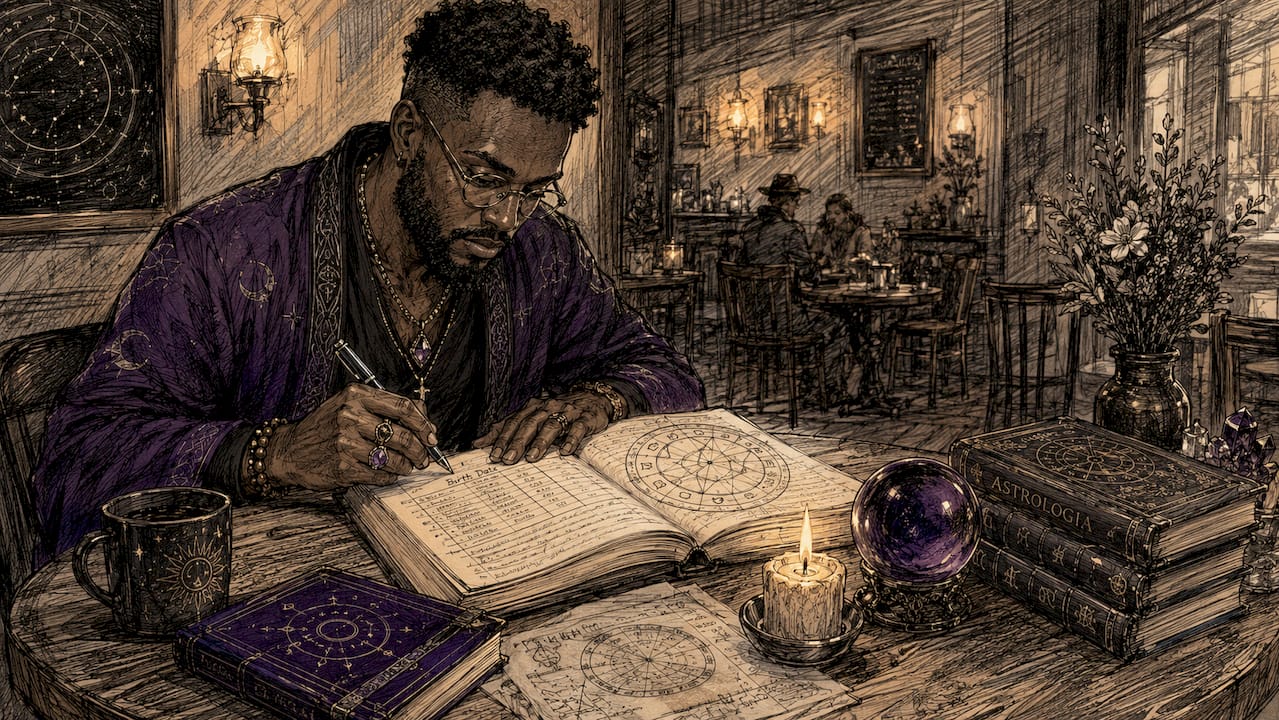
High-quality AI astrology systems use Swiss Ephemeris to calculate precise planetary positions before the AI model ever generates a single sentence. Swiss Ephemeris is an astronomical calculation library used by professional astrologers worldwide. The AI receives those computed positions as grounded data, then interprets them rather than guessing. This step prevents the AI from inventing placements, a problem common in general-purpose language models that have no access to live astronomical data.
The difference between a basic chart calculator and a true AI reading is synthesis. A calculator tells you that your Moon is in Scorpio in the 8th house. An AI reading explains what that placement means in the context of your Venus in Gemini, your Capricorn rising, and the current Saturn transit through your 2nd house. That synthesis is where personalized astrology becomes genuinely useful.
Key data points the AI uses to build your natal chart:
- Birth date: Determines sun sign and annual planetary positions.
- Exact birth time: Sets the Ascendant (rising sign) and house cusps.
- Birthplace: Adjusts for geographic latitude and longitude, affecting house divisions.
- Aspect patterns: Angular relationships between planets that shape personality themes.
Pro Tip: Always enter your exact birth time when using any AI astrology platform. Even a 15-minute difference can change your rising sign and shift every house in your chart, altering the entire reading.
What role do real-time planetary transits play?
Transit tracking is what makes AI astrology feel alive rather than static. Your natal chart never changes, but the planets keep moving. When Saturn crosses your natal Venus, or Jupiter enters your 10th house, those movements create real-time influences that a personalized AI reading can identify and explain specifically for you.
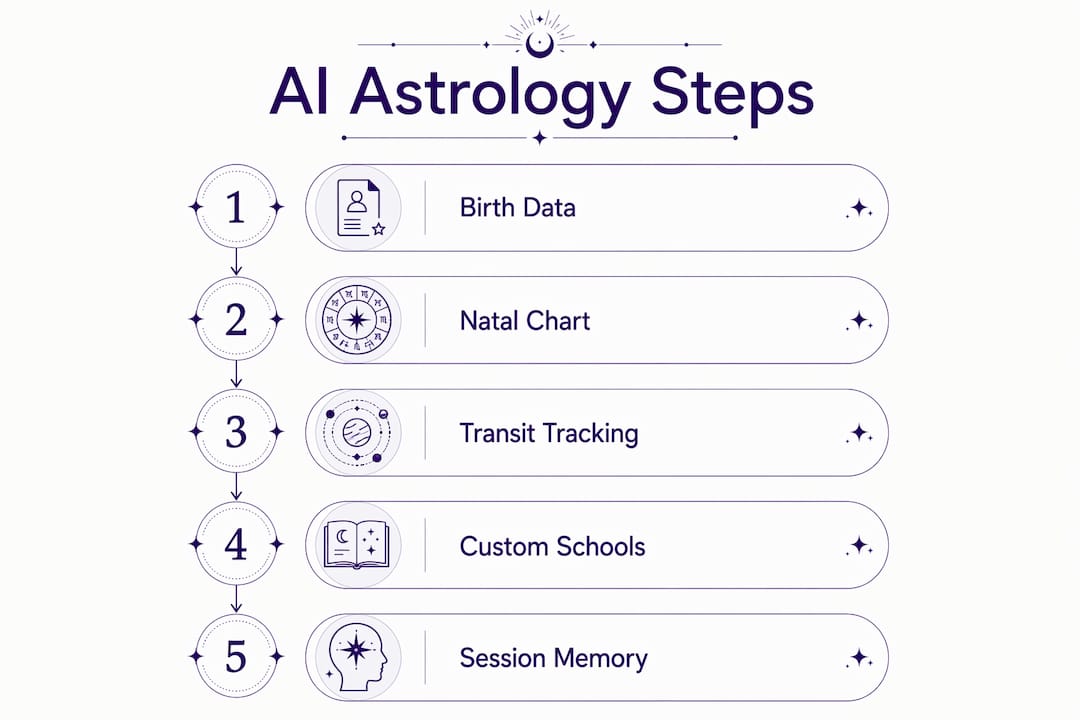
AI astrology platforms calculate current planetary positions daily and overlay them onto your natal chart automatically. The result is a reading that tells you not just who you are, but what is happening to you right now. A generic horoscope might say "Scorpios feel tension this week." A transit-aware AI reading says "Saturn is squaring your natal Mercury in the 3rd house, which may slow communication and require extra patience in written agreements."
The specificity matters. Consider these examples of how transit personalization works:
- Jupiter transiting your 2nd house: Signals a period of financial expansion tied to your natal 2nd-house ruler's sign and condition.
- Mars conjunct your natal Sun: Brings a surge of energy and drive, but the house placement tells you which life area activates.
- Neptune squaring your Ascendant: Creates confusion around identity and self-presentation, most felt if your Ascendant is in a mutable sign.
AI-driven horoscope analysis on platforms like Tarosyn tracks these transits continuously. You get updates that reflect where the planets actually are relative to your chart, not a one-size-fits-all weekly forecast. The Indian AI astrology market alone is projected to reach $1.8 billion by 2030, which reflects how strongly readers are moving toward personalized, data-driven guidance over generic forecasts.
How AI adapts to different astrological schools and methods
Not all astrology is the same. Hellenistic astrology uses whole-sign houses and sect. Modern psychological astrology focuses on inner archetypes. Evolutionary astrology centers on the soul's growth across lifetimes. Vedic astrology uses the sidereal zodiac and a completely different house system. A generic AI reading ignores these distinctions entirely.
The better approach is a practitioner-tuned Knowledge Base. Successful AI astrologers load their own interpretive rules, notes, and methodological preferences into the AI system. The AI then reads every chart against those rules rather than pulling from generic language model training data. The output matches the practitioner's voice and method, not a blended average of every astrology book ever written.
The table below shows how different astrological schools shape AI reading output:
| School | House system | Key focus | AI tuning requirement |
|---|---|---|---|
| Hellenistic | Whole sign | Sect, bonification, maltreatment | Sect-aware interpretation rules |
| Modern psychological | Placidus | Inner archetypes, shadow work | Depth psychology framing |
| Evolutionary | Placidus or whole sign | Soul growth, nodal axis | Karmic and past-life context |
| Vedic (Jyotish) | Whole sign (sidereal) | Dashas, yogas, divisional charts | Sidereal zodiac and dasha system |
Professional astrologers who use AI assistants with custom Knowledge Bases reduce chart drafting time by 70%–90%. That time savings lets them focus on the synthesis and client conversation that only a human can provide.
Pro Tip: When choosing a personalized astrology app, ask which astrological school it follows. An app that does not specify a method is likely using a blended generic output that fits no tradition well.
Why session memory makes AI astrology readings deeper over time
A single reading gives you a snapshot. An ongoing conversation gives you a map. Session memory is what separates a one-time AI reading from a continuous astrological relationship.
AI astrology systems that maintain session persistence pass a session ID and conversation history with every new request. The AI knows what you asked last month. It remembers that you mentioned a job change in march, that you asked about your relationship in june, and that you are currently navigating a Saturn return. Each new reading builds on that accumulated context rather than starting from zero.
Here is how session memory improves your readings over time:
- Context retention: The AI references your previous questions and life events, making each new reading more relevant.
- Pattern recognition: Over multiple sessions, the AI identifies recurring themes in your chart and your life, pointing out connections you might miss.
- Refined questions: Because the AI remembers your chart and history, you can ask follow-up questions without re-explaining your situation every time.
- Evolving accuracy: As you share more about your actual experiences, the AI calibrates its interpretations to match what resonates for you specifically.
This is the closest AI comes to replicating what a long-term human astrologer provides. A skilled astrologer who has worked with you for five years knows your patterns, your blind spots, and your recurring questions. Session memory gives AI the same structural advantage, even if the depth of human intuition remains different. Platforms built with session continuity at their core produce readings that feel genuinely personal rather than freshly generated each time.
Key Takeaways
AI personalizes astrology readings by combining precise natal chart data, real-time transit tracking, practitioner-tuned methods, and session memory into a continuously evolving, individual reading.
| Point | Details |
|---|---|
| Natal chart precision | Exact birth time and birthplace are required for accurate house placements and rising sign. |
| Swiss Ephemeris grounding | AI systems use Swiss Ephemeris to calculate real planetary positions before generating any text. |
| Transit personalization | Real-time planetary overlays on your natal chart produce specific, timely guidance rather than generic forecasts. |
| Method-specific tuning | AI readings improve significantly when built against a practitioner's Knowledge Base and chosen astrological school. |
| Session memory depth | Persistent conversation history lets AI build an evolving astrological profile that grows more accurate over time. |
Where AI ends and human judgment begins
I have spent years watching AI tools get applied to astrology, and the pattern is consistent. AI handles the analytical heavy lifting well. It calculates, synthesizes, and drafts faster than any human. But the moment a reading requires genuine judgment about a specific person's unique context, the AI needs a human in the loop.
The best practice I have seen is treating AI as a junior editor. AI cannot replace human judgment on chart synthesis. It can draft the interpretation of your Saturn square Mercury. A skilled astrologer still decides whether that aspect is the most important thing in your chart right now, or whether your progressed Moon conjuncting your natal Sun matters more for the question you actually asked.
The readers who get the most from AI astrology are the ones who use it to go deeper, not to replace the process. They use AI to get a first reading, identify the themes that resonate, and then bring those themes to a human practitioner for nuanced conversation. AI astrology works best as a starting point and a daily companion, not as the final word. The technology is genuinely good at personalized ongoing guidance. The synthesis of what it all means for your specific life remains yours to interpret, ideally with human support.
— Joseph
Tarosyn brings AI astrology personalization together
Tarosyn combines AI-powered tarot, astrology, and numerology in one place, built for readers who want more than a generic daily horoscope.
Your daily horoscope on Tarosyn is generated with your sign's specific planetary context, not a recycled forecast. For deeper readings, Tarosyn's three-card spread readings integrate astrological and tarot insights into a single personalized session. Subscription plans start at accessible price points, with free features available from day one. You can view Tarosyn's subscription tiers to find the level that fits your practice. The platform also includes a social community where you can share insights and connect with others on the same path.
FAQ
How does AI personalize astrology readings differently than a horoscope app?
A generic horoscope app groups all people of one sun sign together. AI personalization uses your exact birth date, time, and location to build a natal chart unique to you, then interprets current planetary transits against that specific chart.
What is Swiss Ephemeris and why does it matter for AI astrology?
Swiss Ephemeris is an astronomical library that calculates precise planetary positions. AI astrology systems use it to ground readings in real data, preventing the AI from inventing planetary placements.
Can AI astrology remember my previous readings?
Yes, when a platform uses session persistence. The system passes your session ID and conversation history with each new request, allowing the AI to build on prior readings rather than starting fresh every time.
Does AI astrology work for Vedic as well as Western astrology?
AI systems tuned with a Vedic Knowledge Base can apply sidereal zodiac calculations, dasha systems, and divisional charts. Without that specific tuning, most AI astrology defaults to Western tropical methods.
Is AI astrology accurate enough to replace a human astrologer?
AI handles chart calculation and initial interpretation well, but final synthesis and client-specific judgment remain the responsibility of a human astrologer. AI works best as a complement to, not a replacement for, human expertise.