
Personalized tarot readings are structured reflective sessions that use symbolic card imagery, spread selection, and your specific life context to generate insight rather than prediction. The practice draws on psychological concepts including archetypal projection, narrative construction, and what researchers call the generation effect, where insights you reach yourself stick better than advice handed to you. Clinical psychologists like Dr. Daniel Glazer have noted that tarot functions as a projective tool, similar to techniques used in talk therapy. Understanding how personalized tarot readings work means recognizing that the cards do not tell your future. They help you see your present more clearly.
How personalized tarot readings work: the core process
A personalized reading begins with intention. Before a single card is drawn, you or your reader identifies a focus question or life area. That question shapes everything that follows, from which spread is selected to how each card position is interpreted.
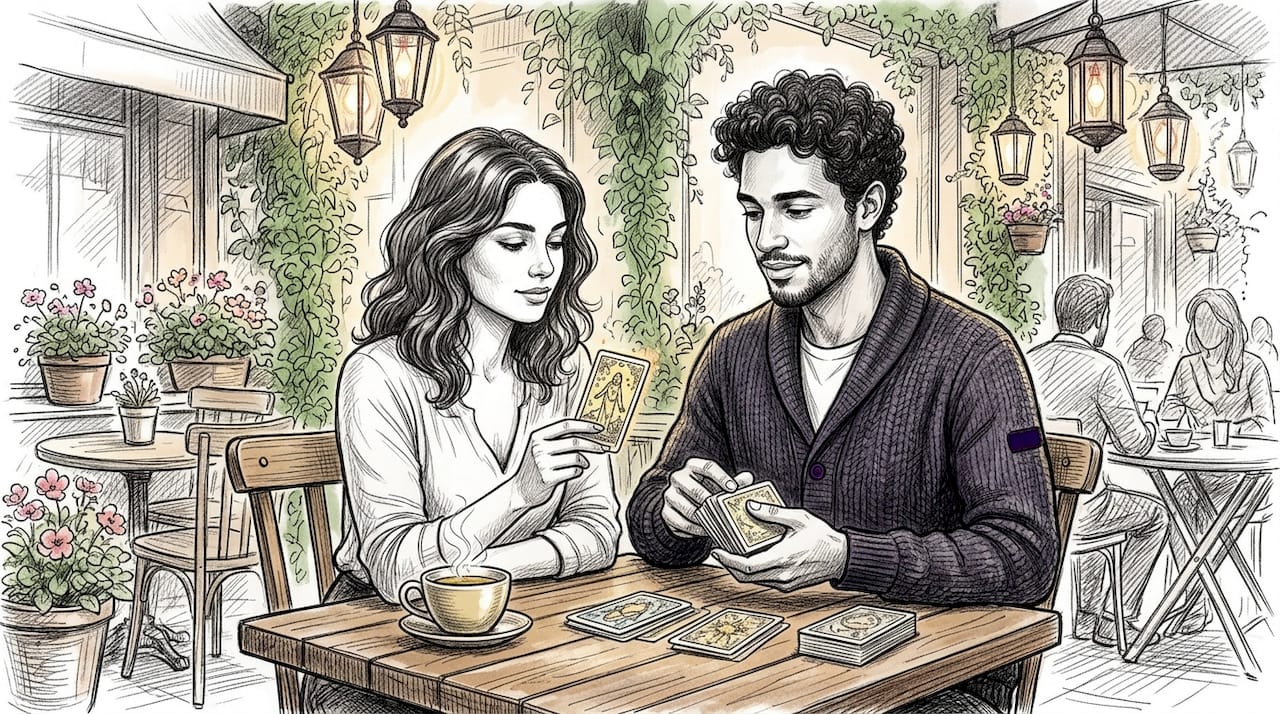
The spread is the layout of cards on the table, and each position carries a defined meaning. A three-card spread might place cards in "past," "present," and "future" positions. A Celtic Cross uses ten positions covering everything from your core situation to hidden influences and likely outcomes. The Crossroads Decision spread on Tarosyn, for example, maps each card position to a specific decision factor, making the reading directly relevant to a choice you face. The position context is what separates a personalized reading from a generic one.
What makes the reading truly individual is the integration of your life history, emotional state, and current circumstances into the interpretation. A skilled reader does not recite a card's textbook meaning. They ask what the imagery brings up for you, then connect that response to your stated situation. Quality AI platforms avoid absolute predictions, framing readings as questions and perspectives aligned with your situation. That framing keeps the reading reflective rather than determinative.
- Intention setting: Name a specific question or life area before the session starts.
- Spread selection: Choose a layout whose card positions match the type of insight you need.
- Contextual interpretation: Apply the card's symbolism to your stated situation, not a generic meaning.
- Reflection prompts: Use the reading to generate questions, not conclusions.
- Follow-up journaling: Write down what resonated and why, to deepen the insight over time.
Pro Tip: Frame your focus question as an open question rather than a yes/no question. "What do I need to understand about this relationship?" produces richer reflection than "Will this relationship work out?"
How does tarot function as a psychological tool?
Tarot introduces what researchers call productive constraint. When you externalize a problem onto a set of cards, chaotic rumination becomes a navigable structure. The cards do not add new information. They organize the information already present in your mind into a format you can examine.
The psychological mechanism here is projection. Tarot cards act as projective tools that enable you to project subconscious thoughts and feelings onto symbolic imagery. That externalization helps surface suppressed emotions and supports emotional growth. The process is similar to how a therapist might use a Rorschach inkblot or a sand tray: the ambiguity of the stimulus invites your own meaning, not a prescribed one.
"Tarot acts as a mirror rather than a crystal ball, helping externalize chaos and providing new perspectives." Is tarot reading the new therapy? | Gathered
The generation effect reinforces this. Interpretive flexibility in tarot invites you to engage actively in meaning-making, which enhances memory and insight retrieval compared to passive advice. When you construct the meaning yourself, you commit to it more deeply. That commitment is what drives behavior change.
Here is how the psychological sequence typically unfolds in a session:
- You state an intention, which activates focused attention on a specific problem.
- Cards are drawn, introducing randomness that disrupts habitual thinking patterns.
- You project personal meaning onto the card's imagery and symbolism.
- The reader or AI platform reflects that meaning back within the context of your stated situation.
- You construct a narrative that reframes your experience in a way that feels both new and true.
The tarot archetypes used across most decks, including the Fool, the Tower, and the High Priestess, function as universal psychological patterns. Carl Jung described archetypes as shared structures of the unconscious. Tarot's 78-card system maps onto a wide range of human experiences, which is why the imagery resonates across cultures and life situations.
What are the benefits and limits of personalized tarot readings?
Tarot's ritual and symbolic nature offers psychological value through increased self-awareness and decision clarity, even without scientific predictive validation. That distinction matters. The benefit is real. The mechanism is psychological, not supernatural.
| Benefit | What it means in practice |
|---|---|
| Reduced decision anxiety | Externalizing a problem onto cards makes it feel more manageable and less overwhelming. |
| Improved self-awareness | Projecting onto symbolic imagery surfaces thoughts you had not consciously articulated. |
| Narrative clarity | A spread gives your situation a structure, which makes it easier to identify next steps. |
| Emotional validation | Seeing your experience reflected in a card's imagery can confirm that your feelings are real and worth examining. |
The limits are equally clear. Tarot carries no scientific evidence for predictive accuracy. Confirmation bias and synchronicity theories partly explain why readings can feel uncannily accurate: you notice the hits and discount the misses. Over-reliance on readings for major decisions, especially medical, legal, or financial ones, is a genuine risk. A reading is a reflective prompt, not a substitute for professional advice.
Pro Tip: Set a personal rule before each session: the reading informs your thinking, but you make the final call. That boundary keeps tarot as a tool for clarity rather than a source of dependency.
Daily tarot use can reduce anxiety and foster self-reflection when approached with that mindset. The key is treating each reading as a question to sit with, not an answer to act on immediately.
How can you engage with personalized tarot readings practically?
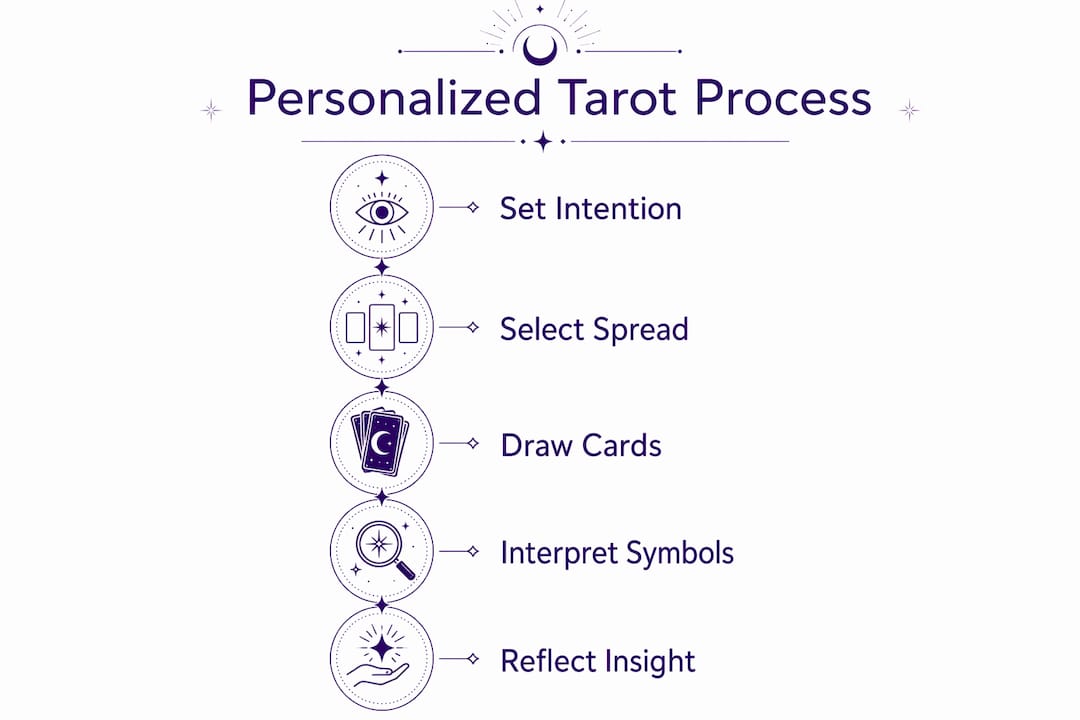
A standard personalized session follows a clear sequence. You set your intention, select or receive a spread, draw cards, interpret each card within its position context, and then reflect on the overall narrative the spread creates. The final step, reflection, is where most of the value lives.
AI tarot readings can instantly personalize interpretation based on your context, journaling history, and specific inquiries. That makes tarot accessible at any time and turns readings into a daily reflective practice rather than an occasional event. Tarosyn's AI-powered platform does exactly this, drawing on your prior sessions and stated focus areas to generate interpretations that connect to your actual situation.
Practical applications vary by need:
- Daily single-card draws: Pull one card each morning and journal one sentence about how it connects to your day.
- Decision guidance spreads: Use a multi-position spread like the Crossroads Decision layout when facing a specific choice.
- Emotional check-ins: Draw three cards to represent what you are feeling, what is driving that feeling, and what would help.
- Pattern recognition: Review your journal entries monthly to identify which cards appear repeatedly and what themes emerge.
| Session type | Best spread | Ideal frequency |
|---|---|---|
| Daily reflection | Single card | Daily |
| Decision support | Three-card or Crossroads | As needed |
| Monthly overview | Wheel of the Month | Monthly |
| Deep personal work | Celtic Cross | Weekly or biweekly |
Therapists use tarot as a projective tool to encourage client reflection, often combining sessions with journaling or art exercises. You can apply the same structure independently. After each reading, write down the card that surprised you most and ask yourself why it surprised you. That question often points directly to the area needing the most attention.
Key Takeaways
Personalized tarot readings work because they structure your own thoughts through symbolic imagery, active meaning-making, and context-specific interpretation, not prediction.
| Point | Details |
|---|---|
| Intention drives personalization | Starting with a focused question shapes every card interpretation that follows. |
| Spreads create structure | Each card position carries a defined meaning that connects the card to your specific situation. |
| Projection surfaces insight | You project subconscious content onto card imagery, which makes hidden thoughts easier to examine. |
| Benefits are psychological | Tarot reduces decision anxiety and improves self-awareness through narrative construction, not predictive accuracy. |
| AI enhances accessibility | AI-powered platforms personalize readings using your journaling history and prior sessions, making daily practice practical. |
Why I think most people misunderstand what tarot is actually doing
People come to tarot expecting answers. What they get, when the reading is done well, is better questions. That shift is harder to accept than it sounds, because we are conditioned to want resolution. Tarot offers something more useful: a structured way to sit with uncertainty without being paralyzed by it.
What I find most striking about personalized readings is how the act of naming your question out loud changes your relationship to the problem. Before you draw a card, you have already done something significant. You have committed to examining a specific situation rather than avoiding it. The card that follows is almost secondary to that act of attention.
The personal growth that comes from regular tarot practice is not mystical. It is the result of repeated, structured self-examination. You build a habit of asking what you actually think and feel, rather than what you think you should think and feel. That habit compounds over time.
The risk I see most often is people treating a reading as a verdict. A card does not decide anything. You do. The reading gives you a frame. What you build inside that frame is entirely yours. Approach tarot with curiosity and a willingness to be wrong about yourself, and it becomes one of the more honest tools for self-examination available.
— Joseph
Tarosyn brings personalized readings to your daily practice
Tarosyn is an AI-powered platform that combines personalized tarot, astrology, numerology, and a live community in one place. Each reading on Tarosyn adapts to your stated focus, prior sessions, and the spread you choose, so the interpretation connects to your actual situation rather than a generic card meaning.
You can browse community tarot readings to see how others interpret the same cards across different life contexts, which sharpens your own reading skills. Tarosyn also offers a range of spread options, from single-card daily draws to full Celtic Cross sessions, so you can match the depth of the reading to what you need that day. The platform is built for people who want tarot to be a practical, repeatable part of their self-reflection routine.
FAQ
What is a personalized tarot reading?
A personalized tarot reading is a structured session that uses your specific question, chosen spread, and life context to generate reflective insight. It differs from a generic reading by connecting each card's symbolism directly to your stated situation.
How do AI tarot readings work?
AI tarot readings personalize interpretation by drawing on your journaling history, prior sessions, and specific inquiries to generate context-relevant responses. Platforms like Tarosyn frame readings as reflective questions rather than fixed predictions.
Do personalized tarot readings have scientific support?
Tarot carries no scientific evidence for predictive accuracy, but research supports its psychological value through narrative construction, reduced decision anxiety, and improved self-awareness. The benefit is real; the mechanism is psychological, not supernatural.
What spreads work best for self-discovery?
Three-card spreads work well for emotional check-ins, while the Celtic Cross suits deeper personal examination. The Crossroads Decision spread is most effective when you face a specific choice and need to map out the factors involved.
How often should you get a personalized tarot reading?
Daily single-card draws build self-reflection habits over time, while deeper spreads are most useful weekly or when a specific situation calls for structured thinking. Consistency matters more than frequency.