
The five actions that reliably keep an online community active and engaged are: post on a consistent schedule, activate new members within 48 hours, run a weekly ritual, build a small leader team, and measure monthly active members (MAU) as your primary health signal. Everything else is secondary.
Quick-start checklist (copy this into your planning doc):
- Post several times per week as the host during the initial phase
- Send a welcome message to every new member within 24 hours
- Pin a "Start Here" post with one clear first action
- Identify 3–5 active members and give them a named role
- Track MAU, reply-to-post ratio, and 30-day activation rate weekly
Pro Tip: After 3–6 months of consistent hosting, shift from primary creator to editor. Curate and amplify member posts instead of generating all content yourself. This preserves your bandwidth and signals to members that the community belongs to them.
Key Takeaways
Consistent host posting, fast new-member activation, and a small leader team are the three actions that move the needle most reliably in the first six months.
| Point | Details |
|---|---|
| Post several times per week | Host consistency is the single most reliable driver of early community momentum. |
| Activate new members in 48 hours | Members who post within their first 48 hours are far more likely to stay active long-term. |
| Track MAU, not total members | MAU is the primary health metric; a reply-to-post ratio above 2 is a healthy secondary signal. |
| Build a 3–7 person leader team | Active moderators and ambassadors sustain activity during periods when the host is less present. |
| Tarosyn for spiritual communities | Tarosyn provides daily content anchors, welcome flows, and community journal tools that match these tactics. |
Table of Contents
- Why online communities go quiet
- Ten strategies that reliably boost activity
- How to recruit, train, and empower community leaders
- What to measure and how to set benchmarks
- A 3–6 week re-engagement sprint
- Clear moderation, community guidelines, and safety
- Setting realistic engagement goals and managing expectations
- Handling conflicts and negative behavior constructively
- How to collect and act on member feedback
- Tailoring tactics to your platform and audience
- What actually works, and what takes longer than you think
- Tarosyn gives spiritual communities a ready-made engagement system
- Sources
Why online communities go quiet
Most quiet communities share the same handful of root causes. Spotting yours early saves weeks of guessing.
- Host silence: The host stops posting regularly. Members have no signal to return on a schedule, so they drift. Fix: resume a 3-post-per-week minimum immediately.
- Poor onboarding: New members join, see no clear next step, and never post. Fix: add a pinned "Start Here" post with one low-friction first action (answer one question, introduce yourself in one sentence).
- Fragmented spaces: Too many channels or categories scatter conversation. Fix: reduce to 3–5 focused spaces and archive the rest.
- Unclear purpose: Members cannot explain what the community is for. Fix: write a one-sentence promise and put it in the header, welcome message, and pinned post. Communities with a specific, compelling purpose achieve measurably higher engagement than vague-topic groups.
- No feedback loop: Members give no input and feel unheard. Fix: run a monthly one-question poll asking what they want more of.
- Low first-reply rate: New member posts go unanswered. Fix: assign a moderator to reply to every first post within two hours.
Five-minute self-audit: Check your last 14 days of posts. Did you post at least six times? Did every new member get a reply within 24 hours? Do you have more than five active channels with fewer than three posts each? Those three checks surface the most common failure modes in under five minutes.
Ten strategies that reliably boost activity
1. Treat onboarding as your first engagement moment
The first 48–72 hours determine whether a new member ever posts. Send a personal welcome message within 24 hours. Pin a "Start Here" post that gives one specific, low-friction first action: "Drop your name and one thing you're working on below." Members who post within their first 48 hours are far more likely to remain active months later.
Sample welcome message:
2. Build a predictable posting cadence
Consistent posting by the host — 3–5 posts per week — is the single most reliable driver of early community momentum in the first six months. A simple weekly rhythm works well:
- Monday: Open question ("What's one goal you're setting this week?")
- Wednesday: A short tip, resource, or insight
- Friday: Member wins or highlights ("Share a win from this week")
After month three, start curating member posts instead of writing all content yourself. The cadence stays; the source shifts.
3. Use conversation-first post formats
Open-ended questions, polls, and vulnerability prompts generate higher reply rates than long-form statements. Keep prompts short. "What's your biggest challenge with X right now?" outperforms a 500-word essay every time. AMAs (Ask Me Anything sessions) work well as monthly anchors because they give passive members a low-barrier reason to participate.

Pro Tip: Run a two-week A/B test: post an open question on Monday in week one, and a poll on Monday in week two. Track reply counts. Whichever format gets more replies becomes your default Monday format for the next month.
4. Anchor the calendar with live events
Live events — Q&As, office hours, workshops — act as calendar anchors. Attendees are more likely to continue participating after a live session than members who only read posts. Run one live event per month at minimum, at a consistent day and time. Bi-weekly is better once you have the bandwidth. Announce it seven days out, three days out, and the morning of.
5. Connect members to each other, not just to you
Buddy systems and small-group cohorts reduce dependence on the host and create peer accountability. Pair new members with a "community buddy" for their first two weeks. For larger groups, run cohort-based onboarding: bring in new members in batches of 10–20 and give them a shared first-week challenge.

6. Make recognition unlock real access
Cosmetic badges motivate briefly. Recognition that unlocks real benefits — an exclusive channel, early access to content, or a direct line to the host — creates lasting incentive. Tie your top contributor status to something tangible: a private Q&A, a featured spotlight, or early access to new features.
7. Keep your space design tight
Limit active channels or categories to 3–5. Every additional space dilutes conversation. Duke Center for Teaching & Learning guidance recommends small, focused spaces to prevent fragmentation and improve participation. Archive low-traffic channels rather than leaving them visible and empty.
8. Reduce friction everywhere
Members post more when posting is easy. Check three things: Are notifications set to alert members when someone replies to their post? Is the mobile experience usable? Can a member post in under 30 seconds? On platforms like Discord or Slack, pin a cross-post template so members know exactly where to share different content types. On Discourse or Mighty Networks, use category descriptions to guide members to the right space.
9. Build a prompt library
Keep a running doc of 20–30 post prompts you can pull from on low-inspiration days. Organize by type:
- Intro prompts: "Tell us your name and one thing you're hoping to get from this community."
- Engagement prompts: "What's one thing you learned this week that surprised you?"
- Re-engagement prompts: "We haven't heard from you in a while — what's been on your mind lately?"
10. Seed early discussions with a founding cohort
Recruit 20–50 engaged members before or just after launch to seed early discussions and set the tone. These founding members reduce the empty-room problem that kills new communities. Reach out personally, explain the vision, and give them a named role (Founding Member, Charter Member) that acknowledges their early contribution.
How to recruit, train, and empower community leaders
A community of 500 members typically runs on the energy of 3–7 highly active contributors. Identifying and supporting those people is one of the highest-leverage things you can do.
How to spot them: Look for members who reply to others unprompted, post consistently without being asked, and welcome new members on their own. In Discord or Slack, sort by message count. In Discourse or Mighty Networks, check who has the most replies and likes given (not just received).
What to give them:
- A named role or badge that signals their status publicly
- Access to a private moderator or leader channel
- Early access to new content, features, or events
- A direct line to you for feedback and ideas
Hybrid onboarding for new leaders works the same way it does for members: an automated first-touch (a welcome message and a short onboarding doc) followed by a personal conversation within the first week.
Moderator playbook (short version):
- Reply to all new member posts within two hours
- Flag rule violations with a private message before a public warning
- Escalate harassment or repeated violations to the community manager immediately
- Use this conflict script: "I noticed your post may have made some members uncomfortable. Can we talk about it privately?"
Ambassador invite template: "Hey [Name], I've noticed how consistently you show up and support others here. I'd love to invite you to join our moderator team. It comes with [specific perk]. Interested in a quick chat?"
New moderator onboarding checklist:
- Read and sign the community guidelines
- Get access to the moderator channel
- Shadow one moderation decision in the first week
- Post your first welcome message to a new member within 48 hours
Pro Tip: Give moderators a monthly 30-minute check-in call. Burnout among volunteer moderators is the most common reason a leader team dissolves. A short call keeps them connected and surfaces problems before they become exits.
What to measure and how to set benchmarks
Track monthly active members (MAU) as your primary health metric; it tells you whether the community is growing, stable, or shrinking in real terms. Total member count is a vanity metric. A community with 200 MAU out of 300 members is healthier than one with 200 MAU out of 5,000.
Secondary metrics to watch:
- Reply-to-post ratio (target: above 2)
- New-member activation rate: percentage of members who post within their first 30 days
- Posts per active member per month
- Event attendance rate
- DAU/MAU ratio (daily actives divided by monthly actives)
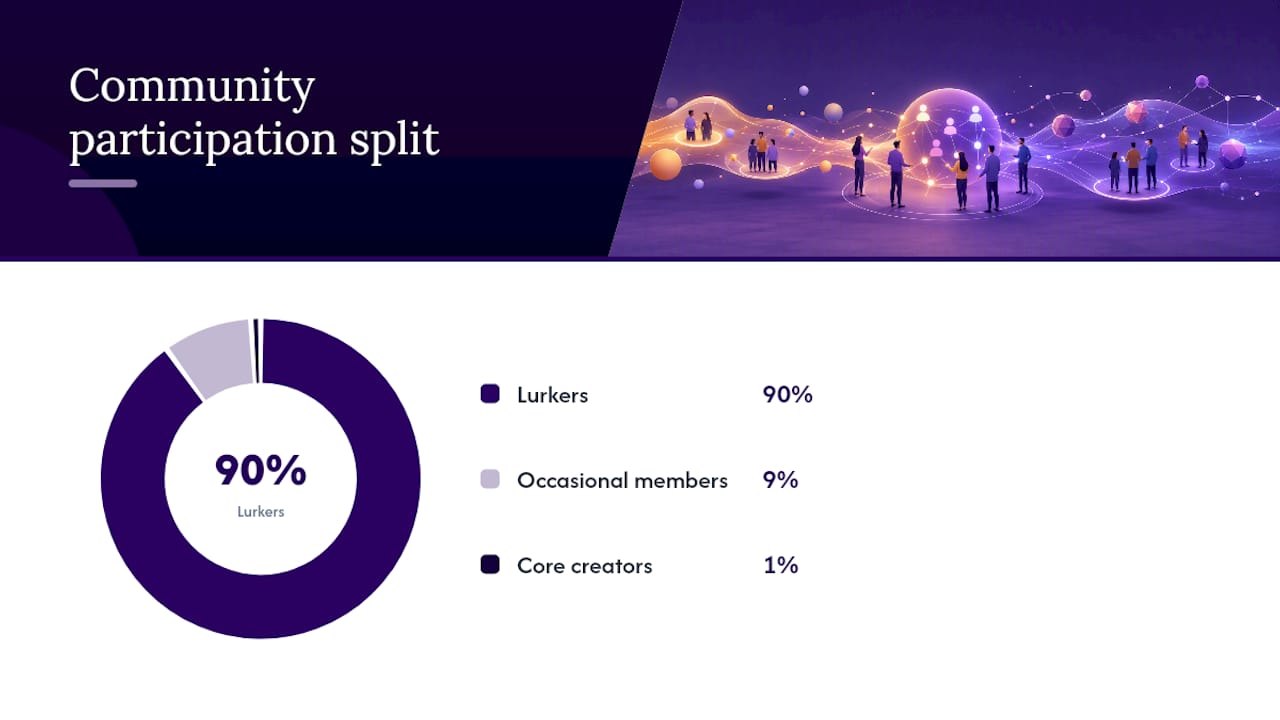
The 90-9-1 rule is a useful baseline: roughly 90% of members lurk, 9% contribute occasionally, and 1% create most content.
How to run a short experiment: Pick one metric (reply rate). Run it for two weeks across at least 10 posts. Compare reply counts to the two weeks before. If the result holds, make it a standard practice.
| Metric | Healthy range | Warning sign | Action |
|---|---|---|---|
| MAU / total members | 20–40% | Below 10% | Fix onboarding and cadence first |
| Reply-to-post ratio | Above 2 | Below 1 | Add open-ended prompts |
| 30-day activation rate | 30–50% | Below 20% | Rewrite welcome sequence |
| Event attendance | 5–15% of MAU | Below 3% | Change timing or format |
| DAU/MAU ratio | 10–20% | Below 5% | Add daily content anchors |
If activation is low, fix onboarding before adding new features. That is the most common sequencing mistake.
A 3–6 week re-engagement sprint
When activity drops, run this sequence. It takes about two hours to set up and one hour per week to maintain.
- Week 0 (audit): Pull a list of members who have not posted in 30+ days. Segment into two groups: members who were once active, and members who never posted at all.
- Week 1 (personal outreach): Send a personalized DM to the "once active" group. Use this template: "Hey [Name], we miss you around here. We've been talking a lot about [topic they engaged with before]. Anything we can do to make this more useful for you?"
- Week 2 (event anchor): Announce a live event or AMA for week three. Send a broadcast to all dormant members with a clear CTA: "We're hosting a live Q&A on [date]. One question, 30 minutes. Come ask anything."
- Week 3 (live event): Run the event. Follow up with a summary post and tag attendees by name.
- Week 4 (small group): Invite re-engaged members into a short-term small group (a 4-week challenge or cohort). This converts one-time returners into regular contributors.
- Weeks 5–6 (measure): Check MAU and activation rate against your pre-sprint baseline. If MAU is up by 10% or more, the sprint worked. If not, repeat the personal outreach with a different message angle.
Outreach templates:
- Personalized DM: "Hey [Name], I was thinking about your post on [topic]. We'd love to hear more from you."
- Broadcast CTA: "We're running a live session on [date]. Drop your question in the thread below and we'll answer it live."
- Event invite: "You're invited to [Event Name] on [Date/Time]. It's free, it's 30 minutes, and it's a good chance to connect with others working on [shared goal]."
Pro Tip: Never send a re-engagement broadcast without a specific CTA tied to a specific date. "We miss you, come back" gets ignored. "We're hosting a live Q&A on Thursday at 2 PM, drop your question here" gets clicks.
Clear moderation, community guidelines, and safety
Clear rules reduce conflict and make members feel safe enough to participate. Write your community guidelines in plain language: what is welcome, what is not, and what happens when someone crosses a line. Post them in a pinned location every new member sees on day one.
Three things your guidelines must cover: the tone you expect (respectful, specific, on-topic), the behaviors that result in a warning versus an immediate removal, and how members can report a problem. A vague "be kind" policy does not give moderators enough to act on. Specific examples do.
Review your guidelines every six months. Communities evolve, and rules written for 50 members often need updating at 500. Tarosyn's own community guidelines offer a clear example of how to set expectations without over-legalizing the language.
Setting realistic engagement goals and managing expectations
New community managers often set engagement targets based on what they want, not what is realistic for their stage.
Set goals in tiers. In months 4–6, focus on retention: keep MAU stable or growing.
Results from consistent effort typically show up in 6–12 weeks, not 6–12 days. If you post consistently, reply to every new member, and run one live event per month, you will see measurable improvement in reply rates and MAU within two months. Expect slow weeks. They are normal.
Handling conflicts and negative behavior constructively
Conflict handled poorly drives good members out faster than almost anything else. The goal is not to eliminate disagreement but to keep it from becoming personal or hostile.
When a member posts something that violates guidelines, address it privately first. A public callout embarrasses the member and signals to others that the community is adversarial. Use a private message: "Hey, I noticed your post may have crossed a line for some members. Here's what our guidelines say about this. Can you edit or remove it?" Most members respond well to a calm, specific, private message.
For repeated violations, follow a clear escalation path: private warning, then a temporary posting restriction, then removal. Document each step. If you ever need to remove someone, a documented trail protects you and keeps the decision defensible.
Positive behavior deserves the same attention. When a member handles a disagreement gracefully or supports another member through a hard moment, name it publicly. "I want to call out how [Name] handled that conversation — that's exactly the kind of community we're building."
How to collect and act on member feedback
Members who feel heard stay longer. Build a simple feedback loop into your monthly rhythm.
Run a one-question poll every four weeks. Rotate the question: "What topic do you want more of?" one month, "What's one thing we could do better?" the next. Keep it to one question. Long surveys get ignored.
After every live event, send a two-question follow-up: "What was most useful?" and "What would you change?" Read every response. Pick one thing to act on before the next event, and tell members you did it. "Based on your feedback from last month's Q&A, we're moving the start time to 7 PM" closes the loop and builds trust.
Once per quarter, share a short summary of what you heard and what you changed. This is one of the most underused tactics in community management. It signals that feedback has a destination.
Tailoring tactics to your platform and audience
The same tactic works differently depending on where your community lives and who your members are.
Platform differences matter. Discord rewards fast, casual conversation and works well for gaming, creative, and interest-based communities. Slack suits professional or team-based groups where members expect structured channels and integrations. Discourse is built for threaded, long-form discussion and works well for technical or knowledge-sharing communities. Mighty Networks and BuddyBoss are purpose-built for paid or course-based communities where the host wants more control over the member experience and monetization. Each platform has a different default posting behavior, so your cadence and prompt style should match.
Audience segments need different approaches. New members need hand-holding: a welcome message, a clear first action, and a reply within 24 hours. Lurkers need low-friction entry points: polls, reactions, and short prompts they can answer in one sentence. Power users need challenge and recognition: harder questions, leadership roles, and early access. Segmenting members and blending automated onboarding with high-touch follow-up for priority segments protects culture as a community scales.
For spiritually focused communities, shared rituals and content create identity and belonging in ways that generic engagement tactics do not. A daily tarot card pull, a weekly astrology check-in, or a shared numerology prompt gives members a reason to return on a schedule and a shared language to connect around.
What actually works, and what takes longer than you think
The pattern that shows up consistently across communities of different sizes is this: the ones that stay active are run by someone who shows up on a schedule, replies fast, and makes a small group of members feel genuinely seen. That is it. Platform choice, gamification systems, and content variety matter, but they are secondary to those three things.
At small scale (20–100 members), a ritual cadence does most of the work. A group of 40 members where the host posts a Monday question every week and replies to every response will outperform a group of 400 where the host posts sporadically. The ritual is the signal. Members learn to return because something predictable is waiting for them. How daily, predictable content creates habitual return behavior is the same principle that makes daily horoscopes and tarot pulls so effective as community anchors.
At larger scale (500+ members), the ambassador program becomes the multiplier. A community of 800 with six active moderators who each welcome new members, run a monthly thread, and flag problems early will sustain itself through periods when the host is less active. The host's job shifts from content creator to culture keeper.
Timeline expectations: most communities see meaningful improvement in reply rates and MAU within 6–8 weeks of consistent effort. The re-engagement sprint described above typically shows measurable results in 3–4 weeks. Do not judge a tactic after one week. Two weeks of consistent application is the minimum before drawing any conclusion.
Tarosyn gives spiritual communities a ready-made engagement system
Running a spiritually focused community means your engagement tactics need to match your content. Tarosyn is built for exactly that. Its AI-powered tarot readings, daily horoscopes, and numerology insights give community managers a library of daily content anchors that members return to on a schedule — the same predictable ritual cadence this article identifies as the core driver of sustained activity.

Tarosyn's social tools map directly to the tactics covered here: welcome flows for new member activation, member spotlights through the community journal, and shared content like tarot energy readings that give members a shared language and a reason to post. The platform handles the content infrastructure so you can focus on the human side of moderation and connection.
If you manage or plan to build a spiritually focused community, visit Tarosyn to explore the full feature set and start a free account.
Sources
- Community engagement playbook: proven strategies to grow and retain members | BuddyBoss
- Systeme
- 15 Community Engagement Strategies That Work in 2026 | Bonfire
- How to Increase Engagement in Online Communities for 2026 - FluentCommunity
- How To Scale An Online Community Without Losing Engagement (2026) - JoinHere
- Building an Engaged Online Community: Strategies That Actually Work - Social Meep