
Get a new Tarosyn member to their first meaningful action within 10 minutes of signup by guiding them to a low-effort starter activity, while deeper feature discovery, profile enrichment, and norms are introduced later based on their individual experience level and interest. The first step is always tailored: new members are routed based on their profile fields to content matched to their background, ensuring onboarding adapts to whether they are new or practiced users. Everything else, deeper feature discovery, profile enrichment, and community norms, comes after that first win.
Day 0 checklist (run in under 10 minutes):
- Pin a Start Here post in your welcome space with a clear action paired with a personal touch
- Send a Day 0 welcome message (email or in-app DM) with a direct link to one piece of content, such as the daily horoscope or a starter reading
- Ask one low-effort intro question: "What brings you here today, tarot, astrology, or numerology?"
Key Takeaways
Onboarding new spiritual community members on Tarosyn works best when you reduce friction to one clear first action, collect only essential data, and use human-toned automation timed across Day 0, Day 3, and Day 7.
| Point | Details |
|---|---|
| Define one activation metric | Pick time-to-first-action or Day-1 return rate as your single success signal. |
| Limit signup to 3–5 fields | Collect primary interest, experience level, display name, email, and optional birth date only. |
| Pin a Start Here space | A pinned welcome post with one action link and a human signature drives the first click. |
| Automate with a human tone | Use AI for timing; keep messages short, signed by a host, and capped at one per channel per week after Day 3. |
| Tarosyn as your onboarding base | Tarosyn's horoscope hub, Public Journal, topic pages, and AI readings give new members a first meaningful action in under two minutes. |
Table of Contents
- How do you define a successfully onboarded spiritual community member?
- What data should you collect at Tarosyn signup?
- How does progressive disclosure work for a Tarosyn onboarding flow?
- How do you build a Start Here space and write Day-0 messages?
- What starter activities get new Tarosyn members to act?
- How do you automate welcome sequences without sounding robotic?
- How do you seed community norms without a long rules page?
- What metrics should you track and how do you iterate?
- Your plug-and-play Tarosyn onboarding checklist
- How do you personalize onboarding for different experience levels?
- What barriers do new members commonly face during onboarding?
- How do you integrate community guidelines into onboarding?
- How do you set up a buddy system for new Tarosyn members?
- How do you keep members engaged after their first action?
- The real tradeoff in Tarosyn onboarding is pacing, not automation
- Tarosyn's features map directly to this onboarding playbook
- Primary sources and further reading
- Sources
How do you define a successfully onboarded spiritual community member?
Pick one narrow, observable outcome and measure it. "Successfully onboarded" on Tarosyn means a new member has completed their profile, taken one first action (reacted to a post, saved a reading, or replied to an intro prompt), and returned on Day 1 or Day 2. The specific first action and return prompt are adapted based on the member's experience level collected at signup.
| Activation metric | What to track | Why it matters |
|---|---|---|
| Time-to-first-action | Minutes from signup to first reaction or save | Predicts Day-7 retention |
| Day-1 return rate | Members who log back in within 24 hours | Signals habit formation |
| First-week contribution | Members who post or reply within 7 days | Measures community integration |
| Profile completion | Fields filled at end of Day 0 | Enables personalization |
Reducing friction and prioritizing one clear next action is the most direct lever for improving all four metrics above. Map each metric to a dashboard event so you can spot drop-off points quickly.
What data should you collect at Tarosyn signup?
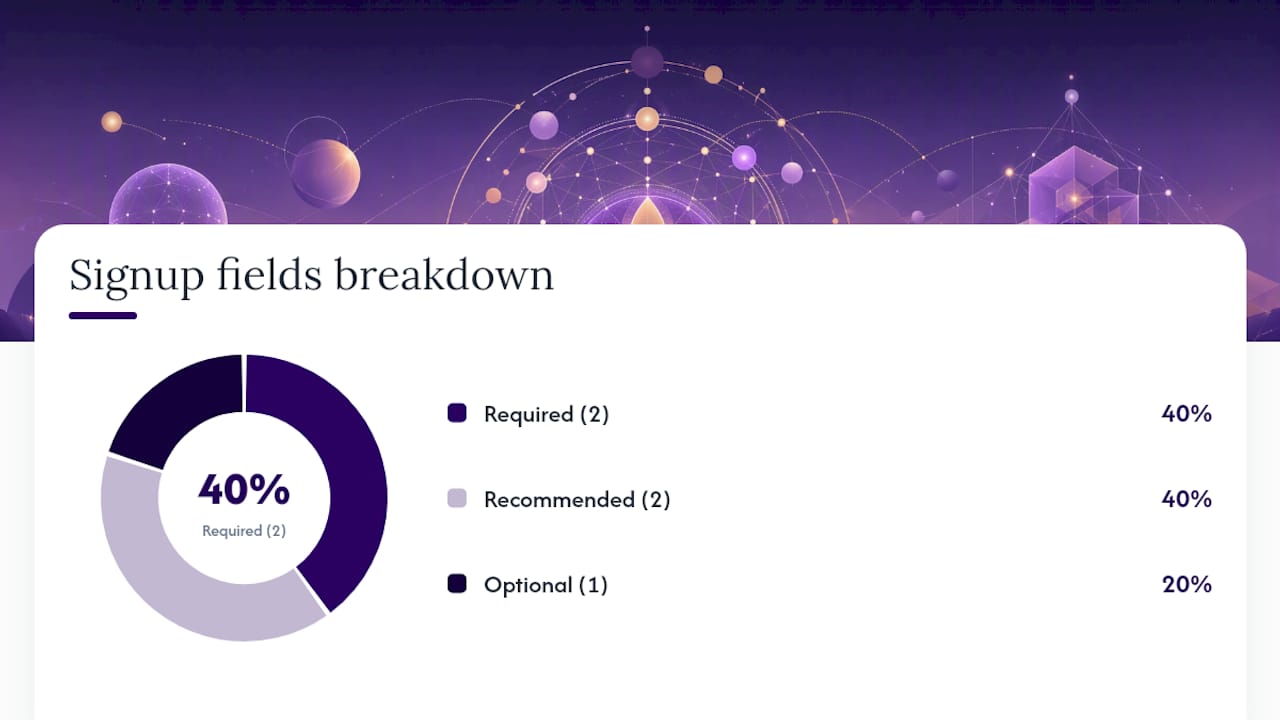
Collect only what shapes the member's first experience. Three to five fields is the right ceiling. Every extra question at signup increases the chance a new member leaves before reaching their first action.
Recommended signup fields:
- Primary interest (tarot, astrology, numerology) — routes the member to relevant content immediately
- Experience level (new to spiritual tools / some experience / practiced) — adjusts the tone of automated nudges
- Display name — required for community participation
- Email — required for the welcome sequence
- Birth date (optional at signup) — needed for birth chart and personalized horoscope; defer if the member skips it
Defer enrichment questions, such as rising sign, life path number, or preferred reading style, to later micro-prompts triggered after the first action. Relocating non-essential inputs to the profile stage and triggering enrichment later improves activation by keeping the signup path short.
Pro Tip: Set birth date as optional at signup and surface a gentle prompt inside the app after the member saves their first reading. Completion rates for optional fields rise sharply when the member already sees the value of the feature.
How does progressive disclosure work for a Tarosyn onboarding flow?
Show only what the member needs to take one action, then reveal more. Separating upfront requirements from in-context education reduces abandonment and keeps the first session focused.
- At signup: collect the 3–5 essential fields, then route the member directly to their first content match (a horoscope for their sign, a starter tarot reading, or the spirituality topic page)
- After first action: surface one follow-up prompt ("Save this reading to track your progress") and introduce the Public Journal as a place to reflect
- Days 2–7: introduce community features one at a time: intro post, first reply, attending a live event or poll
- Week 2 onward: surface premium features, birth chart depth, synastry, and numerology insights, only after the member has returned at least twice
Pro Tip: Use in-app tooltips with a clear "Skip for now" option at each new feature reveal. Members who skip are not disengaged; they are pacing themselves. Give them a resume path.
How do you build a Start Here space and write Day-0 messages?
A pinned Start Here space is the single most reliable way to help new members find relevant conversations and starter activities. Keep it short and action-oriented.
Start Here space checklist:
- One-sentence purpose statement ("This is where you begin your Tarosyn experience")
- One clear first action with a direct link
- Quick links to the spirituality topic page, the Public Journal, and community guidelines
- A human signature from the host or community manager
Pinned post template:
Welcome. Start by reading today's horoscope for your sign or pulling a free tarot card. Drop your sign in the comments so we can say hello. If you have questions, reply here and [Host Name] will get back to you within 24 hours.
Day 0 email/DM template:
Hi Name], glad you're here. Your first step: check your [daily horoscope or try a free reading. It takes about two minutes. Reply to this message anytime. — [Host Name], Tarosyn Community
What starter activities get new Tarosyn members to act?
The best first activity is the one that requires the least decision-making. Reacting to a post, reading a daily horoscope, or saving a reading are all low-effort and immediately rewarding.
Good first activities:
- React to a featured reading in the community feed
- Answer a one-question poll ("Which card resonates with you this week?")
- Post a one-line intro using a prompt ("I'm here for [tarot/astrology/numerology] because...")
Avoid asking new members to: write a long bio, join a live session on Day 0, or navigate to a feature that requires a paid upgrade before they have seen any value.
Buddy programs and low-pressure starter activities convert curiosity into early participation more reliably than event invitations alone. Surface recent intro posts near the Start Here space so new members see that others are doing the same thing.
Pro Tip: Pin two or three recent intro posts from existing members directly in the Start Here space. Seeing real examples removes the blank-page hesitation that stops new members from posting.
How do you automate welcome sequences without sounding robotic?
AI automation handles timing and consistency; the message itself must still sound human. Use a human name in the "From" field, keep messages short, and always include one clear next step.
| Day | Channel | Message focus | Length |
|---|---|---|---|
| Day 0 | Email + in-app | Welcome + one first action link | 3–4 sentences |
| Day 3 | Email or push | "Did you save a reading?" + community highlight | 2–3 sentences |
| Day 7 | Introduce the Public Journal + invite a reply | 3–4 sentences | |
| Week 2 | In-app nudge | Surface a premium feature relevant to their interest | 1–2 sentences |
A multi-step sequence timed across Day 0, Day 3, and Day 5–7 builds habit and reduces confusion better than a single welcome message.
Automation guardrails:
- Cap automated messages at one per channel per week after Day 3
- Hand off to a human moderator if a member replies with a question or concern
- Never send two automated messages in the same 24-hour window
How do you seed community norms without a long rules page?
Model the behavior you want. Post examples of the kind of content that fits the community, then celebrate members who do the same. A pinned onboarding space with curated starter threads teaches norms faster than a policy document.
Short rules snippet for Start Here (behavior-focused):
- Share your own experience, not advice presented as fact
- Respect that members are at different stages of their spiritual path
- Keep readings and reflections personal; tag content that may be sensitive
- Celebrate others' insights; debate ideas, not people
- Follow the full community guidelines for detailed guidance
Celebration template:
What metrics should you track and how do you iterate?
Track four core metrics: time-to-first-action, Day-1 return rate, first-week contribution, and profile completion. Walking through the onboarding flow yourself and reviewing recent member questions is the fastest way to find friction points.
- Days 1–30: measure time-to-first-action and Day-1 return; A/B test welcome copy (short vs. slightly longer)
- Days 31–60: measure first-week contribution; test changing the starter activity (poll vs. intro prompt vs. reading save)
- Days 61–90: measure profile completion and Day-30 retention; test buddy pairing for members who have not posted by Day 7
| Experiment | Variable | Success signal |
|---|---|---|
| Welcome copy A/B | Short (3 sentences) vs. medium (5 sentences) | Higher Day-1 return rate |
| Starter activity swap | Poll vs. intro prompt | Higher first-week contribution |
| Buddy pairing | Paired vs. unpaired members at Day 7 | Higher Day-30 retention |
Your plug-and-play Tarosyn onboarding checklist
Use this checklist to set up and run the first 30 days of onboarding for new Tarosyn members.
Day 0:
- Pin Start Here post with one action and host signature
- Send Day 0 welcome email/DM with a direct content link
- Confirm 3–5 signup fields are live and birth date is optional
Days 1–7:
- Send Day 3 nudge referencing the member's stated interest
- Send Day 7 email introducing the Public Journal
- Surface intro prompt in-app after first action
Weeks 2–4:
- Trigger Week 2 in-app nudge for a relevant premium feature
- Pair members who have not posted by Day 7 with a buddy
- Post one celebration shout-out per week in the community feed
Templates to have ready:
- Pinned Start Here post (see Section 5 above)
- Day 0 email/DM (see Section 5 above)
- Day 3 nudge: "You saved a reading this week. The Public Journal is a great place to write down what came up for you."
- Buddy intro script: "Hi [Name], I'm [Buddy Name]. I've been on Tarosyn for [X months]. Feel free to ask me anything about [tarot/astrology/numerology]."
How do you personalize onboarding for different experience levels?
A member who has never pulled a tarot card needs a different first step than someone who tracks their birth chart weekly. Use the experience level field collected at signup to branch the onboarding path.
For members new to spiritual tools, route them to a simple explainer reading and a one-question poll. Keep the first action passive: read, react, save. For members with some experience, surface the AI-personalized astrology readings and invite them to post a reflection. For practiced members, introduce the Living Public Record and the Public Journal on Day 1 and invite them to contribute a perspective.
Members unfamiliar with AI tools may hesitate before their first reading. A one-line note in the Start Here space, "Our AI generates your reading based on your inputs; you interpret what resonates," removes that hesitation without a lengthy explanation.
What barriers do new members commonly face during onboarding?
The three most common barriers are: not knowing where to start, feeling that the community is already too established to join, and privacy concerns about sharing personal data.
Address the first by making the Start Here space the only visible destination on Day 0. Address the second by surfacing recent intro posts from members who joined in the last 30 days, not just veteran members. Address the third with a one-line privacy note at signup: "We collect only what we need to personalize your experience. You control what you share publicly."
A reusable onboarding checklist that includes orientation, activation, connection, and a return path directly counters the "I don't know where to start" barrier by making the path visible.
How do you integrate community guidelines into onboarding?
Place a short, behavior-focused rules snippet inside the Start Here space, not on a separate page that requires navigation. Link to the full community guidelines for members who want detail, but keep the in-flow version to five items or fewer.
Introduce one guideline at a time through in-app tooltips as members reach each new feature. When a member posts their first public reflection, a brief tooltip noting "Keep reflections personal and experience-based" lands at exactly the right moment, without front-loading rules before the member has any context for them.
How do you set up a buddy system for new Tarosyn members?
Match new members to experienced ones based on their primary interest field collected at signup. A tarot-focused new member pairs with a tarot-active veteran; an astrology newcomer pairs with someone who regularly engages with birth chart content.
Send the buddy intro script (see Section 10) on Day 3, after the new member has taken their first action. Pairing before any action risks the new member feeling watched rather than supported. Keep the buddy relationship light: one check-in message at Day 3 and one at Day 14 is enough structure without pressure.
Buddy pairing based on shared interest works better than random pairing. Use the astrology and shared identity content on the Tarosyn blog to give buddies conversation starters.
How do you keep members engaged after their first action?
The first action creates a data point; the second action creates a habit. After a member saves a reading or posts an intro, send a prompt that references what they just did: "You saved the Three Card Spread. The Public Journal is where members write down what came up for them."
Introduce one new feature or community space per week for the first four weeks. Week 1: readings and reactions. Week 2: the Public Journal. Week 3: topic pages and community threads. Week 4: premium features relevant to their stated interest. This pacing prevents feature overload while keeping the member moving forward.
The real tradeoff in Tarosyn onboarding is pacing, not automation
Most community managers ask the wrong question. They ask, "How much should we automate?" The better question is, "At which points does a human response change the outcome?"
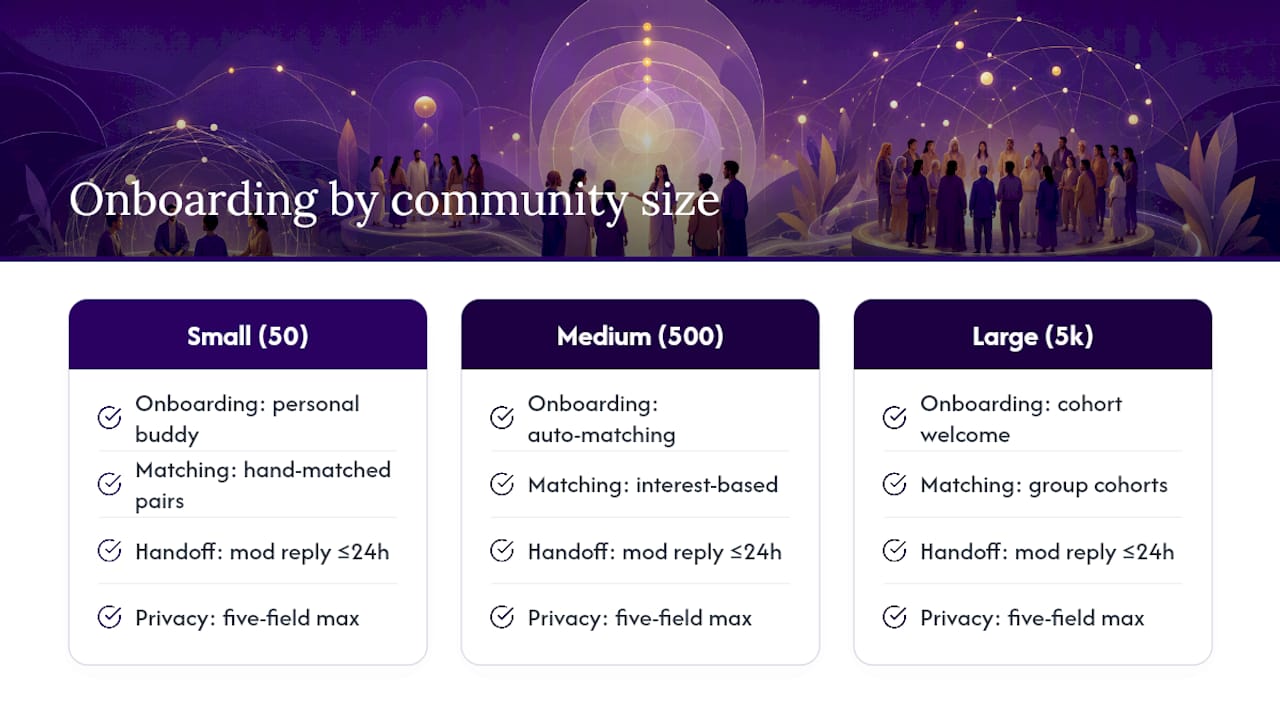
Automation handles timing well. It does not handle a member who replies to a Day 3 nudge with "I'm not sure this is for me." That moment needs a human. Build your onboarding so every automated message has a clear handoff path: if a member replies, a moderator responds within 24 hours.
The other tradeoff is growth versus intimacy. A community of 50 members can run a personal buddy program with hand-matched pairs. At 500 members, you need interest-based auto-matching. At 5,000, you need cohort onboarding with group welcome sessions. Scale the human-touch elements deliberately, not by accident.
For spiritual communities specifically, privacy is not a compliance checkbox. It is a trust signal. Members sharing tarot readings and birth chart data are sharing something personal. Keep the data-minimization note visible in onboarding and never ask for more than the five fields listed in Section 3.
Tarosyn's features map directly to this onboarding playbook
Tarosyn gives you the infrastructure to run this playbook without building it from scratch. The daily horoscope hub is a ready-made first-action destination. The Public Journal is your celebration and reflection space. The Living Public Record gives new members a transparent view of how the platform develops, which builds trust before they share anything personal. Topic pages like the spirituality hub route members to relevant content on Day 0 without requiring you to curate it manually.

AI tarot readings, birth chart tools, and numerology insights are all available as first-action content matched to the member's profile and experience level, so a new member can reach a meaningful moment in under two minutes, regardless of their background. Tarosyn collects only the data needed to personalize that first experience. To set up your onboarding flow, start with Tarosyn and use the checklist in Section 10 as your Day 0 guide.
Primary sources and further reading
- Elevating community onboarding: insights and strategies for 2026 — strategy guide covering AI automation guardrails and human-tone principles
- Optimizing member onboarding: how to reduce friction and strengthen early activation — playbook for minimizing signup friction and prioritizing time-to-value
- Community onboarding checklist for new members — reusable checklist covering orientation, activation, connection, and return path
- #99 How to design an incredible onboarding experience — timing guidance for multi-step email and nudge sequences
- Onboarding patterns (Android developer guidance) — UX patterns for progressive disclosure and permission priming
- Community onboarding strategies — platform-focused guidance on Start Here spaces and pinned starter content
- How to welcome new members in your community — best practices for buddy programs and low-pressure starter activities
- Onboard online community members — practical QA steps including walking the onboarding flow and reviewing member questions
- Tarosyn Living Public Record — transparency log for platform development; useful for trust-building in welcome messages
Sources
- Elevating community onboarding: insights and strategies for 2026
- Optimizing member onboarding: how to reduce friction and strengthen early activation
- Community onboarding checklist for new members
- #99 How to design an incredible onboarding experience
- Onboarding patterns (Android developer guidance)
- Community onboarding strategies
- How to welcome new members in your community: Best practices for 2026
- Onboard online community members