Moon circles provide intentional gatherings that strengthen social belonging, amplify personal reflection, and create collective accountability. Whether you are looking to join one or start your own, understanding what these gatherings do, and why they work, helps you get more from the practice.
- Structured communal reflection and accountability: Moon circles create a recurring, predictable space where participants set intentions, share honestly, and hold each other to personal commitments.
- Ritualized space for self-knowledge and emotional support: Through meditation, journaling, and facilitated dialogue, participants build self-reflexivity and self-determination — capacities researchers link directly to living a fuller life.
Evidence for these functions comes from ethnographic academic research, journalistic reporting, and facilitator testimony gathered across the United States.
Key Takeaways
Moon circles work because they combine regular group ritual with witnessed sharing and public commitment, three mechanisms that consistently strengthen both personal clarity and community belonging.
| Point | Details |
|---|---|
| Core community role | Moon circles reduce isolation by creating a recurring, nonjudgmental space for shared reflection and accountability. |
| Academic support | Ethnographic research links moon circle rituals to self-reflexivity and self-determination as central participant outcomes. |
| Ritual structure matters | A consistent arc (opening, sharing, closing) produces stronger results than informal or unstructured gatherings. |
| Ethics are non-negotiable | Consent, confidentiality, and respectful sourcing of cultural materials protect participants and sustain the group. |
| Tarosyn for logistics | Tarosyn's Cosmic Calendar, ritual prompts, and Community Reflections journal support scheduling and ongoing group practice. |
Table of Contents
- What is a moon circle, and what formats does it take?
- How do moon circles function socially and psychologically?
- What actually happens inside a moon circle?
- What are the real benefits of regular moon circle practice?
- How do you join or start a moon circle?
- Ethics, consent, and cultural sensitivity in moon circle practice
- Practical tools that support moon circle organizers and participants
- An editorial perspective on what moon circles actually do
- Tarosyn supports your moon circle practice
- Sources
What is a moon circle, and what formats does it take?
A moon circle is a group gathering organized around a specific lunar phase and focused on shared intention, reflection, and connection. The format varies widely.
New moon circles center on planting intentions for the cycle ahead. Full moon circles tend toward release, gratitude, and reviewing what has grown or shifted. Some groups run open-format gatherings that blend both energies depending on the season or the group's needs.
Beyond the lunar timing, the activities inside a circle differ just as much. Drumming, humming, and rattling circles use rhythm to move participants out of analytical thinking and into the body. Journaling circles pair quiet writing with group sharing. Hybrid and online gatherings have expanded access considerably, letting participants join from home while still experiencing a structured ritual arc.
Group size runs from three friends in a backyard to thirty or more in a rented community space. Some circles are entirely peer-led; others are guided by a trained facilitator who distributes handouts, leads meditations, and manages the group's pacing. Intergenerational attendance is common, with participants ranging from their twenties to their nineties showing up in the same circle.
How do moon circles function socially and psychologically?
Moon circles act as a direct antidote to modern isolation, giving participants a nonjudgmental space to feel seen, heard, and supported on a regular schedule. That is the core social role. The psychological mechanisms behind it are well-documented.
Three social-science concepts explain why group rituals like moon circles tend to produce bonding and follow-through. Collective effervescence, a term from sociologist Émile Durkheim, describes the heightened sense of unity that emerges when people engage in synchronized activity together. Social facilitation means that performing an intention or sharing a reflection in front of others increases the likelihood of acting on it. Public commitment adds another layer: stating a goal aloud in a group setting raises accountability because others have witnessed it. These mechanisms together explain why moon circles tend to produce stronger follow-through than solo journaling or private intention-setting.
Academic ethnographic research reinforces this. A University of Chicago study found that moon circle rituals, specifically meditation, bodily attunement, and facilitated dialogue, build self-knowledge and self-reflexivity that participants connect to meaningful life change. A separate qualitative study of 15 participants identified five recurring themes from new moon ritual practice, including improved positive mental health, enhanced spiritual connection, and a felt sense of community support. Both studies used small qualitative samples, so the findings are directional rather than conclusive, but they consistently point to benefits of moon circle practices.
What actually happens inside a moon circle?
Most circles follow a recognizable arc: opening, check-in, main activity, and closing. The specific elements vary, but the structure is consistent enough that a newcomer can orient quickly.
Common ritual elements include:
- Grounding or opening meditation (5–10 minutes): settles the group and marks the transition from ordinary time.
- Intention-setting or release work: new moon circles ask participants to name what they want to call in; full moon circles invite release of what no longer serves.
- Sharing and witnessing: each participant speaks briefly while others listen without interruption or advice.
- Journaling: private writing that deepens the reflection before or after group sharing.
- Embodied practice: drumming, humming, or rattling to move beyond purely cognitive processing.
- Optional integrations: tarot pulls, astrology check-ins, or shadow work prompts that tie the circle's theme to a broader symbolic framework.
- Closing ritual: a shared breath, chant, or gratitude round that signals the circle is complete.
Facilitators often distribute printed handouts, archetype imagery, or a cosmic calendar to support meaning-making and give participants something to take home.
| Format | Primary purpose | Common practices | Group tone |
|---|---|---|---|
| New moon circle | Intention-setting, new beginnings | Journaling, visualization, goal-sharing | Quiet, inward, hopeful |
| Full moon circle | Release, gratitude, review | Sharing, burning rituals, movement | Expressive, celebratory |
| Open-format circle | Flexible, community-led | Mixed activities, drumming, tarot | Varied, participant-driven |
What are the real benefits of regular moon circle practice?
The primary benefits reported across research and practitioner accounts are emotional support, increased clarity, personal accountability, and a measurable sense of well-being. These are not incidental. They follow directly from how the circle is structured.
Sharing in a witnessed group setting produces a different quality of reflection than private journaling. When someone speaks an intention aloud and others receive it without judgment, the speaker often gains clarity they did not have before speaking. The group's consistent presence, meeting at the same lunar phase each month, creates a rhythm of accountability that solo practice rarely sustains.
The Journal of Ecopsychology study noted that participants described a sense of transformation and community support as central outcomes, alongside improved mental health. Healing-focused rituals, particularly those that incorporate somatic or emotional work, tend to deepen these effects over time.
How do you join or start a moon circle?
Joining is low-barrier. Starting one is feasible with a few clear facilitation practices in place.
To join an existing circle:
- Search local community boards, yoga studios, wellness centers, or Meetup groups for moon circle gatherings in your area.
- Ask about the format, group size, and any guidelines before attending.
- Arrive with an open intention rather than a specific outcome in mind.
- Expect a structured but flexible agenda, usually 60–90 minutes.
To start your own circle:
- Choose your cadence: new moon, full moon, or both, once a month.
- Set clear group guidelines: confidentiality, no unsolicited advice, consent before touch.
- Create a simple opening ritual (a shared breath or a grounding meditation) and a matching closing.
- Invite 4–12 people to start; smaller groups build trust faster.
- Prepare a short facilitator script and any handouts or prompts you plan to use.
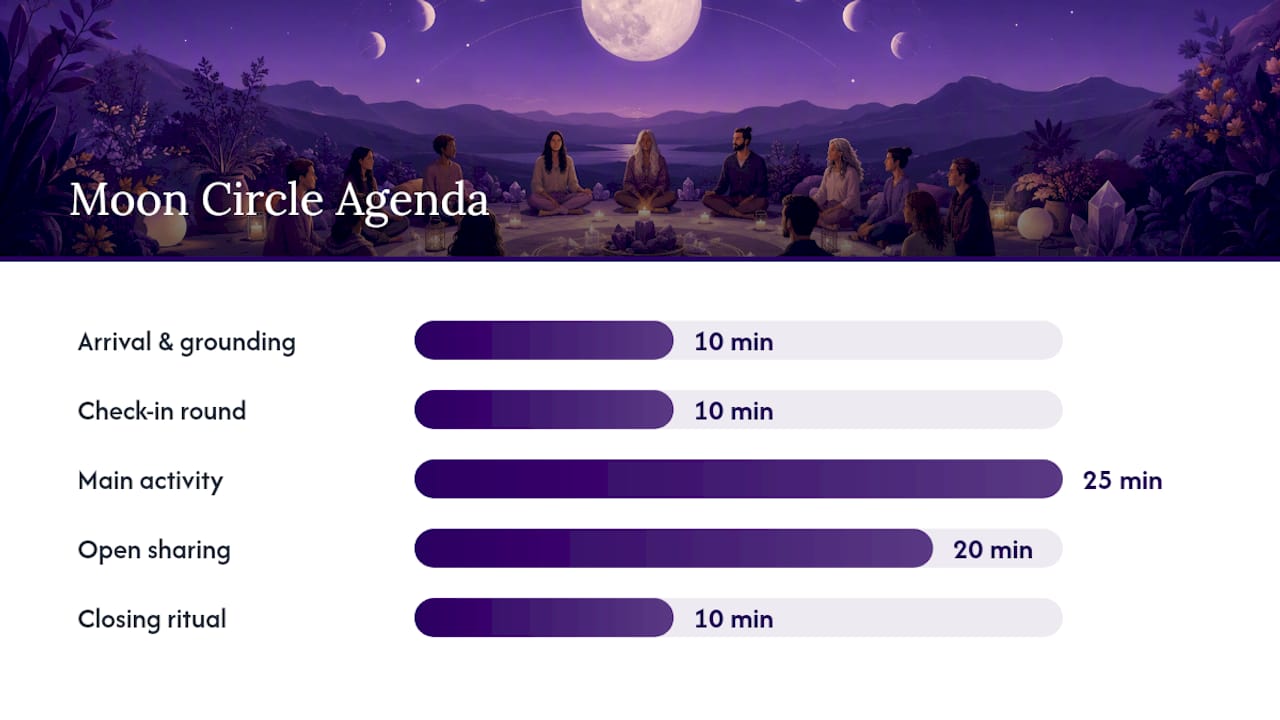
Sample 75-minute agenda:
- 0–10 min: Arrival, grounding meditation
- 10–20 min: Check-in round (one word or one sentence each)
- 20–45 min: Main activity (journaling, sharing, drumming, or tarot pull)
- 45–65 min: Open sharing and witnessing
- 65–75 min: Closing ritual and intention recap
Pro Tip: Rotate the facilitation role among trusted members after the first few months. Shared leadership builds group ownership and prevents burnout in a single organizer.
Ethics, consent, and cultural sensitivity in moon circle practice
The ethical bottom line is this: consent, attribution, and safety are non-negotiable. Everything else is flexible.
Consent and facilitator responsibilities:
- State confidentiality expectations at the start of every gathering.
- Offer trigger warnings before any activity that touches grief, trauma, or loss.
- Make participation in each element optional, never pressured.
- Clarify physical boundaries before any touch-based practice.
Red flags to watch for:
- Facilitators who charge escalating fees for "higher-level" access or secret teachings.
- Groups that discourage members from leaving or questioning practices.
- Cultural symbols or ceremonies presented without attribution or context (for example, using Indigenous ceremonial elements without acknowledgment of their origin).
When incorporating archetypes, goddess imagery, or ceremonial elements from specific cultural traditions, name the source. Respectful sourcing means crediting the tradition, learning from practitioners within it, and not flattening complex cultural practices into aesthetic props. Moon circle traditions draw from many lineages. Honoring that diversity makes the practice stronger, not weaker.
Practical tools that support moon circle organizers and participants
The most useful tools for running a consistent circle are a lunar calendar, a set of repeatable ritual prompts, and a shared space for ongoing reflection between gatherings.
- Cosmic Calendar: Tarosyn's Cosmic Calendar lets organizers track lunar phases and schedule gatherings around new and full moons without manual research.
- Ritual prompts and tarot integrations: Tarosyn's tarot and astrology content gives facilitators ready-made thematic prompts tied to current planetary energy, useful for opening discussions or journaling exercises.
- Community journaling: The Community Reflections journal gives participants a shared digital space to post reflections between meetings, keeping the circle's energy alive outside the monthly gathering.
A practical workflow: publish a private event note in the community journal before each circle with the lunar theme and one or two prompts. After the gathering, invite participants to post a single reflection or intention. This creates a living archive of the group's growth over time.
An editorial perspective on what moon circles actually do
Moon circles tend to get framed as a wellness trend. That framing undersells them. The social-psychological mechanisms at work, collective effervescence, public commitment, witnessed sharing, are the same ones that make any consistent group ritual effective. The lunar timing is a scheduling anchor as much as a spiritual one. What makes a circle work is not the moon. It is the regularity, the structure, and the quality of attention people bring to each other. Groups that meet consistently, hold clear agreements, and rotate leadership tend to produce the strongest outcomes. The ones that drift, skip months, or rely entirely on a single charismatic facilitator tend to dissolve. The moon gives you a reason to show up. The group gives you a reason to come back.
Tarosyn supports your moon circle practice
Tarosyn gives moon circle organizers and participants a single place to handle scheduling, ritual content, and shared reflection. Instead of managing a lunar calendar, a prompt library, and a group journal across separate tools, you get them in one place.
Use the Cosmic Calendar to plan your next new or full moon gathering. Pull a custom tarot reading to anchor your circle's theme. Share reflections in the Community Reflections journal so your group stays connected between meetings. Start with a free account at Tarosyn and see which features fit your circle's rhythm.
Sources
- Why the Moon Circle is Making a Resurgence
- Journal of Ecopsychology, Volume 6 Article 3 (Moon rituals ethnographic study)
- Moon Manifestation: Ritual, Placebo, or Circadian Science? What 40,000 Years of Lunar Practice Actually Does to Your Brain | Vibrae
- Drum, hum and rattle at a South Burlington moon circle