Tarot symbols are not decoration. They are the language the cards use to speak. The role of symbolism in tarot cards is to carry meaning that words alone cannot hold, connecting you to patterns in your own life through image, color, number, and archetype. Each card is a compressed story. When you learn to read the symbols, you stop guessing at meanings and start having a real conversation with the cards.
Tarot functions as a self-organized system of signs, blending word and image to decode messages from the collective unconscious. Sociocultural semiotic research confirms this: the pictures on tarot cards operate according to what Carl Jung called the "symbolic language of the collective unconscious," where images carry psychological weight that bypasses rational thought. That is why a single glance at the Tower card can feel immediately charged, even before you know its formal meaning.
Here is what tarot symbolism actually does for you:
- It gives abstract psychological states a visible form you can work with
- It connects personal experience to universal patterns, so your situation feels less isolated
- It allows past, present, and possible futures to appear in one spread as a narrative
- It activates intuition by engaging the visual and emotional brain, not just the analytical one
- Major Arcana archetypes anchor the whole system, giving each reading a psychological backbone
1. What are the key archetypes in the Major Arcana?
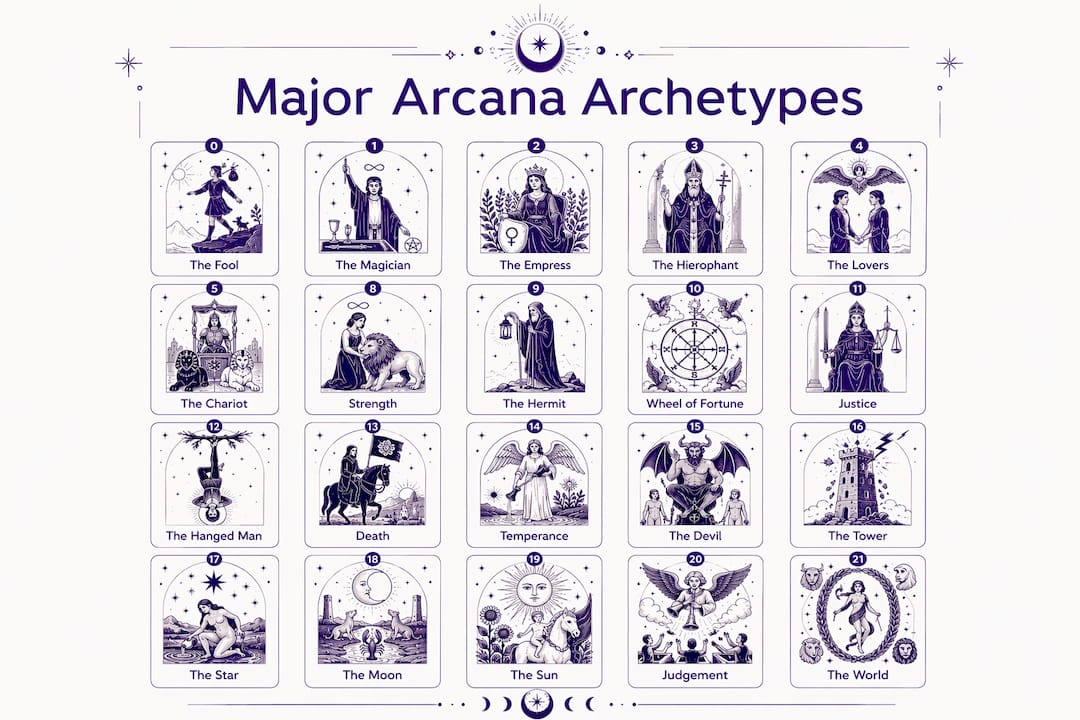
The 22 Major Arcana cards embody Jungian archetypes: universal, inherited psychological patterns that every human carries. These are not characters in a story. They are forces. The Fool, The Empress, The Devil, The Hermit, and The World each give a face to something that lives in the collective psyche.
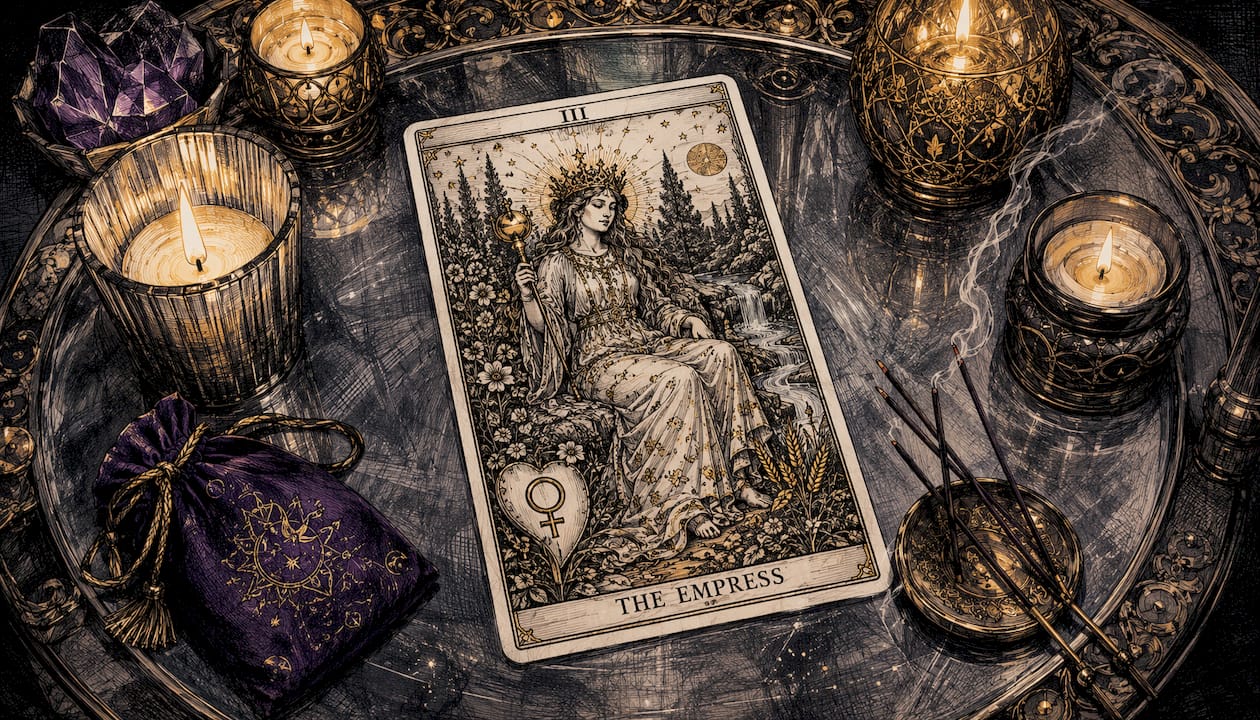
Jung mapped these patterns to specific psychological structures. The Empress carries the Great Mother archetype: nurturing, fertile, creative. The Devil holds the Shadow, the repressed and unlived parts of the self. The Hermit embodies the Wise Elder. The World represents the Self, the goal of psychological wholeness. These correspondences are starting points, not fixed rules, since a single card can express multiple archetypes depending on context.
A useful way to think about archetypes is as psychic weather systems. Major Arcana forces move through your life whether you invite them or not. Minor Arcana cards, by contrast, reflect your daily personal responses to those larger forces. When The Tower appears, you are not causing that energy. You are inside it.
The Fool's Journey through all 22 cards parallels Jung's individuation process: the ego's development from naive beginner to integrated Self. Act I (cards I through VII) builds the ego. Act II (VIII through XIV) confronts the unconscious. Act III (XV through XXI) integrates shadow, suffering, and renewal. The World card at position 21 is not an ending. It is a completed cycle, ready to begin again at a deeper level.
One caution worth taking seriously: archetypal inflation. Jung warned that identifying with an archetype rather than relating to it is a genuine psychological risk. Saying "I am the Wise One" instead of "I am experiencing wisdom" is the difference. The Fool, who begins the Major Arcana carrying nothing and claiming nothing, is actually the model for healthy engagement with these forces.
Pro Tip: When a Major Arcana card appears in your reading, ask yourself which archetype it represents and how that force is moving through your life right now, without claiming it as your identity. That small shift keeps the reading grounded and useful.
- The Empress: Great Mother archetype, creativity and abundance
- The Devil: Shadow archetype, bondage to unconscious patterns
- The Hermit: Wise Elder archetype, solitude and inner guidance
- The High Priestess: Anima archetype, mystery and receptivity
- The World: The Self archetype, wholeness and integration
You can explore these tarot archetypes in more depth to see how each card maps to its psychological pattern.
2. How did tarot symbolism develop over time?
Tarot did not begin as a spiritual tool. The Victoria and Albert Museum's research traces tarot's origins to Renaissance Europe, where the cards were used for a trick-taking game played by Italian nobles. The imagery was recognizable to those players: classical mythology, aristocratic heraldry, and figures from carnival processions. The Visconti-Sforza deck, commissioned in 15th-century Milan, is among the earliest known examples.
The four suits (cups, swords, coins, and wands) were not invented by tarot. Historical cartomancy records show that Italian card games used these Latin suits for at least 70 years before the first tarocchi deck appeared. Tarot inherited them and built the 22 Major Arcana on top of that existing structure.
The shift toward divination came in the late 18th century. Etteilla, born Jean-Baptiste Alliette, created the first deck designed specifically for fortune-telling in the 1770s. By the 1780s, writers were claiming Egyptian origins for tarot, a theory that remains unproven but proved influential. In 1861, French occultist Eliphas Levi published work that integrated numerology and Kabbalah into tarot design, transforming it from a parlor game into a serious esoteric system. Levi also introduced the terms "Major Arcana" and "Minor Arcana."
The Rider-Waite-Smith deck, published in 1909, changed everything. It was the first deck to fully illustrate the Minor Arcana cards, making intuitive reading accessible to anyone. Pamela Colman Smith's artwork, created under Arthur Edward Waite's direction, established a visual vocabulary that most modern decks still use.
- Renaissance origins: playing cards with aristocratic and folklore imagery
- 18th century: Etteilla introduces dedicated divination decks
- 19th century: Eliphas Levi adds Kabbalah, numerology, and occult structure
- 1909: Rider-Waite-Smith deck sets the modern visual standard
- Today: artists and designers continue to reinterpret the symbolic language
3. How do you interpret tarot symbolism in personal readings?
Start with the suits. The role of suits in a tarot deck is to give every Minor Arcana card an elemental context before you read its specific meaning. Cups (water) point to emotion, relationships, and intuition. Swords (air) address thought, communication, and conflict. Wands (fire) carry passion, drive, and creative energy. Pentacles (earth) cover material life: work, money, health, and stability.
When one suit dominates a spread, that tells you where the energy is concentrated. A reading full of Swords calls you to examine your thinking patterns. Heavy Cups energy asks whether your emotions are flowing or stuck. You do not need to memorize 56 card meanings if you first understand what terrain each suit covers.
Reading a spread as a whole narrative is where symbolism really opens up. Each card's symbols interact with the cards around it. Water imagery in one card and fire imagery in the next creates visible tension. A figure facing away from the rest of the spread suggests avoidance. Recurring colors, numbers, or motifs across multiple cards point to the reading's central theme. For practical guidance on tarot and self-reflection, this narrative approach consistently surfaces more useful insight than reading cards in isolation.
The same caution about archetypal inflation applies here. If The Emperor appears and you immediately think "that's me," pause. Ask instead: where is structured authority showing up in your life right now? Relating to the symbol rather than claiming it keeps your reading clear. Resources on tarot and intuition consistently point to this conscious, observational stance as the foundation of accurate reading.
Pro Tip: Before interpreting individual cards, scan the full spread for suit distribution and recurring visual motifs. That overview often reveals the reading's core message faster than analyzing each card separately.
- Cups: ask whether your emotional life is open or guarded
- Swords: examine which thoughts are serving you and which are not
- Wands: check where your energy is going and whether it is focused
- Pentacles: assess what you are building and whether it is sustainable
4. What does symbolism actually mean in tarot?
Symbolism in tarot is the system by which images carry meaning beyond their literal appearance. A tower struck by lightning is not just a building on fire. It is a compressed statement about sudden disruption, the collapse of false structures, and the release of suppressed energy. The visual semiotics of tarot operate through this kind of layered encoding, where each image functions simultaneously as a cultural reference, a psychological trigger, and a personal mirror.
Color, number, posture, and background all carry symbolic weight. The High Priestess sits between two pillars, one black and one white, signaling the threshold between conscious and unconscious. The Star pours water from two vessels, one onto land and one into a pool, representing the balance between practical action and inner renewal. These details are not arbitrary. They were placed deliberately, and reading them gives you access to the card's full meaning.
Symbolism also makes tarot culturally adaptable. The Rider-Waite-Smith deck drew on Western esoteric traditions, but the underlying archetypal patterns it encodes appear across cultures. Different decks use different imagery to express the same psychological structures. A Death card in one deck shows a skeleton; in another, it shows a chrysalis. The symbol changes. The archetype does not.
Tarosyn brings tarot symbolism to life for you
Tarot's symbolic depth is real, and working through it alone takes time. Tarosyn gives you a faster path. As an AI-powered spiritual platform, Tarosyn analyzes the archetypal and elemental symbolism in your specific cards and translates it into personal insight you can actually use.
You can start with a structured reading like The World in a Three Card Spread, which applies Major Arcana symbolism directly to your current situation. Or explore suit-specific readings like the Queen of Swords to see how Swords symbolism plays out in a real spread. Tarosyn's community journal lets you share what you notice and learn from others working through the same symbols. The platform connects archetypal meaning to your lived experience, so the cards stop feeling abstract and start feeling relevant.
Key Takeaways
Tarot symbolism functions as a visual language that connects personal experience to universal psychological patterns, making every reading a structured conversation with your own unconscious.
| Point | Details |
|---|---|
| Symbols are the core language | Each tarot image encodes meaning through color, number, posture, and archetype, not just its surface picture. |
| Major Arcana carry archetypes | The 22 Major Arcana embody Jungian patterns like the Shadow, the Great Mother, and the Self. |
| Suits frame every reading | Cups, Swords, Wands, and Pentacles each cover a distinct domain: emotion, thought, action, and material life. |
| History shaped the symbols | Tarot imagery evolved from Renaissance card games through 19th-century occultism into the modern visual standard set by the Rider-Waite-Smith deck in 1909. |
| Tarosyn applies this for you | Tarosyn's AI-powered platform connects archetypal symbolism to your personal readings for direct, practical insight. |