
Tarot is defined as a projective psychological tool that helps you organize complex emotions into coherent personal narratives. The role of tarot in self-reflection is not to predict outcomes. It is to surface what you already know but have not yet examined clearly. Rooted in modern narrative therapy and metacognitive science, tarot gives you a structured way to externalize inner conflicts, name difficult feelings, and rewrite the stories you tell about yourself. This guide explains how that process works, which practices make it most effective, and how to build a consistent habit that supports real personal growth.
How does tarot facilitate self-reflection from a psychological perspective?
Tarot functions as a structured self-examination technology that uses symbolic imagery and forced-choice constraints to bypass your habitual mental patterns. This method has persisted for over 500 years and is now supported by modern psychology. The reason it works is not mystical. It is cognitive.
When you draw a card, you project your current emotional state onto its imagery. That projection creates distance between you and the feeling. Distance produces objectivity. Objectivity makes it easier to examine what is actually happening inside you rather than what you assume is happening.
Three psychological mechanisms drive this process:
- Projection and externalization. Tarot cards serve as a mirror, not a map. They reflect unresolved conflicts and hidden patterns back to you in symbolic form, making them easier to examine without defensiveness.
- Disruption of autopilot thinking. The randomness of card selection is key. It introduces unpredictability that breaks your habitual narrative and forces you to recognize patterns you have been overlooking.
- Metacognition. Tarot interrupts autopilot thinking and turns vague self-awareness into action-oriented self-knowledge. You stop reacting and start observing your own thought process.
Tarot also engages symbolic cognition, the same mental process active in dream interpretation and narrative therapy. You are not reading a card for its literal meaning. You are using it as a prompt to construct a story about your inner life. That story becomes the material for reflection.
Pro Tip: Before you interpret a card's traditional meaning, spend 60 seconds writing down your immediate emotional reaction to its imagery. That first response is often more revealing than any guidebook definition.
What are common tarot spreads and journaling practices for self-reflection?
The format of your reading determines how much insight you extract. A single-card pull gives you a daily focus point. A structured spread gives you a framework for examining a specific situation from multiple angles. Both serve different purposes, and knowing which to use matters.
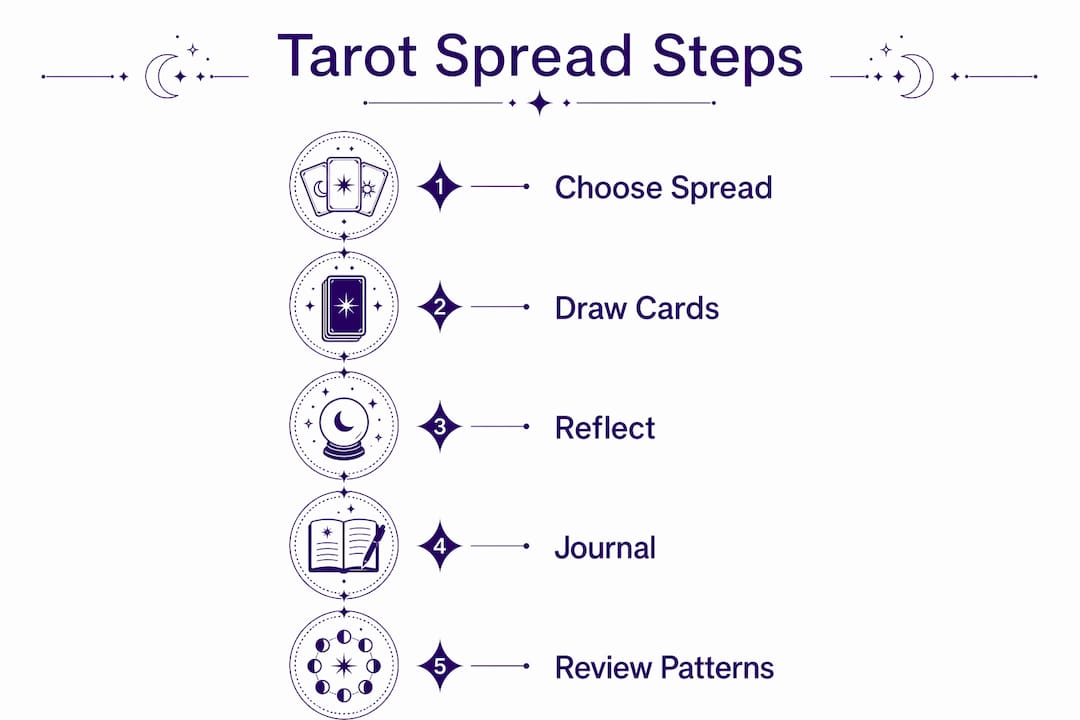
Structured spreads with defined card positions prevent self-deceptive narratives and direct your attention toward unconscious aspects that need examination. Without structure, you tend to cherry-pick meanings that confirm what you already believe.
Three spreads work particularly well for self-reflection:
- Three-card mind-body-spirit spread. Each position targets a distinct layer of your experience: what you are thinking, what you are feeling physically, and what your deeper values are signaling. This spread is fast and effective for daily check-ins.
- Shadow work spread. Positions are labeled for your conscious self, your hidden self, what you fear, and what you need to integrate. This format is designed specifically for tarot cards for self-discovery at a deeper level.
- Ten-card self-portrait spread. Covers present circumstances, subconscious influences, past patterns, future possibilities, and your own agency within the situation. Use this monthly rather than daily.
Journaling after a reading is where the real processing happens. Two techniques are most effective:
- Immediate capture. Write for five minutes right after drawing your cards, before you consult any reference material. Record what you noticed, what surprised you, and what you wanted to avoid looking at.
- Card dialogue. Write a short conversation between yourself and the card as if it were a character. Ask it a direct question and write whatever response comes. This technique engages narrative construction and often surfaces emotions that standard journaling misses.
Pro Tip: Date every journal entry and note which spread you used. Reviewing three months of entries reveals recurring themes that single readings cannot show you.
Is tarot a mirror or a map? Clarifying the most common misconception
Tarot cards reflect your internal state. They do not prescribe a fixed outcome. This distinction is the most important one to understand before you build any self-reflective practice around tarot.
The misconception that tarot tells you what will happen creates three specific problems:
- Confirmation bias. When you approach a reading hoping for a specific answer, you interpret every card to support that answer. The reading stops being reflective and becomes a rationalization exercise.
- Reassurance seeking. Repeated reassurance-seeking from tarot readings increases anxiety and undermines your confidence over time. Healthy tarot use focuses on reflective learning, not dependency.
- Loss of agency. Treating cards as instructions removes you from the decision-making process. You stop being the author of your story and start waiting for permission to act.
Tarot used well is a conversation with yourself, not a message from an external authority. The card draws your attention to something. What you do with that attention is entirely your choice.
Tarot practice encourages presence and inner listening, helping you tolerate ambiguity rather than demand immediate answers. That tolerance is itself a form of emotional growth. Sitting with an uncomfortable card without rushing to resolve its meaning builds the same capacity as sitting with an uncomfortable feeling in real life.
The most productive framing is this: ask what the card reveals about your current thinking, not what it predicts about your future circumstances.
How to integrate tarot into a personal growth routine
A tarot practice that supports sustained personal growth requires intention, structure, and clear limits. Without those three elements, readings become either a daily ritual with no depth or an anxious habit that generates more confusion than clarity.
Start by changing the questions you bring to your readings. Predictive questions ("Will this work out?") produce vague, anxiety-driven interpretations. Reflective questions produce usable insight. Effective prompts include:
- "What am I avoiding thinking about right now?"
- "What belief is shaping my behavior in this situation?"
- "What would I do if I trusted myself more fully here?"
- "What pattern keeps showing up, and what does it cost me?"
A 2024 study by Krow et al. demonstrated that tarot combined with mindfulness journaling produces measurable improvements in psychological well-being and internal locus of control. Internal locus of control means you believe your actions shape your outcomes. That belief is foundational to personal growth.
Frequency matters. Daily single-card pulls build familiarity with symbolic language. Weekly three-card spreads provide enough structure for meaningful reflection without creating dependency. Monthly deep spreads, like the ten-card self-portrait, track longer-term patterns. Avoid reading multiple times on the same question in a single day. That behavior signals reassurance-seeking, not reflection.

Combining tarot with mindfulness practices strengthens both. The ritual of shuffling and drawing cards creates a meditative pause that disrupts autopilot cognitive patterns and surfaces suppressed emotions. Treat that pause as intentional. Breathe before you draw. Set a clear intention. Those 30 seconds of preparation change the quality of what follows.
Tarot is a complementary tool. It works alongside therapy, coaching, and other reflective practices. It does not replace professional support when you are dealing with serious mental health challenges, grief, or trauma.
Pro Tip: Keep a "recurring cards" list in your journal. When the same card appears three or more times in a month, treat it as a signal worth examining in depth, not a coincidence.
| Reflection prompt type | Example question |
|---|---|
| Avoidance | "What am I not letting myself think about?" |
| Belief mapping | "What assumption is driving my behavior here?" |
| Pattern recognition | "What keeps repeating, and what does it protect me from?" |
| Agency building | "What would I do if I already trusted my instincts?" |
| Emotional clarity | "What feeling have I been labeling incorrectly?" |
Key Takeaways
Tarot works as a self-reflection tool because it externalizes your inner experience through symbolic imagery, structured spreads, and intentional questioning, giving you the distance needed to see your own patterns clearly.
| Point | Details |
|---|---|
| Tarot is projective, not predictive | Cards reflect your internal state, not fixed future outcomes. |
| Structure prevents bias | Defined spread positions stop you from cherry-picking comfortable meanings. |
| Reflective questions matter | Ask what you are avoiding or believing, not what will happen. |
| Journaling deepens insight | Writing immediately after a reading captures raw, unfiltered self-knowledge. |
| Consistency builds precision | Regular practice helps you spot recurring patterns and defense mechanisms over time. |
What I have learned from watching people use tarot honestly
The readers who get the most from tarot are not the ones who know the most card meanings. They are the ones willing to sit with a card that makes them uncomfortable and ask why it landed that way.
The most common mistake I see is using tarot to feel better rather than to see more clearly. Those are different goals, and they produce different habits. Feeling better is fine. But if every reading ends with reassurance and no new self-knowledge, the practice is not working. You are using a mirror to apply makeup instead of to check whether something is wrong.
The second mistake is treating an uncomfortable card as bad news. The Tower, the Five of Cups, the Ten of Swords: these cards are not punishments. They are invitations to look at something you have been avoiding. The readers who approach those cards with curiosity rather than dread consistently report the most useful insights.
Patience is the underrated skill in tarot practice. A reading that confuses you today often makes complete sense in two weeks. That delay is not a failure of the tool. It is the tool working correctly, surfacing something that needed time to become visible.
The tarot archetypes embedded in the 78-card system represent universal human experiences. You are not reading about the future. You are reading about yourself, right now, through a symbolic language that has been refined over centuries. Treat it that way and it will serve you well.
— Joseph
Tarosyn's tools for building a self-reflective tarot practice
Tarosyn brings together AI-guided tarot readings, structured spreads, and a community of readers focused on personal growth, all in one place.

Start with the three-card spread to get a clear, structured reading you can journal around immediately. Tarosyn's AI prompts guide you through each card position with reflective questions designed to move you past surface-level interpretation. The platform also connects you with tarot insights and reflections shared by other readers, so your practice stays grounded in real experience rather than theory. If you want to go deeper, Tarosyn's personal growth topic feed curates readings and prompts specifically for self-discovery and emotional clarity.
FAQ
What is the role of tarot in self-reflection?
Tarot serves as a projective tool that externalizes your inner conflicts and emotions through symbolic imagery, making them easier to examine objectively. It is aligned with narrative therapy and helps you move from feeling stuck to understanding your own story more clearly.
Can tarot replace therapy or professional mental health support?
Tarot is a complementary reflective practice, not a substitute for professional therapy or mental health care. Use it alongside other support systems, not instead of them.
How often should you use tarot for self-reflection?
Daily single-card pulls build symbolic familiarity, while weekly three-card spreads provide structured reflection without creating dependency. Avoid re-reading the same question multiple times in one day.
What makes a tarot question effective for self-discovery?
Reflective questions focused on beliefs, patterns, and avoidance produce more insight than predictive questions about outcomes. Ask "What am I not seeing?" rather than "What will happen?"
Why do structured tarot spreads work better than free-form readings?
Defined card positions direct your attention to specific aspects of a situation and prevent confirmation bias. Without structure, you tend to interpret cards in ways that confirm what you already believe rather than revealing what you have missed.