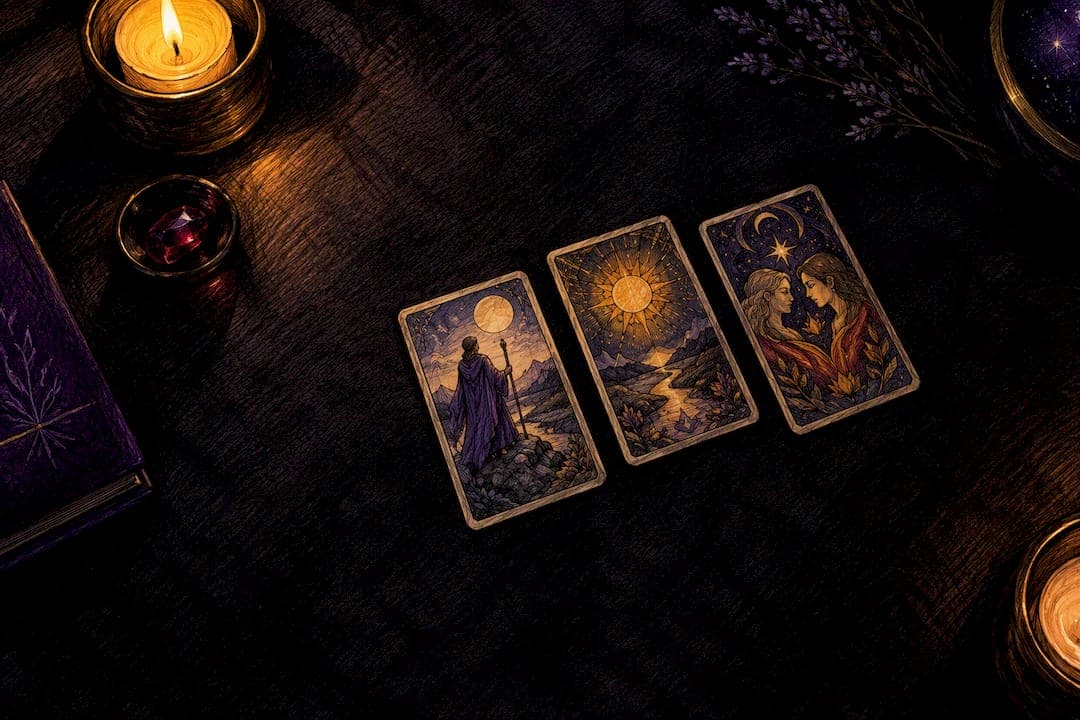
A three card spread is a tarot layout that uses three cards to answer one question quickly. It works for a daily check-in, a fast decision, or a journaling prompt. The most common version follows past, present, and future, but other layouts work just as well for focused insight.
TL;DR:
- Most tarot readings benefit from a specific, clear question rather than vague or general inquiries to yield meaningful insights.
- Using a three card layout for weekly planning or decision-making provides quick, focused guidance tailored to narrow questions.
- Connecting the three cards with cause-and-effect relationships helps build coherent stories instead of viewing each card in isolation.
- Keep a log of your readings with dates and questions to recognize recurring themes and improve accuracy over time.
- Ethical guidelines advise obtaining consent and framing tarot as reflective rather than predictive, especially when reading for others.
Table of Contents
- What a three card spread is and when to use it
- Common three card layouts with sample questions
- How to shuffle, place, and read three cards
- Reading ethics and boundaries
- Practice tips to sharpen your three card readings
- Making three card spreads part of a regular practice
- Try guided three card readings with Tarosyn
- Sources
- FAQ
What a three card spread is and when to use it
Tarot dates back to 14th-century Italy, where early decks held 22 major arcana cards and 56 minor cards. Three-card spreads became popular later as a simple way to work with a full deck without needing ten or more positions. Three cards give you enough structure to build a story, but not so much that the reading becomes confusing.
Use a three card spread when you want:
- A quick answer to a single, clear question
- A daily card pull to set an intention or reflect on the day
- A fast way to journal about a decision without overthinking it
Save larger spreads, like the Celtic Cross or horseshoe spread, for questions with more layers. Three cards work best when the question is narrow and the answer needs to come fast.
Common three card layouts with sample questions
Pick a layout based on what you want to know. Each one arranges the same three cards in a different order, which changes the story you build.
- Past, present, future. Ask something like "What led me here, and where am I headed?" A reversed card in the past position might point to an old pattern resurfacing, while the future card shows where that pattern leads if nothing changes.
- Situation, obstacle, advice. Ask "What am I facing, and what should I do?" This layout is recommended by tarot practitioners because it points toward action instead of passive forecasting. Read the first card as the setup, the second as what's in the way, and the third as the move to make.
- Mind, body, spirit. Ask "How am I doing, right now, on every level?" This layout works well for a general check-in rather than a specific question. Read each card on its own, then look for a shared theme across all three.
Smaller variations work too. A relationship-focused version might use you, them, and the connection between you. A week-ahead version could use early week, midweek, and late week. A decision-clarifying version might use option A, option B, and the deciding factor. Each variation keeps the three-card format but reshapes the question to fit what you actually want to know.
How to shuffle, place, and read three cards
Start with intention, not the cards. Word your question clearly before you touch the deck.
- Set your intention. Say your question out loud or write it down. A specific question gets a more useful answer than a vague one.
- Shuffle and decide on reversals. Shuffle until it feels done, then decide ahead of time whether you'll read upside-down cards as reversed or turn them upright. Reversed cards often signal a blocked, delayed, or internal version of the card's usual meaning.
- Lay out the three cards in your chosen positions, left to right.
- Read the connections, not just the cards. The middle card usually acts as the pivot between the first and third. Link the three with words like "because," "but," or "unless" to turn three separate images into one narrative.
- Test the reading. Write down your first impression, then check back in a day or two to see if it held up.
Pro Tip: Read the middle card last. It only makes sense once you know what comes before and after it.
Reading ethics and boundaries
Tarot works best when both people in the room, or just you and yourself, agree on what's happening.
- Ask for consent before reading for someone else, even casually.
- Avoid reading about a third party who isn't present. Reframe the question to focus on the seeker's own choices instead.
- Respect that some religious traditions reject divination outright, including horoscopes and similar practices. Don't push a reading on someone who holds that view.
- Frame the reading as reflection, not prophecy. It's a prompt for thinking, not a guaranteed outcome.
Practice tips to sharpen your three card readings
New readers often name each card in isolation. "Past: The Tower. Present: The Star. Future: The Sun." That's a list, not a story.
- Connect the cards with cause and effect instead of reading them one by one.
- Try timed readings: give yourself two minutes to build a full sentence from all three cards.
- Swap the position order occasionally to see how the same three cards read differently in a new layout.
- Add a fourth clarifier card when a reading feels stuck between two meanings.
Keep a simple log of your draws. Note the date, the question, the cards, and your first read. Check back in 48 hours to see what actually happened, which turns vague impressions into a record you can learn from.
Pro Tip: Review your reading log once a month. Patterns show up faster than you'd expect.

Making three card spreads part of a regular practice
A daily draw, five minutes of journaling, and a monthly review of your log will teach you more than any single dramatic reading. Three-card spreads also pair well with a birth chart or numerology reading, since a planetary transit or life-path number can add context to a card that feels ambiguous on its own. Saving readings over time, through an app like Tarosyn's example readings, makes it easier to spot which interpretations actually held up.
— Joseph Calitoy
Try guided three card readings with Tarosyn
There are apps that let you run three card spreads without starting from a blank deck every time. Some build on your history, so a reading you save today can connect to additional insights you added previously.

- Guided readings that walk through each of the three positions
- Saved reading history so you can track patterns instead of relying on memory
- Journaling tools built into each reading for follow-up notes
You can browse public three card readings to see how others frame their questions, or start your own. The Annual circle and Mystic monthly plans are available for subscription, with pricing detailed on the publisher's site. Start a reading and save it to your own history at Tarosyn.
Sources
This guide draws on tarot ethics guides, spread references, and a Pew-based study on tarot use. For more on reflective practice, see this guide to tarot and self-reflection.
FAQ
What is a good 3-card tarot spread for the week?
An early week, midweek, and late week layout works well for a week-ahead reading. Ask what energy or challenge shows up in each stretch of the week, then read the three cards as a single arc rather than three separate days.
Why does God forbid tarot?
The Catechism of the Catholic Church states that divination practices, including consulting horoscopes and similar methods, are to be rejected. This reflects a specific religious teaching rather than a universal rule, so views on tarot vary by faith and individual belief.
What is the best tarot card spread?
There isn't one best spread since the right choice depends on your question. A situation, obstacle, advice layout is often recommended for action-oriented questions, while past, present, future suits general reflection.
When should you not do a tarot reading?
Avoid a reading when you don't have consent to read for someone else, since ethical guidance recommends getting explicit permission or reframing the question to focus on your own perspective. Also skip a reading if you're looking for a guaranteed outcome rather than a reflective prompt.