
Community wellbeing means the collective spiritual and emotional health of a group: felt as belonging, mutual support, shared rituals, and energetic harmony among its members. A multi-site field study from Oxford and Coventry found that ritual participation raised social bonding scores by roughly 5.4% and positive affect by 13.1%. Apps like Tarosyn build entire community features around that finding, giving groups a shared space for tarot, journaling, and ritual.
You can spot a wellbeing-rich community in three signals:
- Belonging. Members feel recognized and welcomed, not just tolerated.
- Ritual practice. The group returns to shared rites, readings, or ceremonies on a rhythm.
- Mutual support. People show up for each other outside of scheduled events, not only during them.
Pro Tip: If you can name one ritual your group repeats every week, you already have the seed of strong community wellbeing. Build outward from that.
Key Takeaways
Community wellbeing forms when a group combines belonging, mutual support, and repeated shared ritual, a pattern peer-reviewed field research links directly to measurable bonding.
| Point | Details |
|---|---|
| Definition in one line | Community wellbeing is the collective spiritual and emotional health of a group. |
| Ritual drives bonding | Ritual participation increased social bonding by 5.4% and positive affect by 13.1% in field research. |
| Six attributes to build | Belonging, shared ritual, reciprocity, clear leadership, reflection, and inclusivity sustain healthy groups. |
| Measure it simply | A four-question monthly pulse survey tracks connection, support, and growth over time. |
| Watch for red flags | Power hoarding and spiritual bypassing signal a group needs shared governance, not a hero leader. |
| Platforms support, don't replace, ritual | Tarosyn's journal and saved-reading features help groups practice consistently between live gatherings. |
Table of Contents
- What Does Community Wellbeing Mean in Everyday Practice?
- Why Do Rituals Build Community Wellbeing?
- What Attributes Should a Spiritual Community Cultivate?
- What Are the Signs a Spiritual Community Is Thriving?
- How Do You Run a Ritual That Builds Belonging?
- How Can You Measure Community Wellbeing?
- What Are Common Pitfalls in Spiritual Communities?
- How Do Online Platforms Support Community Wellbeing?
- What I've Noticed About Ritual and Belonging
- A Simple Way to Practice What You've Read
- Frequently Asked Questions
- Sources
What Does Community Wellbeing Mean in Everyday Practice?
Each piece of the definition shows up in ordinary moments, not grand gestures. Belonging is a member being missed when they skip a session. Mutual support is someone offering a birth chart reading to a friend going through a hard month. Shared rituals are the repeated practices, a tarot pull, a full moon circle, a Sunday check-in, that give the group its rhythm. Energetic harmony is the felt sense that a session left everyone lighter than it found them.
Online, this looks like:
- A live group ritual streamed at a set time each week.
- Members posting reflections in a shared journal after a reading.
- Direct messages that go beyond small talk into real support.
In person, it looks like a seated circle, a shared altar, or a potluck after a moon ceremony. Traditions vary, so healthy communities adapt their language and symbols rather than demanding one orthodoxy. A Tarosyn blog post on astrology and shared identity explores how a common symbolic language, sun signs, tarot archetypes, numerology, gives diverse members something to organize around without erasing individual belief.
Why Do Rituals Build Community Wellbeing?
The bonding effect of ritual isn't folklore. Oxford and Coventry researchers tracked participants across multiple religious ritual sites and measured a 5.4% increase in social bonding and a 13.1% increase in positive affect following participation. The same study found that increases in pain threshold, a proxy for mu-opioid activity in the brain, predicted how strongly people bonded afterward.
Synchronized movement, shared attention, and even mild physical discomfort during ritual activate biological systems tied to trust and attachment. This is why a group chant or synchronized breathing exercise can create closeness that a casual conversation rarely does.
The mechanism has a name in social psychology: collective effervescence, the heightened emotional state that emerges when people move, speak, or focus together. Shared intentionality, everyone aiming at the same symbolic goal, amplifies it further.
You don't need a formal religious structure to get this effect. Research on secular rituals like Sunday Assemblies found bonding increases comparable to religious settings, and the change in positive affect predicted the bonding boost. Anthropological analysis backs this up: rituals recruit the same neurochemical bonding pathways whether the framework is Wiccan, Christian, secular, or entirely personal. The implication for tarot and astrology circles is direct. The specific tradition matters less than the consistency and structure of the practice itself.
What Attributes Should a Spiritual Community Cultivate?
Six attributes show up again and again in communities that sustain wellbeing over years, not just weeks:
- Belonging and safety. People need to feel physically and emotionally secure before they open up. Pro Tip: Name your community's unspoken agreements out loud. Silence around expectations breeds anxiety, not safety.
- Shared ritual or practice. A repeated rhythm, weekly readings, monthly moon circles, gives members something to anchor to.
- Reciprocity and mutual support. Giving and receiving support should flow in both directions, not just from leader to member.
- Clear boundaries and leadership. Healthy groups name who holds what role and what happens when conflict arises.
- Reflective practice. Journaling or discussion time after ritual turns raw experience into lasting insight.
- Inclusivity. Newcomers and different traditions should find room to participate without abandoning their own beliefs.
Ritual is what holds these attributes together. A one-time workshop builds excitement; a repeated practice builds identity. Community-development research on purpose, place, and relation makes the same point: durable wellbeing comes from consistent, low-barrier gathering spaces, not one-off events.
What Are the Signs a Spiritual Community Is Thriving?
A thriving group shows patterns you can observe within a few sessions, not just claims it makes about itself:
- Consistent attendance at shared rituals, not just spikes around holidays.
- Members supporting each other outside official events, texting, checking in, sharing resources.
- Open questioning is welcomed rather than treated as disloyalty.
- Transparent handling of donations, fees, or requests for money.
- Visible onboarding so newcomers know how to participate within their first visit.
Busy calendars and large member counts can mask a group that's actually struggling. Watch behavior between events, not just attendance numbers, for the real signal.
How Do You Run a Ritual That Builds Belonging?
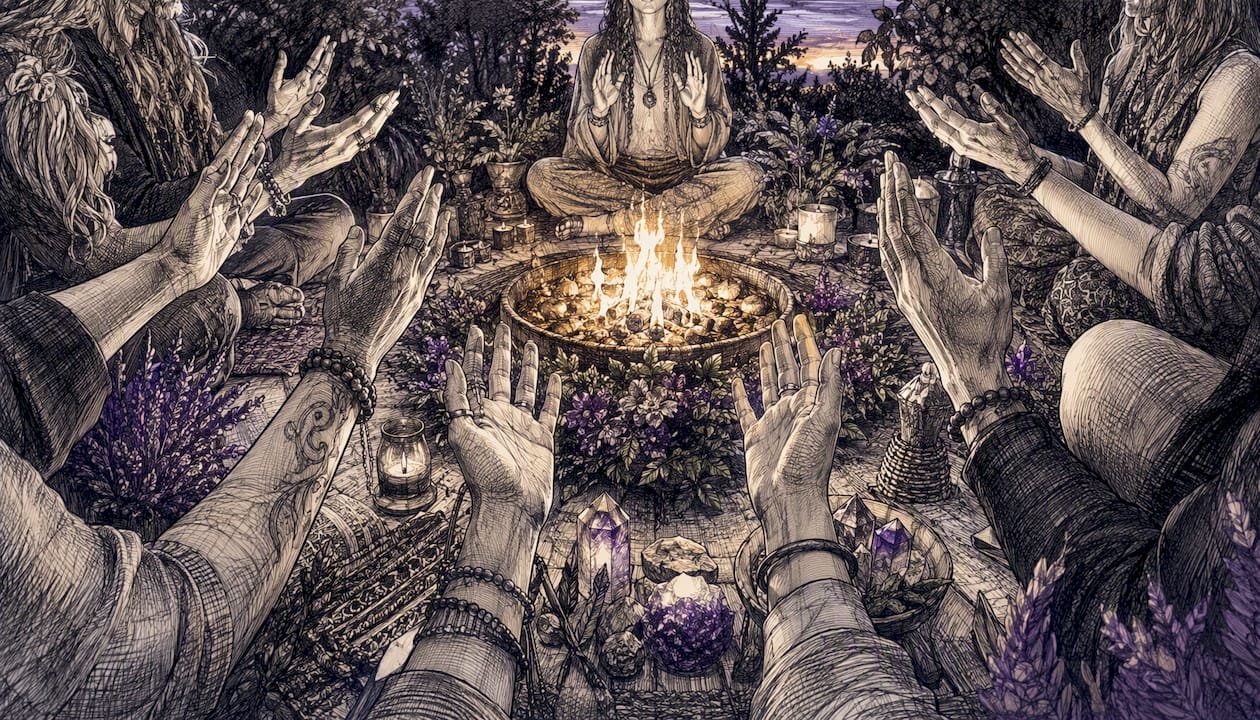
Here's a ten to twenty minute template you can adapt for either an in-person circle or a video call:
- Opening (2-3 minutes). A grounding breath, a candle lighting, or a spoken intention to mark the start.
- Practice (8-10 minutes). A shared tarot pull, a synchronized meditation, or a themed spread like the Samhain Veil spread that everyone draws from at once.
- Sharing (5-7 minutes). Each member offers one sentence about what came up. No cross-talk or advice-giving yet.
- Close (1-2 minutes). A closing phrase or gesture everyone repeats together.
For a synchronous online version, send the meeting link and ritual outline 24 hours ahead, mute members by default during the practice segment to preserve focus, and use a shared visual (a single tarot card on screen) so remote members feel anchored to the same moment. Caption or transcribe the sharing segment for accessibility.
Pro Tip: In-person groups can lean into physical synchrony, standing, breathing, moving together. Remote groups should lean into visual and verbal synchrony instead, since bodies aren't sharing the same room.
Weekly daily tarot pulls or synastry-based discussion prompts also work well as low-effort recurring rituals for smaller groups.
How Can You Measure Community Wellbeing?
You don't need a research grant to track this. A four-question pulse survey, sent monthly, covers the essentials:
- How connected did you feel to this group this month? (1-5)
- Did you feel supported when you needed it?
- Did you support someone else in the group?
- Did you learn something about yourself through our shared practice?
Pair those answers with a quick behavior check: attendance trends, how often members initiate contact with each other, and whether newcomers stick around past their third session. A six-domain wellbeing template, covering flourishing individuals, good relationships, capable leadership, healthy practices, community satisfaction, and shared mission, gives a more thorough framework if your group wants to go deeper. Collect responses anonymously and share aggregate results back with the group; that transparency itself builds trust.
What Are Common Pitfalls in Spiritual Communities?
Watch for these red flags, and address them fast:
- Power hoarding. One person controls all decisions. Fix: rotate facilitation roles.
- Spiritual bypassing. Real problems get dismissed as "low vibration." Fix: name discomfort directly instead of spiritualizing it away.
- Lack of consent or transparency. Members feel pressured into rituals or payments. Fix: make participation and costs explicit upfront.
- Boundary violations. Personal space or emotional limits get ignored. Fix: state boundaries publicly and enforce them consistently.
- Shaming dissent. Disagreement gets treated as betrayal. Fix: build shared governance so no single voice decides what's acceptable.
How Do Online Platforms Support Community Wellbeing?
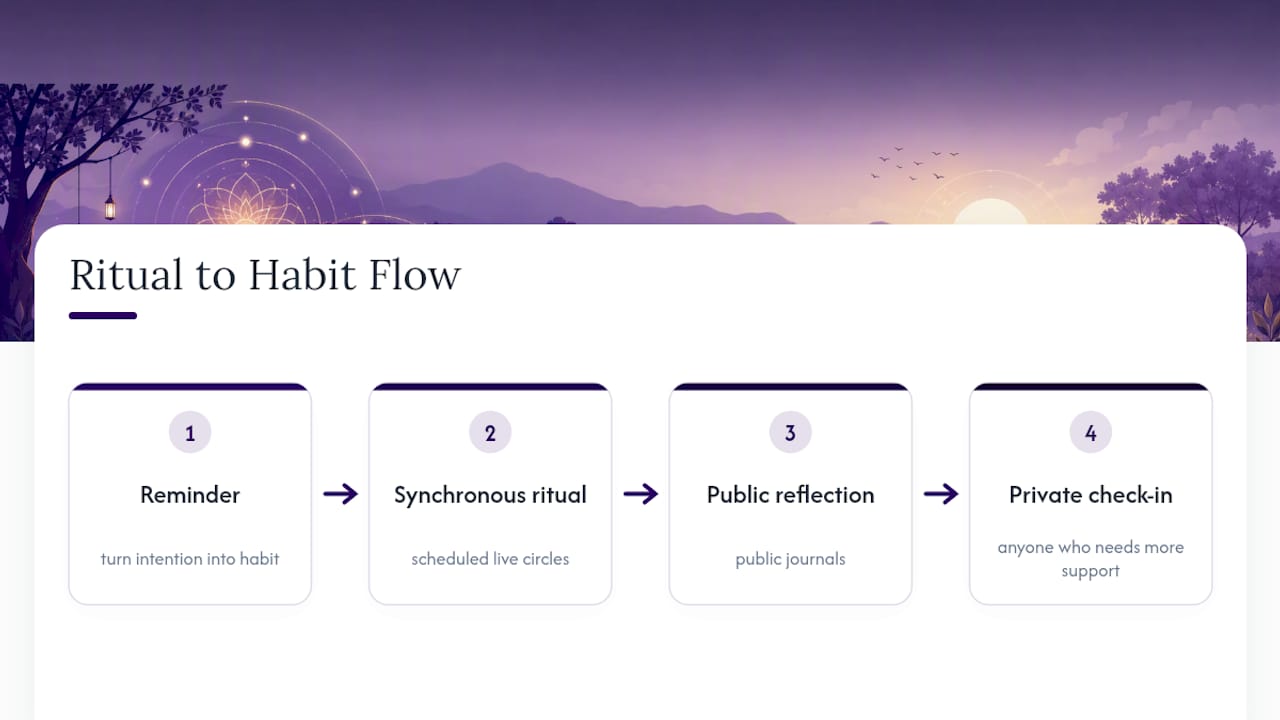
The right platform features turn intention into habit. Look for ritual prompts, scheduled live circles, public journals, saved readings, clear community guidelines, and structured onboarding for new members.
A simple flow that works well: a reminder notification, a synchronous ritual, a public reflection post, and a private check-in for anyone who needs more support. That sequence mirrors the mechanism researchers found in ritual and social-support studies: repeated, structured co-participation builds denser support ties over time.
Tarosyn's public journal feature and living public record reflect this design thinking. But no platform substitutes for human facilitation. Tools schedule the ritual; people still have to show up, listen, and hold space for each other.
What I've Noticed About Ritual and Belonging
I've watched small tarot circles outlast big, flashy events for one reason: repetition builds trust faster than novelty does. If you take nothing else from this piece, try the ten-minute ritual template above with three people this week, then check in with the pulse survey a month later. Notice what shifts.
A Simple Way to Practice What You've Read
Tarosyn gives you a structured place to run the exact practices covered here, without building a ritual calendar or reflection system from scratch. Its public journal lets members post reflections after a shared reading, saved readings let a group revisit a ritual's meaning weeks later, and built-in community guidelines set expectations before anyone even joins a circle.
If you're ready to test one of the templates from this guide, start with a shared prompt like the Chariot in a relationship spread for a mutual-support session, or use the daily horoscope as a recurring check-in for your group. Explore the free tier first, then look at the subscription options if your circle wants deeper archive and journaling tools.
Frequently Asked Questions
What does community wellbeing mean in a spiritual context? It means the collective emotional and spiritual health of a group, measured through belonging, mutual support, shared rituals, and a sense of energetic harmony among members.
What is community health as it relates to spiritual groups? In this context, community health refers to the same collective wellbeing, how connected, supported, and aligned members feel through shared practice, rather than a public-health metric.
Why is community wellbeing important for spiritual seekers? Groups with strong wellbeing give members consistent ritual, real support during hard times, and a felt sense of belonging that solo practice rarely provides on its own.
How can I improve community wellbeing in my own circle? Start one repeated ritual, add a reflective sharing step afterward, and check in monthly with a short pulse survey to track connection and support over time.
What are common community wellbeing indicators to track? Attendance consistency, peer support outside events, transparent handling of money or requests, and how quickly newcomers feel included all signal group health.
Sources
- Multi-site field study on ritual, pain threshold, and social bonding (Oxford/Coventry fieldwork)
- Collective ritual and social support networks in rural South India (Royal Society)
- Secular and religious rituals both increase social bonding (PLOS One, 2021)
- Anthropological/evolutionary analysis of ritual and social bonding (Wiley)