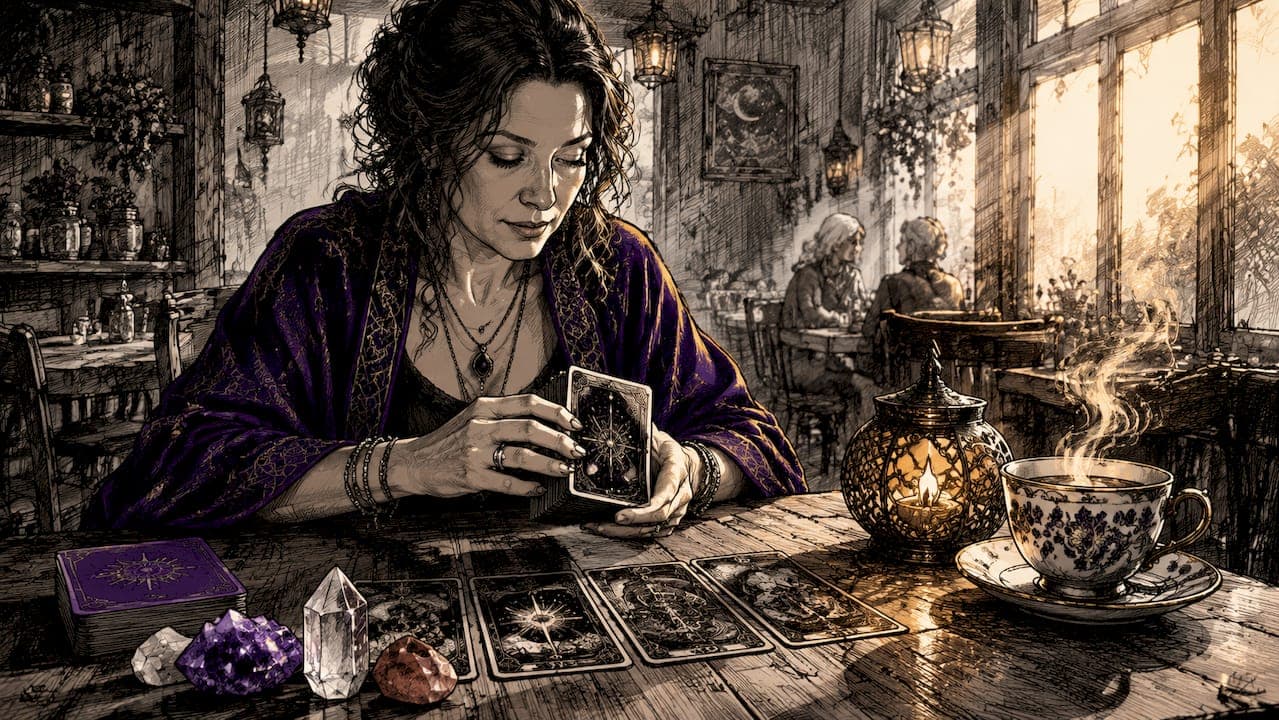
Tarot card reading is the practice of interpreting a deck of 78 symbolic cards to explore personal questions and gain insight through structured reflection. The formal term used by practitioners is "cartomancy," though tarot reading has become its own recognized discipline. A standard reading session lasts 30–60 minutes and uses layouts called spreads, such as the three-card draw or the Celtic Cross, to organize card meanings around a central question. Tarot does not predict a fixed future. It surfaces patterns, possibilities, and perspectives that the reader may not have consciously named yet. Platforms like Tarosyn bring this practice into a structured digital space, combining AI-powered readings with community insight to make tarot accessible to anyone curious about self-discovery.
What is tarot card reading and how does the deck work?
A tarot deck contains exactly 78 cards, divided into two groups: the Major Arcana and the Minor Arcana. Each group serves a distinct purpose in a reading, and understanding both is the foundation of tarot card interpretation.
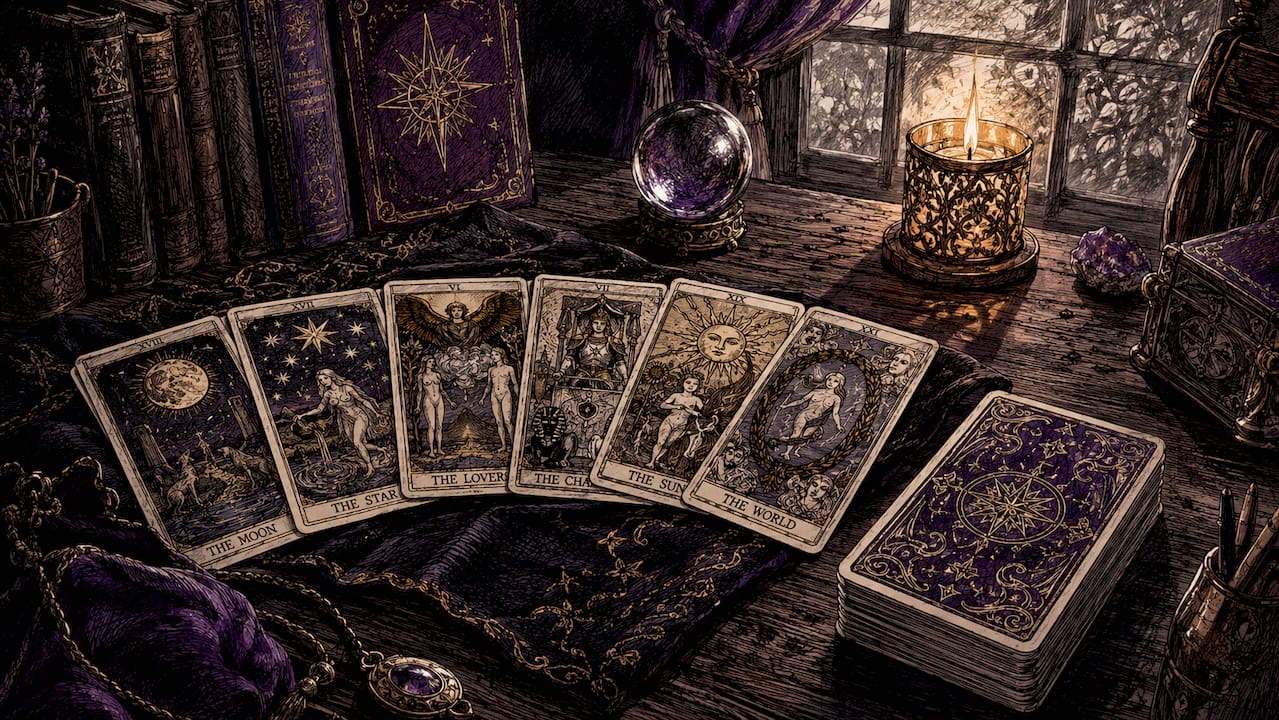
The Major Arcana consists of 22 cards. These represent major life themes, turning points, and universal archetypes. Cards like The Tower, The Moon, and The World speak to large-scale forces at work in a person's life.
The Minor Arcana contains 56 cards split into four suits:
- Wands represent fire energy: passion, creativity, and ambition.
- Cups represent water energy: emotions, relationships, and intuition.
- Swords represent air energy: thought, conflict, and communication.
- Pentacles represent earth energy: money, work, and physical reality.
Each suit runs from Ace through 10, plus four court cards: Page, Knight, Queen, and King. The court cards often represent people or personality types relevant to the question at hand.
The symbolism in tarot draws from archetypes, elemental theory, and numerology to communicate complex personal themes. This is not arbitrary imagery. Every color, figure, and object in a card carries a layer of meaning built over centuries. The tarot archetypes found in the Major Arcana, for example, mirror stages of human experience that nearly every person encounters across a lifetime. That shared symbolic language is what makes tarot a consistent tool for reflection across cultures and time periods.
How does tarot reading work? Process, spreads, and questions
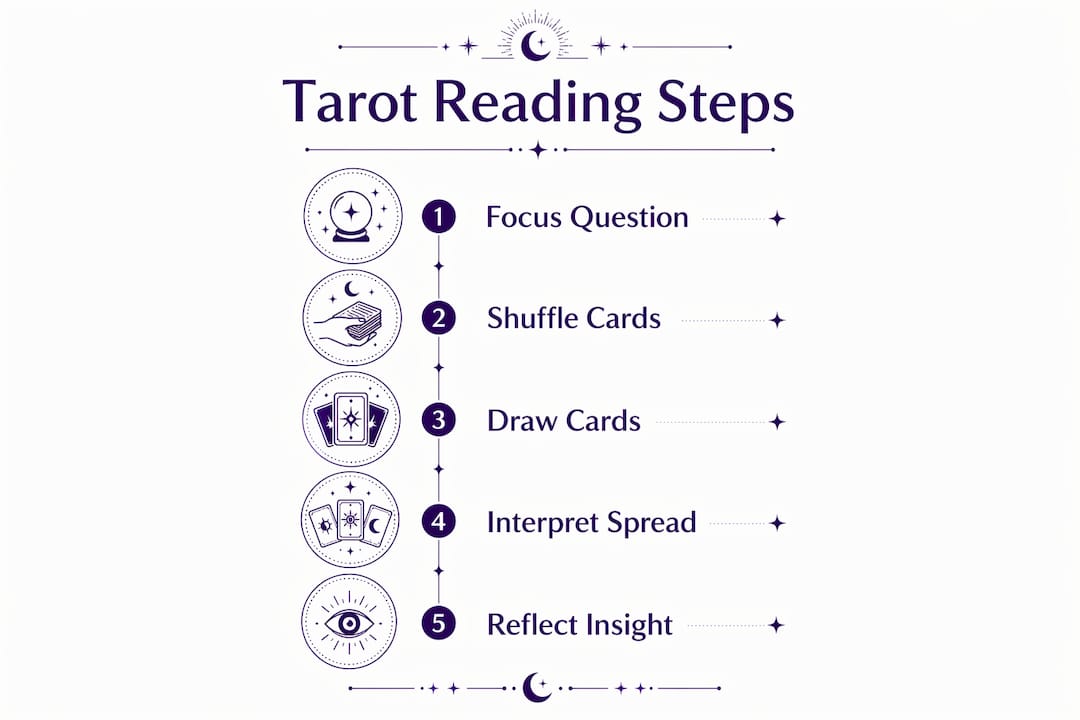
A tarot reading follows a clear process. You begin by focusing on a question, shuffle the deck with that question in mind, and then draw cards into a specific layout called a spread. Shuffling methods are flexible. There is no single correct technique. What matters is your focus and intent during the shuffle.
The question you bring to a reading shapes everything. Open-ended questions consistently produce more useful readings than yes/no questions. "What do I need to understand about this situation?" works far better than "Will this work out?" The first invites reflection. The second demands a verdict the cards are not designed to give.
Common tarot spreads
The three most widely used spreads are:
- One-card draw. Pull a single card for a daily focus or a quick check-in on a specific question. This is the best starting point for beginners.
- Three-card spread. Draw three cards representing past, present, and future. This layout adds context and shows how a situation has developed over time.
- Celtic Cross. A 10-card layout that covers the central issue, obstacles, subconscious influences, hopes, fears, and likely outcomes. This is the most detailed spread in common use.
How card positions shape meaning
| Spread | Cards Used | Best for |
|---|---|---|
| One-card draw | 1 | Daily focus or simple questions |
| Three-card spread | 3 | Situational context and timelines |
| Celtic Cross | 10 | Complex decisions and deep insight |
Card positions in a spread directly change how you interpret each card. The same card drawn in the "obstacle" position means something different than when it appears in the "advice" position. This is why the layout matters as much as the card itself. A reading without a defined spread structure often produces vague, unfocused results.
How to interpret tarot cards accurately
Tarot card interpretation combines three elements: the traditional meaning of the card, its position in the spread, and its relationship to the cards around it. Advanced readers treat tarot as a layered system where these three elements work together to build a narrative, not a list of isolated definitions.
The most common beginner mistake is reading each card in isolation. You draw the Five of Swords, look up its meaning, and stop there. That approach misses the point. Cards work as an interconnected story, and the card next to the Five of Swords changes its meaning significantly. A card of conflict sitting beside the Ace of Cups suggests a fresh emotional start emerging from difficulty. The same conflict card beside The Tower suggests something more disruptive.
Traditional card meanings give you a starting vocabulary. Context gives you the sentence. Position gives you the grammar. All three together produce a reading that actually says something useful.
Pro Tip: When you draw a card that confuses you, look at the imagery before you look up the meaning. Notice what draws your eye first. That instinctive reaction often points directly to what the card is saying about your situation.
Reversed cards, meaning cards drawn upside down, add another layer. Many readers interpret reversed cards as blocked or internalized energy rather than the card's full expression. A reversed Strength card, for example, may suggest self-doubt rather than outward courage. You do not have to read reversals as a beginner. Build comfort with upright meanings first, then add reversals when you feel ready.
What are the benefits of tarot reading for self-discovery?
Tarot reading today functions primarily as a spiritual and self-reflective tool rather than a method of fortune-telling. This shift in how people use tarot is significant. It moves the practice from passive prediction to active self-examination.
The practical benefits include:
- Pattern recognition. Tarot externalizes internal thoughts by placing them onto symbolic cards. This makes it easier to see recurring themes in your behavior or circumstances that you might otherwise overlook.
- Emotional clarity. Naming a feeling is the first step to processing it. Cards give you a concrete image to attach to vague emotional states, which makes reflection more focused.
- Reframing problems. A card you did not expect forces you to consider an angle you had dismissed. This is one of the most practical uses of tarot for decision-making.
- Shadow work. Tarot is widely used to examine the parts of yourself you tend to avoid. The Moon card, for example, often surfaces fears and unconscious patterns that are influencing your choices without your awareness.
- Daily grounding. A single-card morning draw takes two minutes and sets a reflective tone for the day. Many people use this practice the way others use journaling.
The power of a reading lies in the querent's engagement. The querent is the person asking the question. When you bring genuine curiosity and a willingness to sit with what comes up, tarot surfaces patterns you already sensed but had not yet named. The cards do not create insight from nothing. They give shape to what is already present. Tarosyn's personal growth resources extend this process by connecting tarot insights with community reflection and AI-guided interpretation.
Key Takeaways
Tarot card reading is a structured reflective practice that uses 78 symbolic cards, defined spreads, and open-ended questions to surface personal insight rather than predict fixed outcomes.
| Point | Details |
|---|---|
| Deck structure matters | A standard 78-card deck splits into 22 Major Arcana and 56 Minor Arcana cards, each with distinct symbolic roles. |
| Open questions produce better readings | Asking "What do I need to know?" yields more useful reflection than yes/no or outcome-focused questions. |
| Spreads define meaning | Card positions in layouts like the Celtic Cross change interpretation; the same card means different things in different positions. |
| Read cards as a story | Interpreting cards individually is the most common beginner error; meaning comes from how cards interact in the spread. |
| Tarot is a reflective tool | The most effective use of tarot is self-examination and pattern recognition, not fortune-telling. |
Why tarot is more useful than most people expect
People come to tarot expecting a verdict. They want to know if the relationship will work, if the job will come through, if the risk is worth taking. That expectation is understandable, and it is also the thing that limits what tarot can actually do for you.
What I have found, after years of working with tarot as a reflective practice, is that the cards are most useful precisely when you stop demanding answers and start asking better questions. The most effective tarot work happens when you treat the deck as a mirror, not an oracle. A mirror shows you what is already there. An oracle tells you what will happen. The first is genuinely useful. The second is a fantasy.
The querent's mindset determines the quality of every reading. If you sit down defensive, looking for confirmation of what you already believe, you will find it. If you sit down open, willing to be surprised, you will get something worth thinking about. That is not mysticism. That is how reflection works in any format.
The misconception I see most often is that tarot requires belief in the supernatural to be useful. It does not. You can approach it as a structured thinking tool, a way to slow down and examine a situation from multiple angles, and get real value from it. The symbolism does the work of prompting new perspectives. Your own mind does the rest.
— Joseph
Tarosyn brings tarot readings to you
Tarosyn combines AI-powered tarot with a community of readers who share real readings and insights every day.
You can browse community tarot readings to see how others interpret spreads and apply card meanings to real situations. If you want a reading of your own, Tarosyn's AI generates personalized interpretations based on your question and chosen spread. Examples like the Knight of Cups in a Three Card Spread or the Chariot in a Celtic Cross show the depth of interpretation available. Whether you are new to tarot or building a daily practice, Tarosyn gives you the tools and the community to go deeper.
FAQ
What is tarot card reading used for today?
Tarot card reading is used primarily as a self-reflective tool for personal insight, emotional clarity, and decision-making. Most practitioners today use it to examine patterns and possibilities rather than predict fixed outcomes.
How many cards are in a tarot deck?
A standard tarot deck contains 78 cards: 22 Major Arcana cards representing major life themes and 56 Minor Arcana cards divided into four suits.
Is tarot card reading accurate?
Tarot reading is not a predictive system with measurable accuracy. Its value comes from the quality of reflection it prompts. Open-ended questions and genuine engagement produce the most useful readings.
What should I expect in a tarot session?
A typical tarot session lasts 30–60 minutes. You focus on a question, cards are drawn into a spread, and each card's meaning is interpreted in relation to its position and neighboring cards.
What are the most common types of tarot spreads?
The three most common spreads are the one-card draw for daily focus, the three-card spread for past, present, and future context, and the Celtic Cross for detailed multi-layered readings.