
Journaling deepens intuition by improving self-awareness, making subconscious patterns visible, and creating a feedback loop between your inner signals and real-world outcomes. Try this now: set a 10-minute timer (step 1), write the question "What do I already know about this?" at the top of a blank page (step 2), then write without stopping and circle the first phrase that surprises you (step 3). The sections below cover the mechanisms behind this process, the most useful methods, ready-to-use prompts, and a simple way to track your progress.
Key Takeaways
Journaling deepens intuition by creating a written record of inner signals, bodily sensations, and recurring patterns that you can verify against real-world outcomes over 30–90 days.
| Point | Details |
|---|---|
| Core mechanism | Journaling surfaces subconscious patterns through self-awareness, somatic logging, and a feedback loop between entries and outcomes. |
| Research backing | A 12-week PAJ trial showed reduced distress and improved well-being; expressive writing reviews confirm benefits are real but privacy and instruction matter. |
| Start small | Recording three positive events daily for 14 days produced measurable mood improvements in at least one study summarized by Sanford Health. |
| Avoid rumination | Use structured prompts that move toward a question or next step; end every session with one concrete action. |
| Tarosyn tools | Tarosyn's guided sessions and Community Reflections journal support the body-scan-to-freewrite method and pattern tracking described in this article. |
Table of Contents
- What is intuitive journaling, and what forms does it take?
- Why journaling deepens intuition: the psychological mechanisms
- Which journaling methods reliably grow intuition?
- A 15-minute journaling session you can do today
- High-impact prompts and mini-exercises to access your inner voice
- The dark side of journaling and how to avoid it
- How to tell if your intuition is actually growing
- What the research actually shows about journaling and intuition
- An editorial perspective on journaling and intuition
- Tarosyn's guided journaling tools for intuition practice
- Sources
What is intuitive journaling, and what forms does it take?
Intuitive journaling is a writing practice where you put inner signals, gut feelings, bodily sensations, and recurring thoughts onto the page so you can read them back, spot patterns, and act on them with more confidence. The goal is not to produce polished writing. The goal is to make the nonconscious conscious.
"Intuition" here means the trusted inner signals that arise from pattern recognition, bodily sensation, and rapid nonconscious processing. These signals are real cognitive events. Journaling gives them a place to land.
Common forms include:
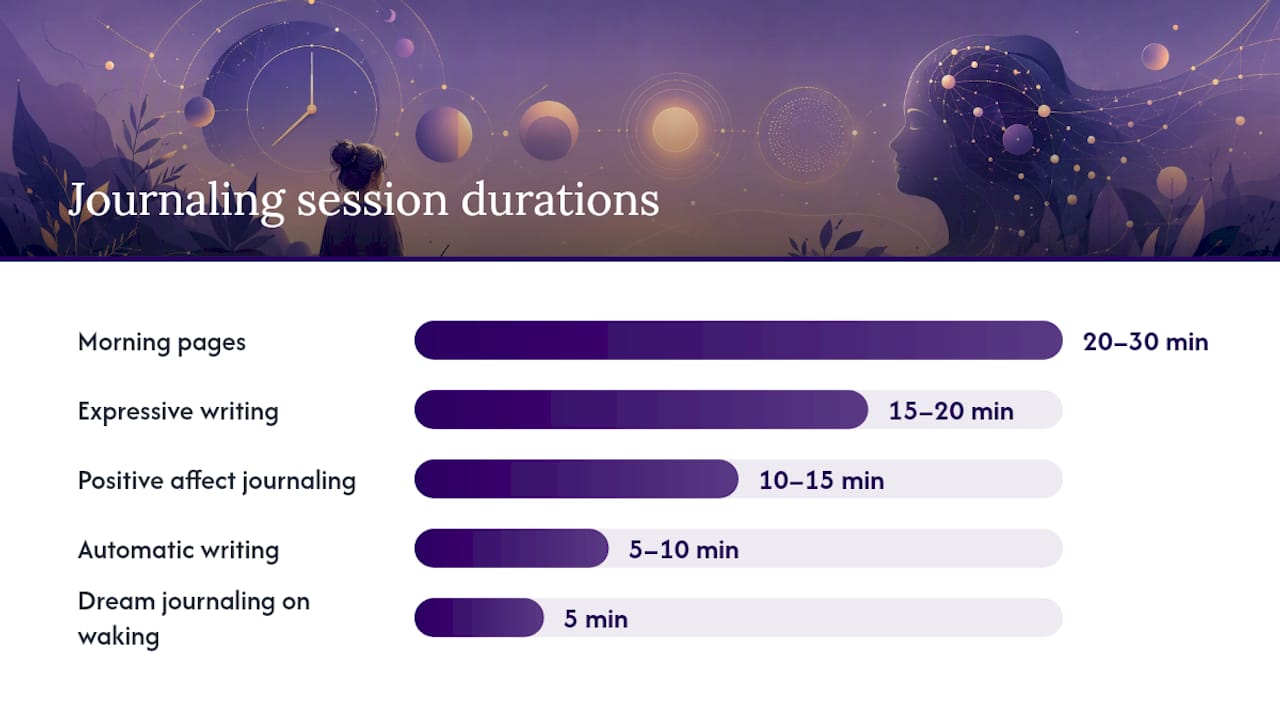
- Expressive writing: Unstructured writing about thoughts and feelings, typically 15–20 minutes, used to process difficult experiences and surface emotional clarity.
- Morning pages: Three longhand pages written first thing in the morning, popularized by Julia Cameron and Natalie Goldberg, designed to clear mental clutter before the day begins.
- Automatic writing: Writing continuously without pausing to edit or judge, used to bypass the filtering mind and access faster, less-censored responses.
- Positive affect journaling (PAJ): Structured prompts focused on gratitude, positive events, and emotional strengths, shown in clinical research to reduce distress and improve well-being.
- Dream journaling: Recording dream content immediately on waking, used to track recurring symbols and emotional themes that often mirror waking intuitive signals.
- Gratitude anchoring: Brief daily logs of three specific positive events, used to train attention toward what is working and build a baseline of emotional stability.
Each form targets a slightly different route to intuitive clarity. The method you choose depends on your goal and your intuitive style, which the next section explains.
Why journaling deepens intuition: the psychological mechanisms
Journaling amplifies intuition through four overlapping processes: it builds self-awareness, surfaces repeated patterns, moves subconscious data into readable form, and logs the bodily signals that often carry intuitive information before the mind catches up.
Self-awareness and pattern recognition
When you write regularly, you create a searchable record of your own reactions. Over time, you notice that certain situations produce the same physical tightness, the same hesitation, or the same burst of energy. That recognition is the substrate of intuition. You are not guessing. You are reading a pattern you have documented.
Brief, regular journaling builds self-awareness and reduces stress, according to Healthline's synthesis of evidence and expert guidance. The key word is "regular." A single entry is a data point. Thirty entries are a pattern.
Externalizing subconscious data
Freewriting and automatic writing work because they reduce the editing lag between a thought and its appearance on the page. When you write fast and without judgment, phrases appear that you did not consciously plan. Those phrases often carry information your analytical mind had not yet organized. Reading them back is the equivalent of listening to yourself from the outside.
Practitioner frameworks that begin with a short body scan and then move to a timed freewrite make it easier to capture intuitive hits without the conscious mind editing them out. The Vitarsis intuition journaling guide describes a four-step process: record bodily sensations, freewrite to clear conscious clutter, ask a focused question, and log first impressions for later evaluation.
Somatic markers and bodily signals
Antonio Damasio's somatic marker hypothesis holds that the body flags emotionally significant information before the conscious mind processes it. A tight chest before a bad decision, a light feeling before a good one. Journaling gives you a place to log those sensations next to the context that triggered them. Over weeks, the pairings become legible.
Pro Tip: Write a one-line body note at the start of every entry: "Right now my body feels ___." Over 30 days, review those notes alongside the decisions you made that day. The correlations often become clear quickly.
What the evidence says
Statistic callout: Sanford Health reports that recording three positive events daily for 14 days produced reductions in depressive symptoms comparable to antidepressant effects in at least one study of mild-to-moderate depression.
A randomized trial of internet-delivered positive affect journaling found decreased mental distress and improved well-being relative to usual care over 12 weeks, with moderate adherence. A systematic review of expressive writing found that benefits are real but heterogeneous: whether journals were collected or analyzed by researchers significantly moderated outcomes, which means privacy and instruction both affect how well journaling works.
That last point matters. Journaling in a space you know is private tends to produce more candid, and therefore more useful, entries.
Which journaling methods reliably grow intuition?
Different methods reach intuitive clarity through different routes. Choose based on what you are trying to do.
- Expressive writing (15–20 min): Best for processing a specific decision, conflict, or emotional block. Write about the event from multiple angles without editing. Good for verbal and analytical thinkers.
- Morning pages (20–30 min): Best for daily mental clearing. Three longhand pages before checking your phone. Natalie Goldberg's Writing Down the Bones describes this as "composting" the mind. Works well for people who feel mentally cluttered in the morning.
- Automatic writing (5–10 min): Best for accessing fast, unfiltered responses. Set a timer, write a question at the top, and do not stop writing until the timer ends. Suited to people who tend to overthink.
- Positive affect journaling / PAJ (10–15 min): Best for building emotional stability as a foundation for clearer signals. Use structured prompts about what went well, what you are grateful for, and what you are looking forward to. PAJ delivered via the web showed measurable well-being improvements in a 12-week trial.
- Dream journaling (5 min on waking): Best for readers who notice strong imagery or recurring themes in dreams. Keep a notebook at the bedside and write before doing anything else. Pairs well with pattern-review sessions.
- Gratitude anchoring (3–5 min): Best as a daily anchor that stabilizes mood and trains attention. Three specific items, not generic ones. "I am grateful for the conversation I had at 2 PM" is more useful than "I am grateful for my friends."
Matching method to intuitive style: If your intuition tends to arrive as a physical sensation, prioritize body-scan entries and somatic logging. If it arrives as images or symbols, dream journaling and visual prompts work better. If it arrives as a sudden verbal knowing, automatic writing is your fastest route. You can find resources on intuition styles and exercises at Tarosyn's topic hub.
For crisis decisions, use expressive writing to process the emotional charge first, then automatic writing to access the signal underneath. For daily practice, morning pages or PAJ build the baseline. For creativity work, automatic writing and dream journaling surface material that analytical thinking tends to suppress.
A 15-minute journaling session you can do today
Do this session once to generate a verifiable intuitive hit you can test in the real world. The structure follows the body-scan-to-freewrite framework recommended by practitioner guides.
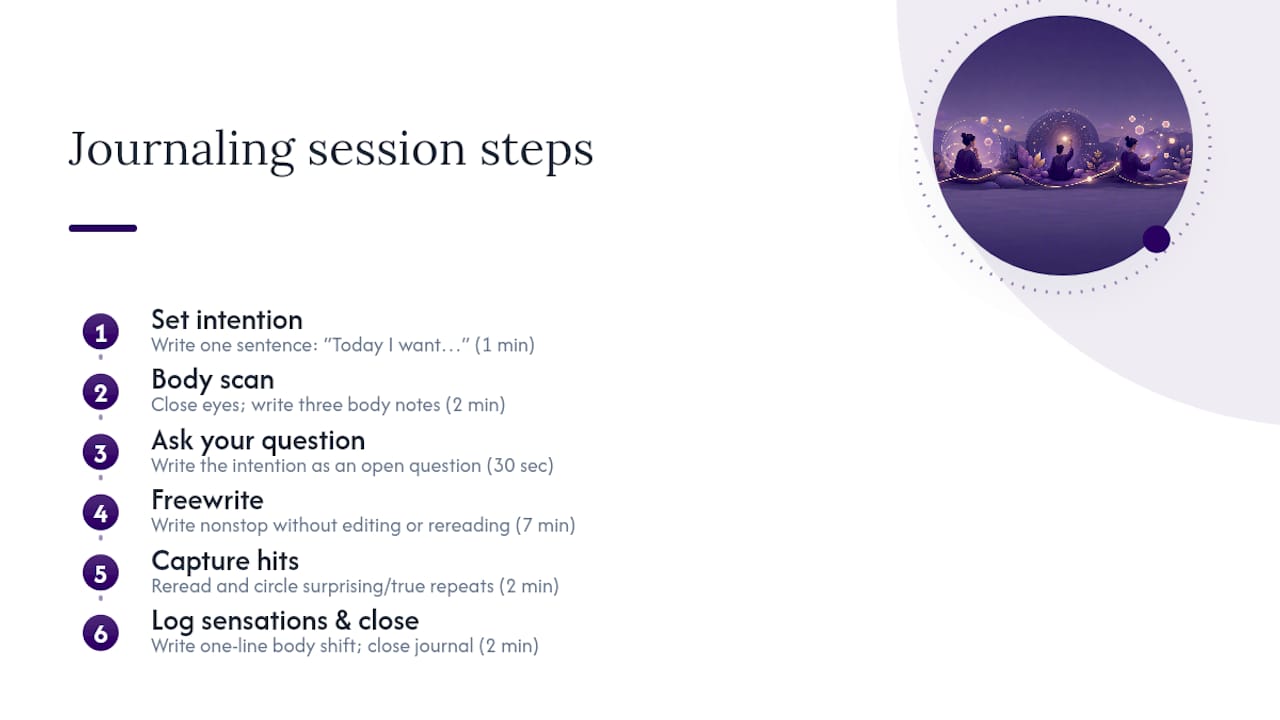
Step 1 — Set your intention (1 min) Write one sentence: "Today I want to understand ___." Be specific. "Today I want to understand why I keep hesitating about ___" is more useful than "I want clarity."
Step 2 — Body scan (2 min) Close your eyes. Notice where you feel tension, ease, or numbness. Open your eyes and write three body notes: location, sensation, intensity (low/medium/high). Do not interpret yet.
Step 3 — Ask your question (30 sec) Write the question from your intention at the top of a fresh page. Keep it open-ended. "What do I already know about this?" works for most situations.
Step 4 — Freewrite (7 min) Write without stopping. Do not edit, cross out, or reread. If you run out of words, write "I don't know what to write" until something else comes. The Vitarsis guide calls this clearing conscious clutter to reach the signal underneath.
Step 5 — Capture hits (2 min) Reread what you wrote. Circle any phrase that surprised you, felt true in your body, or appeared more than once. These are your intuitive hits.
Step 6 — Log sensations and close (2 min) Write one line: "After writing, my body feels ___." Note any shift from your step 2 scan. Close the journal. Do not share the raw entry.
Action test: Pick one circled phrase and design a low-risk real-world check. If the phrase was "I need more time before deciding," set a 48-hour pause on the decision and note what changes. Log the outcome in your next entry.
High-impact prompts and mini-exercises to access your inner voice
Prompts work because they bypass the filtering mind. A timed format adds pressure that reduces overthinking. Use these directly in your journal.
Decision-making prompts
- What do I already know about this that I haven't said out loud?
- If I trusted my first answer completely, what would I do?
- What would I tell a close friend in this exact situation?
- What am I pretending not to know?
Pattern detection prompts
- What situation keeps repeating in my life right now?
- When did I last feel this way, and what happened next?
- What theme shows up in my last five journal entries?
- What do I keep almost saying, then stopping?
Creativity and inner voice prompts
- Write a letter from your future self about this decision.
- What does the part of me that already knows the answer want to say?
- Describe the feeling of the right choice, not the logic of it.
- What would I write if no one would ever read this?
Dream work prompts
- What image from last night's dream stayed with me, and where do I feel it in my body?
- If the main figure in my dream were a part of me, what would it be saying?
- What emotion did I wake up with, and where does it show up in my waking life?
The 3-3-3 method
Write for 3 minutes on what you feel. Write for 3 minutes on what you know. Write for 3 minutes on what you want. Do not pause between segments. Read back only the third segment. The first two clear the noise; the third tends to carry the signal.
10 minutes to intuition template
- 0:00–2:00 — Body scan note (3 sensations, written fast)
- 2:00–7:00 — Freewrite on your current question, no stopping
- 7:00–9:00 — Circle two phrases that feel most true
- 9:00–10:00 — Write one sentence: "The thing I most need to remember from this is ___."
Equipment: Pen and paper or a private digital journal. Paper tends to produce less self-editing. Keep entries in a dedicated notebook or a password-protected app so you write without an audience.
The dark side of journaling and how to avoid it
Journaling usually helps, but it can amplify worry when used without structure. These are the most common problems and how to handle each one.
- Rumination: Writing about a problem repeatedly without resolution deepens distress rather than relieving it. Fix: use structured prompts that move toward a question or a next step, not just a description of what went wrong.
- Overanalysis of hits: Tracking intuitive hits is useful. Obsessing over whether each one was "right" turns the practice into a performance. Fix: set a simple validation rule (one low-risk real-world test per hit, logged once, then released).
- Privacy risk: Unguarded entries can be read by others, which changes what you write. Fix: use a locked physical journal or a password-protected app. Never store raw entries in a shared cloud folder.
- Avoidance writing: Some people use journaling to process feelings instead of taking action. The journal becomes a substitute for the conversation or the decision. Fix: end every session with one concrete next step, written as a sentence.
- Spiritual bypassing: Using journaling to confirm what you already want to believe, rather than to surface what you actually feel. Fix: include at least one prompt per session that challenges your current position.
If a journal entry surfaces thoughts of self-harm, severe trauma memories, or feelings you cannot manage alone, stop the session and contact a licensed mental health professional. Journaling is a self-reflection tool, not a substitute for clinical care. The Shadow & Healing Tarot Spread at Tarosyn can serve as a structured companion for shadow-work entries, but it does not replace professional support.
How to tell if your intuition is actually growing
Observable indicators that your intuitive accuracy is improving:
- You reach clarity on decisions faster than you did 30 days ago.
- Bodily cues (tension, ease, a gut drop) now match outcomes you can verify.
- Your hunches are more accurate when you check them against what actually happened.
- You second-guess yourself less after making a decision.
- Recurring themes in your journal now feel familiar rather than surprising.
- You notice the signal earlier in a situation, before the situation becomes urgent.
Simple tracking template
Log these four items after each session:
| Field | What to write |
|---|---|
| Question | The specific question you brought to the session |
| Hit | The phrase or feeling you circled |
| Physical sensation | What your body felt when you circled it |
| Follow-up outcome | What actually happened (fill in 24–72 hours later) |
Run this for 30 days. At day 30, count how many hits matched their outcomes. At day 90, review for patterns in the type of question where your accuracy is highest.
Expect false positives, especially in the first two weeks. The mind is good at finding confirmation. A hit only counts if you logged it before the outcome, not after. Acceptable timeframes for seeing consistent improvement are 30–90 days of sessions three or more times per week.
What the research actually shows about journaling and intuition
Research supports journaling's benefits, but with important qualifications that affect how you should practice.
The systematic review of expressive writing found heterogeneous effects across studies. One consistent moderator: when researchers collected and analyzed participant journals, outcomes changed. This suggests that writing for an audience, even a clinical one, reduces the candor that makes journaling effective. Write for yourself.
The PAJ randomized trial showed decreased anxiety and depression measures and improved resilience over 12 weeks, with moderate adherence. The practical implication: short, positive-affect prompts alongside deeper freewriting sessions produce measurable well-being improvements, and well-being is the foundation that makes intuitive signals easier to read. Distress narrows attention; stability widens it.
Sanford Health's summary points to evidence that even simple exercises, like listing three good things for 14 days, produce mood improvements that support clearer inner signal detection. The bar to start is low.
The practical implications for self-guided practice: a brief orientation to why and how you are journaling improves results. Reading this article counts as that orientation. Using structured prompts rather than blank-page free-for-all sessions also helps, especially early in the practice. Effect sizes in journaling research are modest and context-dependent. Journaling is not a cure for anything. It is a tool for building a clearer relationship with your own patterns.
An editorial perspective on journaling and intuition
The most underrated part of intuition journaling is the feedback loop, not the writing itself. Most guides focus on the session. The real work happens 48 hours later, when you go back and check whether the hit you circled matched what actually occurred. That check is what separates journaling-as-reflection from journaling-as-skill-building.
People often skip the follow-up because it feels like homework. But without it, you are accumulating entries without accumulating evidence. The session templates in this article are designed to make the follow-up automatic: you log the question, the hit, and the sensation in the same entry, so the outcome check has a clear target.
The other thing most guides understate is the role of privacy. The systematic review found that journal collection by researchers moderated outcomes. That is a clinical finding with a direct practical implication: if you know someone might read your entries, you write differently. You edit. You perform. And the signal you are trying to catch gets filtered out before it reaches the page. A locked journal is not a preference. It is a functional requirement.
Tarosyn's Community Reflections journal is a space for sharing processed insights, not raw entries. That distinction matters. Share the pattern you noticed after 30 days, not the unfiltered freewrite from Tuesday morning.
Tarosyn's guided journaling tools for intuition practice
Tarosyn pairs guided journaling sessions with a full spiritual ecosystem so you can move from a written intuitive hit directly to a tarot reading or community reflection without losing the thread.

Two features map directly to the methods in this article. The guided timed sessions use the body-scan-to-freewrite structure described above, with built-in prompts for decision-making, pattern detection, and dream work. The Community Reflections journal lets you review how other practitioners log and validate their intuitive hits, which is useful for calibrating your own tracking after 30 days.
For readers ready to pair journaling with a structured reading, Tarosyn's public readings offer community-contributed insights alongside AI-powered tarot that you can use as a prompt for your next session. Start with a free guided journaling sample or browse Community Reflections to see the practice in action.
Sources
- Journaling can improve mental health and wellness - Sanford Health News
- Positive affect journaling randomized trial (PAJ) - PMC6305886
- Benefits of journaling - Healthline
- Intuition journaling guide - Vitarsis