
Angel numbers are repeating or patterned number sequences that many people use as symbolic prompts. Treat one as a personal signal to pause and reflect, not as a deterministic forecast. When 111 or 444 catches your eye, the useful response isn't to search for a fixed prophecy. It's to notice the moment, name what's on your mind, and write it down.
Two actions matter more than any chart lookup:
- Pause where you are and note the context: what you were thinking, doing, or deciding right before the number appeared.
- Write a one-line impression in a journal or notes app, even if it's just "saw 222 while worried about the job offer."
That habit, more than any list of meanings, is what separates a passing coincidence from a pattern worth trusting. Tarosyn author Joseph Calitoy has spent time studying how numerology and personal reflection intersect, and the guidance in this piece leans on that practical, journaling-first approach rather than rigid predictions.
Key Takeaways
Angel numbers work best as a personal journaling prompt, verified through repetition and tested against real decisions over time, not read as fixed prophecy.
| Point | Details |
|---|---|
| Definition first | Angel numbers are repeating or patterned sequences (111, 444, 11:11) used as symbolic prompts, not deterministic messages. |
| Context beats charts | Record the emotion, decision, and setting around a sighting before consulting any meaning list. |
| Verify recurrence | Confirm a number actually repeats over days or weeks before assigning it symbolic weight. |
| Use both lenses | Pair numerology themes with a pragmatic test: does the prompt change your clarity or behavior? |
| Practice with Tarosyn | Tarosyn's journaling tools and daily horoscope help readers track sightings and connect them to numerology and astrology over time. |
Table of Contents
- What Angel Numbers Meaning Actually Refers To
- Where Do Angel Numbers Show Up Most Often?
- What Do the Common Angel Numbers Mean?
- How Do You Interpret Angel Numbers For Yourself?
- Are Angel Numbers Real, Or Just Pattern Recognition?
- Why Trust This Guide On Angel Numbers Meaning
- What Actually Matters When Working With Angel Numbers Meaning
- Build Your Own Angel Number Practice With Tarosyn
- Sources
What Angel Numbers Meaning Actually Refers To
Angel numbers meaning, in plain terms, describes the practice of reading significance into repeating or patterned digits: triple repeats like 111 or 444, mirror sequences like 1221, and clock patterns like 11:11. The term also covers sequential runs such as 1234, which some readers interpret as a nudge toward forward motion. Allure's overview of the practice describes these as recurring sequences that show up in everyday places: clocks, receipts, addresses, even a stranger's license plate.
Why do these sequences grab attention in the first place? Human perception is wired for pattern detection. Repetition stands out against noise. A random four-digit total on a receipt gets ignored; $11.11 does not. That's not a spiritual claim, it's a feature of how visual and numerical attention works, and it's a big part of why angel numbers feel meaningful even before anyone assigns them a story.
The modern framing of angel numbers owes a lot to numerology and to popularizers like Doreen Virtue, whose books helped move the concept from niche numerology circles into mainstream wellness culture. Vogue's coverage of the trend ties the current wave of interest to social media, where short-form posts turn a number sighting into shareable content. That context matters: you're not tapping into an ancient, universally agreed code. You're engaging with a contemporary interpretive layer, built mostly in the last few decades, that borrows structure from older numerology traditions.
Three things worth remembering as you start noticing sequences:
- A single sighting is just a data point, not a message.
- Context (what you were doing or feeling) shapes the meaning more than the digits alone.
- The goal is reflection, not prediction.
Where Do Angel Numbers Show Up Most Often?
Angel numbers tend to surface in ordinary, unremarkable places, which is part of what makes them feel uncanny when you notice them. Common spots include:
- Digital clocks and phone lock screens (11:11, 12:34, 3:33)
- Receipts and checkout totals
- Street addresses and apartment numbers
- License plates on cars ahead of you
- Timestamps on texts, emails, or social posts
- Song lengths or track numbers on a playlist
Spotting the number is only half the work. What you record around it is what makes the sighting useful later. Note your emotional state (anxious, hopeful, distracted), what decision or question was active in your life at that moment, and whether anyone else was with you. A number seen while you're stressed about a relationship carries different weight than the same number seen while you're relaxed and scrolling.
Start a simple log, a notebook, a notes app folder, or a dedicated page works fine. Record the date, the number, where you saw it, and one line about your state of mind. Frequency matters here: synchronicity-focused guides recommend confirming that a pattern actually recurs before you assign it meaning. Seeing 444 once is a curiosity. Seeing it five times in a week while you're weighing a job change is worth examining.

Pro Tip: Keep your log boring and consistent. Three columns, date, number, one-line context, will tell you more after a month than a page of elaborate interpretation written in the moment.
What Do the Common Angel Numbers Mean?
Numerologists generally treat repeating digits as amplified versions of that number's core theme. KnowTheAngels' breakdown of recurring numbers frames 111 as tied to new beginnings, 222 to balance, and 444 to grounding and protection. These are starting points for reflection, not fixed verdicts, so read them as prompts rather than answers.
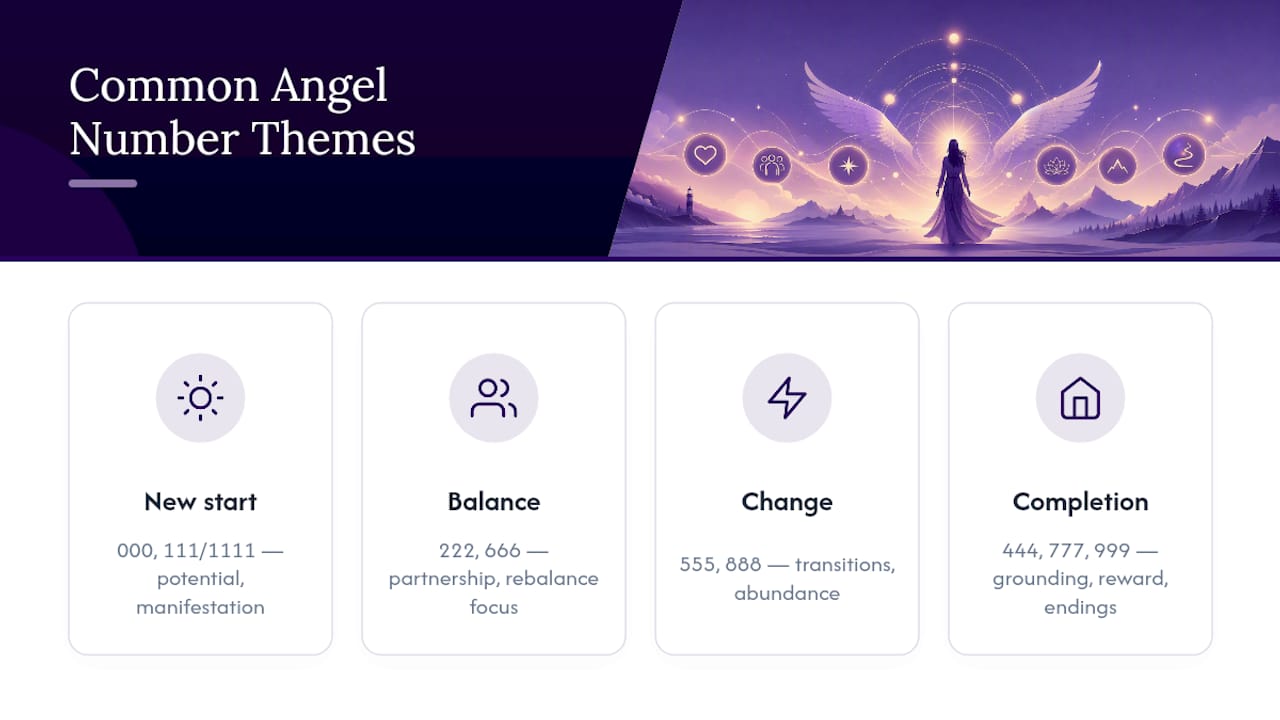
000 often reads as a marker of potential or a fresh cycle, before something has fully formed. Common context: transitions, waiting periods, the space between one chapter ending and the next starting. Reflective prompt: What am I waiting to begin?
111 and 1111 frequently get tied to new beginnings and manifestation, the idea that attention and intention are aligning. Common context: starting a project, meeting someone new, a fresh idea taking hold. Reflective prompt: What am I actively creating right now?
222 is often read as balance or partnership, a signal to slow down rather than force an outcome. Common context: negotiations, relationship decisions, patience-testing situations. Reflective prompt: Where do I need more patience or cooperation?
333 commonly suggests growth or creative expression, sometimes described as encouragement to keep moving. Common context: creative work, self-expression, feeling supported in a decision. Reflective prompt: What am I holding back from expressing?
444 tends to signal grounding, stability, or protection. Common context: financial decisions, home life, moments of doubt about safety or direction. Reflective prompt: What foundation am I building on right now?
555 usually points to change, often unexpected or accelerated. Common context: a move, a job shift, a relationship ending or starting. Reflective prompt: What change am I resisting?
666 is widely misread as purely negative, but many numerologists frame it as a call to rebalance attention, often toward material versus emotional priorities. Common context: overwork, financial stress, neglecting relationships. Reflective prompt: What area of my life feels out of balance?
777 often gets tied to luck, alignment, or confirmation that effort is paying off. Common context: after a period of hard work, right before a result lands. Reflective prompt: What effort am I about to see rewarded?
888 commonly suggests abundance or a cycle reaching fullness. Common context: financial shifts, closing out a project, harvest-type moments. Reflective prompt: What am I ready to receive or release?
999 usually reads as completion, the end of a cycle. Common context: endings, graduations, letting go of something that's run its course. Reflective prompt: What needs to close before something new can start?
Mirror times like 11:11 deserve a separate note because clocks are the single most common place people report sightings. The mirrored structure itself, rather than the specific digits, is often what people find most striking, since it feels less like coincidence than a straight sequence might.
USA TODAY's reporting on angel numbers notes that many numerologists frame these sequences as confirmations or "green lights" rather than guaranteed predictions, a distinction worth keeping in mind as you move from noticing a number to deciding what it means for you.
How Do You Interpret Angel Numbers For Yourself?
Generic meanings only get you partway. The real work happens when you map a sequence against your own circumstances and track whether the interpretation holds up. Christianity.com's writing on the topic notes that practitioners recommend keeping a log of thoughts, feelings, and life context whenever a sequence appears, so the meaning becomes personal rather than borrowed from a chart.
Here's a repeatable workflow:
- Pause. Don't rush past the sighting. Give it five seconds of attention.
- Capture the basics. Time, place, and what you were feeling, written down immediately, not reconstructed later.
- Record your first impression. Before consulting any meaning list, what did the number make you think of?
- Map it to a numerology theme. Use the common meanings above as a reference, not a verdict.
- Test it over two to four weeks. Did treating the sighting as a prompt change a decision, or did it just fade into background noise?
A basic journal template can be as simple as four lines: What was I thinking about? What decision was on the table? What did I do differently afterward, if anything? Did the number recur? Tarosyn's guide to journaling practice walks through templates that work well for this kind of tracking.
One additional tool worth learning is digit-sum reduction, a common numerology technique. Take a sequence like 1234, add the digits (1+2+3+4=10), then reduce again (1+0=1). That final digit maps back to core numerology themes, in this case, new beginnings. It's not a scientific method, but it's a consistent way to interpret sequences that don't repeat a single digit.
The meaning of an angel number rarely lives in the number itself. It lives in what you were carrying when you saw it, and whether naming that out loud changed anything.
Pro Tip: If a number keeps showing up during a specific type of decision (money, relationships, work), that pattern is more informative than the number's textbook meaning.
Are Angel Numbers Real, Or Just Pattern Recognition?
Skeptics have a fair point, and it's worth sitting with rather than dismissing. Psychologists describe apophenia as the tendency to see meaningful patterns in random data, and confirmation bias as the tendency to notice evidence that confirms what you already expect while ignoring evidence that doesn't. Add selective attention, your brain filtering for what it's primed to notice, and it's easy to see why someone thinking about angel numbers starts spotting them everywhere.
That doesn't make the practice worthless. Try a pragmatic test instead of an ideological one:
- Does treating the number as a prompt change your behavior or clarity in a way that helps?
- Would you have made the same decision anyway, or did the pause genuinely shift something?
- Are you using the number to avoid a decision, or to sit with one more honestly?
If the answer leans positive, the practice has value regardless of whether you believe in a supernatural mechanism behind it. AmazingNumerology's take frames repeating digits as amplified energy worth using as a reflection prompt, not a guaranteed sign. That's a workable middle ground for skeptics and believers alike.
Why Trust This Guide On Angel Numbers Meaning
This guide draws on numerology frameworks from established practitioner sources, mainstream reporting on the trend, and a journaling-first methodology rather than rote chart lookup. Joseph Calitoy's contribution to Tarosyn's content reflects that same approach: treat angel numbers as a contemporary interpretive layer, not an ancient universal code, and prioritize personal testing over borrowed certainty.
To keep building the practice, these resources go deeper:
- Tarot and numerology connections, for readers who want to see how numbers and cards overlap
- Spiritual affirmations built from numerology numbers, a practical next step after journaling
- Tarosyn's daily horoscope, for readers who want a daily prompt tied to astrology alongside number tracking
- Tarosyn's public community journal, for comparing sightings with other people doing the same practice
What Actually Matters When Working With Angel Numbers Meaning
Most advice on this topic treats angel numbers like a vending machine: put in a number, get out a fixed meaning. That's the part I'd push back on hardest. The numerology associations for 111 or 444 are useful starting vocabulary, but they're not the point. The point is what happens when you stop, write down what you were carrying in that moment, and check back in a few weeks to see if anything shifted.
Conventional angel-number content skips the tracking step almost entirely, and that's the gap that matters most. A chart lookup gives you a story. A log gives you evidence, about your own patterns, your own recurring worries, your own decision points. If you take one thing from this guide, let it be the habit, not the digit meanings. Start with two weeks of honest notes before you trust any interpretation, including the ones you just read here.
— Joseph Calitoy
Build Your Own Angel Number Practice With Tarosyn
A journal alone can only take you so far; at some point you want a second perspective on what a pattern might mean for a specific question in your life. Tarosyn pairs that reflection with AI-guided tarot and numerology readings built around your own birth details and the questions you're actually sitting with, rather than a one-size-fits-all number chart.

If you've started logging sightings of 111 or 444 around a decision, a guided reading can help you connect that pattern to the bigger picture. Tarosyn's three-card spread is built for exactly that kind of open question, and the platform saves your readings so you can compare them against your journal entries over time. For readers drawn to the numerology side specifically, Tarosyn's spirituality resources connect number themes to tarot and astrology in one place. Partner resources like Black Witch Coven's guide to trusting your intuition pair well with this kind of practice too. Start a reading today and see how your next sequence sighting lines up.
Sources
For readers who want to go beyond this guide, Allure's explainer covers common sequences and everyday examples. USA TODAY offers a grounded, mainstream take on the trend's popularity. Christianity.com examines the practice from a faith-based angle, while KnowTheAngels and Code of Ascension go deeper into pattern verification. Vogue covers the astrology community's perspective on decoding sequences.
- A Guide to Angel Numbers and What They Mean | Allure
- Christianity
- What are angel numbers? | USA TODAY
- Recurring Numbers: Pattern Recognition, Meaning, and Caution (KnowTheAngels)
- Synchronicity Numbers Meaning Guide: Spiritual Meanings of Repeating Numbers | Code of Ascension
- How To Decode Them, According To An Astrologer | Vogue