Tarot and numerology are two systems expressing the same underlying language about how consciousness develops through numbered stages. The tarot deck divides into the Major Arcana and the Minor Arcana, each forming a numerical sequence that maps cycles of growth, challenge, and completion. Numerology reads the qualities those numbers carry. Tarot makes those qualities visible through imagery and symbol. Together, they give you two views of the same map.
Here is what that connection looks like in practice:
- Number reduction: Every double-digit card reduces to a single digit, revealing a hidden layer of meaning beneath the surface image.
- Archetypal cycles: Numbers 1–10 trace a complete arc from pure potential to full manifestation, repeated across all four suits.
- Master numbers: 11, 22, and 33 carry amplified energy that shows up in specific Major Arcana cards.
- Personal numerology: Your life path number translates directly into a tarot birth card, linking your numerological profile to a Major Arcana archetype.
- Spread patterns: Repeating numbers across a spread signal a dominant theme that can override individual card meanings.
The Hermetic Order of the Golden Dawn engineered this fusion deliberately around 1888. W.W. Westcott and S.L. MacGregor Mathers assigned the Fool to position 0, adjusted card sequences to align with Kabbalistic and astrological correspondences, and built the mathematical structure that virtually every modern tarot deck still uses. This was not ancient tradition passed down through centuries. It was a precise design by people who understood both systems deeply enough to fuse them into something neither could be alone.
How numerology works and why it applies to tarot
Numerology treats numbers as qualities, not quantities. Each number describes a specific mode of consciousness, reflecting how energy organizes itself through stages of potential, development, and completion. That framing maps directly onto tarot's visual language, which is why the two systems fit together so cleanly.
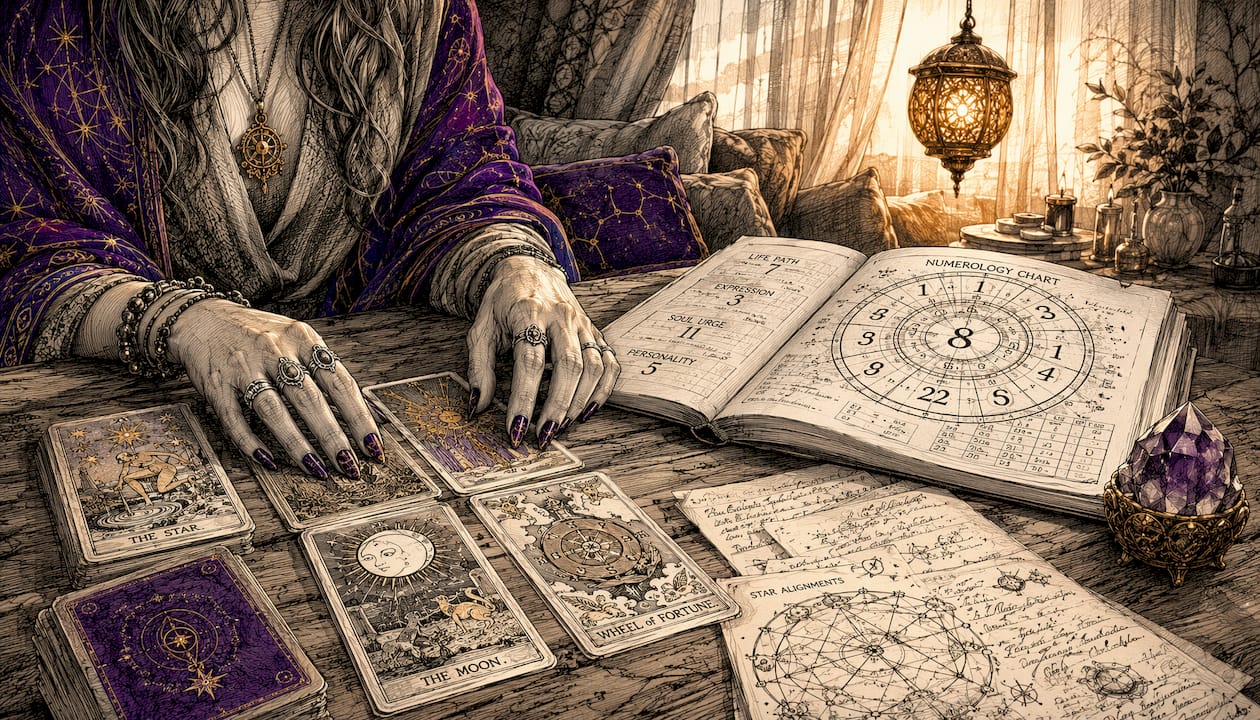
The Pythagorean tradition forms the backbone of how numerology applies to tarot. Pythagoras taught that numbers are living principles structuring reality itself. His concept of the sacred decad, a triangular arrangement of rows containing 1, 2, 3, and 4 items totaling 10, gave the number 10 special significance as a symbol of perfection and return. The total card count of 78 is itself a triangular number: 1 + 2 + 3 + 4 + 5 + 6 + 7 + 8 + 9 + 10 + 11 + 12. That was not an accident.
Key numerological concepts that apply directly to tarot:
- Digit reduction (theosophical reduction): Add the digits of any number until one remains. This reveals the single-digit principle operating beneath a card's surface meaning.
- Odd/even polarity: Odd numbers (1, 3, 5, 7, 9) carry active, dynamic energy. Even numbers (2, 4, 6, 8, 10) carry receptive, stabilizing energy.
- Life path numbers: Calculated from your birth date, these link to specific Major Arcana cards as personal birth cards.
- Personal year cycles: A nine-year numerological cycle that can be mapped against tarot spreads for timing and context.
- The Decad: The numbers 1–10 contain all principles of existence. Ten returns to one, completing and restarting the cycle.
The Kabbalistic Tree of Life adds another layer. Its ten Sephiroth (emanations) correspond directly to the numbered cards of the Minor Arcana, from Kether (1, pure potential) through Malkuth (10, physical manifestation). This gives each number a precise metaphysical address within a system that tarot's designers consciously built upon.
1. Aces: pure potential and new beginnings
The Ace in each suit carries the energy of the number 1, which Pythagorean philosophy calls the Monad: unity, the source, the undivided point before anything splits into duality. In Kabbalistic terms, each Ace is Kether manifesting through its element. The Ace of Wands is transcendent will as fire. The Ace of Cups is transcendent love as water. The Ace of Swords is transcendent truth as air. The Ace of Pentacles is transcendent abundance as earth.
All four Aces offer raw potential waiting to be activated. Nothing has been built yet. The seed exists, but the soil has not been chosen.
2. Twos: duality, choice, and balance
The number 2 introduces polarity. One force meets another, and a decision becomes necessary. The Twos across all suits reflect this tension between opposing forces, whether that is emotional ambivalence (Two of Cups), intellectual conflict (Two of Swords), competing priorities (Two of Pentacles), or competing wills (Two of Wands).
In the Major Arcana, the High Priestess holds the 2 position. She sits between two pillars, one black and one white, embodying the principle of duality without resolving it. She knows both sides and chooses to hold the tension rather than collapse it into a decision.
3. Threes: growth, creativity, and first manifestation
Three is where potential becomes visible. The number 3 represents the union of 1 and 2 producing something new: synthesis, creation, the first evidence that something is actually growing. Threes across the suits show early-stage results. The Three of Pentacles shows skilled work being recognized. The Three of Cups shows community and celebration. The Three of Wands shows plans extending outward toward the horizon.
The Empress holds position 3 in the Major Arcana. She is abundance, fertility, and creative force made physical. The Hanged Man (12, reducing to 3) and the World (21, reducing to 3) both carry this creative energy at higher octaves: the Hanged Man through surrender that produces new perspective, the World through the completion that seeds the next cycle.
4. Fours: structure, stability, and foundation
Four is the stabilizing force. It appears in the four elements, the four seasons, the four cardinal directions. Fours in tarot mark the point where something solid has been built, for better or worse. The Four of Pentacles shows material security held tightly. The Four of Cups shows emotional stability that has turned inward and stagnant. The Four of Swords shows rest after conflict.
The Death card (13) reduces to 4, connecting transformation directly to the principle of foundation-building. Beneath the dissolution, something more stable is being constructed. The ending is not chaos. It is composting.
5. Fives: crisis, conflict, and the midpoint challenge
Five is the most consistently difficult number across both the Minor and Major Arcana, and the reason is structural. Five sits at the center of the 1–9 cycle. It is the point where the initial momentum of 1–4 meets resistance, and the system must either break through or break down. The Five of Wands shows scattered conflict. The Five of Pentacles shows material loss. The Five of Cups shows grief. The Five of Swords shows defeat.
The Hierophant holds position 5 in the Major Arcana. His number represents discipline and the governing of opposing forces, which is exactly what the Minor Arcana Fives show failing. When the Hierophant's principle of structured guidance is absent, the raw energy of five produces conflict instead of mastery. Tarosyn's Hierophant relationship reading illustrates this directly: the card's number 5 energy shifts meaning significantly depending on whether it appears in a position of challenge or resolution within a spread.
6. Sixes: harmony, recovery, and rebalancing
After the disruption of five, six brings resolution. The number 6 corresponds to Tiphareth on the Kabbalistic Tree of Life, the beauty at the heart of the system, the point of balance between all other forces. Sixes across the suits show a return to equilibrium. The Six of Cups brings nostalgia and emotional warmth. The Six of Pentacles shows generosity and fair exchange. The Six of Wands shows public recognition after struggle.
The Lovers card holds position 6 in the Major Arcana, representing the harmony of two forces in conscious alignment. Six is where the system breathes out after the tension of five.
7. Sevens: introspection, spiritual questioning, and inner work
Seven is the number of mystery and inner development. Sevens in tarot consistently point inward rather than outward. The Seven of Cups shows illusion and the need to discern what is real. The Seven of Pentacles shows patient assessment of long-term work. The Seven of Swords shows strategy and the need to think carefully. The Seven of Wands shows holding a position under pressure.
When multiple 7s appear across a spread, the reading's dominant frequency is introspection and spiritual questioning. The number itself becomes the message, regardless of what each individual card appears to say. The Chariot holds position 7 in the Major Arcana, showing mastery achieved through inner alignment rather than external force.
8. Eights: power, momentum, and regeneration
Eight carries the energy of cycles, strength, and forward movement. Turned on its side, 8 becomes the infinity symbol, suggesting continuous flow rather than a fixed endpoint. Eights in tarot show momentum building. The Eight of Pentacles shows dedicated skill development. The Eight of Wands shows rapid movement and communication. The Eight of Cups shows the strength to walk away from what no longer serves.
Strength holds position 8 in the Major Arcana, demonstrating the principle of inner power applied with calm rather than force. The Tower (16) reduces to 7, but the Star (17) reduces to 8, connecting the hope and renewal of the Star to Strength's sustained application of spiritual force.
9. Nines: completion, wisdom, and the end of a cycle
Nine is the final single digit, the point where a cycle reaches its natural conclusion. Nines in tarot carry the weight of accumulated experience. The Nine of Pentacles shows self-sufficiency earned through long effort. The Nine of Cups shows emotional fulfillment. The Nine of Wands shows resilience after repeated challenges. The Nine of Swords shows the anxiety that comes with knowing a cycle is ending.
The Hermit holds position 9 in the Major Arcana. He has walked the full journey and now carries his lantern for others. A Life Path 9 in numerology carries the same assignment: wisdom earned through the complete experience of the cycle, now offered outward. The Hermit and Life Path 9 describe identical things in different forms.
10. Tens: culmination, transition, and the seed of what comes next
Ten marks the end of the cycle and simultaneously contains the seed of the next one. In Pythagorean numerology, 10 is the Decad: perfection, the return to unity at a higher level. The Ten of Pentacles shows generational wealth and legacy. The Ten of Cups shows emotional fulfillment across a family or community. The Ten of Wands shows the burden of carrying everything to the finish line. The Ten of Swords shows a definitive ending that clears the ground completely.
The ten does not reduce further in the Minor Arcana, but it carries the energy of 1 within it. Every ending is also a beginning. The Wheel of Fortune holds position 10 in the Major Arcana, symbolizing the completion of a cycle and the moment of totality before the wheel turns again.
How the Major Arcana uses numerology differently
The Major Arcana runs from 0 to 21, and its mathematical structure is more deliberate than most readers realize. The 22 cards arrange into three rows of seven, with the Fool standing apart at 0.
- Row one (Keys 1–7): The powers of consciousness available to the developing soul. The Magician, High Priestess, Empress, Emperor, Hierophant, Lovers, and Chariot.
- Row two (Keys 8–14): The laws governing those powers. Strength, Hermit, Wheel of Fortune, Justice, Hanged Man, Death, and Temperance.
- Row three (Keys 15–21): The effects produced when power meets law. The Devil, Tower, Star, Moon, Sun, Judgement, and World.
Justice sits at position 11, the mathematical center of the entire tableau. Every pair of cards equidistant from Justice sums to 22. Keys 10 and 12 sum to 22. Keys 9 and 13 sum to 22. Keys 1 and 21 sum to 22. Justice is not just a card about fairness. It is the fulcrum of the system's architecture.
Master numbers appear here as well. Justice at 11 carries amplified energy beyond its reduction to 2. The number 22 appears as the total card count of the Major Arcana, connecting to the master builder energy of 22 in numerology. These numbers resist reduction because their doubled energy carries specific significance that the single digit alone cannot hold.
Digit reduction reveals hidden connections between double-digit cards and their single-digit counterparts:
- Death (13) reduces to 4 (the Emperor): transformation building a new foundation.
- Temperance (14) reduces to 5 (the Hierophant): patient alchemy governing opposing elements.
- The Tower (16) reduces to 7 (the Chariot): collapse forcing the path of inner mastery open.
- The Star (17) reduces to 8 (Strength): hope expressed as sustained, calm spiritual force.
- The World (21) reduces to 3 (the Empress): completion returning to creative generative energy.
Practical ways to use numerology in your tarot readings
The most direct technique is digit reduction. When you draw a card with a double-digit number, add those digits together. The resulting single digit names the underlying principle at work beneath the card's surface imagery. Death (13) becomes 4. The Tower (16) becomes 7. This gives you a second card to read alongside the first, one explicit and one hidden.
Pro Tip: When a reading feels confusing or contradictory, sum all the card numbers in the spread and reduce to a single digit. That number names the reading's root tone. A spread reducing to 9 is fundamentally about completion and release, regardless of what any individual card appears to say.
Watch for repeating numbers across a spread. When multiple cards share the same number, that number becomes the reading's dominant message. Three cards reducing to 4 are insisting on structure and commitment. Three cards reducing to 7 are calling for introspection and spiritual questioning. The number tells you the energy. The individual cards tell you where that energy is operating.
Practical techniques to apply right now:
- Calculate your birth card: Add your full birth date to a single number (or stop at a two-digit master number). That number is your Major Arcana birth card. A Life Path 7 corresponds to the Chariot.
- Track your personal year: Add your birth month, birth day, and the current year together, then reduce. The resulting number names the numerological cycle you are in, and the corresponding tarot card describes its energy.
- Note numerical sequences in spreads: A 3-4-5 sequence shows natural progression. A jump from 2 to 5 to 8 suggests rapid development skipping through stages.
- Use Fives as a diagnostic: When Fives cluster in a reading, the querent is at a genuine midpoint crisis. The question is not whether the challenge is real but which governing principle (the Hierophant's number 5 energy) is missing from their approach.
- Apply reduction to clarify challenging cards: When the Tower or Death appears and a querent is unsettled, reducing to 7 or 4 respectively shifts the conversation from fear to function.
For tarot guidance that integrates these numerological layers into live readings, working with a practitioner who explicitly uses number reduction and spread-level numerology can sharpen interpretations considerably.
How Tarosyn brings numerology and tarot together
Tarosyn is an AI-powered spiritual ecosystem that integrates tarot, astrology, and numerology into a single platform. It uses numerological calculations and archetypal data to personalize readings, connecting card meanings to the specific numerical cycles a reader is moving through.
The practical difference this makes is precision. A standard reading of the Hierophant gives you tradition, authority, and spiritual guidance. A numerology-informed reading through Tarosyn connects the card's number 5 energy to the querent's current personal year cycle, the suit context of surrounding cards, and the reduction values of other cards in the spread. The interpretation becomes specific rather than general.
Benefits of using an AI-integrated platform for numerological tarot study:
- Personalized number mapping: Your life path and personal year numbers are factored into card interpretations automatically.
- Spread-level numerology: The platform calculates the root tone of a full spread, not just individual cards.
- Archetypal cross-referencing: Tarosyn's tarot archetypes library connects each card's number to its Kabbalistic, Pythagorean, and Hermetic correspondences.
- Consistent reduction: Double-digit cards are always reduced and cross-referenced with their single-digit counterparts, so hidden layers surface in every reading.
- Community context: Readings are situated within a social ecosystem where you can see how others interpret the same numerical patterns.
Pro Tip: Use Tarosyn's spread readings to study how the same number behaves differently across suits. Pull up any three-card spread featuring a Five and compare how the number's energy shifts between Wands, Cups, Swords, and Pentacles. The contrast teaches you more about the number than any definition will.
The Temperance relationship spread on Tarosyn shows this in action. Temperance at position 14 reduces to 5, the Hierophant, connecting the angel's patient alchemy directly to the governing principle of discipline in relationships. That reduction is not visible in the card's surface imagery alone. Numerology surfaces it.
Try a three-card spread reading on Tarosyn to see how the World card's number 21 (reducing to 3) shapes the reading's creative and generative undertone, even when the surrounding cards point toward endings.
Key Takeaways
Tarot and numerology are one system expressed in two forms: numbers name the qualities, and cards make those qualities visible through image and symbol.
| Point | Details |
|---|---|
| Numbers 1–10 form a complete arc | Each number from Ace to Ten traces a stage from pure potential through crisis to completion, repeated across all four suits. |
| The Golden Dawn engineered the system | The modern tarot-numerology structure was deliberately built around 1888, not inherited from ancient tradition. |
| Digit reduction reveals hidden layers | Adding the digits of double-digit Major Arcana cards (e.g., Death 13 reduces to 4) connects each card to a deeper single-digit principle. |
| Repeating numbers override individual cards | When multiple cards share the same number in a spread, that number names the reading's dominant energy regardless of suit or imagery. |
| Personal numerology links to tarot archetypes | Your life path number maps directly to a Major Arcana birth card, giving your numerological profile a visual and archetypal face. |