
A birth chart is defined as a precise celestial snapshot of the sky at the exact moment and location of your birth. This astrology birth chart self-analysis guide walks you through reading that snapshot step by step, from generating your natal chart to applying its insights for real self-discovery. Astrologers call this process natal chart interpretation, and it centers on three core elements: your Sun sign, Moon sign, and Rising sign. You will also learn how planetary houses and major aspects add depth to your understanding. All you need to start is your birth date, exact birth time, and birthplace.
What do you need before starting your birth chart analysis?
Generating an accurate birth chart requires three inputs: your birth date, your exact birth time to the minute, and your birth location. Most free online chart calculators produce a complete chart in about 2–3 minutes once you enter those details. The birth time is the most critical piece. Without it, your Ascendant and house placements will be wrong or missing entirely.
Birth time errors as small as 30 minutes can shift house cusps and even your Moon sign, which changes every 2.3 days. That kind of error sends your entire analysis in the wrong direction. Verify your birth time using your official birth certificate before you begin.
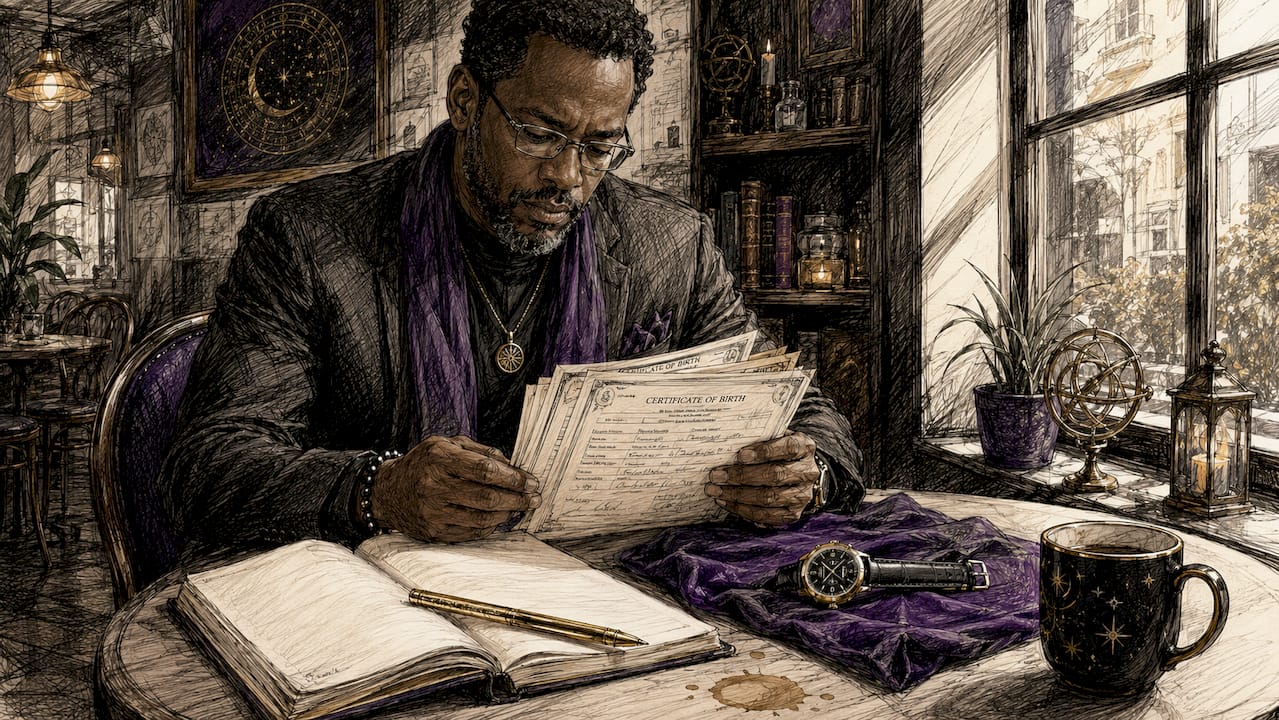
| Input | Why it matters |
|---|---|
| Birth date | Sets Sun sign and planetary positions |
| Exact birth time | Determines Rising sign and all 12 house cusps |
| Birth location | Adjusts local horizon for accurate house calculation |
| Verified source | Birth certificate removes guesswork from time accuracy |
Pro Tip: If your birth certificate lists only an approximate time, note that your house placements may be unreliable. Focus your early analysis on Sun and Moon signs until you can confirm the exact time.
How to interpret your birth chart's foundational elements
The Big Three placements — Sun, Moon, and Rising signs — form the foundation of birth chart interpretation and define the core of your personality. Astrologers recommend starting here before touching anything else in the chart. Each placement answers a different question about who you are.
Sun sign: your core identity
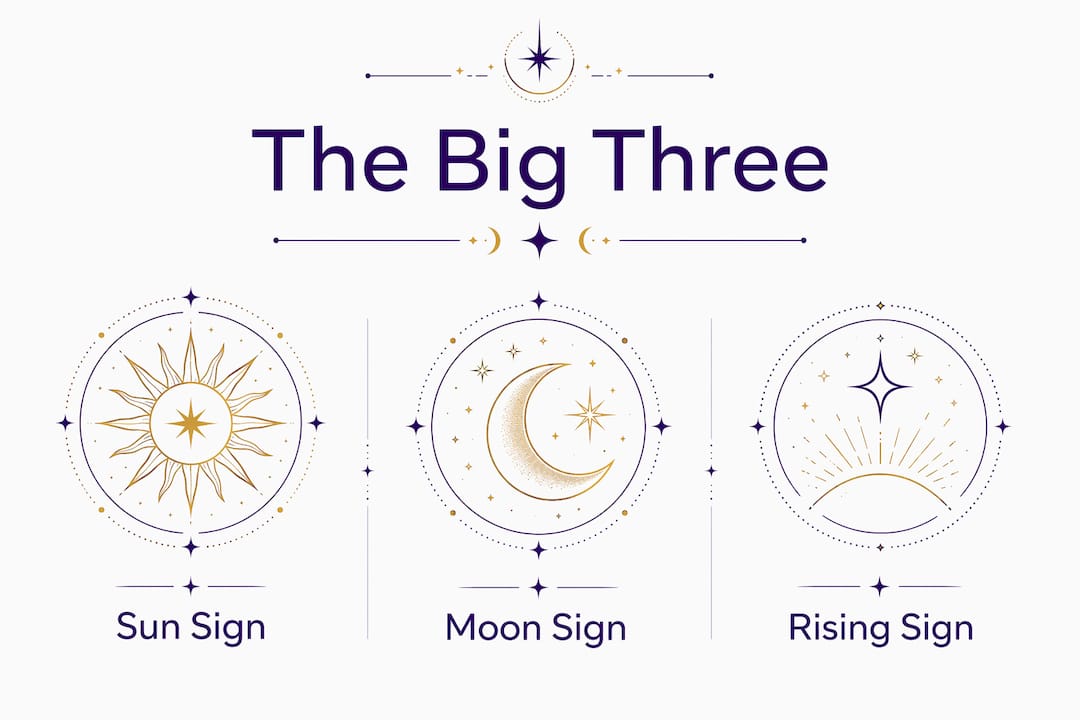
Your Sun sign represents your conscious identity, your will, and the qualities you are actively developing throughout your life. It is the sign most people know from popular astrology. A Capricorn Sun, for example, tends to build structure and pursue long-term goals with discipline.
Moon sign: your emotional landscape
Your Moon sign describes how you process emotions, what makes you feel safe, and your instinctive reactions. Because the Moon changes signs every 2.3 days, your birth time must be accurate to confirm it. A Scorpio Moon, for instance, processes feelings with intensity and needs deep trust before opening up.
Rising sign: your outer persona
Your Rising sign, also called the Ascendant, is the zodiac sign that was on the eastern horizon at your birth. It shapes how others perceive you and how you approach new situations. The Rising sign changes every two hours, which is why birth time accuracy matters so much.
These three placements interact constantly. A Leo Sun with a Pisces Moon and a Virgo Rising, for example, shows someone who craves recognition but processes emotion quietly and presents a careful, analytical face to the world. Recording all three in a notebook before moving forward keeps your analysis grounded.
Follow these steps to find and record your Big Three:
- Enter your birth data into a reputable chart calculator.
- Locate the symbol for the Sun and note its zodiac sign.
- Find the Moon symbol and record its sign.
- Look for "ASC" or "Ascendant" and note that sign.
- Write a one-sentence description of each placement in plain language.
- Read the three descriptions together and note where they agree or create tension.
Pro Tip: Pay attention to the element of each placement. Fire signs (Aries, Leo, Sagittarius) act; Earth signs (Taurus, Virgo, Capricorn) build; Air signs (Gemini, Libra, Aquarius) think; Water signs (Cancer, Scorpio, Pisces) feel. Knowing your elemental mix tells you a lot about how you move through the world.
What do planetary houses and aspects add to your chart?
Experts recommend a hierarchical layering approach: start with the Big Three, then move to planetary signs, houses, and major aspects in sequence. Skipping ahead creates confusion. Each layer adds context to the one before it.
Understanding the 12 houses
Astrological houses correspond to 12 life areas, and planets placed within those houses show where your energy focuses. The 1st house covers identity and appearance. The 7th covers partnerships. The 10th covers career and public reputation. Houses rotate approximately one degree every four minutes, which is why your birth time and location must be precise.
A planet in a house does not guarantee outcomes in that life area. It shows where you are likely to invest energy and encounter significant themes. Mars in the 10th house, for example, points to a driven, competitive approach to career rather than a guaranteed promotion.
Reading major aspects
Major aspects are the angular relationships between planets in your chart, and they reveal your internal dynamics. Trines and sextiles indicate areas of natural flow and ease. Squares and oppositions point to tension, challenge, and the friction that drives growth.
| Aspect | Angle | Interpretive tone |
|---|---|---|
| Trine | 120° | Natural talent, ease, flow |
| Sextile | 60° | Opportunity, cooperation |
| Square | 90° | Tension, challenge, motivation |
| Opposition | 180° | Polarity, awareness, integration |
| Conjunction | 0° | Intensity, fusion of energies |
Do not read a square as bad news. A Venus square Saturn, for example, can describe someone who works hard for what they love and builds lasting relationships through effort rather than luck.
Pro Tip: Before analyzing aspects, write down one specific question about your life. "Why do I struggle with commitment?" or "Where does my drive come from?" Focusing on a single theme makes the aspect patterns far more readable and personally relevant.
How do you apply natal chart insights to personal growth?
Birth charts reveal tendencies and energetic blueprints, not fixed predictions of specific life events. This distinction matters. Reading your chart as a script leads to fatalistic thinking. Reading it as a map of tendencies opens up real self-awareness.
Effective self-analysis starts with a specific personal question rather than a broad attempt to decode every placement at once. Ask something concrete: "What does my chart say about how I handle conflict?" Then look at Mars, its sign, its house, and its major aspects. That focused approach surfaces genuine insight.
Birth charts are tools for radical self-acceptance. Challenging placements are not flaws. They are the exact areas where your most meaningful growth happens.
Use these practices to connect your chart to daily life:
- Identify recurring patterns. If Saturn appears prominently in your chart, notice where you feel blocked or where you push hardest. That is Saturn's lesson in action.
- Track emotional triggers. Your Moon sign and its aspects often explain why certain situations hit harder than expected.
- Combine astrology with other tools. Pairing chart insights with journaling, therapy, or practices like tarot and astrology deepens the reflection.
- Revisit your chart at major life transitions. A chart you read at 22 will read differently at 35 because you have more lived experience to match against its patterns.
- Avoid fatalistic conclusions. Challenging aspects open channels for growth when you approach them with curiosity rather than dread.
The goal of astrology for personal growth is not to explain away your behavior. It is to give you a clearer picture of your tendencies so you can make more deliberate choices.
Common mistakes to avoid when reading your birth chart
Most errors in birth chart interpretation fall into a few predictable categories. Knowing them in advance saves you time and frustration.
- Using an unverified birth time. Even a 30-minute error shifts house cusps and can change your Moon sign entirely. Always confirm your time before trusting house placements.
- Overloading on data. Reading every planet, asteroid, and minor aspect at once produces noise, not insight. Start with the Big Three and add one layer at a time.
- Labeling aspects as good or bad. Trines are not automatically positive, and squares are not automatically negative. Every aspect carries both a gift and a challenge depending on how you work with it.
- Treating the chart as static. Your chart does not change, but your relationship to it does. Revisit it annually or during major life shifts.
- Skipping professional guidance when stuck. If a placement confuses you or triggers a strong emotional reaction, a professional astrologer or a supportive community resource can offer grounded perspective.
- Ignoring the astrology calendar context. Current planetary transits interact with your natal chart. Understanding timing adds a practical layer to your self-analysis.
Key Takeaways
A birth chart is a map of tendencies, not a script, and reading it in layers from the Big Three outward produces the clearest and most useful self-analysis.
| Point | Details |
|---|---|
| Verify birth time first | Even a 30-minute error shifts house cusps and can change your Moon sign. |
| Start with the Big Three | Sun, Moon, and Rising signs give you the fastest, most grounded personal insight. |
| Layer progressively | Add houses, then planetary signs, then aspects one step at a time to avoid confusion. |
| Ask a specific question | Focused intent produces clearer chart insights than broad decoding attempts. |
| Use the chart for growth | Treat challenging aspects as areas of opportunity, not fixed limitations. |
What I have learned from years of chart reading
The single biggest mistake I see is people trying to read everything at once. They pull up a chart covered in glyphs, lines, and numbers, and they immediately want to know what all of it means. That impulse is understandable, but it produces overwhelm, not insight.
My approach has always been to start with one question. Not "Who am I?" but something specific: "Why do I keep attracting the same kind of relationship?" or "What does my chart say about my work style?" That question acts as a filter. Suddenly, you know which planets and houses to look at first.
The other thing I have come to believe strongly is that the chart is not a verdict. I have seen people with difficult Saturn placements build extraordinary lives. I have seen people with "easy" charts struggle deeply. The placements describe the terrain, not the outcome. You still choose how to walk it.
Approach your chart with personal growth as the goal, not self-judgment. The chart is most useful when you treat it as a conversation with yourself, not a report card.
— Joseph
Tarosyn's tools for your birth chart practice
Tarosyn brings together AI-powered tarot readings, daily horoscopes, and a live community to support the kind of ongoing self-reflection that birth chart analysis calls for.
After you identify your key placements, a personalized reading can help you go deeper. The Queen of Wands reading on Tarosyn, for example, pairs well with chart insights around confidence and creative drive. For relationship themes surfaced in your 7th house, the relationship compatibility tool adds another layer of clarity. Tarosyn's subscription plans also give you access to expanded readings and community discussions where you can share your chart observations and get feedback from others on the same path.
FAQ
What is a birth chart in astrology?
A birth chart, also called a natal chart, is a map of where the planets were positioned at the exact moment and location of your birth. It serves as a blueprint of your personality tendencies, emotional patterns, and life themes.
How accurate does my birth time need to be?
Your birth time should be accurate to within a few minutes. A 30-minute error can shift your house cusps and potentially change your Moon sign, which significantly affects interpretation.
What are the Big Three in astrology?
The Big Three are your Sun sign, Moon sign, and Rising sign. They form the foundation of birth chart interpretation and give the clearest picture of your core identity, emotional style, and outward persona.
Can I read my birth chart without an astrologer?
Yes. Start with your Sun, Moon, and Rising signs using a free chart calculator, then layer in houses and aspects gradually. A professional astrologer adds value when you want deeper interpretation or feel stuck on a specific placement.
Do birth chart placements predict my future?
Birth charts map tendencies and internal patterns, not specific future events. They show where your energy naturally flows and where you are likely to face challenges, but they do not determine outcomes.