A birth chart is a precise astronomical map of the sky at the exact moment and location of your birth, used in astrology to reveal patterns in personality, behavior, and life experience. Also called a natal chart, it captures where every planet in the solar system was positioned relative to Earth at your first breath. Astrologers read these positions to draw meaningful personal insights. To generate one, you need three inputs: your birth date, birth time, and birth location. Each variable shapes the chart in specific ways, and understanding how birth chart works starts with knowing what those variables actually produce.
What are the main components of a birth chart?
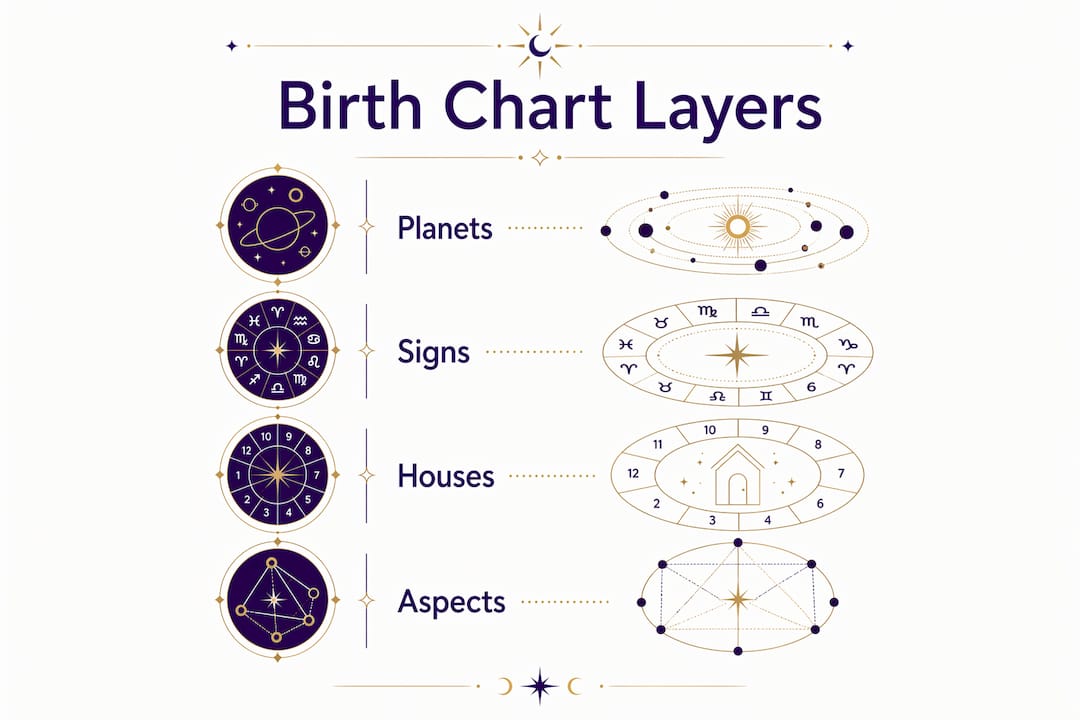
A natal chart is built from four interconnected layers: planets, signs, houses, and aspects. Each layer adds a different dimension to the overall picture. None of them works in isolation.
Planets: the actors
Planets represent core drives and energies within your psyche. The Sun governs identity and purpose. The Moon rules emotional needs and instincts. Mercury shapes how you think and communicate. Venus describes what you value and how you connect. Mars drives ambition and action. The outer planets, Jupiter through Pluto, operate on longer cycles and shape generational and deep psychological patterns.

Zodiac signs: the style
Each planet falls in one of the 12 zodiac signs at the moment of birth. The sign describes how that planet's energy expresses. Mars in Aries acts boldly and directly. Mars in Libra weighs options before moving. The sign does not change what the planet does. It changes the style in which it does it.
Houses: the life areas
The 12 houses divide the chart into specific life domains. Each house governs a distinct area of lived experience, from self-identity in the first house to the subconscious in the twelfth. A planet in the seventh house expresses its energy through partnerships. The same planet in the tenth house expresses through career and public reputation.
Aspects: the relationships
Aspects are the angular distances between planets, measured in degrees. Major aspects include the conjunction at 0°, sextile at 60°, square at 90°, trine at 120°, and opposition at 180°. Each angle describes a specific type of relationship between two planetary energies.
| Component | What it represents | Example |
|---|---|---|
| Planets | Core drives and psychological functions | Moon = emotional needs |
| Zodiac signs | Style of expression | Moon in Scorpio = intense emotional depth |
| Houses | Life area where energy operates | Moon in 4th house = home and family focus |
| Aspects | Relationship between two planets | Moon square Saturn = emotional restriction |
Why does birth time and place matter so much?
Birth time is the most critical variable in natal chart generation. The Ascendant changes roughly every 2 hours, with houses rotating 1° every 4 minutes. A small error in recorded time produces a noticeably different chart.
A birth time error of just four minutes shifts the Ascendant by about 1 degree, which can move house cusps and change which house a planet occupies. That shift alters the interpretation of that planet's life domain. The Ascendant anchors the entire house system, so its accuracy is foundational.
Birth location matters because it sets the geographic coordinates used to calculate the local horizon at the moment of birth. Two people born on the same day at the same time but in different cities will have different Ascendants and house placements. The planets will be in the same signs, but the chart structure will differ.
- Known birth time: Use the exact time from a birth certificate when possible.
- Unknown birth time: Astrologers use noon as a placeholder, but this produces unreliable Ascendant and house placements.
- Birth time rectification: A professional process that reverse-engineers birth time using significant life events. It is complex and time-intensive.
Pro Tip: Check your official birth certificate for the recorded time. Hospital records are more reliable than family memory, which can drift by 30 minutes or more.
How do planets, signs, houses, and aspects combine in interpretation?
Reading a natal chart is a synthesis process, not a checklist. True understanding requires combining planets, signs, houses, and aspects as a system rather than reading each placement in isolation. This is where most beginners get stuck.
Consider a concrete example. Venus in Gemini placed in the seventh house describes someone who values variety and intellectual connection in partnerships. Add a square from Saturn to that Venus, and the picture shifts. Saturn squares Venus introduces friction, suggesting that relationships require effort and may feel restricted or delayed. The planet, sign, house, and aspect together tell one coherent story.
Aspects animate the chart. Trines and sextiles tend toward harmony, squares and oppositions indicate tension, and conjunctions intensify the blending of two energies. These angular relationships reveal where you cooperate with yourself and where you create internal conflict.
The most common interpretive mistake is over-focusing on the Sun sign. Sun sign astrology, the kind found in newspaper columns, uses only one of dozens of chart factors. The Big Three, which are the Sun, Moon, and Rising sign, form the foundation of personality and provide a far more complete picture than the Sun sign alone. The Moon sign governs your emotional interior. The Rising sign shapes how others perceive you and sets the house structure for the entire chart.
Synthesis also means recognizing that no single placement is "good" or "bad." A Saturn square to Venus is not a curse. It is a pattern that describes where discipline and patience produce the most meaningful relationships. The chart describes tendencies, not outcomes.
How can beginners start reading their own natal charts?
Start with the Big Three before anything else. Identify your Sun sign, Moon sign, and Rising sign. These three placements give you a working psychological portrait that you can build on.
- Find your Sun sign. This describes your core identity and conscious purpose. It is the placement most people already know.
- Find your Moon sign. This reveals your emotional needs, instincts, and what makes you feel secure. It often describes your private self more accurately than the Sun.
- Find your Rising sign (Ascendant). This shapes your social presentation and sets the house structure. The Rising sign influences how others see you and determines which house each zodiac sign rules in your chart.
- Check your house placements. Note which houses hold the most planets. A cluster of planets in the third house points to a life strongly shaped by communication and learning. A cluster in the eighth house suggests themes of transformation and shared resources.
- Study your major aspects. Look for squares and oppositions first. These are the areas of your chart that generate the most internal tension and, often, the most growth.
Pro Tip: Use Tarosyn's daily horoscope tools alongside your natal chart study. Tracking how current planetary movements interact with your natal placements builds practical interpretive skill faster than reading alone.
Avoid the trap of reading each placement as a fixed verdict. Birth charts reflect habits of consciousness and adaptive patterns, not predetermined fate. The chart describes where you tend to go by default. Awareness of those defaults is the first step toward choosing differently.
You can also pair your natal chart with relationship analysis. Synastry compares two charts to reveal compatibility dynamics, showing where two people's planetary energies align or create friction.
Key Takeaways
A birth chart works by mapping planetary positions at your exact birth moment across four layers: planets, signs, houses, and aspects, which must be read together as a system for meaningful interpretation.
| Point | Details |
|---|---|
| Four core components | Planets, signs, houses, and aspects each add a distinct layer to chart interpretation. |
| Birth time precision | The Ascendant shifts every 2 hours; even a 4-minute error changes house placements significantly. |
| Synthesis over isolation | Reading planets, signs, and houses together produces accurate insights; Sun sign alone does not. |
| The Big Three | Sun, Moon, and Rising sign form the foundation of any natal chart reading for beginners. |
| Charts show patterns, not fate | Birth charts describe habitual tendencies and adaptive patterns, not fixed outcomes. |
Birth charts as living tools, not fixed verdicts
I have spent years studying natal charts, and the single biggest shift in my understanding came when I stopped treating the chart as a personality label and started treating it as a map of habitual consciousness. The chart shows you where your default settings are. It does not tell you where you have to stay.
The evolutionary astrology tradition makes this explicit. Chart interpretation focuses on tendencies and adaptive patterns, not predetermined fate. A Mars square Pluto does not mean you are destined for conflict. It means power and assertion are areas where you will face repeated tests until you develop conscious skill. That framing changes everything.
What I find most people miss is the chart ruler. The Ascendant and its ruling planet shape the overall tone of the chart and deserve careful study before diving into individual placements. Most beginners skip straight to their Sun or Moon and miss the structural key that holds the whole chart together.
My honest advice: sit with your chart for months, not hours. The layers reveal themselves gradually. Each time a major transit activates a natal placement, you get a live demonstration of what that placement actually means for you specifically. That real-time feedback is worth more than any textbook definition.
— Joseph
Personalized readings with Tarosyn
Tarosyn brings natal chart interpretation together with AI-powered tarot and astrology tools in one place. If you want to go deeper than self-study, a custom canvas reading gives you a personalized look at the archetypes and energies most active in your chart right now. Tarosyn also offers daily horoscopes by zodiac sign to keep your chart study grounded in current sky patterns. For readers who want to connect tarot symbolism with their natal placements, Tarosyn's integrated tools make that combination practical and accessible.
FAQ
What is a birth chart in astrology?
A birth chart, also called a natal chart, is an astronomical map of planetary positions at the exact moment and location of your birth. Astrologers use it to interpret personality patterns, life themes, and psychological tendencies.
How does birth time affect a natal chart?
Birth time determines the Ascendant and house placements. The Ascendant changes roughly every 2 hours, so even a small time error shifts the entire house structure and changes which life areas each planet governs.
What are the Big Three in a birth chart?
The Big Three are the Sun sign, Moon sign, and Rising sign. They form the core of natal chart interpretation and provide a more complete personality portrait than the Sun sign alone.
Can I read my birth chart without knowing my exact birth time?
You can identify planetary sign placements without a birth time, but the Ascendant and house positions will be unreliable. Astrologers use noon as a placeholder in this case, which limits the chart's accuracy.
What do aspects mean in a birth chart?
Aspects are angular distances between planets that describe how those planets interact. Trines and sextiles indicate harmony, squares and oppositions indicate tension, and conjunctions blend two energies intensely.