
Karmic debt numbers are 13, 14, 16, and 19, written in numerology as 13/4, 14/5, 16/7, and 19/1 because the compound form stays visible before final reduction. They show up in your Life Path, Birthday, or Expression numbers and mark a concentrated lesson your chart wants you to work through. None of this locks you into a fixed fate. Treat it as a curriculum, not a sentence.
TL;DR:
- Karmic debt numbers 13, 14, 16, and 19 can appear in your birthday, Life Path, or Expression numbers, indicating specific lessons to work through.
- Checking all chart positions, including intermediate totals in addition to the final numbers, helps identify these debts, which are often overlooked with quick calculations.
- Each debt relates to unique themes: discipline (13/4), moderation (14/5), humility (16/7), and balanced independence (19/1), emphasizing active correction over fixed fate.
- Working with these numbers involves conscious habit formation, journaling, and affirmations targeted at the core lesson, rather than treating them as permanent labels.
- Karmic debt numbers are distinct from master numbers, as they highlight areas for growth rather than amplified potential, and multiple debts can coexist in a single chart.
Table of Contents
- What Are Karmic Debt Numbers and Where Do They Show Up?
- How Do You Calculate a Karmic Debt Number?
- What Do 13/4, 14/5, 16/7, and 19/1 Actually Mean?
- How Do You Work With a Karmic Debt Number Day to Day?
- Where Did Karmic Debt Numbers Come From?
- Karmic Debt Numbers vs. Master Numbers and Other Chart Markers
- Common Misconceptions About Karmic Debt Numbers
- How Karmic Debt Numbers Interact With the Rest of Your Chart
- Real-World Patterns: What Karmic Debt Looks Like in Practice
- The Tarosyn Take on Working With Karmic Debt Numbers
- Ready to Check Your Own Numbers?
- Sources
- FAQ
What Are Karmic Debt Numbers and Where Do They Show Up?
Check three spots in your chart. Each one can carry a karmic debt on its own, and some people find more than one.
- Your birthday. If you were born on the 13th, 14th, 16th, or 19th of any month, that alone counts as a karmic debt marker, no further math required.
- Your Life Path running total. Add the digits of your birth date step by step. If an intermediate sum lands on 13, 14, 16, or 19 before you reduce it to a single digit, note it down before you continue.
- Your Expression or Destiny number. This comes from converting your full birth name into numbers and adding them up. Multiple positions in one chart can hold different debts at once.
If none of the four numbers appear anywhere in your chart, that is fine. Your growth themes will show up through other markers instead, like master numbers or challenge numbers, or through your birth chart in astrology.
How Do You Calculate a Karmic Debt Number?
The math is simple addition, but the trick is pausing before you reduce.
- Write out your birth date numerically (month, day, full year).
- Add every digit together, but stop and record the number the moment your running total hits 13, 14, 16, or 19.
- Keep reducing to get your final Life Path digit, but keep the intermediate karmic number on file. That intermediate stop is the debt.
- For Expression numbers, convert each letter of your birth name using the Pythagorean system (A=1, B=2, C=3, and so on through I=9, then repeating), add the digits of your first, middle, and last names, and again watch for a 13, 14, 16, or 19 appearing before you collapse it to one digit.
Say someone was born July 9, 1990. Adding 7 + 9 + 1 + 9 + 9 + 0 gives 35, which reduces to 8. But if you add in stages (7 + 9 = 16), you hit an intermediate 16 before continuing. That 16 is worth flagging even though the final Life Path is 8.
A calculator saves time here, since layered addition gets easy to fumble by hand.
Pro Tip: Do the math twice, once by hand and once with a calculator. Numerology beginners often reduce too early and miss the compound number sitting right in the middle of their own addition.
What Do 13/4, 14/5, 16/7, and 19/1 Actually Mean?
Each compound carries a distinct lesson tied to its final digit, and numerology writers agree on the core themes even when the wording differs.
- 13/4: discipline and follow-through. This number points to a pattern of shortcuts or unfinished work in a past cycle. The corrective work is structure: small daily routines, finishing what you start, and resisting the urge to skip steps that feel boring.
- 14/5: freedom without excess. The lesson centers on overindulgence, whether that is substances, distraction, or restlessness that never settles. Moderation strategies and firm personal boundaries do the repair work here.
- 16/7: humility after a fall. This one often carries a story of pride or ego that led to a personal collapse. The path forward is honest reflection and rebuilding trust in yourself and others, without leaning on old reputations.
- 19/1: independence that doesn't isolate. People with this number tend to resist help even when they need it. The growth edge is learning to lead while staying connected, and asking for support instead of proving everything alone.
| Compound | Reduced digit | Core theme |
|---|---|---|
| 13 | 4 | Discipline, structure, completion |
| 14 | 5 | Moderation, freedom, self-control |
| 16 | 7 | Humility, honesty, inner rebuilding |
| 19 | 1 | Balanced independence, service |
Journalistic coverage of numerology frames these four numbers as lessons carried over from a past life that need active correction. Whether or not you take the past-life framing literally, the practical takeaway holds either way: each number names a specific skill you're being asked to practice, not a flaw you're stuck with.
How Do You Work With a Karmic Debt Number Day to Day?
Naming the debt is the easy part. Numerologists consistently point out that conscious repetition of the corrective habit is what turns a karmic debt number from a label into a working tool.
- Journal the pattern. Every time you notice yourself avoiding discipline (13/4), overdoing something (14/5), acting from pride (16/7), or refusing help (19/1), write down the moment. Patterns become obvious after two or three weeks.
- Build one small daily habit tied to your number. A 13/4 might set a 10-minute cleanup routine each evening. A 14/5 might commit to one screen-free hour. A 16/7 might write a nightly honesty check-in. A 19/1 might practice asking one person for help each week.
- Use affirmations built around the theme, not generic positivity. Pairing a number's lesson with affirmations rooted in your numerology chart keeps the practice specific instead of vague.
- Bring it into a reflective practice, whether that's a tarot journaling habit, a meditation routine, or a shared reflection with a friend or community group who can hold you accountable.
- Consider a guided reading when you're stuck. A structured session can help you see how your karmic debt number interacts with the rest of your chart, which is often where the real insight sits, not in the number alone.
Pro Tip: Pick one habit per karmic debt number, not five. Numerology coaches consistently see people abandon the whole practice when they try to fix everything at once.
Where Did Karmic Debt Numbers Come From?
Karmic debt numbers trace back to Western numerology's blending of Pythagorean number theory with ideas about karma borrowed loosely from Eastern philosophical traditions. Pythagoras and his followers treated numbers as carrying inherent qualities and moral weight, which gave later numerologists a framework for assigning meaning to specific digits and compounds.
The karmic layer came later, as 20th century numerology writers folded in the concept of unfinished business carrying over from a previous existence. This is where the "debt" language comes from: the idea that certain numbers mark territory you left unresolved before, and now must address.
Several numerology sources describe the same four compounds as a fixed set, which suggests the framework solidified into something close to a standard fairly early in modern numerology's development. That consistency is notable in a field where interpretations often vary widely between schools and authors.
None of this is tied to a single ancient text or named founder. Karmic debt numbers are better understood as a modern synthesis, built from older number symbolism and layered with a specific narrative about lessons carried forward. Knowing that origin helps set expectations. This is a practical interpretive tool refined over decades, not a rule handed down from antiquity.
Karmic Debt Numbers vs. Master Numbers and Other Chart Markers
Karmic debt numbers and master numbers sit on opposite ends of numerology's meaning spectrum, even though both survive the reduction process in similar ways.
Master numbers (11, 22, 33) represent amplified potential. They show up when a reduction would otherwise land on 2, 4, or 6, and numerologists treat them as a sign of heightened ability paired with heightened pressure. A master number says you're carrying more capacity than average, along with more responsibility to use it well.
Karmic debt numbers point the opposite direction. They mark a specific area where something was mishandled or left incomplete, and the chart is asking for deliberate repair. Where a master number amplifies, a karmic debt number corrects.
It also helps to separate karmic debt from karmic lessons, a related but distinct concept. Karmic lessons come from numbers missing entirely from your name, pointing to energy you haven't developed yet. Karmic debt, by contrast, comes from numbers you do have, tied to specific compound totals that need active correction. One is about absence. The other is about repair.
Challenge numbers and Pinnacle numbers add further texture, describing obstacles and opportunities tied to specific life periods. A karmic debt number can overlap with any of these markers, which is part of why full-chart readings matter more than fixating on one number in isolation.
Common Misconceptions About Karmic Debt Numbers
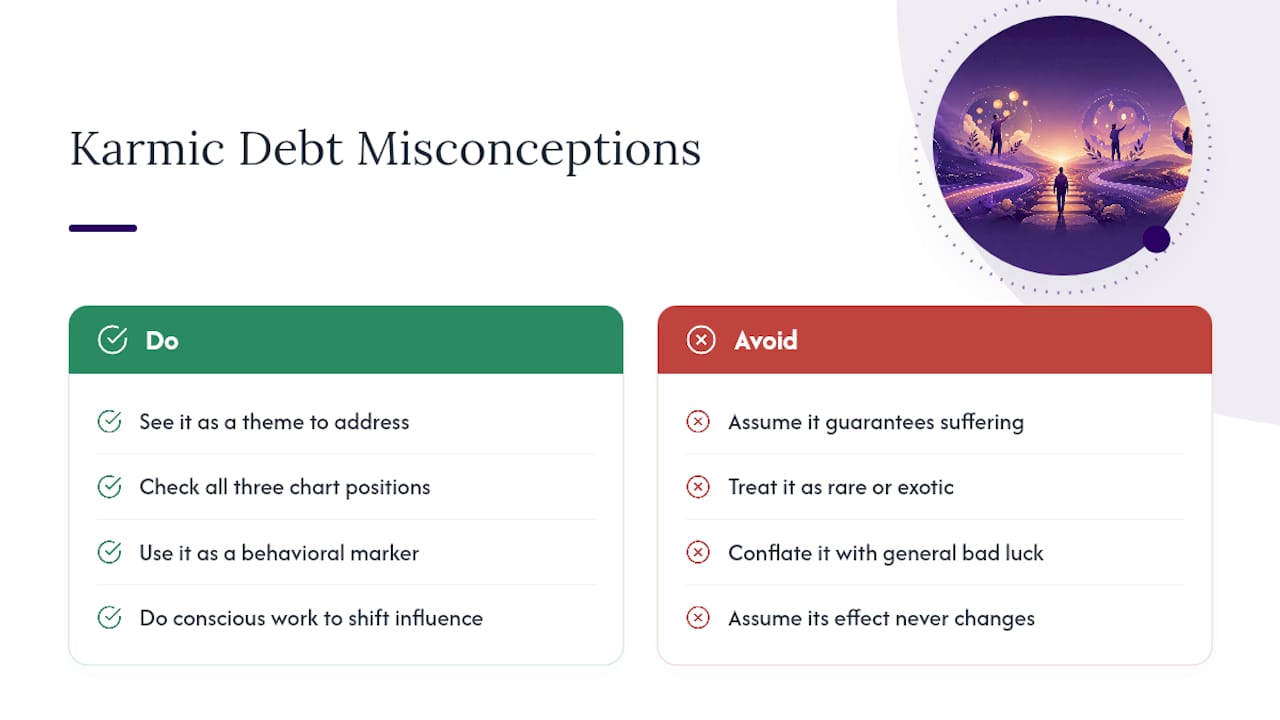
The biggest myth is that a karmic debt number guarantees suffering. It does not. It flags a theme that needs attention, similar to how a recurring ache points you toward a specific muscle that needs stretching. Ignore it and the pattern tends to repeat. Work with it and the pattern loosens.
A second misconception treats karmic debt as rare or exotic. In practice, four numbers among the countless possible name and birth date combinations show up more often than people expect, especially once you check all three chart positions rather than just the final Life Path digit.
A third myth conflates karmic debt with bad luck in a general, superstitious sense. Numerology treats these numbers as behavioral and psychological markers, not omens. A 14/5 person isn't cursed toward chaos. They're simply more likely to wrestle with restraint, and knowing that in advance is an advantage, not a warning label.
People also assume a karmic debt number is permanent and unchanging in its effect. The lesson itself stays present in the chart for life, but its influence on your actual behavior shifts based on how much conscious work you put in. Someone in their 20s wrestling openly with a 16/7's pride patterns often looks very different by their 40s if they've done the reflective work.
Finally, some assume you need a karmic debt number to have personal growth work to do. Everyone has growth edges. Karmic debt numbers just name a few of them with unusual precision.
How Karmic Debt Numbers Interact With the Rest of Your Chart
A karmic debt number rarely operates alone. It colors whatever position it occupies, which means the same number produces different results depending on where it lands.
A karmic debt appearing in your Life Path number affects your overall life direction and the recurring theme across your decades. The same debt showing up in your Expression number instead shapes how you present yourself and communicate, since Expression numbers govern talents and outward identity. A debt in a Pinnacle number narrows its influence to a specific life period rather than your whole life arc.
Master numbers and karmic debts can technically coexist in different chart positions, giving someone both amplified potential and a specific area needing repair. This combination tends to produce intense, high-contrast personalities. Someone with an 11 Life Path and a 14/5 Expression number, for example, might carry unusual intuitive gifts alongside a genuine struggle with moderation, and the two traits often feed into each other rather than staying separate.
Your Sun sign and birth chart in astrology add another layer entirely. Numerology and astrology describe personality and pattern through different systems, but both frameworks circle back to similar ideas about karma and repeated life lessons, which is why many people cross-reference both when trying to understand a recurring struggle.
Real-World Patterns: What Karmic Debt Looks Like in Practice
Numerologists often illustrate 13/4 through people who repeatedly start ambitious projects and abandon them just short of completion, whether that's a degree, a business plan, or a home renovation. The corrective arc usually isn't dramatic. It's someone finally finishing the unglamorous 20% of a project they used to walk away from, over and over, until the habit of finishing becomes automatic.
A 14/5 pattern commonly shows up as someone who thrives during structured seasons of life, like a demanding job or a training program, then swings hard into disorganized excess the moment that structure disappears. The lesson tends to click once the person builds their own internal structure instead of relying on external schedules to keep them in check.
16/7 stories often involve a public or professional setback tied to overconfidence, followed by a genuinely humbler, more grounded rebuilding phase. People describe this less as punishment and more as a forced recalibration that ends up serving them better long term.
19/1 tends to look like a highly capable, self-reliant person who burns out from refusing delegation or support, then learns, sometimes the hard way, that leadership includes trusting other people. Once they start asking for help earlier, the same independence becomes an asset instead of a liability.
None of these patterns are guaranteed outcomes. They're the recognizable shapes numerologists see repeat across different individuals carrying the same karmic debt number.

The Tarosyn Take on Working With Karmic Debt Numbers
Karmic debt numbers get more useful the moment you stop treating them as a static label and start treating them as a working reference point, and that's the philosophy behind how Tarosyn approaches numerology. Tarosyn is built as an AI-powered spiritual ecosystem that combines tarot, astrology, numerology, and a community of people doing similar reflective work, precisely because no single number or card tells the full story on its own.
Joseph Calitoy's writing for the Tarosyn blog treats numerology the same way a good coach treats a diagnostic test: informative, not deterministic. [Joseph Calitoy's professional credentials or background in spirituality, astrology, or numerology are not specified here]. [Case studies or testimonials demonstrating Joseph Calitoy's expertise or user success from the platform are not included].
The practical upside of using an integrated platform is continuity. You can check a number today, journal against it next week, and revisit the pattern a month later without losing the thread.
— Joseph Calitoy
Ready to Check Your Own Numbers?
If you've been running the math in your head while reading this, the next logical step is seeing it laid out clearly instead of guessing at intermediate sums. Tarosyn pulls numerology, tarot, and astrology into one place, so instead of juggling a separate calculator, a separate journal app, and a separate horoscope site, you get one connected view of your chart and how your karmic debt number fits into it.

Start with a public tarot reading to see how your karmic debt themes show up alongside the cards, or browse the personal growth topic hub for exercises built around exactly this kind of numerology work. Save what resonates, track it over time, and revisit it whenever the same pattern resurfaces. That's the whole point of catching a karmic debt number early: you get to work with it on your own terms, not react to it after the fact.
Sources
- Karmic Debt Number Calculator: 13, 14, 16, 19 Meaning and How to Calculate | Mystical Digits
- Karmic Debt Numbers Meaning | AstroBhava
- MindBodyGreen — karmic debt numbers article
- What is karmic debt number and what role do they play in numerology? | Times of India
FAQ
What Are the Four Karmic Debt Numbers?
The four karmic debt numbers are 13, 14, 16, and 19, written as 13/4, 14/5, 16/7, and 19/1 to preserve the compound form before final reduction.
Is Having a Karmic Debt Number Bad?
No. It signals a concentrated growth theme, not a punishment, and numerologists frame it as a catalyst for change once you name it and work with it deliberately.
How Do I Find My Karmic Debt Number?
Check your birthday for a direct 13, 14, 16, or 19, then track the intermediate totals in your Life Path and Expression number calculations before you reduce them to a single digit.
Can You Have More Than One Karmic Debt Number?
Yes, since debts can appear separately in your Life Path, Birthday, and Expression or Destiny positions, and some charts show two or more at once.
Are Karmic Debt Numbers the Same as Master Numbers?
No. Master numbers (11, 22, 33) amplify potential, while karmic debt numbers flag a specific area needing correction, and a single chart can contain both in different positions.