
How astrology reflects karma in your natal chart
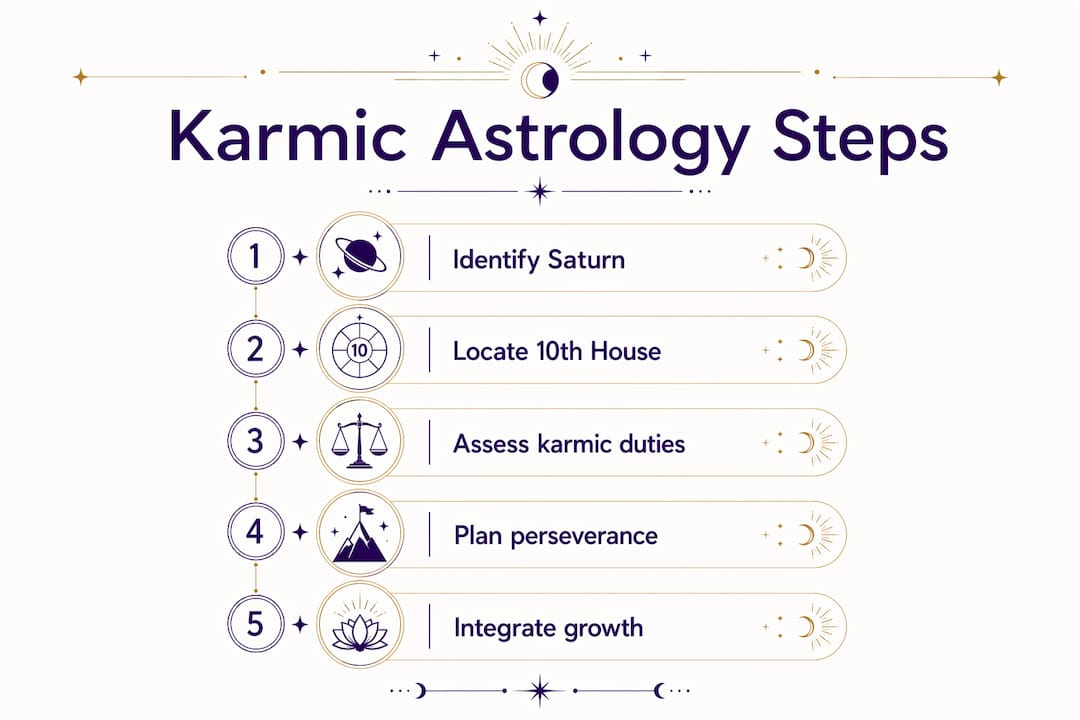
Your natal chart is a blueprint of Prarabdha Karma, the specific portion of past-life actions that are active in your current lifetime. Planetary positions are not random. They show the soul's chosen lessons and the spiritual challenges it agreed to face this time around.
Vedic astrology, known as Jyotisha or "the science of light," organizes karma into three main types:
- Sanchita Karma: The total storehouse of actions accumulated across all past lifetimes. Too vast for any single chart to show completely, it shapes your overall spiritual weight and capacity.
- Prarabdha Karma: The slice of Sanchita Karma selected for this lifetime. This is what your birth chart actually maps, including the timing of when specific karmic seeds ripen through the Dasha system.
- Kriyaman Karma: The karma you create right now through present choices. Free will operates here, and how you respond to your chart's challenges generates new karma for future lifetimes.
- Agami Karma: Actions planned or contemplated for the future, which transition into Kriyaman Karma once physically carried out.
Three planets stand out as primary karmic markers: Saturn (Shani), Rahu, and Ketu. Together, they form the core of why astrology reflects karma so clearly in a chart. Astrology shows tendencies and lessons, not locked-in outcomes.
Table of Contents
- Why Saturn (Shani) is the planet of karmic accountability
- How Rahu and Ketu reveal your karmic axis
- How to read karmic patterns in your birth chart without fatalism
- How Tarosyn integrates karmic astrology with personal growth
- Tarosyn gives you a clear path through your karmic chart
- Key Takeaways
Why Saturn (Shani) is the planet of karmic accountability
Saturn is called Karma Karaka because it represents consequence, accountability, and time above all other planets. Where Saturn sits in your chart is where karma is most active, most demanding, and ultimately most rewarding when you meet it with the right attitude.
- Karmic testing zones: Saturn's house placement reveals the area of life where you face the greatest challenges and where maturity is non-negotiable.
- Delays as lessons: Saturn's association with delays and restrictions is not punishment. It slows things down so you develop patience, discipline, and genuine competence before receiving rewards.
- Retrograde Saturn: A retrograde Saturn in the natal chart intensifies this function. It suggests that past-life Saturn karma was not adequately addressed and has returned with greater urgency in this lifetime.
- Long-term growth: Saturn's lessons rarely resolve quickly. They unfold over years, pushing the soul toward spiritual maturation through sustained effort.
- Karmic rewards: When Saturn's demands are met with responsibility rather than avoidance, the rewards it delivers tend to be lasting and deeply earned.
Saturn in the 10th house, for example, points to a karmic duty tied to career and public life, requiring perseverance and integrity over many years. The challenge is real, but so is the payoff.
How Rahu and Ketu reveal your karmic axis
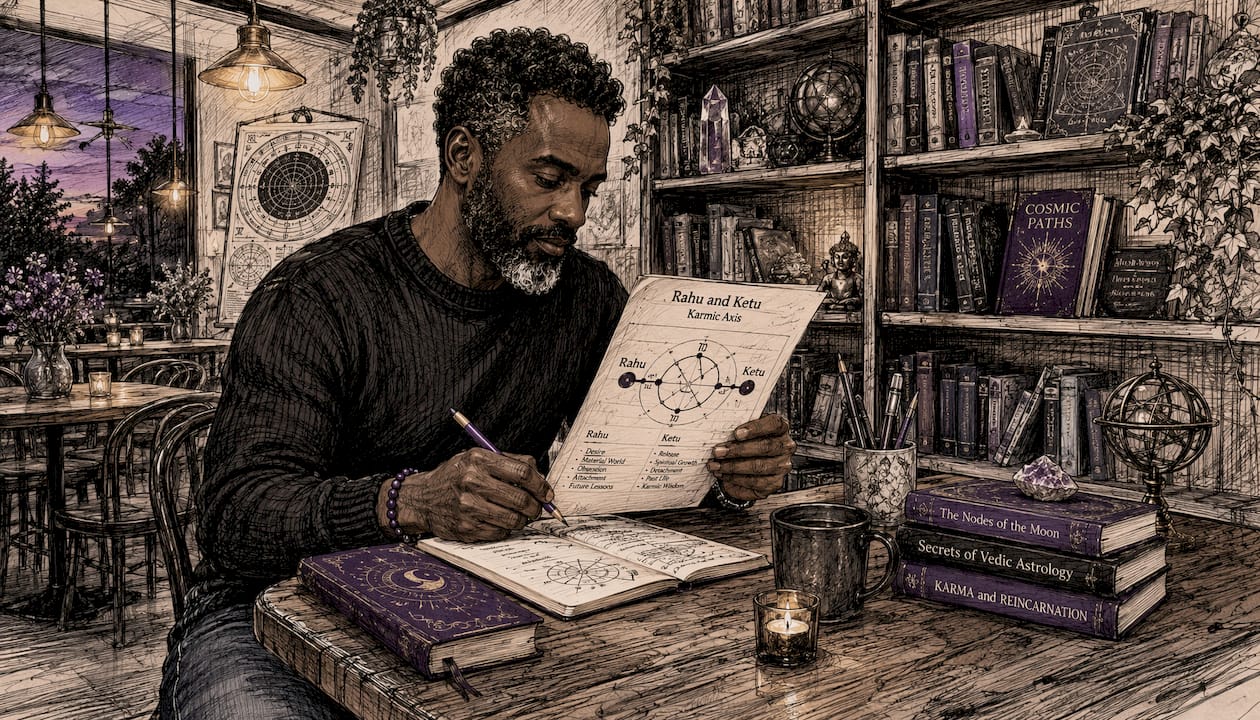
Rahu and Ketu form the main karmic axis in any birth chart. They are always exactly opposite each other, and together they describe the soul's direction of growth and the territory it is leaving behind.
- Rahu (North Node): Represents unfulfilled desires, karmic hunger, and the experiences the soul is being pushed to develop. Rahu's placement shows where you have a deep, almost compulsive pull toward qualities that were absent or underdeveloped in past lives.
- Ketu (South Node): Represents past-life mastery and spiritual debts. Wherever Ketu sits, the soul has already traveled that terrain extensively. Skills feel natural at first, but hollow over time, because the soul is not here to repeat that territory.
- Recurring challenges: The Rahu-Ketu axis identifies recurring karmic themes. Challenges tied to this axis tend to repeat until the underlying lesson is understood and integrated.
- Rahu in the 7th house: Creates an intense karmic hunger for relationship and partnership, often because previous lives lacked emotional bonding. The lesson is about wholeness through relating, not just the relationship itself.
- Ketu's spiritual function: A strongly placed Ketu, such as in Scorpio, Sagittarius, or the 9th or 12th house, suggests a soul with deep spiritual preparation across many lifetimes, pointing toward moksha as a genuine possibility.
- Balanced awareness: Working consciously with both nodes, leaning into Rahu's growth edge while releasing Ketu's attachment, supports deeper spiritual evolution.
Pro Tip: If you notice a recurring pattern in relationships, finances, or career, check which house Rahu occupies in your chart. That placement often names the exact theme the soul is here to develop.
How to read karmic patterns in your birth chart without fatalism
The birth chart outlines Prarabdha Karma, but it does not seal your fate. Present conscious actions through Kriyaman Karma can shift how karmic patterns unfold. Astrology is a guidance system, not a verdict.
- Houses and karmic lessons: The 12th house is a karmic gateway where past actions are discharged through experiences of loss, isolation, or deep spiritual work. The 8th house holds karma that arrives unexpectedly, demanding total transformation. The 6th house represents karma that strengthens the soul through service, discipline, and overcoming obstacles.
- Upachaya houses as growth arenas: The 3rd, 6th, 10th, and 11th houses are known as Upachaya houses, or houses of growth. Malefic planets placed here often act as catalysts rather than purely negative forces, symbolizing a storehouse of past merit that requires present discipline to activate.
- Dridha vs. Adridha Karma: Fixed karma (Dridha) arises from deliberate past actions and is harder to alter. Unfixed karma (Adridha) comes from unintentional actions and responds more readily to present effort and awareness.
- Personal vs. collective karma: Personal karma shows in individual chart placements. Collective karma, shared by generations or communities, often manifests through outer-planet transits and generational Dasha cycles affecting large groups simultaneously.
- Planetary transits and progressions: Transits activate karmic potentials already present in the natal chart. A challenging Saturn transit does not create new karma; it ripens what was already seeded.
- Unresolved patterns: Recurring life themes, such as repeated relationship failures or persistent financial obstacles, signal unresolved karmic lessons until awareness and maturity are developed.
- Spiritual remedies: Mantras, service, and mindful awareness are classical tools for working with karmic patterns. They do not erase Prarabdha Karma, but they shift your inner relationship to it, which is where real transformation happens.
The ancient Vedic teaching puts it plainly: fools obey the planets, but wise people work with them consciously. Astrology as a self-discovery tool functions best when you use it to understand your patterns, not to predict your limits.
How Tarosyn integrates karmic astrology with personal growth
Tarosyn is an AI-powered spiritual ecosystem that brings astrology, tarot, numerology, and community together in one place. For spiritual seekers working with karmic patterns, that combination matters. A natal chart reading tells you where Saturn is testing you. A daily horoscope shows you when a transit is activating that placement. A tarot reading adds a symbolic layer that often surfaces the emotional or subconscious dimension of the same theme.
- Chart analysis for karmic awareness: Tarosyn decodes planetary placements to help you identify which karmic themes are active right now, not just in theory.
- Tarot and astrology together: Tarot readings on Tarosyn complement astrological insight by reflecting the present moment's energy, useful when a transit is in motion and you want to understand how to respond.
- Numerology layer: Numerology adds a third lens, confirming patterns that appear in both the chart and the cards.
- Community for shared growth: Tarosyn's social community connects you with others navigating similar karmic themes, which supports the kind of reflection that accelerates awareness.
| Tarosyn feature | How it supports karmic understanding |
|---|---|
| Natal chart astrology | Maps Prarabdha Karma through planetary placements and house positions |
| Daily horoscope | Tracks active transits so you know when karmic themes are ripening |
| AI tarot readings | Adds symbolic insight to present-moment karmic challenges |
| Numerology | Confirms recurring patterns across multiple spiritual systems |
| Community journal | Shared reflection on karmic themes with others on the same path |
Vedic astrology teaches that astrology clarifies the patterns through which karma manifests. Tarosyn applies that principle across multiple tools so you get a fuller picture of where you are and what the chart is asking of you.
Tarosyn gives you a clear path through your karmic chart
Reading your natal chart for karmic patterns is one thing. Having a platform that connects the dots across astrology, tarot, and numerology every day is another.
Tarosyn is built for spiritual seekers who want more than a one-time chart reading. You get personalized tarot readings that reflect your current karmic moment, daily horoscopes tied to your sign, numerology insights, and a community of people working through the same questions. No separate apps, no scattered tools. Start with a reading at Tarosyn and see which karmic themes your chart is highlighting right now.
Key Takeaways
Astrology reflects karma by mapping the soul's past actions and present spiritual lessons directly onto the natal chart through planetary placements, houses, and the karmic axis of Rahu and Ketu.
| Point | Details |
|---|---|
| Natal chart as karmic blueprint | The birth chart maps Prarabdha Karma, the specific past-life actions active in your current lifetime. |
| Saturn as Karma Karaka | Saturn's placement shows where karmic challenges are most demanding and where long-term growth is possible. |
| Rahu and Ketu axis | Rahu points to unfulfilled desires driving growth; Ketu shows past-life mastery and areas of detachment. |
| Free will through Kriyaman Karma | Present choices actively shape karmic outcomes, so the chart is a guide, not a fixed sentence. |
| Tarosyn for karmic insight | Tarosyn combines natal chart analysis, daily horoscopes, tarot, and community to support ongoing karmic self-understanding. |