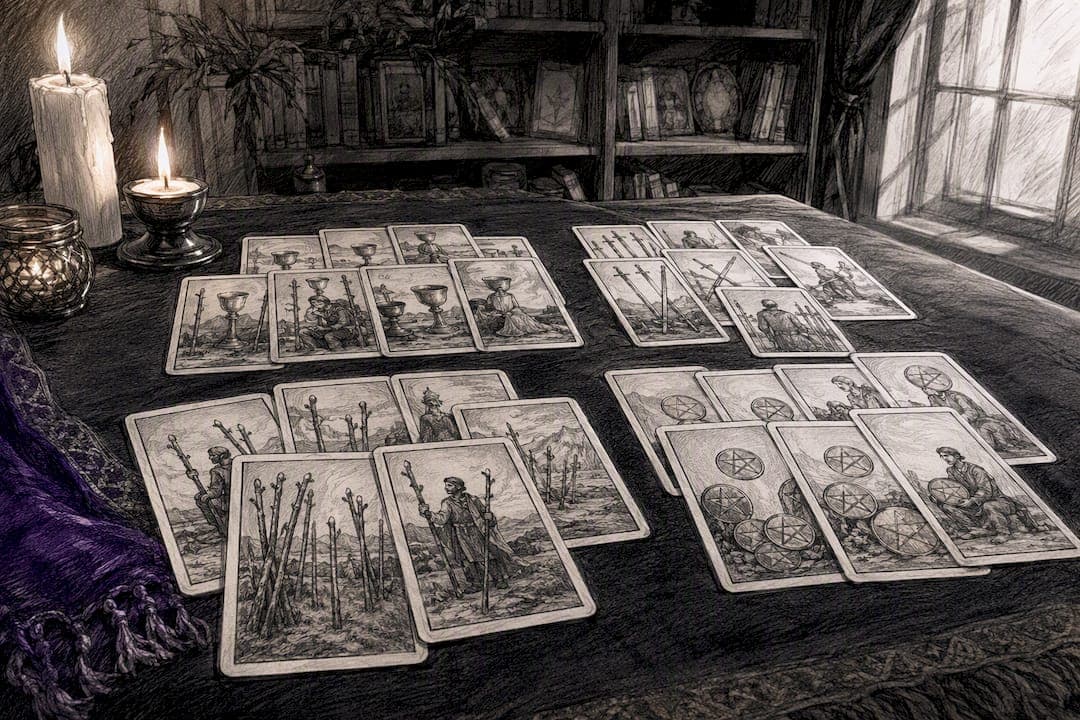
The Minor Arcana are the 56 suit cards in a tarot deck: Wands, Cups, Swords, and Pentacles, each running Ace through Ten plus four court cards. Where the Major Arcana marks life's big turning points, the Minor Arcana track daily choices and habits. This guide breaks down every suit, number, and court role so you can read any Minor Arcana card with confidence.
TL;DR:
- The Minor Arcana consist of 56 cards divided into four suits, each telling a part of the daily life story from sparks to completion.
- Number patterns across suits show that odd numbers indicate action and tension, while even numbers suggest balance and resolution, with Fives marking low points.
- Reversed cards generally signal blockage or internalization, and suit balance in a spread helps determine the overarching themes more than individual card meanings.
- Learning the suit system first, then the numeric progression and court roles, improves fluency and helps interpret spreads more accurately.
- Practicing with suit-focused drills and real spreads, especially analyzing suit dominance and position, accelerates mastery of the Minor Arcana readings.
Table of Contents
- What Minor Arcana Meanings Actually Cover
- The Number Pattern That Unlocks All 40 Pip Cards
- Suit of Wands: Ambition, Action, and Creative Fire
- Suit of Cups: Emotion, Intuition, and Relationships
- Suit of Swords: Thought, Truth, and Conflict
- Suit of Pentacles: Work, Money, and the Material World
- How to Read Suit Balance and Handle Reversals
- How Tarosyn Practitioners Build Fluency With All 56 Cards
- A Concise Meaning Table for All 56 Cards
- The Symbols That Show Up Again and Again
- Rider-Waite, Thoth, and Marseille: Same Cards, Different Voices
- Reading Minor and Major Arcana Together
- Minor Arcana in Real Spreads
- What Changed Once I Stopped Skipping the Pip Cards
- Practice What You've Learned With Guided Readings
- A Few More Places to Study
- Sources
What Minor Arcana Meanings Actually Cover
The Major Arcana gets the spotlight because it holds the dramatic cards: Death, The Tower, The Sun. But the Minor Arcana consist of 56 cards across four suits that describe the texture of ordinary life. A Major Arcana card might tell you a relationship is ending. A Minor Arcana card tells you what that ending looks like on a Tuesday: an unanswered text, a tense dinner, a quiet decision to walk away.
This guide is built to work two ways. Read it start to finish learning the whole system, or jump straight to a suit when you pull a card you don't recognize.
Here's how to use it:
- Start with the suit. It tells you the life area in play (work, love, conflict, mind).
- Then check the number or court rank. It tells you the stage or the personality type.
- Every card also carries a reversed meaning, usually a blocked, delayed, or internalized version of the upright.
- Use the symbolism guide if imagery in a specific card confuses you.
Once suit and number click together, most of the 56 cards start to feel like variations on a theme rather than 56 separate things to memorize.
The Number Pattern That Unlocks All 40 Pip Cards
Every suit tells the same ten-part story. The Ace is a spark, a raw offer of something new. The middle numbers, roughly Two through Seven, work through the friction of building or testing that spark. Eight and Nine bring near-completion with a catch, and the Ten closes the cycle, often signaling it's time to move to a new Ace. Teaching resources across the tarot community treat this Ace-to-Ten arc as the backbone of pip card memorization, and it holds up whether you're reading Wands or Pentacles.
Three mnemonic hooks make this stick:
- Odd numbers push outward. Aces, Threes, Fives, Sevens, and Nines tend to bring action, change, or tension.
- Even numbers settle inward. Twos, Fours, Sixes, Eights, and Tens tend to bring balance, pause, or resolution.
- The middle number always hurts a little. Fives across all four suits (conflict, loss, disagreement) mark the low point before recovery begins.
Here's the pattern in action: the Two of Wands is a decision point (early friction), the Two of Cups is a bond forming (early friction), and the Two of Swords is a stalemate (early friction). Same number, same developmental stage, different emotional flavor by suit.
Pro Tip: Practice by pulling just the Fives from all four suits and laying them side by side. Once you see how "conflict" looks different in Wands versus Swords, the whole numbering system clicks into place fast.
Suit of Wands: Ambition, Action, and Creative Fire
Wands correspond to Fire, the suit of ambition, creativity, and initiative. When Wands dominate a spread, the reading is about momentum: starting something, chasing a goal, or burning out from doing too much at once.
- Ace of Wands: A new spark, idea, or burst of motivation.
- Two of Wands: Planning, a decision about which path to take.
- Three of Wands: Expansion, early progress, looking ahead.
- Four of Wands: Celebration, a milestone worth marking.
- Five of Wands: Competition, minor conflict, friction among peers.
- Six of Wands: Recognition, a public win.
- Seven of Wands: Defending your position, standing your ground.
- Eight of Wands: Fast movement, quick news, things speeding up.
- Nine of Wands: Near the finish line but exhausted.
- Ten of Wands: Burden, overload, carrying too much before release.
The court cards give you shorthand for people and personalities:
- Page of Wands: A novice with a new idea, still testing it out.
- Knight of Wands: Impulsive pursuit, chasing a goal fast.
- Queen of Wands: Confident, magnetic, creatively mature.
- King of Wands: A visionary leader who inspires action. See how this energy plays out in an actual pull with the Two of Wands in a Celtic Cross.
Suit of Cups: Emotion, Intuition, and Relationships
Cups align with Water, governing feelings, intuition, and relationships. A Cups-heavy spread signals the reading is emotional territory, not a career or money question.
- Ace of Cups: New emotional beginning, an open heart.
- Two of Cups: Mutual connection, partnership forming.
- Three of Cups: Friendship, celebration, community joy.
- Four of Cups: Withdrawal, contemplation, mild dissatisfaction.
- Five of Cups: Loss, regret, focusing on what's gone.
- Six of Cups: Nostalgia, memories, a return to something familiar.
- Seven of Cups: Choices, daydreaming, too many options.
- Eight of Cups: Walking away from something that no longer fits.
- Nine of Cups: Contentment, emotional satisfaction.
- Ten of Cups: Lasting harmony, emotional fulfillment.
Court cards in Cups often represent emotionally attuned people or roles:
- Page of Cups: A sensitive messenger, often bringing news of the heart.
- Knight of Cups: A romantic, pursuing connection with charm.
- Queen of Cups: An empathic guide, deeply intuitive.
- King of Cups: Emotionally steady, calm under pressure. The Ace of Cups in a relationship spread and the King of Cups in a relationship spread both show how this suit plays out when love is the question.
Suit of Swords: Thought, Truth, and Conflict
Swords correspond to Air, the suit of intellect, communication, and conflict. When Swords dominate, expect a reading about decisions, arguments, or mental clarity rather than emotions or money.
- Ace of Swords: A breakthrough, sudden clarity, new idea.
- Two of Swords: Indecision, a difficult choice avoided.
- Three of Swords: Heartbreak, painful truth, betrayal.
- Four of Swords: Rest, recovery, mental retreat.
- Five of Swords: Conflict, a hollow win, tension unresolved.
- Six of Swords: Moving on, transition away from difficulty.
- Seven of Swords: Deception, strategic withdrawal, cutting corners.
- Eight of Swords: Feeling trapped, self-imposed limitation.
- Nine of Swords: Anxiety, sleepless worry, mental spirals.
- Ten of Swords: Rock bottom, painful ending, but also release.
Court cards in Swords tend to represent sharp minds and decisive action:
- Page of Swords: A curious analyst, always asking questions.
- Knight of Swords: Decisive, fast to act, sometimes reckless.
- Queen of Swords: An articulate strategist, direct and clear.
- King of Swords: Authoritative intellect, ruling through logic.
Suit of Pentacles: Work, Money, and the Material World
Pentacles correspond to Earth, covering work, money, health, and the physical body. A Pentacles-heavy spread points toward practical concerns: career moves, finances, or the state of your daily routine.
- Ace of Pentacles: A new opportunity, often financial or career related.
- Two of Pentacles: Juggling priorities, balancing competing demands.
- Three of Pentacles: Collaboration, skilled teamwork.
- Four of Pentacles: Holding tight, financial caution or control.
- Five of Pentacles: Hardship, financial stress, feeling left out.
- Six of Pentacles: Generosity, giving or receiving help.
- Seven of Pentacles: Long-term investment, patience paying off.
- Eight of Pentacles: Diligence, mastering a craft.
- Nine of Pentacles: Self-sufficiency, enjoying earned comfort.
- Ten of Pentacles: Legacy, long-term security, family wealth.
Court cards here represent grounded, practical energy:
- Page of Pentacles: An apprentice, eager to learn a trade or skill.
- Knight of Pentacles: Steady, methodical, reliable in daily work.
- Queen of Pentacles: A practical nurturer, comfortable managing resources.
- King of Pentacles: An established provider, secure and generous.
How to Read Suit Balance and Handle Reversals
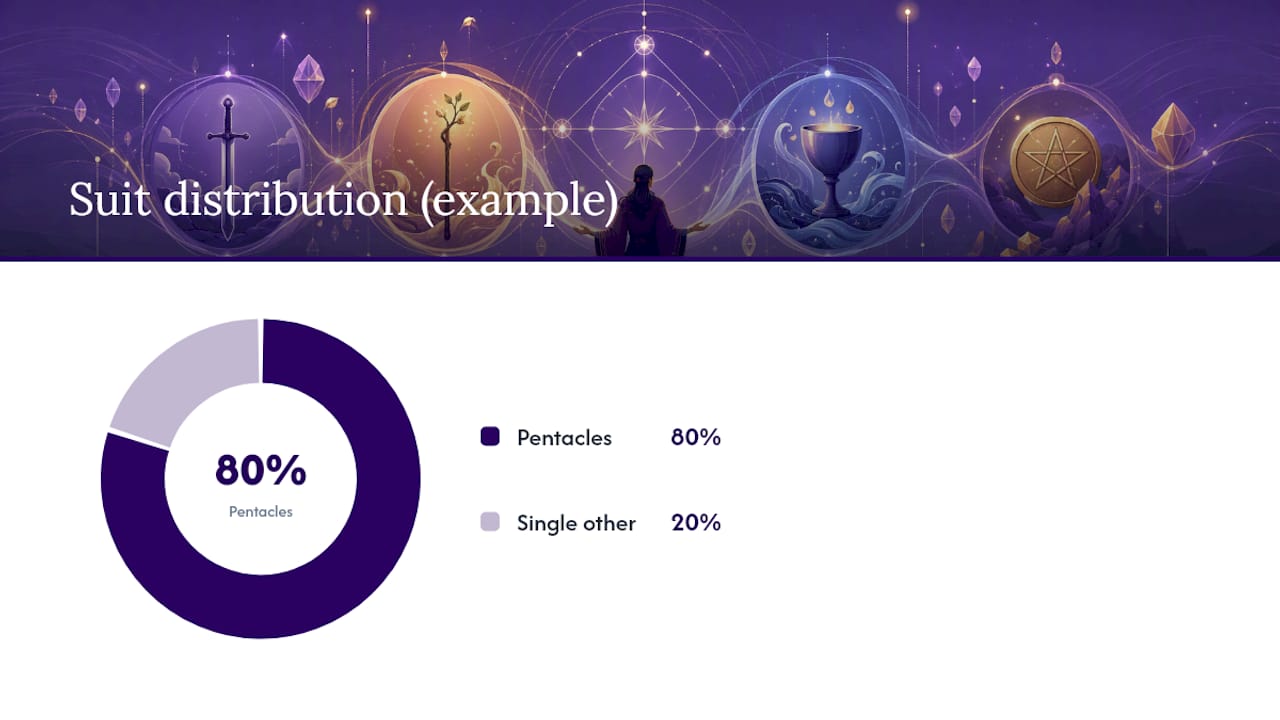
Before you interpret a single card, scan the whole spread for suit distribution. Reading the suit first, then the number, then the position is the sequence most experienced readers rely on, and suit balance is the fastest diagnostic tool available.
If four of five cards in a spread are Pentacles, the reading is about work or money, no matter what the individual cards say. If Swords dominate, expect the question to circle around a decision or conflict, even if the querent framed it as something else.
Position changes meaning too. An Ace of Wands in a "past" position describes a spark that already happened, maybe a project you started and forgot about. The same Ace in a "future" position is a new opportunity still ahead of you. A Three of Cups in an "obstacle" position might mean a friend group is complicating things rather than helping.
For reversals, keep the policy simple: a reversed card usually signals the upright meaning is blocked, delayed, or turned inward. A reversed Five of Wands might mean the conflict is internal rather than with others. A reversed Ten of Cups might mean the harmony exists but hasn't been acknowledged yet.
- Check suit distribution first, before reading individual cards.
- Let position modify meaning: past, present, obstacle, and outcome all shade a card differently.
- Treat reversals as intensity or direction shifts, not opposite meanings.
Pro Tip: When two suits tie for dominance in a spread, it usually means the querent's real question involves both areas at once, like a relationship decision that's also a financial one.
How Tarosyn Practitioners Build Fluency With All 56 Cards
Learning 56 cards cold is a slow grind. A better sequence: learn the four suit domains first, then the numeric arc using the mnemonic hooks above, then memorize pips in suit blocks rather than jumping around, and finally practice three-card spreads focused on a single suit at a time. This mirrors study sequencing recommended for retention, and it works because your brain isn't juggling four unrelated systems at once.
Court cards respond well to a different drill. Frame each court card as a role or energy type rather than a fixed personality, then practice assigning that role to real people you know. Who in your life acts like a Knight of Swords? Who's a Queen of Pentacles? That pattern recognition transfers directly to live readings.
The fastest way to internalize the Minor Arcana isn't flashcards in isolation. It's pulling one suit at a time, running it through timed three-card drills, and only adding the next suit once the current one feels automatic.
The heuristic worth repeating every single time you read: suit first, then number or rank, then position. Skip a step and the interpretation gets muddled fast.
A Concise Meaning Table for All 56 Cards
Here's every card's core upright meaning in one place, organized for quick reference during a reading.
| Number/Rank | Wands | Cups | Swords | Pentacles |
|---|---|---|---|---|
| Ace | New spark | New feeling | New idea | New opportunity |
| Two | Planning | Connection | Indecision | Balancing |
| Three | Expansion | Friendship | Heartbreak | Teamwork |
| Four | Celebration | Withdrawal | Rest | Caution |
| Five | Competition | Loss | Conflict | Hardship |
| Six | Recognition | Nostalgia | Transition | Generosity |
| Seven | Defense | Choices | Deception | Patience |
| Eight | Fast movement | Walking away | Trapped | Diligence |
| Nine | Near finish | Contentment | Anxiety | Self-sufficiency |
| Ten | Overload | Fulfillment | Release | Legacy |
| Page | Novice idea | Sensitive news | Curious mind | Apprentice |
| Knight | Impulsive drive | Romantic pursuit | Decisive action | Steady work |
| Queen | Creative confidence | Empathic guide | Sharp strategist | Practical nurturer |
| King | Visionary leader | Steady advisor | Authoritative logic | Established provider |
Keep this table nearby while you're learning. Once you've read through 15 or 20 real spreads, most of these entries stop needing a second glance.
The Symbols That Show Up Again and Again
Minor Arcana artwork repeats visual cues on purpose, and recognizing them speeds up interpretation even when you can't recall a card's exact keyword. Water appears in Cups cards to reinforce emotional flow. Swords cards frequently show storm clouds or turbulent skies, echoing the suit's mental tension. Pentacles cards ground their figures in gardens, castles, or solid architecture, reinforcing stability and material concern.
Numbers themselves are a symbol system. Look at how many figures appear in a card, how many objects are stacked or scattered, and whether the composition feels crowded or sparse. The Three of Swords shows a heart pierced by three blades against a stormy sky, a direct visual translation of the "heartbreak" keyword. The Ten of Pentacles crowds a family scene with architectural detail, visually reinforcing legacy and permanence.
Direction matters too. Figures facing away from the viewer (the Eight of Cups walking off) suggest departure or introspection. Figures facing forward or reaching toward the viewer (the Six of Pentacles giving coins) suggest generosity or direct engagement.
Color carries weight in most Minor Arcana decks: red for passion or urgency in Wands, blue for calm or sorrow in Cups, gray or stormy tones for tension in Swords, and green or gold for prosperity in Pentacles. None of this is decoration. Once you notice the pattern, unfamiliar cards become easier to read on sight, even before you recall the textbook keyword.
Rider-Waite, Thoth, and Marseille: Same Cards, Different Voices
Most modern readers learn the Rider-Waite Smith deck first, and its Minor Arcana show full illustrated scenes: people, landscapes, action. That's deliberate. Pamela Colman Smith illustrated every pip card with a story, which is why Rider-Waite remains the easiest deck for beginners to read intuitively.
The Thoth deck, designed by Aleister Crowley and painted by Frieda Harris, renames several court cards (Princess and Prince replace Page and Knight in some structures) and leans harder into astrological and elemental correspondences. Thoth Minor Arcana meanings overlap with Rider-Waite at the core but add layers of esoteric symbolism that reward a reader who already knows astrology or Kabbalah.
The Marseille tradition, the oldest of the three, illustrates pip cards abstractly: the Five of Swords in a Marseille deck simply shows five swords arranged geometrically, no scene, no figures. Marseille readers rely far more on numerology and suit symbolism than illustrated storytelling, since there's no visual narrative to lean on.
None of these traditions contradicts the others on core meaning. A Marseille Five of Swords and a Rider-Waite Five of Swords both point toward conflict and tension. The difference is how much visual storytelling supports that meaning versus how much the reader has to supply from memorized correspondences. If you're starting out, Rider-Waite's illustrated approach makes the suit-and-number system in this guide easiest to apply directly.
Reading Minor and Major Arcana Together
A spread rarely contains only Minor Arcana cards, and when Major Arcana cards show up alongside them, the relationship runs in both directions. Major Arcana cards set the scale of what's happening: a big transition, a lesson, a turning point. Minor Arcana cards fill in the mechanics of how that transition is actually unfolding day to day.
Pull The Tower next to the Ten of Swords, and you get a picture of dramatic collapse (Tower) landing through a specific, painful ending (Ten of Swords). Pull The Star next to the Ace of Cups, and hope (Star) is arriving specifically as a new emotional beginning (Ace of Cups). The Major Arcana card answers "what kind of moment is this," and the Minor Arcana card answers "what does that moment look like in practice."
When a spread leans heavily Major Arcana, expect a reading about identity, fate, or a major crossroads. When it leans heavily Minor Arcana, expect a reading about routine, timing, or specific action steps. A balanced mix, roughly even between the two arcana, usually signals a question that's both personally significant and practically immediate, like a career change that's also an identity shift.
Don't treat the Major Arcana as automatically more important just because its cards feel weightier. A reading dominated by Minor Arcana isn't a small reading. It's a reading about the details that determine how the bigger picture actually resolves.
Minor Arcana in Real Spreads
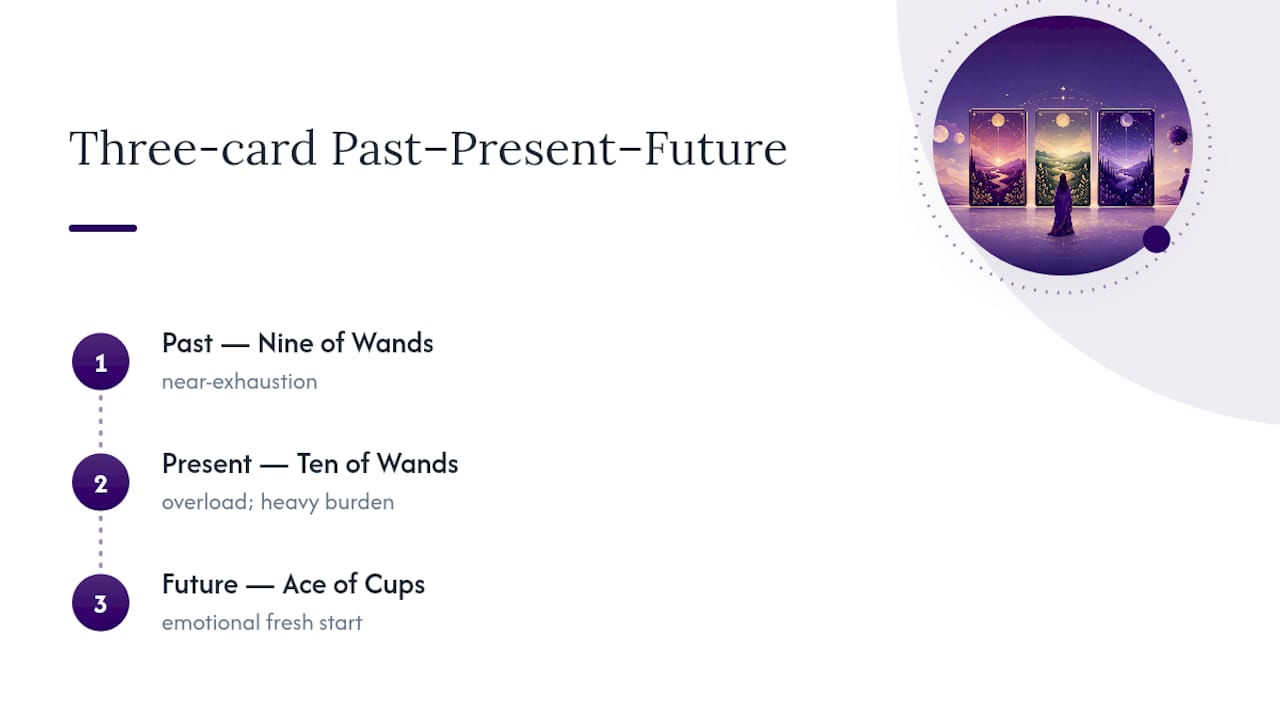
A three-card past-present-future spread makes the numeric arc visible fast. Say you draw the Nine of Wands (past), Ten of Wands (present), and Ace of Cups (future). That's a clean story: near-exhaustion, followed by overload, followed by an emotional fresh start once the burden lifts. You'd read this as someone who's been pushing too hard and is about to pivot toward something that feeds them emotionally instead.
The Celtic Cross spread gives Minor Arcana cards more room to interact with position meaning. A Two of Wands in the "challenge" position reads differently than a Two of Wands in the "outcome" position: one is an obstacle around indecision, the other is a resolution that involves making a plan. The Two of Wands in a Celtic Cross shows exactly how position reshapes a pip card's message.
Relationship spreads lean heavily on Cups and court cards. A Chariot in a relationship spread paired with a Knight of Cups suggests a relationship moving forward through active pursuit and willpower, not passive drift. Court cards in relationship contexts often represent the people involved rather than abstract energies, so a King of Cups showing up might literally describe a partner's emotional steadiness.
Larger spreads, like a three-card outcome spread featuring The World, tend to use Minor Arcana cards as supporting evidence for a Major Arcana conclusion. If The World lands as the outcome and a Ten of Pentacles sits in support, that combination points toward lasting completion with real material stability behind it, not just a symbolic win.
What Changed Once I Stopped Skipping the Pip Cards
Early on, I treated the Minor Arcana as filler between Major Arcana cards, the ones that actually mattered. That was backward. The moment I started reading suit balance first, spreads that used to feel like noise turned into clear, specific stories about timing and action. If you take one thing from this guide, make it that habit: read the suit before anything else, then build from there. Practice with a handful of spreads this week, and the shift will show up fast.
— Joseph Calitoy
Practice What You've Learned With Guided Readings
Reading about suit balance and numeric arcs only gets you so far. Applying it to a real spread, with real feedback, is what actually builds fluency. There are guided AI-assisted readings that walk through a suit-first, number-then-position approach, without requiring you to reference a chart mid-reading.
Every reading you pull can be saved for later review so you can see how your interpretation of a Five of Swords or a Ten of Pentacles evolves over time. Some platforms connect readings to your astrology and numerology profile, helping patterns in your pulls to make sense against your broader chart, not just in isolation.
If you want to put this guide into practice right now, start with a public tarot reading and watch how suit dominance and numeric progression show up in your own pull. It's the fastest way to turn what you just learned into a skill you actually use.
A Few More Places to Study
For visual learners, printable charts covering all 56 cards with upright and reversed keywords make fast reference easier during early practice. For a deeper suit-by-suit breakdown with elemental correspondences, Aeclectic Tarot's Minor Arcana reference remains one of the more thorough teaching resources available.
Sources
- Minor Arcana – Tarot Card Meanings and Symbolism | HowStuffWorks
- The Minor Arcana, Explained | Kalm
- Minor Arcana Tarot Card Meanings | Aeclectic Tarot