
The most effective way to monetize tarot reading content online combines three revenue streams: direct paid readings (live video, chat, or scheduled appointments), recurring subscriptions, and digital products like recorded readings or PDF guides. Together, these three channels cover immediate income, predictable monthly revenue, and passive scaling.
- Live sessions and paid chat: Clients pay per session or per minute through Stripe or PayPal. You deliver the reading in real time via video call or private chat.
- Subscriptions: Members pay a fixed monthly fee for ongoing access, weekly content, or members-only readings.
- Digital downloads and tips: Recorded readings, PDF spread guides, and tip jars generate income without your direct time. Delivery is automatic after checkout.
For a platform approach, Tarosyn gives creators a brand-forward ecosystem with AI-powered readings, themed spreads, community features, and subscription tools built in.
Key Takeaways
The most effective tarot monetization strategy combines direct paid readings, a subscription tier, and at least one digital product, tracked against three core metrics: bookings per day, conversion rate, and average order value.
| Point | Details |
|---|---|
| Top revenue mix | Combine live readings ($30–$150/session), subscriptions, and digital products for stable income. |
| Platform choice | Tarosyn suits brand-first creators; Scrile Stream fits live-session focus; Payhip works for fast digital sales. |
| Launch sequence | Set up payments and booking in week one before promoting to avoid losing early clients. |
| Pricing baseline | Start at the midpoint of the $30–$150 range; underpricing is harder to correct than starting fair. |
| Tarosyn for creators | Tarosyn provides themed readings, subscription tiers, and community tools in one integrated platform. |
Table of Contents
- How do you monetize tarot reading content online?
- Which platform fits your tarot monetization setup?
- Your 30–60 day launch checklist
- How should you price readings and subscription tiers?
- What content and product formats sell best for tarot creators?
- What does a weekly promotion plan look like?
- What are the U.S. legal and tax basics for tarot sellers?
- Which tools do you need to run a tarot business?
- What actually works when you launch a tarot offering
- Tarosyn gives creators a ready-made monetization platform
- Sources
How do you monetize tarot reading content online?
Every revenue channel a tarot creator can use falls into one of three buckets: time-for-money, recurring, or passive. Knowing which bucket a channel belongs to helps you prioritize.
Immediate revenue channels:
- Live video readings: Fixed price per session or pay-per-minute. Client books, pays upfront, and joins a video call. Stripe or PayPal handles the payout.
- Paid chat readings: Text-based, often billed per minute. Good for clients who prefer async or lower-cost entry points.
- Scheduled appointments: Use a booking tool like Calendly or Acuity Scheduling. Client pays at booking; you show up at the agreed time.
- One-off written or email readings: Client submits a question, you deliver a written response within 24–48 hours. Simple checkout, no scheduling needed.
Passive and recurring channels:
- Recorded readings: Pre-recorded video or audio readings on a theme (e.g., "Year Ahead Celtic Cross"). Sell once, deliver automatically.
- PDFs and ebooks: Spread guides, ritual kits, or tarot journaling prompts. Low production cost, high margin.
- Mini-courses and workshops: A four-week course on reading for yourself, priced $47–$197. Platforms like Payhip handle delivery.
- Tips and micropayments: Add a tip option to any booking page or live session. Small amounts add up over time.
- Memberships and subscriptions: Weekly horoscopes, monthly group readings, or a private community. Predictable income that compounds as your audience grows.
An industry guide on diversifying income recommends combining paid readings, courses, and memberships as the core structure for a sustainable tarot business.
Which platform fits your tarot monetization setup?
Three platforms cover most creator needs: Tarosyn for a brand-first ecosystem, Scrile Stream for a full live-session monetization toolkit, and Payhip for simple ecommerce with minimal setup.
| Feature | Tarosyn | Scrile Stream | Payhip |
|---|---|---|---|
| Live sessions | Yes (AI-assisted readings, community) | Yes (HD private video, pay-per-minute or fixed) | No (coaching sessions via booking only) |
| Subscriptions | Yes (Seer, Creator, Founder tiers) | Yes (built-in subscription billing) | Yes (memberships supported) |
| Tips / micropayments | Yes | Yes | Yes |
| Digital product delivery | Yes | Yes | Yes (instant download) |
| Branding & control | White-label ecosystem, own profile | Self-hosted branded platform | Hosted storefront, your branding |
| Platform fees | Freemium; paid tiers unlock features | Custom pricing (white-label license) | Free plan available; 5% transaction fee on free plan |
| Ease of setup | Low (guided onboarding) | Medium (requires configuration) | Very low (minutes to launch) |
| Community tools | Yes (social feed, friend circles, journals) | Limited | None |
| Payment integrations | Stripe, PayPal | Stripe, PayPal, others | PayPal, Stripe, major cards |
| US privacy / compliance | Yes | Yes | Yes |
Quick decision guide:
- Fastest revenue: Payhip. Create a product page in under 10 minutes and start selling downloads or booking coaching sessions the same day.
- Maximum control and live sessions: Scrile Stream. It handles pay-per-minute billing, HD video, and admin tools for a fully branded psychic-reading site.
- Brand-first ecosystem with community: Tarosyn. Best for creators who want AI-assisted readings, themed spreads, a social community, and subscription tiers under one roof.
Your 30–60 day launch checklist
Follow this sequence. Each step builds on the one before it.
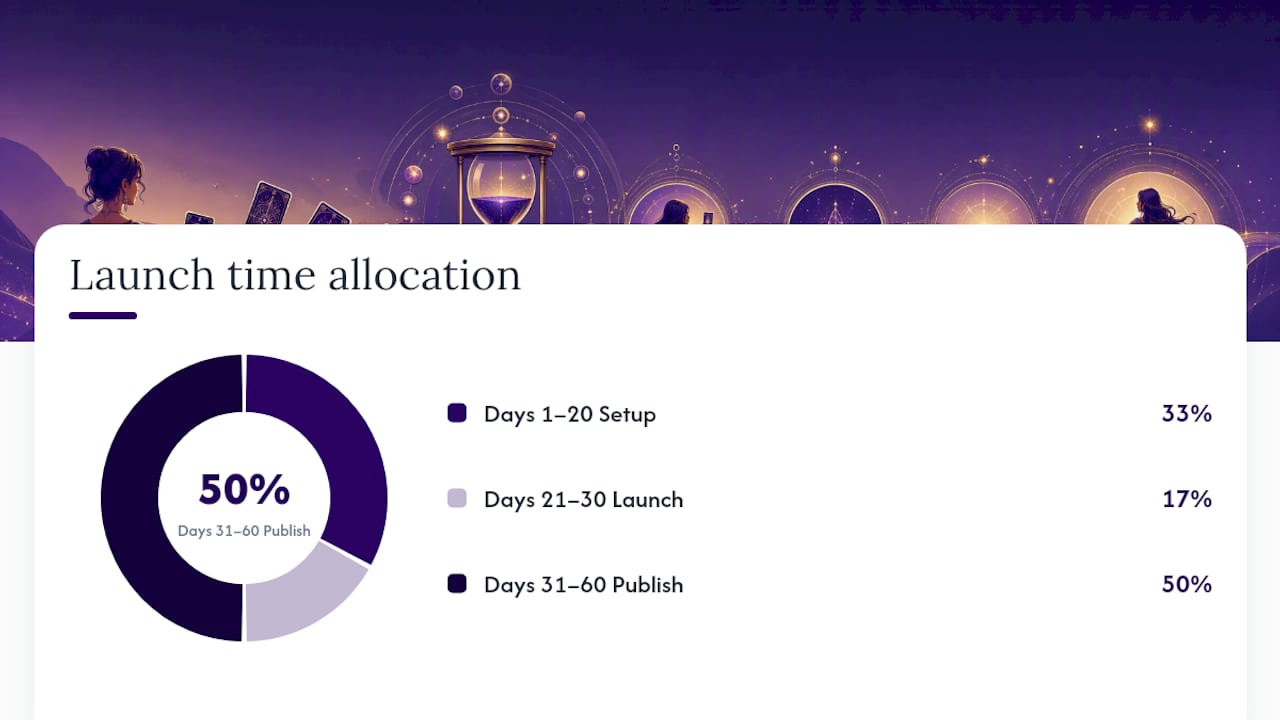
- Days 1–5: Set up your profile and core offer. Choose one platform, create your profile, and define one paid offering (a 30-minute live reading or a PDF guide). Set your price.
- Days 6–10: Add payments and booking. Connect Stripe or PayPal. If you offer live sessions, integrate Calendly or Acuity Scheduling. Test the full checkout flow yourself before going live.
- Days 11–15: Handle basic legal and tax prep. Register a business name if needed. Open a separate business checking account. Set up a simple invoice template. Note: a disclaimer stating your services are for entertainment and self-help purposes is standard practice for U.S. tarot sellers.
- Days 16–20: Build a minimum viable page set. You need five pages: Home, Services, Booking, FAQ, and Privacy/Terms. Nothing more at launch.
- Days 21–30: Soft launch. Offer one free or discounted reading to three to five people in exchange for honest feedback and a written review. Collect email addresses from every interaction.
- Days 31–60: Publish content and promote. Post one short video per week, one educational post, and one lead magnet push. Track bookings per day, conversion rate from free content to paid, and average order value.
Pro Tip: Outsource scheduling and audio editing from day one if your budget allows. A virtual assistant handling calendar management frees you to focus on readings and content, which is where your revenue actually comes from.
A practical launch guide for tarot businesses confirms that scheduling integration and payment processors are the two technical steps that most delay new readers. Set them up in week one.
How should you price readings and subscription tiers?
U.S. solo tarot readers typically charge $30–$150 per session, with entry-level readers starting at $30–$50 for a 20–30 minute reading and experienced readers charging higher rates for 60-minute sessions. Demand for online readings has increased since 2020, which means the market supports higher prices than many new readers assume.
Subscription tier examples:
- Basic ($9–$15/month): Weekly horoscope email, one recorded reading per month, access to a private community feed.
- Mid ($25–$40/month): Everything in Basic, plus one live group reading per month and a monthly PDF spread guide.
- Premium ($60–$100/month): Everything in Mid, plus one private 30-minute reading per month and priority booking.
Sample monthly revenue scenarios:
These are conservative estimates. Adding digital product sales or a course launch can significantly increase monthly totals without adding session hours.
What content and product formats sell best for tarot creators?
- One-off video readings: Record a 15–20 minute themed reading (e.g., "New Moon in Aries"). Sell at $15–$25. Deliver via automated download link.
- PDF spread guides: Two to four pages covering one spread layout with card meanings and journaling prompts. Price at $7–$15.
- Mini-courses: Four to six short video lessons on a specific topic (reading reversals, love spreads). Price at $47–$97.
- Membership content: Weekly written or video readings exclusive to subscribers. Keep each piece under 10 minutes or 500 words.
- Printable ritual kits: A PDF bundle with a spread layout, affirmation cards, and a ritual guide. Price at $12–$20.
- Guided meditations: 10–15 minute audio files paired with a tarot theme. Sell standalone or bundle with a reading.
- Affiliate bundles: Pair your reading with a recommended tarot deck or journal using an affiliate link. You earn a commission on the product sale.
Focused tarot blogging using topic clusters and tutorial posts converts search traffic into paying clients. A post titled "How to read the Three of Swords in a love spread" can rank on Google and link directly to your booking page. Bundling two or three formats (a PDF guide plus a recorded reading, for example) raises average order value without extra session time.
You can also combine tarot with astrology readings to create premium packages that justify higher price points.
What does a weekly promotion plan look like?
A consistent weekly rhythm matters more than any single viral post. Here is a workable template:
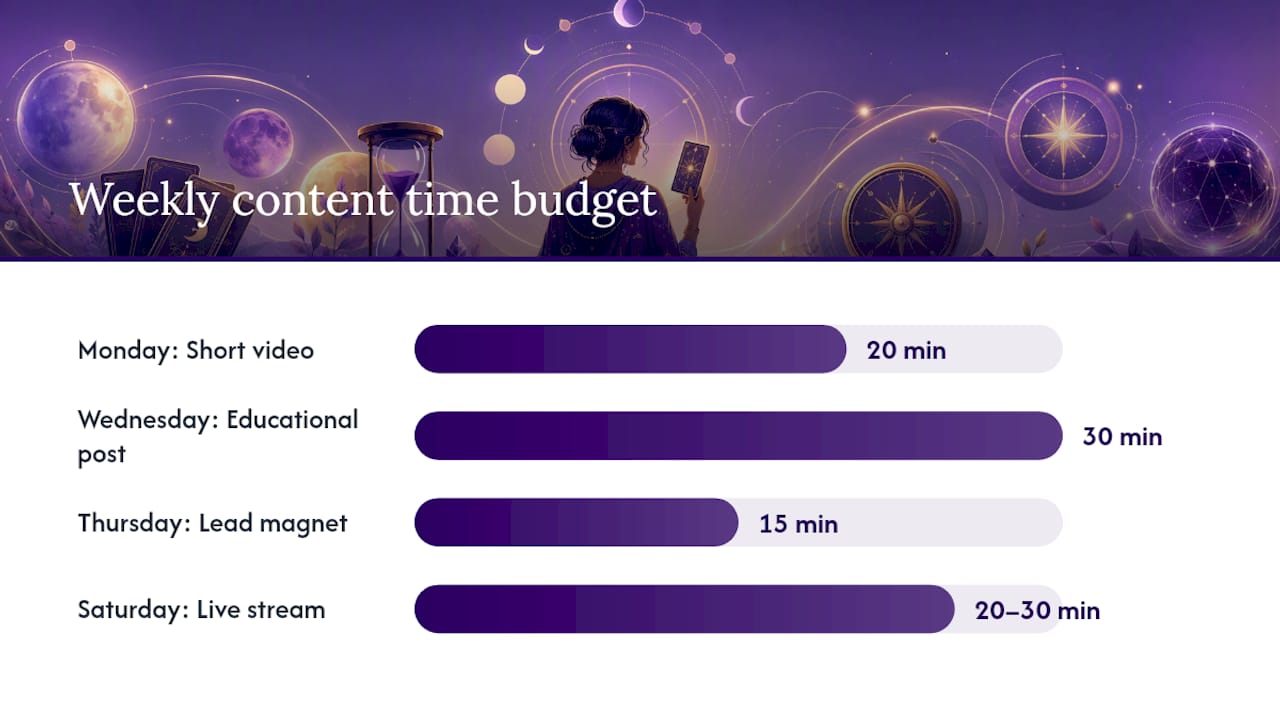
- Monday: Post one short video (60–90 seconds) on TikTok or Instagram Reels. Topic: a single card pull with a practical interpretation. Time budget: 20 minutes.
- Wednesday: Publish one educational post (Instagram carousel or blog post). Topic: a spread tutorial or "how to read X card." Link to your booking page. Time budget: 30 minutes.
- Thursday: Push one lead magnet (a free one-card reading opt-in or a free PDF). Collect email addresses. Time budget: 15 minutes.
- Saturday: Go live for 20–30 minutes on Instagram or YouTube. Do a free mini-reading for a viewer. Mention your paid offerings at the end.
Content intent matrix:
- TikTok / Reels: Discovery. Short, visual, single-card pulls.
- Instagram / Facebook: Engagement. Carousels, polls, community questions.
- YouTube / blog: Conversion. Long-form tutorials, spread walkthroughs, SEO-optimized posts.
- Email: Retention. Weekly digest, exclusive offers, early access to new products.
Building a professional website and email list alongside social media gives you an audience you own, not one that disappears if a platform changes its algorithm. Track three metrics: customer acquisition cost (CAC), lifetime value (LTV), and conversion rate from free content to paid booking.
Partnerships accelerate growth faster than ads for most new creators. Guest posts on spiritual blogs, joint live sessions with yoga instructors or astrologers, and referral incentives (offer 10–15% of a session fee to anyone who sends a paying client) all build reach without ad spend.
What are the U.S. legal and tax basics for tarot sellers?
This section covers practical action items, not legal advice. Confirm specifics with a qualified professional.
- Business registration: Check your state's requirements. Many solo creators operate as sole proprietors with no formal registration needed, but some states require a DBA (Doing Business As) filing.
- Service disclaimer: Add a statement to your website and booking confirmation that your services are for entertainment and self-help purposes only. This is standard practice in the U.S. tarot industry.
- Separate business account: Open a dedicated checking account for all business income and expenses. This makes bookkeeping and tax filing significantly cleaner.
- Invoices and receipts: Issue a receipt for every transaction. Free tools like Wave or a simple Google Docs template work fine at the start.
- Track gross receipts: Record every payment received, including tips and platform payouts. Use a spreadsheet or accounting software like QuickBooks Self-Employed or FreshBooks.
- Quarterly estimated taxes: If you expect to owe $1,000 or more in federal taxes for the year, the IRS requires quarterly estimated payments (due in April, June, September, and January).
- 1099 forms: Payment processors and platforms may issue a 1099-K if your gross receipts exceed the IRS threshold. Keep records of all platform fees paid, as these are deductible business expenses.
- Platform fee reporting: Fees paid to Payhip, Scrile Stream, or similar platforms are deductible. Save every payout statement.
Which tools do you need to run a tarot business?
- Tarosyn: AI-powered spiritual ecosystem with personalized tarot, astrology, community features, themed spreads, and subscription tiers. Best for creators who want an integrated brand-forward platform.
- Scrile Stream: Live HD video, pay-per-minute or fixed pricing, subscriptions, tips, and admin tools for a fully branded psychic-reading site. Best for creators prioritizing live session monetization.
- Payhip: Free storefront for selling digital downloads and coaching sessions. Supports PayPal and major cards with instant payouts. Best for creators who want the lowest possible technical overhead.
- Calendly / Acuity Scheduling: Booking and calendar management. Calendly is simpler; Acuity offers more customization for service-based businesses.
- Stripe / PayPal: Primary payment processors. Stripe is preferred for card payments and subscriptions; PayPal is widely trusted by clients for one-off purchases.
- Zoom / Google Meet: Video call delivery for live readings. Both are free at the basic tier.
- Mailchimp / ConvertKit: Email list management and automated sequences. ConvertKit is better suited to creators selling digital products.
- Google Analytics / Plausible: Track website traffic, conversion paths, and which content drives bookings.
For automation, a simple chatbot (ManyChat on Instagram or a Tidio widget on your website) can handle intake questions, collect client details before a session, and deliver digital products automatically after purchase. This reduces your admin time without requiring any technical background.
What actually works when you launch a tarot offering
The most common mistake new tarot creators make is underpricing. Setting a $20 rate to "build confidence" trains your audience to expect low prices, and raising them later is harder than starting at a fair rate. If you are unsure, price at the midpoint of the $30–$150 range and adjust based on demand.
Refund requests are rare when expectations are set clearly upfront. A one-sentence policy on your booking page ("All sales are final for digital products; live reading cancellations require 24 hours' notice") prevents most disputes before they start.
Free content converts best when it demonstrates your specific style, not generic tarot knowledge. A free one-card pull that shows how you read is more persuasive than a free PDF about tarot history. Use free content to show your voice, then let the paid offering deliver the depth.
A practical rule: aim for 60% of your income from live sessions in your first three months, then shift toward 40% passive (subscriptions, digital products) by month six. This keeps cash flow stable while you build the passive side.
Tarosyn gives creators a ready-made monetization platform
Tarosyn is a purpose-built spiritual ecosystem where creators can host themed paid readings, run subscriptions, share content with a built-in community, and reach users already seeking tarot and astrology guidance. Unlike a generic ecommerce tool, Tarosyn's platform includes AI-assisted readings, collectable card features, a social feed, and subscription tiers designed specifically for spiritual content creators.

Getting started takes three steps: create your creator profile on Tarosyn, add one paid offering (a themed reading or a subscription tier), and share your profile link on one social channel. The platform handles delivery, community visibility, and recurring billing. Visit Tarosyn to join early access and set up your first paid reading today.
Sources
- Scrile Stream psychic reading website
- Sell Psychic Readings Online - Payhip
- 6 Steps to Monetize Your Clairvoyant Content | ABC Money
- Start Your Online Tarot Business: 5-Step Launch Guide
- How to Start (and Grow) a Tarot Business Blog — Summon & Sell
- 10 Ways to Sell Your Tarot Readings Online
This article is general information, not a substitute for advice from a qualified financial advisor. Consult a qualified financial professional about your own circumstances before acting on anything here.