Sacred symbols function as repeatable prompts that connect conscious thought to unconscious insight, giving you a concrete starting point for personal meaning-making every time you sit down to reflect. Whether you work with tarot imagery, planetary glyphs, numerological numbers, or ritual sigils, each symbol type offers a distinct interpretive lens you can apply right now.
Tarosyn's AI-powered platform and contributor Joseph Calitoy provide applied frameworks for working with all four symbol types. The article covers:
- Tarot imagery — archetypal scenes and figures
- Planetary glyphs — timing and energetic quality
- Numerological numbers — process and sequence
- Ritual sigils — intention and activation
Table of Contents
- What role do sacred symbols play in your spirituality?
- The four symbol types and how to read each one
- Short exercises that build real symbol fluency
- How to use sacred symbols with cultural respect
- Key Takeaways
- What practitioners often get wrong about symbol work
- Try the five-step method inside Tarosyn
- Useful sources
What role do sacred symbols play in your spirituality?
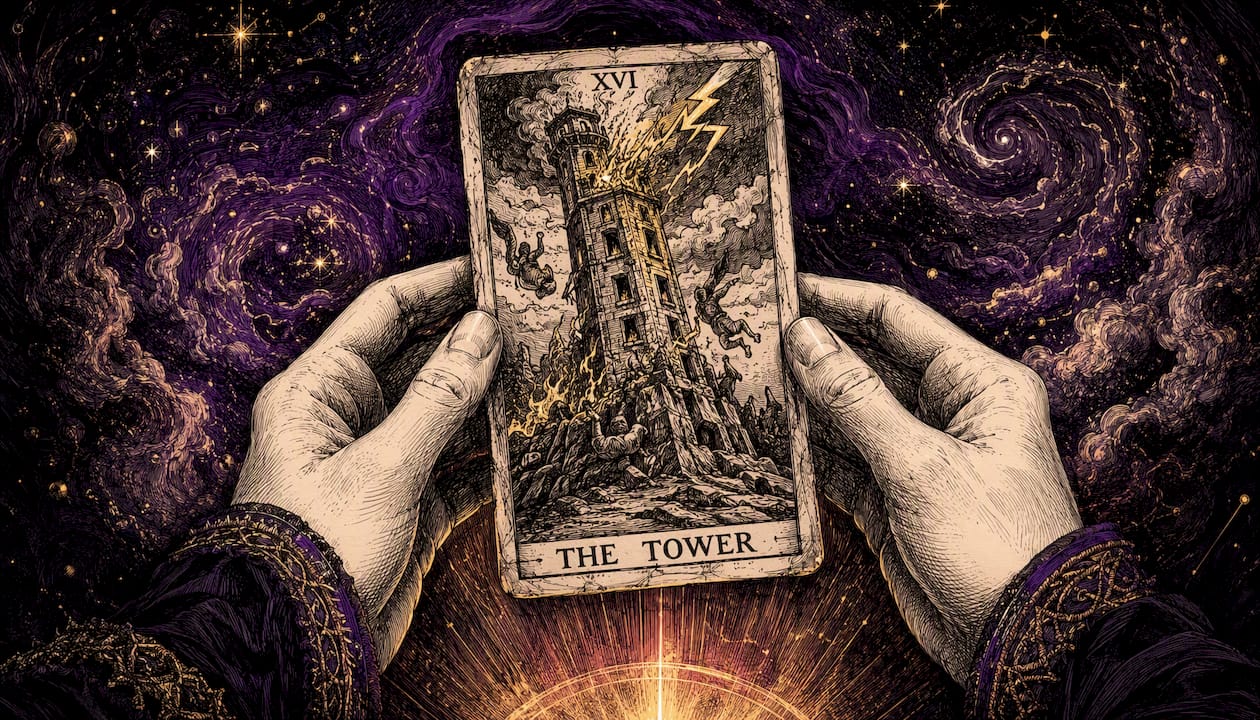
Visual and numinous cues focus attention. When you look at the Tower card or the glyph for Saturn, your brain immediately begins pattern-matching against stored associations, memories, and emotional states. That narrowing of attention is the mechanism, not the magic.
Psychologically, symbols work through priming, associative memory, and projection. A symbol primes you to notice certain feelings; associative memory links it to past experiences; projection lets you place internal material onto an external image where you can examine it more safely. Together, these processes make symbols reliable tools for surfacing unconscious content, as documented across symbolic systems in tarot that integrate numerology, astrology, elements, and Kabbalistic layers into a single interpretive language.
Pro Tip: During a reading, notice where you feel a physical reaction — a tightening in the chest, a sudden exhale, a moment of stillness. That physiological signal is often more reliable than your first verbal interpretation. Write it down before you analyze.
The four symbol types and how to read each one
Tarot imagery, planetary glyphs, numerological numbers, and ritual sigils each operate differently. Understanding their distinct affordances lets you choose the right technique for each, rather than applying one method to everything.
| Symbol Type | Key Correspondences | Fastest Reading Technique | Common Pitfall | Quick Example |
|---|---|---|---|---|
| Tarot imagery | Elements, planets, zodiac, Kabbalah, color | Name what you see, then what it feels like | Over-relying on memorized keywords | The Tower (Mars, Fire) pulled in a career spread: sudden disruption that clears a false structure |
| Planetary glyphs | Planetary archetypes, transits, house positions | Check the glyph's current transit; ask "what quality is active now?" | Treating a transit as fate rather than energy | Saturn glyph: discipline applied to daily health routines |
| Numerological numbers | Life Path, Expression, Soul Urge; sequence logic | Reduce to a single digit; read the process stage it names | Stopping at the number without asking "what phase am I in?" | Life Path: a research and solitude phase, not a permanent personality label |
| Ritual sigils | Personal intention, elemental charge, activation method | State the intention clearly before drawing or using | Activating a sigil without a clear, specific intention | A sigil for "clear communication" charged before a difficult conversation |
Tarot correspondences map Major Arcana cards to zodiac signs and planets, and Minor Arcana suits to elements and decans. Knowing those links means you can derive a card's meaning rather than memorize it.
Three quick example readings:
Tarot — The Hierophant: Literally, a robed figure between two pillars. Archetypally, structured tradition and transmitted wisdom. Action: examine the Hierophant reading and ask which tradition you are being invited to study or question.
Planetary glyph — Venus (♀): The circle of spirit over the cross of matter signals values and attraction. Ask: "What do I genuinely want, beneath what I think I should want?"
Numerology — the number 4: Foundation, structure, and consolidation. If 4 keeps appearing in your readings, you may be in a building phase that requires patience, not acceleration.
Short exercises that build real symbol fluency
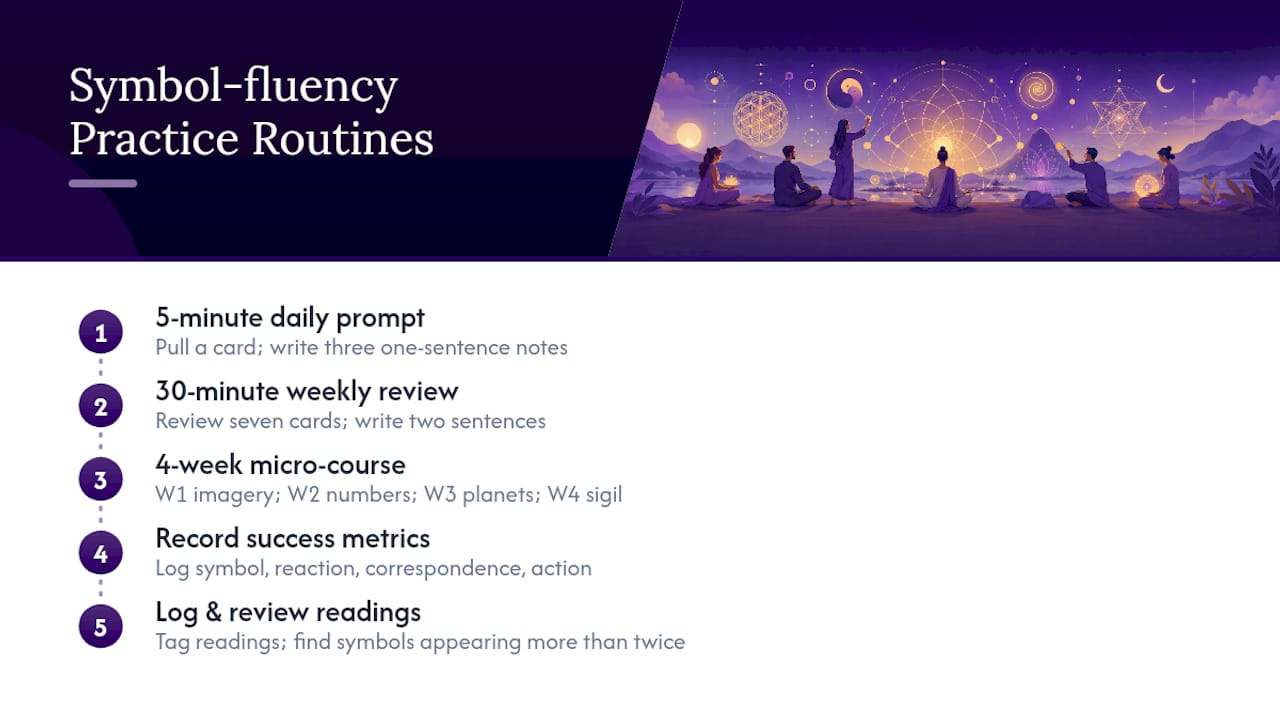
Consistency and reflection build symbol fluency faster than theory alone. Three time-boxed routines:
5-minute daily card prompt. Pull one card each morning. Write one sentence for each: what you see, what it corresponds to, and what it might mean today. That is it. Over weeks, patterns emerge without effort.
30-minute weekly pattern review. At the end of each week, look at your seven daily cards. Which suits dominated? Which numbers repeated? Write two sentences on what that pattern suggests about the week's energy. This is where tarot and mindfulness intersect most clearly.
4-week micro-course. Week 1: tarot imagery only. Week 2: add numerological numbers to each card you pull. Week 3: layer in the planetary correspondence. Week 4: write a sigil for one recurring theme you have identified. By week four, you are reading symbols in combination, not isolation.
Success metrics to record each session: the symbol pulled, your immediate physical reaction, one correspondence you applied, and one action you named. Progress shows up as fewer hedges ("I'm not sure, but maybe...") and clearer action steps.
Log sessions in Tarosyn's journaling feature and tag recurring symbols. Saved readings let you scroll back across months and spot developmental arcs that would be invisible session by session.
Pro Tip: After four weeks, search your saved Tarosyn readings for one symbol that appeared more than twice. Read those entries in sequence. The shift in how you interpreted the same symbol across time is often the clearest evidence of growth.
How to use sacred symbols with cultural respect
Respectful use means: ask before adopting, credit the source tradition, and learn before you practice. That single rule covers most situations.
Do:
- Credit the tradition a symbol comes from when you share your work publicly.
- Study primary sources (texts, teachers, community resources) before using symbols from living traditions.
- Ask a practitioner from that tradition if you are unsure whether a symbol is appropriate for personal use.
Avoid:
- Using sacred objects or symbols from living religious communities as aesthetic props.
- Commercializing symbols that carry active ceremonial meaning for a specific community.
- Presenting another tradition's symbol as your own original creation.
Red flags that a practice may be exploitative: the symbol is sold without attribution, the tradition's practitioners have publicly asked outsiders not to use it, or the use strips the symbol of its original context entirely.
If you realize you have crossed a boundary, stop using the symbol, acknowledge the source publicly if you shared it, and seek guidance from a practitioner of that tradition.
Pro Tip: Before adopting any ritual object or language from a tradition outside your own background, consult at least one primary text and one living practitioner. A five-minute conversation can prevent years of unintentional harm.
Key Takeaways
Sacred symbols work because they give your unconscious a concrete, repeatable prompt to respond to, and consistent practice with a structured method turns that response into usable insight.
| Point | Details |
|---|---|
| Symbols work through psychology | Priming, associative memory, and projection make symbols reliable tools for surfacing unconscious material. |
| Four symbol types, four techniques | Tarot imagery, planetary glyphs, numerological numbers, and ritual sigils each require a distinct reading approach. |
| Five-step method applies to all | Observe, name, map correspondences, personalize, and apply — use the journaling template every session. |
| Consistency builds fluency | Daily 5-minute card prompts and weekly pattern reviews produce clearer insights than occasional deep dives. |
| Tarosyn supports the full workflow | Save readings, tag recurring symbols, and use the Living Public Record to track patterns over time. |
What practitioners often get wrong about symbol work
Most guides treat sacred symbols as a vocabulary to memorize. That framing misses the point. A symbol's power is not in its fixed definition but in the friction between what it traditionally means and what it means to you, right now, in this specific situation.
The five-step method in this article is designed around that friction. Step four, personalization, is where most practitioners spend the least time and where the most useful material lives. Correspondences give you a framework; your personal story gives you the content.
The same applies to AI. Its value is not that it knows the "correct" answer to a reading. Its value is that it offers multiple angles quickly, which forces you to choose, and choosing is where interpretation actually happens. That is the insight practitioners report most often when they describe using AI for tarot and astrology: not that the AI was right, but that responding to it clarified what they already thought.
Treat every symbol as a question, not an answer. Treat every AI response as a draft you are editing, not a verdict you are accepting. That shift alone will make your practice more honest and more useful.
Try the five-step method inside Tarosyn
Tarosyn gives you a direct path to apply everything in this article. Pull a three-card spread and work through the five-step method on each card. Save the reading, tag the symbols that stand out, and return to them in a week.
Three ways to get started today:
- Check your daily horoscope to layer a planetary glyph onto your card pull.
- Browse the spirituality topic page for community reflections on recurring symbols.
Tarosyn's freemium access means you can try the daily card prompt and the five-step method at no cost. Saved readings and longitudinal pattern tracking are available with a subscription, and they are what make the four-week micro-course genuinely useful over time.
Useful sources
- AI Tarot Reading: Can AI Really Read Tarot Cards? And Is It Accurate? | AI Hub
- Tarot Correspondences: Complete Guide to Elements
- Symbolic systems in tarot: 7 Powerful Symbolic Systems in Tarot Revealed - explaintarot.com
- Using AI for Tarot and Astrology: What's Really Going On
- Tarot Symbolism: What Every Card Is Really Saying
- Tarosyn Project — Living Public Record
- AI Tarot Readings, Daily Horoscope & Mystic Community | Tarosyn
Save and tag your first reading after finishing this article. That single entry is the start of your pattern record.