
This article gives you themed spiritual journaling prompts for gratitude, prayer, healing, intuition, and purpose, plus a short practice method for using them well. This list was created with author Joseph Calitoy to help you turn a blank page into a real spiritual practice, not just a habit tracker.
TL;DR:
- Consistent journaling for 15 minutes over four days about personally meaningful topics significantly improves well-being.
- Guided prompts that focus on specific details outperform free writing by enhancing insight and emotional processing.
- Daily, thrice-weekly, or weekly sessions are effective, with handwriting encouraging honesty and searchability.
- Specificity in gratitude prompts yields stronger well-being results than vague thankfulness.
- Repeating focused-week themes helps reveal patterns and deepens understanding, especially when paired with meaningful symbols or insights.
Table of Contents
- How to Use Spiritual Journaling Prompts Effectively
- Gratitude and Praise Prompts That Push for Detail
- Prayer and Listening Prompts for Two-Way Journaling
- Healing, Grief, and Shadow Work Prompts
- Intuition and Symbol Prompts for Inner Guidance
- Purpose and Meaning Prompts for the Long Term
- Running a Focused-Week Prompt Series
- Personalizing Prompts to Your Own Beliefs
- Common Challenges in Spiritual Journaling (And How to Get Past Them)
- How Journaling Insights Become Daily Practice
- Spiritual Journaling vs. General Journaling
- A Personal Note on Practicing What This List Preaches
- Where Tarosyn Fits Into Your Journaling Practice
- Sources
How to Use Spiritual Journaling Prompts Effectively
A single prompt answered once won't do much. Consistency is what makes journaling work, and the research backs a specific starting point: writing for 15 minutes a day over four consecutive days about something personally significant produces measurable well-being changes, according to expressive-writing research from James Pennebaker. That's a low bar. You can hit it in one sitting on your lunch break.
Guided prompts also outperform blank-page journaling for a specific reason: structured writing produces more insight and better emotional processing than free-form entries, based on a review of expressive-writing studies. A prompt gives your attention somewhere to land.
Pick a rhythm that fits your life rather than an ideal one you'll abandon in a week:
- Daily, 10 to 20 minutes. Best for building a habit fast and catching daily shifts in mood or insight.
- Three times a week. A realistic middle ground if daily writing feels like pressure.
- One long weekly session. Works if you prefer depth to frequency, especially for purpose and legacy prompts.
Handwriting slows you down and tends to surface more honest material; typing is faster and easier to search later. Either works. Date every entry, sit in silence for thirty seconds before you write, and keep a simple starter kit nearby: a journal, a pen, 10 to 20 minutes, and a place where you won't be interrupted.
Gratitude and Praise Prompts That Push for Detail
Vague gratitude ("I'm thankful for my family") doesn't move the needle much. Specificity does. Positive psychology research on gratitude journaling shows that prompts forcing detail, naming who, when, and why, produce stronger well-being outcomes than generic thankfulness. Use these to get concrete:
- What is one specific moment from this week you almost overlooked but felt grateful for?
- Who spoke a word of encouragement to you recently, and what did it change in you?
- Name a physical sensation today (warmth, taste, rest) you're grateful for and describe it fully.
- What difficulty from your past turned out to be a hidden gift? Trace how.
- Write a prayer or note of praise using only sensory details from this week.
- Who taught you something you didn't ask to learn? Thank them on the page.
- What part of your body did something remarkable today without your instruction?
- Describe a small kindness a stranger showed you and what it revealed about people.
- What lesson took you the longest to learn, and are you grateful for the delay now?
- Write three sentences of praise addressed to whatever you consider sacred.
Take any single prompt here and expand it into a full paragraph, or turn it into a spoken or written prayer. The goal isn't a checklist. It's noticing what your first-draft gratitude usually skips.
Prayer and Listening Prompts for Two-Way Journaling
Prayer journaling works best as a record of dialogue, not a monologue. These prompts and a repeatable structure turn scattered petitions into something you can track over months.
- What are you asking for right now, stated as plainly as you can?
- What have you been afraid to pray about directly?
- Sit in silence for two minutes. What word or image surfaced?
- What answer to a past prayer are you still waiting to recognize?
- Write a prayer of complaint. Don't soften it.
- What would you ask for if you were certain you'd be heard?
- What impression came to you this week that you dismissed too quickly?
- Who do you need to pray for that you'd rather avoid?
- What decision are you circling that needs a direct question, not a vague hope?
- Write down a single sentence you feel was given to you, not created by you.
A three-part structure makes these repeatable: write the prayer, sit and wait one to three minutes, then immediately jot down whatever impressions surface, a method drawn from structured spiritual journaling guidance. Date these entries and revisit them a month later. Patterns show up that a single entry never reveals.
Healing, Grief, and Shadow Work Prompts
These prompts go deeper, so they need a safety note first: if a memory or emotion surfaces that feels bigger than the page can hold, stop, breathe, and consider talking to a therapist or counselor. Journaling supports processing, but it isn't a replacement for professional care when trauma or strong dysregulation surfaces.
- What pattern keeps repeating in your relationships, and where did it start?
- Who do you still need to forgive, even if they never asked?
- What version of yourself did you have to hide to feel safe as a child?
- Write a letter to the part of you that feels unworthy. Answer it as a wiser self.
- What loss have you not fully grieved because life didn't pause for it?
- Where in your body do you carry old anger? Describe it without judging it.
- What did you learn to believe about yourself that isn't true anymore?
- What would self-compassion sound like right now, in your own voice?
- Name one shadow trait you avoid admitting. What does it protect you from?
- What would healing this actually look like, concretely, six months from now?
Track recurring words or themes across entries. A pattern that shows up three separate times is worth more attention than any single dramatic entry.
Intuition and Symbol Prompts for Inner Guidance
Intuition gets sharper with documentation. Writing down hunches, dreams, and symbols and reviewing them later is how you separate real intuitive hits from wishful thinking, an idea supported by how journaling deepens intuition over time. Use these to build that record:
- What did you dream about last night, and what feeling stayed with you?
- What symbol or image has appeared more than once recently?
- What did your gut tell you today that your logic argued against?
- Describe a moment you "just knew" something before you had proof.
- What animal, number, or color keeps showing up, and what does it mean to you?
- If your intuition could speak in one sentence right now, what would it say?
- What decision are you avoiding because your gut already answered it?
- What did a recent coincidence seem to be pointing toward?
- Write down a hunch today. Set a reminder to check its accuracy in one week.
- What has your body been trying to tell you that your mind keeps overriding?
Pair a short reading with these prompts for extra texture. Pull a three-card spread or check your daily horoscope, then journal on whichever card or line struck you hardest. Over time, tag recurring symbols in a simple index so you can search past entries when the same image reappears.
Purpose and Meaning Prompts for the Long Term
Purpose prompts age differently than gratitude or shadow prompts. Answer them once and they'll feel incomplete. Answer them every few months and you'll watch your own answers evolve.
- What activity makes you lose track of time completely?
- What gift do people consistently point out in you that you downplay?
- If money weren't a factor, what would you build or fix?
- What would you want people to say about your impact after you're gone?
- What is one step, however small, toward the calling you keep postponing?
- What older version of your purpose have you outgrown?
- Who has your presence changed, even in a way they never told you?
- What would "enough" look like in your work and your life right now?
Set a quarterly reminder to revisit this set. The answers rarely stay static, and comparing them side by side over a year often reveals your actual direction better than any single entry could.
Running a Focused-Week Prompt Series
Answering one gratitude prompt on Monday and one shadow prompt on Thursday scatters your attention. A focused week, one theme for seven straight days, builds pattern recognition that random prompts never do, based on guidance on category-based journaling progression.
Here's a simple structure using the healing theme as an example:
- Day 1, notice. Write down the pattern or feeling without analyzing it.
- Day 2, feel. Sit with the emotion attached to it and describe it physically.
- Day 3, story. Trace where this pattern first started in your life.
- Day 4, ask. Write a direct question or prayer asking for clarity on it.
- Day 5, integrate. Write what shifted, even slightly, after four days of attention.
- Day 6, review. Reread all five entries in one sitting.
- Day 7, summarize. Write one paragraph capturing what the week revealed.
This works because repetition on one theme surfaces connections that a single entry hides. You can't see a pattern from one data point.
Pro Tip: Tag each entry with a one-word label (gratitude, listening, shadow, intuition, vocation) and keep a short index at the front of your journal. When you want to trace a theme across months, you'll find it in seconds instead of flipping through fifty pages.
Personalizing Prompts to Your Own Beliefs
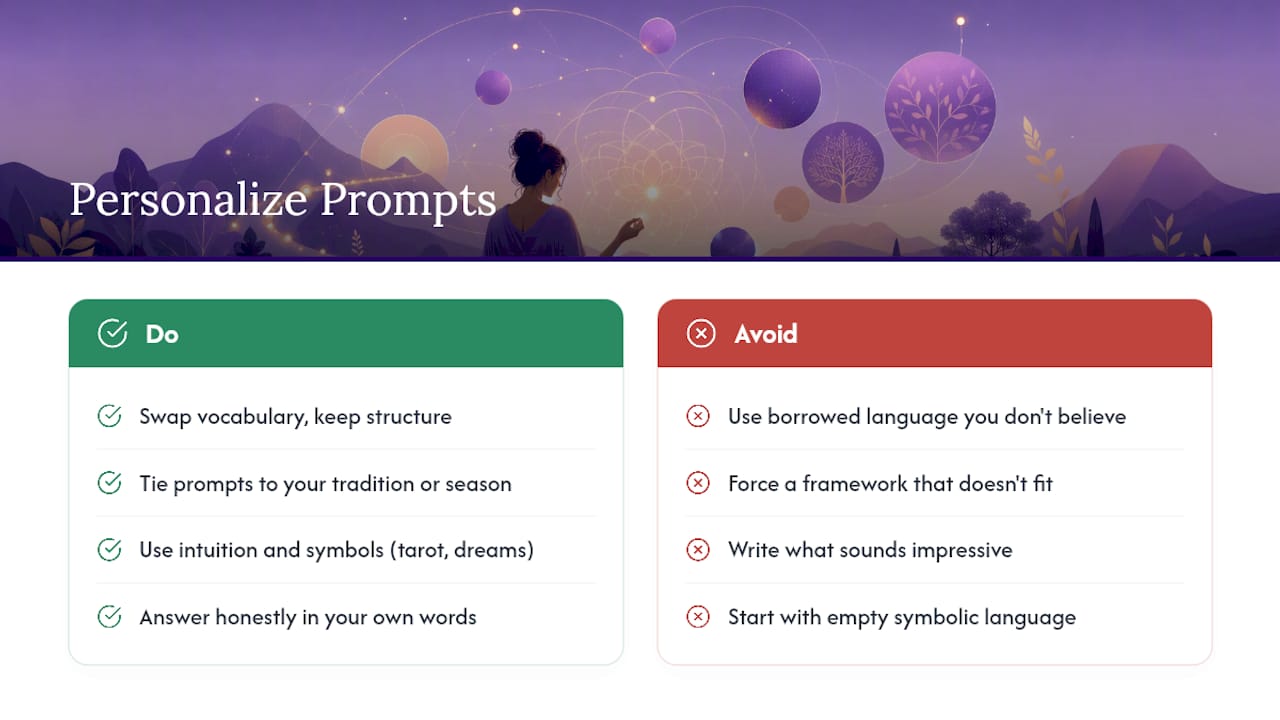
None of these prompts require a specific religious framework to work. Swap the vocabulary, not the structure. If a prompt says "prayer," and that word doesn't fit your practice, replace it with "intention," "reflection," or "the universe," and answer the same underlying question.
Someone working within a specific faith tradition might tie gratitude prompts to scripture, reading a verse before writing. Someone practicing a more eclectic or nature-based spirituality might tie the same prompt to a season, a moon phase, or a tarot card pulled that morning. The prompt about forgiveness works whether you frame the "who" as a deity, your higher self, or simply your own conscience.
The intuition and symbol prompts adapt especially well across traditions, since dreams, coincidences, and gut feelings show up regardless of what you call the source. If you work with tarot or astrology, pairing a reading with self-reflection gives you a built-in symbol system to draw from instead of starting from a blank page every time.
The only real rule: keep the language honest to what you actually believe, not what sounds impressive on the page. A prompt answered in borrowed language from a tradition you don't practice tends to produce shallow entries. A prompt answered in your own words, even clumsy ones, tends to produce the entries you'll want to reread later.
Common Challenges in Spiritual Journaling (And How to Get Past Them)
The most common problem isn't lack of interest. It's staring at a prompt and writing three flat sentences that say nothing real. That usually means the prompt is too big. Break "What is my purpose?" into "What did I enjoy doing before age twelve?" and the answer gets easier to find.
A second challenge is inconsistency. Motivation carries you for four or five days, then the journal sits closed for two weeks. The focused-week method helps here because it gives you a finish line. Seven days feels achievable in a way "journal forever" doesn't.
A third challenge is emotional avoidance, unconsciously choosing gratitude prompts every time because they're comfortable, while grief or shadow prompts sit untouched. There's nothing wrong with gratitude-heavy journaling, but if you notice you're always steering away from one theme, that avoidance itself is worth a prompt.
Fear of being "wrong" trips up beginners too, worrying that their prayer entries sound unsophisticated or their symbol interpretations sound silly. There's no audience grading this. The only standard is whether the entry is honest.
Finally, some people stall because they don't know what to do with old entries. Reread them monthly instead of letting them pile up unread. A journal you never revisit is just storage. A journal you revisit becomes a record of how you've actually changed.
How Journaling Insights Become Daily Practice
An insight that stays trapped on a journal page rarely changes anything. The transfer from page to daily life happens through small, repeatable actions, not big resolutions.
Start with a one-line carryover: after writing, summarize the entry's core insight in a single sentence and place it somewhere you'll see it, a phone note, a sticky note on your mirror, a recurring calendar reminder. If Tuesday's entry revealed that you avoid asking for help, that sentence becomes your filter for the next few days' decisions.
Morning and evening bookends work well too. A thirty-second morning glance at yesterday's entry sets an intention; an evening line noting whether that intention showed up closes the loop. This doesn't require a new journaling session, just a habit of checking in with what you already wrote.
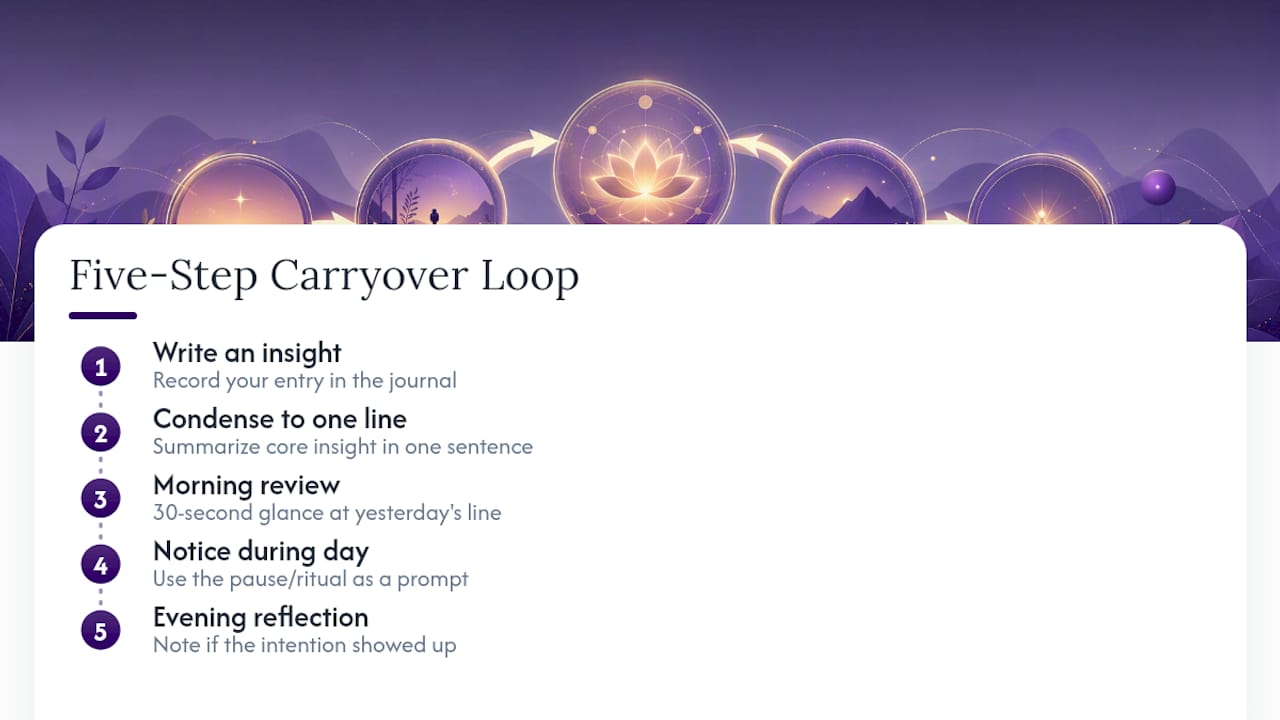
Ritual pairing deepens this further. Short rituals before writing, a breath, a lit candle, thirty seconds of silence, increase how much readers notice in their entries and make the practice easier to carry into ordinary moments during the day. The same pause you use before writing can become a pause you use before a hard conversation or a stressful meeting.
Community accountability helps some people more than solo review, as shown in discussions from a spiritual awakening program. Sharing a reflection or reading a public journal entry from others practicing similarly can reinforce a habit that's easy to abandon alone.
Spiritual Journaling vs. General Journaling
General journaling tends to record events: what happened, how the day went, what's on the to-do list. Spiritual journaling asks a different question underneath the same page: what does this event mean, and what is it asking of you?
A general journal entry about a hard conversation might read, "Had a tense talk with my sister today, feeling drained." A spiritual journal entry on the same event might ask what pattern that tension reveals, what it's teaching about forgiveness, or what it says about a boundary you keep failing to set. Same event, different depth.
The two aren't opposites, and plenty of entries blend both. But spiritual journaling deliberately looks for connection, meaning, guidance, or growth, while general journaling is often satisfied simply capturing what occurred. This is also why themed prompts matter more here than in a standard diary. A theme like gratitude, prayer, or shadow work gives the reflection a direction that a generic "how was your day" prompt doesn't provide.
If you already keep a general journal, you don't need to start a separate one. Add a single spiritual prompt at the end of your regular entry once or twice a week and watch how it changes what you notice in the days that follow.
A Personal Note on Practicing What This List Preaches
Running a focused week on the shadow-work theme taught me more than scattering random prompts ever did. By day four of asking the same underlying question in different ways, a pattern showed up that I'd missed for years: I kept describing the same fear of being a burden in three unrelated stories. That's the value of repetition over variety.
The role of tools like Tarosyn is not to replace the page but to give you something concrete to journal about on days when a blank prompt feels too open. A daily horoscope line or a pulled tarot card becomes the seed for that day's entry instead of staring at nothing.
[E-E-A-T placeholder: author credentials and formal case studies to be added]
— Joseph Calitoy
Where Tarosyn Fits Into Your Journaling Practice
This service isn't a replacement for the page, but it aims to solve a common problem journalers run into: some mornings you have twenty minutes and zero ideas. A daily horoscope, a quick tarot pull, or a saved reading from last week can give you something concrete to write about instead of staring at a blank line.

Pull The World in a Three Card Spread before a purpose-themed entry, or check your daily horoscope before a gratitude session, and let whichever image or line struck you become that day's prompt. Every reading and reflection saves to your account, so six months from now you can compare what a card meant to you then versus what it means now, the same kind of pattern tracking this article recommends for your journal entries. The free tier covers daily horoscopes and basic readings; a subscription unlocks saved reading history and deeper spreads if your practice grows past the basics. Start with Tarosyn and pull today's reading before your next journaling session.
Sources
- James Pennebaker — Expressive writing and health (event summary)
- NCBI — review article on expressive writing and mental health
- Writers
- BMOZI — 50 spiritual journaling prompts for deeper faith