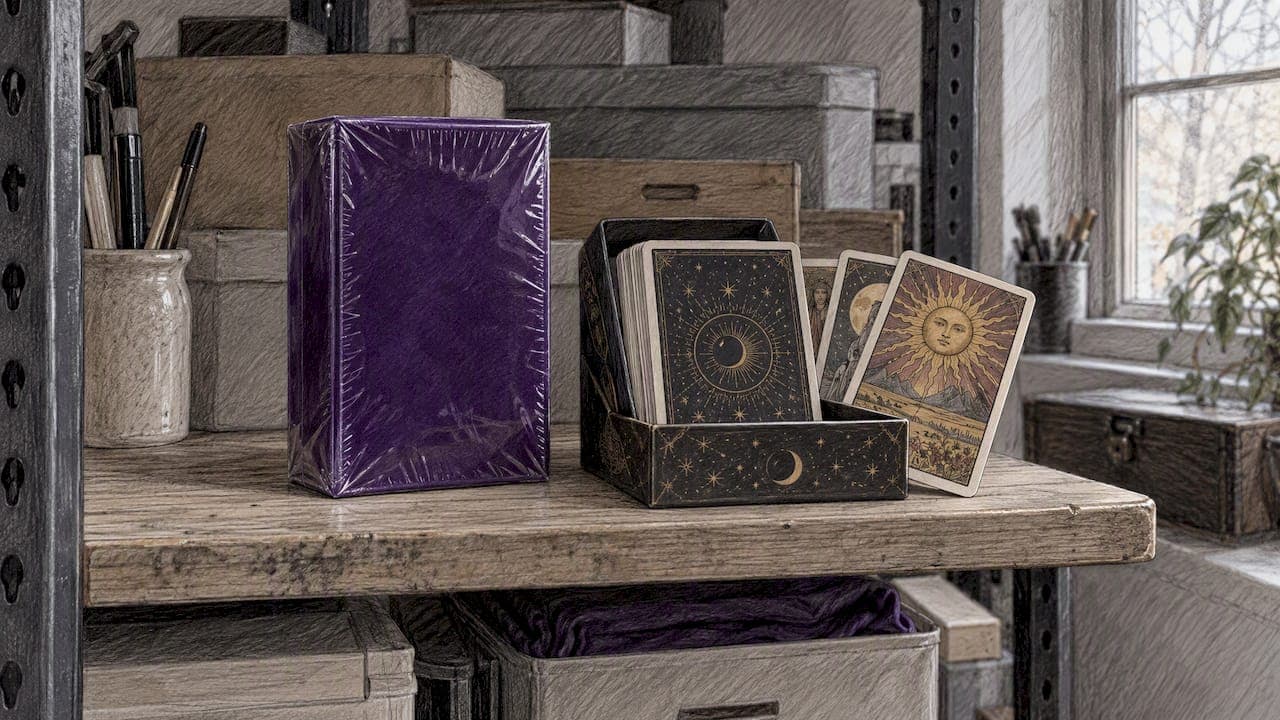
Tarot card collectibles are prized for their art, history, and scarcity rather than their use in a reading. Value rests on factors such as a limited print run, documented provenance, physical condition, and completeness of the original set. This guide shows you how to spot a collectible deck, where to buy and sell safely, how to store what you own, and how to manage a growing collection with intention.
TL;DR:
- Check all 78 cards, the original box and booklet, print details, condition, and traceable ownership; a printed date alone does not prove age.
- Historic deck fragments have sold for six figures, while early first editions can bring thousands; provenance, condition, and completeness shape prices.
- For purchases near several thousand dollars, favor established dealers or auction houses, and require provenance, detailed photos, and payment with buyer protection.
- Use archival boxes and acid free paper, keep decks away from sunlight and temperature swings, and leave mold or pigment damage to conservators.
- Modern decks gain collectible status through genuinely limited, numbered or signed artist runs, while open ended commercial editions lack the same documented scarcity.
Table of Contents
- Collecting vs. Reading: Two Different Relationships With a Deck
- Why Certain Tarot Decks Become Collectibles
- How to Identify a Rare or Valuable Tarot Deck
- Where Collectors Buy and Sell Tarot Decks
- Caring for and Preserving Collectible Tarot Decks
- Building a Meaningful Collection
- Tips for Maintaining and Handling Tarot Decks to Prevent Damage
- Modern Limited Edition and Artist-Created Tarot Decks
- How to Track Market Trends in Tarot Collectible Values
- A Collector's Note on Balance
- Tarosyn as a Digital Companion for Collectors
- FAQ
- Sources
Collecting vs. Reading: Two Different Relationships With a Deck
Reading and collecting serve different goals. A reader builds intimacy with one or two decks through repeated use. A collector looks for art, rarity, and a documented history, and often keeps a prized deck sealed and untouched rather than shuffled daily.
That distinction shapes how you treat your cards:
- Collectors value boxed, pristine condition because an opened deck loses resale value.
- Readers keep a small working set in active rotation, wear included.
- Periodic audits help you decide which decks stay shrink-wrapped and which get used or passed along.
If you want to keep a practice alive alongside a collection, our guide to tarot and self-reflection walks through journaling habits that work well with a dedicated working deck.
Why Certain Tarot Decks Become Collectibles
A deck becomes collectible when scarcity meets reputation. Experts in the field prioritize decks with a fixed-ceiling print run: once the run ends and no reprint follows, the item gains documented, finite supply. Signed or numbered editions from recognized artists add another layer of demand, since buyers can trace the work to a known creator and a known quantity.
- A fixed, closed print run turns an ordinary deck into a documented, finite object.
- Historic importance and verified provenance (Visconti-Sforza fragments, early Tarot de Marseille variants, 1909 Rider-Waite first editions) drive the highest interest.
- Original packaging, booklets, and full card counts matter as much as the cards themselves.
Historic decks can command significant sums at auction. A 2026 market guide notes that Visconti-Sforza fragments have sold for six-figure amounts and Rider-Waite first editions for thousands, with final price tied closely to provenance, condition, and completeness.
How to Identify a Rare or Valuable Tarot Deck
Before you buy, inherit, or sell a deck, work through a short checklist. This applies whether you are evaluating a flea-market find or a deck passed down in a family.
- Confirm completeness: count all 78 cards, and check for the original tuckbox and booklet.
- Examine card stock, edge wear, and how colors shift under raking light.
- Look for printing markers such as catalogue numbers or the absence of modern copyright text, which can indicate an older print run.
- Ask the seller for provenance: receipts, prior auction listings, or notes from a specialist.
- For high valuations, request a certified appraisal or, in rare cases, spectrographic testing of pigments and paper.
Condition hinges on details that are easy to miss. A collector who has handled originals notes that modern reproductions often lack the subtle print quality and precise dimensions of period pieces, so comparing measurements and print clarity against documented examples is worth the extra step.
Pro Tip: Photograph a suspected deck under natural daylight and compare the images against a published visual archive before you commit to a purchase.
Provenance matters more than a printed date. Museum or auction-house verification becomes worthwhile once a deck crosses into specialist price territory, since documented ownership history is what separates a genuine rarity from a convincing reprint.
Where Collectors Buy and Sell Tarot Decks
Channel choice depends on price and how much verification you need. A small purchase from a trusted dealer carries less risk than a private sale with no documentation.
- Specialist auction houses and international auction houses handle high-value, historic pieces and provide catalog records and provenance research, as seen in Sotheby's listing of the Ortiz-Patiño tarot card.
- Specialist dealers and collectible shops suit mid-range purchases and often know the history behind specific print runs.
- Trade fairs and collector conventions let you inspect cards in person before paying.
- Vetted online marketplaces and specialist platforms work for lower-risk purchases when the seller provides clear photos and a return policy.
For anything approaching several thousand dollars, lean toward auction houses or established dealers over private online sales. Ask every seller for provenance, close-up condition photos, and confirmation that the box and booklet are included. Use payment methods that offer buyer protection or escrow on high-value purchases.
Watch for red flags: a seller who refuses close-up photos, printing markers that do not match known editions, or provenance that cannot be traced or confirmed.
Caring for and Preserving Collectible Tarot Decks
Storage choices determine whether a collectible holds its value for decades or degrades within a few years.
- Use acid-free interleaving paper and rigid, archival-quality boxes for anything you intend to keep long-term.
- Keep humidity stable and avoid extreme temperature swings, since paper and pigment react to both.
- Avoid soft PVC sleeves, which can damage cards over time; archival Mylar or Melinex sleeves are the safer choice.
- Keep decks out of direct sunlight to prevent fading.
Conservation guidance from Winterthur Museum, Garden & Library recommends archival-quality, acid-free materials for storage and advises consulting a professional conservator for delicate or high-value paper items rather than attempting repairs yourself.
Pro Tip: Photograph every card and the full set of accessories before you store a deck, and keep a note of where you bought it and for how much.
A museum-grade example shows what real conservation involves: an Ordo Templi Orientis conservation report documents separating hand-painted cards from acidic backing, de-acidifying them, relining onto archival supports, and rehousing in museum-quality materials, which is far beyond a DIY fix. Unstable pigments, mold, or insect damage call for a trained conservator, since a well-meant repair can destroy the provenance a buyer or appraiser would otherwise rely on.
Building a Meaningful Collection
A focused collection is easier to research, store, and eventually sell than a scattered one.
- Pick a focus, such as a specific era, artist, or run of limited editions, so your research and provenance records build on each other.
- Audit your collection periodically: choose one or two workhorse decks for active practice and consider selling, donating, or gifting the rest.
- Frame collecting as an appreciation of art and history rather than a marker of spiritual status.
Cultural commentary on the current wave of deck releases documents how social media has amplified novelty releases and hoarding tendencies, and recommends regular audits and redistribution of unused decks as a direct response. A personal essay on the topic makes a similar point: collecting is a valid interest, but detachment from practice and the dopamine cycle of unboxing are worth watching for.
Tips for Maintaining and Handling Tarot Decks to Prevent Damage
Daily handling habits protect a deck as much as proper storage does.
Wash and dry your hands before handling a valuable deck, since oils and lotions transfer to card stock and cause long-term staining. Hold cards by their edges rather than pressing fingers onto the printed surface, especially with hand-finished or gilded editions. Shuffle gently, or skip shuffling entirely for display-grade decks you do not intend to use.

Keep food, drink, and open flames away from your collection. Return cards to their box immediately after viewing rather than leaving them stacked on a table or shelf. If a deck came with a ribbon, wrap, or sash, use it as intended rather than storing cards loose.
Avoid rubber bands, paper clips, or tape near cards, since adhesives and metal can leave marks or rust stains over time. If you travel with a collectible deck, use a padded, rigid case rather than a soft bag. Check stored decks every few months for signs of moisture, insects, or fading, since early detection makes the difference between a quick fix and a conservation emergency.
Modern Limited Edition and Artist-Created Tarot Decks
Collectibility is not limited to antique decks. Contemporary artists now release tarot decks in small, numbered runs that function the same way a limited print run does for historic pieces.
Practice among limited-edition card producers shows that genuinely collectible runs are individually numbered, sometimes signed, and often sold through members-only channels, which keeps long-term scarcity intact. A numbered deck with the artist's signature on the box carries a different collectible status than an open-ended commercial print run, even if the artwork is similar.
For newcomers building toward this kind of collecting, starting with a deck that includes a detailed guidebook and a recognizable art style gives you a foundation before chasing scarcer finds. Our tarot archetypes reference is a useful starting point for researching how different artists interpret the same cards, which matters once you start comparing editions.
How to Track Market Trends in Tarot Collectible Values
Values shift as artists gain reputation, print runs close, and demand for specific eras rises or falls. Watching auction results over time is the most reliable way to track this.
Auction catalogs from established houses record final sale prices alongside provenance, giving you a dated reference point for comparable pieces. A visual archive such as SIGNED Tarot and Divination Cards documents hundreds of historic and contemporary decks and functions as a reference for iconography and artist reputation, which helps you judge whether a new find fits a known pattern of rising interest.
Market guides published annually, such as the 2026 collectible tarot overview referenced earlier, track how specific categories (early hand-painted decks, first editions, signed modern runs) move in value. Following a handful of specialist dealers and auction houses over a year or two gives you a working sense of which categories are gaining attention before prices catch up.

A Collector's Note on Balance
Physical decks hold history in a way a screen cannot fully replace. The paper, the ink, the wear on a corner all tell a story about who held the cards before you. That said, depth of practice does not require owning every deck ever printed. The collectors who get the most out of this hobby audit what they own, keep a working deck or two in active use, and pass along the rest. If you are documenting your own finds, consider sharing them in community spaces where other collectors compare notes and provenance research.
— Joseph Calitoy
Tarosyn as a Digital Companion for Collectors
Physical decks deserve the archival care covered above, and a digital space can hold what paper cannot: searchable records, reading history, and a place to share finds. Within Tarosyn, you can save readings and generate an AI tarot portrait from a selfie as a personal companion piece to your physical collection.

- Save readings and reflect on your spiritual practice.
- Generate AI tarot portraits as a personal, shareable complement to physical cards.
- Connect with other collectors and readers in a shared community space.
This is not a replacement for a well-stored deck in an archival box. It is a place to document the collection you already have, reflect on readings tied to specific decks, and swap stories with people building collections of their own. Current prices are on Tarosyn's website.
FAQ
Are old tarot cards worth anything?
Old tarot cards can carry real value, but it depends on provenance, condition, and completeness rather than age alone. A documented, complete deck with its original box and booklet is worth far more than a worn, incomplete one from the same era.
What is the most valuable tarot card?
Individual historic cards with strong documented provenance, such as hand-painted fifteenth-century examples, have sold through major auction houses for substantial sums. Value depends heavily on the specific card's history and condition rather than a single fixed figure across the category.
What is a good gift for someone who enjoys tarot cards?
A deck with a detailed guidebook and a recognizable art style makes a strong gift for someone building a collection or starting a practice. A numbered or signed limited edition from a known artist is a stronger choice for someone already interested in collecting rather than daily reading.
What is the rarest tarot deck?
Fragments from historic hand-painted decks like the Visconti-Sforza cards, along with very early Tarot de Marseille variants, rank among the rarest known examples, with surviving pieces held in museum collections. First editions of widely reprinted decks, such as the 1909 Rider-Waite, are far more common but still considered valuable among specialist collectors.
Sources
- Collectible Tarot Decks: How To Identify A Historic Deck, The Rarest Editions And Value In 2026 - Coins&More
- Ordo Templi Orientis (O.T.O.)
- Caring for Your Collections - Winterthur Museum, Garden & Library
- SIGNED Tarot and Divination Cards: A Visual Archive by Laetitia Barbier — Morbid Anatomy
- Tarot Deck Hoarding: When Collecting Becomes Spiritual Consumerism