
Spiritually, personal branding is your soul-level identity — the consistent way your inner purpose expresses itself through ritual, symbol, and practice. This is not about marketing yourself or building an audience. It is about recognizing the energetic signature you already carry, what the Kripalu tradition calls a soul signature: an innate imprint to be uncovered, not invented. The difference matters. Marketing-style branding asks, "How do I appear?" Soul-level identity asks, "What is already true about me?" Try this now: write one sentence using this template — "I am a [two-word essence] who [verb phrase]." For example: "I am a quiet witness who helps others see clearly." That sentence is your starting point.
Key Takeaways
Your spiritual personal brand is a soul-level identity you uncover through repeated practice with divination, ritual, and journaling — not a persona you construct for others.
| Point | Details |
|---|---|
| Soul-level definition | Spiritual personal branding is your energetic signature, discovered through practice, not manufactured for an audience. |
| Start with one sentence | Write "I am a [two-word essence] who [verb phrase]" to name your working signature right now. |
| Use the 3-card spread | Draw Root, Expression, and Edge cards and write one connecting sentence to find your current signature. |
| Practice for one week | Pull one card daily, journal two sentences, and track recurring symbols for seven days. |
| Tarosyn for ongoing practice | Tarosyn's personalized readings, journaling, and horoscope tools help you track and refine your signature over time. |
Table of Contents
- Why does a soul-level spiritual identity matter for seekers?
- What are the core elements of a spiritual personal brand?
- Concrete exercises to discover your spiritual signature
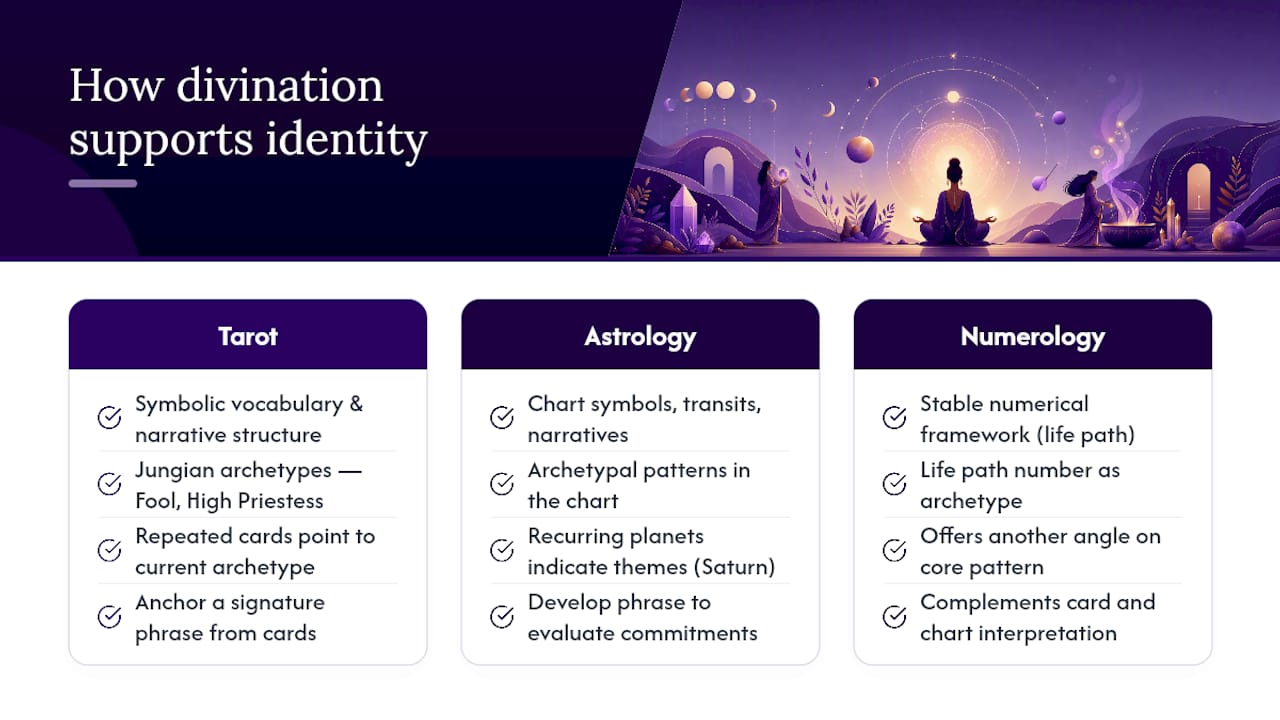
- How do tarot, astrology, and numerology support identity work?
- How do you practice spiritual identity work ethically?
- A 4-week plan to clarify and live your spiritual signature
- Why clarifying your spiritual identity matters right now
- Tarosyn gives you tools to track and sustain this practice
- Sources
Why does a soul-level spiritual identity matter for seekers?
Knowing your spiritual signature gives you a reliable reference point for decisions, boundaries, and practice. When you are clear on your core essence, you stop second-guessing which rituals fit, which communities align, and which commitments drain you. That clarity is practical, not abstract.
Research supports this. McMaster University analysis notes that divination offers personal insight, emotional validation, and a perception of control — and that it appeals especially to people excluded from organized religion, including young people, women, and LGBTQ seekers. Divination works partly because it gives agency back to people whose questions formal systems do not answer.
The concrete benefits of clarifying your spiritual signature include:
- Clearer decisions — you can ask whether a choice aligns with your core essence rather than external expectations
- Stronger boundaries — you recognize which practices and communities honor your values
- Deeper ritual — rituals become more resonant when they reflect who you actually are
- Resilience — a stable inner identity holds steady when circumstances shift
- Alignment with purpose — the soul signature and soul plan work together: the signature is your core essence; the plan is the growth path that expresses it
The exercises in the following sections work because they give you repeatable ways to surface and test that signature.
What are the core elements of a spiritual personal brand?
A spiritual personal brand is built from repeatable, embodied elements — not promotional tactics. Think of it as the pattern that shows up consistently across your readings, rituals, and relationships.
| Core Element | What It Looks Like in Practice | Example |
|---|---|---|
| Archetype | A recurring card, planetary placement, or mythic figure | The High Priestess appears in three consecutive readings |
| Ritual style | How you open and close practice sessions | Lighting a candle, setting an intention, closing with gratitude |
| Language and voice | Words and phrases you return to naturally | "I witness," "I hold space," "I return to stillness" |
| Symbolic aesthetic | Objects, colors, or images that feel resonant | A moon altar, deep indigo, water imagery |
| Community practice | How you share and reflect with others | Weekly check-ins, public journaling, accountability circles |

Tarot's 78 cards present archetypal imagery that readers use to construct identity — ethnographic research shows that learning tarot resembles learning a symbolic language, one that readers then apply to self-definition. Each element in the table above is a place to audit what you already do and notice what feels most like you.
Concrete exercises to discover your spiritual signature
Use a 3-card discovery spread
This spread works best at the start of a new cycle — a new moon, a birthday, or a season change.
- Shuffle your deck while holding this question: "What is the core of my spiritual identity right now?"
- Draw three cards and place them left to right: Root (what grounds you), Expression (how your essence shows up), Edge (where you are growing).
- Write one sentence for each card using this frame: "This card shows me that I am someone who ___."
- Read all three sentences together. Notice what phrase or theme connects them.
- Write that connecting theme as a single sentence. That is your working spiritual signature.
You can see how a specific card shapes identity language in a three-card reading example on Tarosyn.
Five journaling prompts
Use these after any reading, chart review, or numerology session:
- Which symbol or figure kept drawing my attention, and what does it remind me of in my own life?
- What quality do I most want to embody this season?
- Where do I feel most like myself — what am I doing, and who is around me?
- What would I do differently if I fully trusted my core essence?
- Which card or archetype has appeared more than once this month, and what is it pointing to?
One-week micro-ritual
Spend 5–10 minutes each morning for seven days. Pull one card, read it, and write two sentences: what the card reflects about your current state, and one small action that aligns with your signature. Do this at the same time each day. Consistency matters more than length.
Pro Tip: Track your cards in a simple list. After seven days, look for a repeated suit, archetype, or theme. That repetition is data about your signature, not coincidence.
Combining readings, journaling, and small rituals creates a feedback loop that surfaces recurring themes faster than any single practice alone, as Tarosyn's self-discovery methodology describes.
How do tarot, astrology, and numerology support identity work?
These systems provide symbolic vocabulary and narrative structure for identity-making. They do not tell you who you are. They offer a set of possibilities you can try on, test, and refine.
A 2022 study published in Implicit Religion frames this well:
Source: Astrology, modernity and the project of self-identity
This open-framework quality is what makes divination useful for soul-level identity work. A fixed system would tell you who to be. An open framework invites you to interpret, which is exactly the skill that builds self-knowledge.
Jungian archetypes connect this to psychology. The Fool, the High Priestess, the Hermit — these are not just card names. They are patterns of human experience that Carl Jung identified as universal. When a card keeps appearing in your readings, it may be pointing to an archetype you are currently living. Ask yourself: "Which archetype keeps reappearing in my readings or chart?" Then: "How would this archetype describe my work in one sentence?"
A concrete example: if Saturn keeps appearing in your transits or the World card recurs in spreads, you might develop a habitual phrase like "I build slowly and with intention" — and use that phrase to open ritual sessions or evaluate new commitments. The Empress archetype works similarly: a reader who repeatedly draws her might anchor their signature around nurturing, creative abundance, or embodied presence.
Numerology adds a third layer. Your life path number gives a stable numerical archetype that complements card and chart work, offering another angle on the same core pattern.
How do you practice spiritual identity work ethically?
Ethics matter here because spiritual identity is relational. Many practices carry cultural lineage, and using them without context or credit causes real harm.
Watch for these red flags:
- Adopting sacred practices from a specific cultural or religious lineage without learning their origin or seeking permission
- Using spiritual language — "high vibe," "aligned," "sacred" — as aesthetic packaging rather than lived practice
- Performing spiritual identity for an audience rather than practicing it privately first
- Ignoring consent when sharing community rituals or readings that involve others
- Treating lineage-specific symbols as interchangeable decoration
A practical boundary checklist:
- Ask: Is this practice honorific — am I engaging with it respectfully and with some understanding of its source?
- Ask: Is it sourced — do I know where it comes from and who carries that lineage?
- Ask: Is it consented — if this involves another person's energy or story, do they know?
- Keep lineage credit visible. If you use a Yoruba-derived practice, say so.
- Center lived experience over aesthetics. A practice that looks spiritual but does not change how you act is performance, not identity.
The tarot and yoga connection offers a useful model here: both traditions ask practitioners to embody principles, not just display them.
A 4-week plan to clarify and live your spiritual signature
A four-week structure gives you momentum and feedback faster than occasional one-off rituals.
Week 1: Discover
Pull one card daily and journal two sentences. Complete the 3-card discovery spread on day 7. Write your working spiritual signature sentence.
Week 2: Test
Make two small decisions using your signature as a filter. Before each decision, ask: "Does this align with my core essence?" Note whether the answer felt clear or uncertain. Browse community readings on Tarosyn to see how others translate recurring symbols into identity language.
Week 3: Ritualize
Build a 5-minute opening ritual that reflects your signature. Use your dominant archetype, your signature phrase, and one physical anchor (a candle, a stone, a breath pattern). Repeat it daily. Track your daily horoscope alongside your card pulls to notice where astrology and tarot themes overlap.
Week 4: Share and reflect
Share one insight from your practice with a trusted person or community. Review your four weeks of notes. Look for two or three recurring symbols, phrases, or archetypes. Revise your signature sentence if needed. Decide whether to run the plan again or move to a deeper practice.
Log progress in a simple notebook or digital journal. When the same symbol appears three or more times, treat it as a confirmed element of your signature, not a coincidence. Iterate the plan every four weeks for the first three months.
Why clarifying your spiritual identity matters right now
Many seekers carry a clear sense that something is true about them at a deep level — and an equally clear frustration that they cannot name it. That gap is not a personal failure. Symbolic practice exists precisely to help you cross it. When external structures feel uncertain, having a stable inner reference point changes how you move through the day. One micro-practice this week — the 3-card spread, a single journaling prompt, five minutes of morning ritual — is enough to start noticing the pattern. Notice one thing that shifts.
Tarosyn gives you tools to track and sustain this practice
Tarosyn brings together personalized tarot readings, journaling, horoscope tracking, and community reflection in one place — so the exercises in this guide have a home. You can save readings, track recurring cards and symbols over time, and use the built-in journaling tools to log your signature work after each session. The community features let you share insights and see how other seekers are translating their readings into identity language.
Start with a personalized reading on Tarosyn to put the 3-card discovery spread into practice today.
Sources
These sources were chosen for their scholarship on divination and identity, practitioner guidance on soul-level work, and Tarosyn's own methodology resources. Tarosyn's blog posts serve as practical continuations of the exercises above.
- Full article: Astrology, modernity and the project of self-identity
- Analysis: Why centuries-old astrology and tarot cards still appeal to us - McMaster News
- Discovering Your Soul Signature | Kripalu