
Astrology is a self-discovery tool defined as a symbolic language that maps personality, emotional patterns, and life rhythms through the positions of celestial bodies at the time of your birth. Unlike fortune-telling, it does not predict fixed outcomes. Carl Jung regarded astrology as representing all ancient psychological knowledge, endorsing it as a language for unconscious patterns. That framing matters. Frameworks like Myers-Briggs and the Enneagram serve the same basic function: they give you a vocabulary for understanding yourself. Astrology does the same, with the added layer of timing and cycles that those tools lack.
Why astrology is a self-discovery tool: birth charts and archetypes
Astrology's core mechanism is directed introspection. Growth comes not from the stars themselves but from the disciplined self-reflection that astrological symbols prompt. The birth chart is the primary structure for that reflection.
The "big three" as a starting point
The Sun, Moon, and Rising signs, collectively called the "big three," give you three distinct layers of self-understanding:
- Sun sign: Your core identity, conscious will, and the qualities you are actively developing.
- Moon sign: Your emotional instincts, subconscious reactions, and what makes you feel secure.
- Rising sign (Ascendant): How you present yourself to the world and the lens through which you filter experience.
The "big three" provide a structured starting point for introspection comparable to Myers-Briggs or the Enneagram, without requiring complex mastery of the full chart. That low barrier matters for anyone new to using astrology for personal growth.
Archetypes as behavioral mirrors
Each planetary placement corresponds to an archetype, a universal pattern of behavior and motivation. When you read that your Mars is in Capricorn, you are not receiving a fixed label. You are receiving a mirror that reflects a tendency toward disciplined, goal-driven action. The question astrology asks is: does this pattern serve you, or does it limit you?

The Saturn Return, which occurs around ages 27–30 and again at 57–60, is one of the most widely used timing frameworks in astrology. It prompts direct questions about choice versus obligation in how you have built your life. That kind of structured self-examination is exactly what makes astrology useful as a growth tool.
Pro Tip: Pair your birth chart review with a journal. Write down which placements feel accurate and which feel foreign. The gap between the two is where the most useful self-inquiry lives.
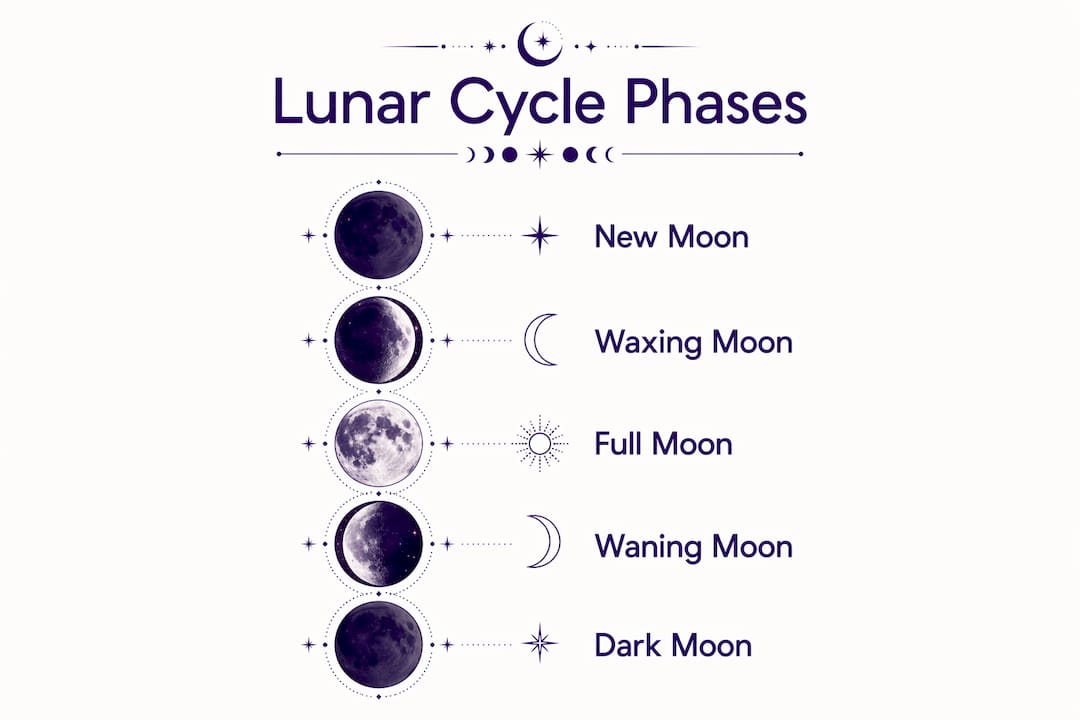
How does the lunar cycle support ongoing self-awareness?
The lunar cycle completes approximately every 29.5 days, offering a natural, repeating rhythm that anyone can track without prior astrology knowledge. That repeatability is the point. You do not need a birth chart to use the moon as a self-reflection tool.
The four phases each serve a distinct purpose:
- New Moon: Set clear intentions. Write down what you want to call in or build during the coming cycle. Keep it specific.
- Waxing Moon: Take action. This is the phase for momentum, outreach, and moving toward your intentions.
- Full Moon: Reflect and release. Notice what has come to light. Identify what is no longer serving you.
- Waning Moon: Rest and integrate. Pull back, review your notes, and prepare for the next cycle.
| Phase | Duration | Primary focus |
|---|---|---|
| New Moon | Days 1–3 | Intention setting |
| Waxing | Days 4–14 | Action and growth |
| Full Moon | Days 15–17 | Reflection and release |
| Waning | Days 18–29 | Rest and integration |
Tracking lunar phases with journaling enhances emotional awareness and builds discipline in self-growth practices. The monthly rhythm creates accountability without rigidity.
Pro Tip: Use Tarosyn's cosmic calendar to track lunar phases in real time. Pair each phase with a short journal entry to build a month-over-month record of your emotional and behavioral patterns.
Does astrology's flexible structure actually empower personal agency?
Astrology's decentralized and democratic nature allows individuals to interpret their own life path, often feeling more affirming than rigid behavioral models. That is a meaningful distinction. Clinical psychology operates within hierarchies of diagnosis and normative comparison. Astrology has no such hierarchy.
"Astrology offers a flexible, symbolic language for self-understanding and soul work. Unlike clinical psychology frameworks with hierarchies, it gives individuals agency to interpret their own experience without requiring expert validation."
— Emma Love Arbogast, Liberating Astrology
That openness is both astrology's strength and its challenge. Because no authority tells you what your chart "means," you are responsible for your own interpretation. That responsibility is exactly what builds self-awareness. You learn to sit with ambiguity, test interpretations against lived experience, and revise your understanding over time.
Astrology helps people name emotional wounds and recurring patterns, which supports healing and greater self-compassion. Confronting shadow aspects through symbolic language carries less self-judgment than a clinical diagnosis. That softer entry point makes difficult self-examination more accessible.
What are the common misconceptions about astrology and self-discovery?
The biggest misconception is that astrology assigns a fixed identity. It does not. Astrology provides a fluid language to observe recurring patterns, not a permanent label. Using it passively, or as an excuse for behavior, removes its real value entirely.
Watch for these patterns that signal unhealthy astrology use:
- Saying "I can't help it, I'm a Scorpio" instead of examining the behavior.
- Treating your Sun sign as your complete identity rather than one layer of many.
- Using Mercury Retrograde as a reason to avoid decisions rather than a prompt for extra care.
- Memorizing traits instead of treating the birth chart as a symbolic language to explore what is active right now.
Healthy astrology use looks different. You read a placement, notice whether it resonates, ask why it resonates, and then decide what to do with that awareness. The chart is a starting point for inquiry, not a conclusion. Combining astrology with journaling, mindfulness, or therapy produces far better results than astrology alone.
How to start using astrology for self-discovery today
You do not need to master the full birth chart to begin. Start with the simplest entry points and build from there.
- Find your "big three." Use any reputable free birth chart calculator online. You need your birth date, birth time, and birth location. Write down your Sun, Moon, and Rising signs.
- Read for patterns, not predictions. When you read about a placement, ask: "When has this shown up in my life?" Look for recurring themes, not future events.
- Track the lunar cycle. Note the New Moon date each month. Set one clear intention. Return at the Full Moon to assess what shifted.
- Use astrology journaling prompts. Examples: "Where in my life am I acting from my Moon sign's fears rather than my Sun sign's strengths?" or "What is my Saturn placement asking me to take more seriously?"
- Combine tools. Tarot and astrology work well together. A tarot pull at the New Moon can clarify the intention you set. A pull at the Full Moon can surface what needs releasing.
- Follow the astrology calendar. Knowing when major transits occur, such as a planet changing signs or a lunar eclipse, helps you use timing as a personal growth checkpoint rather than a source of anxiety.
The goal is a regular practice, not perfect knowledge. Consistency matters more than expertise.
Key Takeaways
Astrology functions as a self-discovery tool by providing a symbolic language that reveals personality layers, emotional patterns, and life rhythms through structured frameworks like the birth chart and lunar cycle.
| Point | Details |
|---|---|
| Start with the "big three" | Your Sun, Moon, and Rising signs give you three distinct, immediately usable layers of self-insight. |
| Use the lunar cycle monthly | The 29.5-day cycle provides a repeating rhythm for intention, action, reflection, and rest. |
| Avoid passive use | Treating placements as fixed labels removes astrology's value as a tool for awareness and choice. |
| Combine with journaling | Writing alongside chart or lunar work deepens pattern recognition and builds long-term self-knowledge. |
| Agency is the point | Astrology's flexible, non-hierarchical structure puts interpretation in your hands, which builds genuine self-understanding. |
Astrology taught me to ask better questions
I spent years treating my Sun sign as a personality summary. It felt accurate enough to be comfortable and vague enough to be useless. What changed my relationship with astrology was shifting from "what does this say about me" to "what is this asking me to look at."
The Saturn Return concept was the first time astrology felt genuinely confrontational in a useful way. It did not tell me who I was. It asked whether the life I had built reflected my actual choices or just the path of least resistance. That question had nothing to do with fate and everything to do with self-examination.
The symbolic language of astrology gave me a way to discuss inner patterns without the clinical weight of a diagnosis. That matters. When you can name a tendency as "Moon in Virgo anxiety about imperfection" rather than just "I'm a perfectionist," you create just enough distance to examine it. Distance is what makes change possible.
My honest advice: use astrology as a question generator, not an answer book. The placements that irritate you most are usually the ones worth the most attention. Stay curious, stay skeptical, and keep the interpretation in your own hands.
— Joseph
Tarosyn brings astrology and self-discovery together
Tarosyn combines personalized astrology, tarot readings, and numerology in one place, built specifically for people who want to use these tools for real self-understanding.
Check your daily horoscope to stay connected to current astrological influences without needing to interpret transits yourself. Tarosyn's readings are designed to prompt reflection, not just deliver information. Whether you are working with your birth chart for the first time or deepening an existing practice, the platform gives you structured entry points at every level. Pair a daily horoscope with a tarot reading like the Knight of Cups spread to add an emotional layer to your self-inquiry. The combination of astrology and tarot in one place makes consistent practice easier to maintain.
FAQ
What is the main purpose of astrology as a self-discovery tool?
Astrology functions as a framework for directed introspection, using symbolic language to help you recognize personality patterns, emotional tendencies, and life rhythms. The value comes from the self-reflection it prompts, not from prediction.
Do I need to know my birth time to start using astrology?
Your birth time is needed for an accurate Rising sign, but your Sun and Moon signs require only your birth date and location. You can begin meaningful self-reflection with just those two placements.
How is astrology different from Myers-Briggs or the Enneagram?
All three offer structured vocabularies for self-understanding, but astrology adds a timing dimension through transits and cycles like the lunar month and Saturn Return. It also has no normative hierarchy, so interpretation stays with the individual.
Can astrology be used alongside therapy or mindfulness practices?
Astrology works well as a complement to therapy, journaling, and mindfulness. It provides symbolic language for patterns that other practices can then examine in more depth. It is not a substitute for professional mental health support.
What is the fastest way to start using astrology for personal growth?
Find your "big three" placements using a free birth chart calculator, then track the lunar cycle for one full month using a journal. Those two steps give you immediate, practical entry points without requiring deep astrological knowledge.