
Spiritual communities scale differently because they face a structural trade-off between three things that cannot all be maximized at once: reach, intimacy, and high-quality information exchange. This constraint, described in network research as the community trilemma, explains why a group that feels sacred at 30 members often feels hollow at 300. You have three clear paths: keep the group small and deep, decentralize into replicable pods, or accept broadcast trade-offs and redesign your governance accordingly. Platforms like Tarosyn, where a notable survey confirmed strong interest in online spiritual care, show that the choice of format shapes retention more than any content strategy. Dunbar's number sets a natural ceiling on trust-based community before structure must change.
Pick your path now:
- Stay small: Cap membership at 15–25. Protect depth.
- Decentralize: Create replicable pods of 10–15 with shared rituals and a central hub.
- Broadcast: Accept lower intimacy, invest in governance, and design clear member pathways.
Quick signals to watch: first-time sharer rate, supportive-reply ratio, and facilitator response latency.
Key Takeaways
Spiritual communities scale differently because the community trilemma makes it structurally impossible to maximize reach, intimacy, and information quality at the same time.
| Point | Details |
|---|---|
| Choose your goal first | Decide between depth, reach, or curated exchange before picking a format or growth target. |
| Sacred circles stay small | Groups of 3–15 with intentional facilitation reliably produce deep connection and ritual fidelity. |
| Watch operational signals | Track first-time sharer rate, supportive-reply ratio, and facilitator burnout before changing format. |
| Gate phases on metrics | Move from pilot to replication only after 90-day retention meets your baseline target. |
| Build as infrastructure | Privacy-first defaults and governance structures protect trust better than feed mechanics do. |
Table of Contents
- Why the community trilemma forces every spiritual group to choose
- Headcount thresholds and signals that tell you to change your model
- Which community formats match which scaling goals
- Product and design patterns that protect what matters when you scale
- How to handle trust, safety, and spiritual care at scale
- What to measure, how long phases take, and what they cost
- A step-by-step checklist to scale your spiritual community responsibly
- How Tarosyn supports responsible scaling
- The hard choice most community leaders avoid
- Tarosyn: explore the platform
- Sources
Why the community trilemma forces every spiritual group to choose
The community trilemma states that a group can optimize for reach (many members), intimacy (deep trust), or high-quality two-way exchange but not all three simultaneously. As headcount grows, interaction topology shifts. A group of 50 operates many-to-many: anyone can speak, anyone can respond, and relationships form across the whole network. Push past a few hundred members and the topology shifts to hub-and-spoke: a small number of voices dominate, most members become passive consumers, and the group starts to resemble an audience more than a community.
For spiritual practice, this shift has real consequences. Trust, ritual fidelity, and psychological safety all depend on members feeling seen by other members, not just by a leader. When a group moves from 50 to 500, the average member's experience changes from "I know these people" to "I recognize some names." That loss of entitativity — the felt sense that the group is a coherent "we" — is not a morale problem. It is a structural one, and no amount of better content fixes it without a format change.
Digital religion research adds another layer: people rarely commit to one spiritual community online. They assemble a personal spiritual ecosystem from multiple niche groups. Retention improves when your community offers something specialized and a clear path forward, not when it tries to be everything to everyone.
Headcount thresholds and signals that tell you to change your model
These thresholds are practical guides, not hard rules. Use them alongside the operational signals below.
- Sacred circle (3–15 members): Deep connection is reliably achievable. Facilitation is light. This is the format where ritual fidelity is highest.
- Small group (16–50 members): Many-to-many interaction still works, but facilitation becomes critical. Assign a named facilitator.
- Tight community (51–150 members): Approaching Dunbar's ceiling. Subgroups start forming naturally. Begin tracking reply ratios and sharer rates.
- Tipping point (150–300 members): Hub-and-spoke dynamics emerge. Passive membership rises. Decentralization or governance redesign is needed.
- Broadcast community (300+ members): Intimacy is structurally limited. Invest in clear pathways, moderation staffing, and pod infrastructure.
Operational signals that mean act now:
- Response latency on member posts rises above 24 hours consistently
- First-time sharer rate drops week over week for four or more consecutive weeks
- Supportive-reply ratio (replies that affirm or extend a post) falls below 50%
- Facilitator reports burnout or skips scheduled sessions
- The same conflict resurfaces without resolution across multiple threads
When you see two or more of these signals together, do not wait for a full quarter of data. Run a format experiment within 30 days.
Which community formats match which scaling goals
Moderated, transparent community design with trained facilitators consistently improves belonging and reduces harm across all formats below.
| Format | Best for | Expected scale path | Intimacy trade-off |
|---|---|---|---|
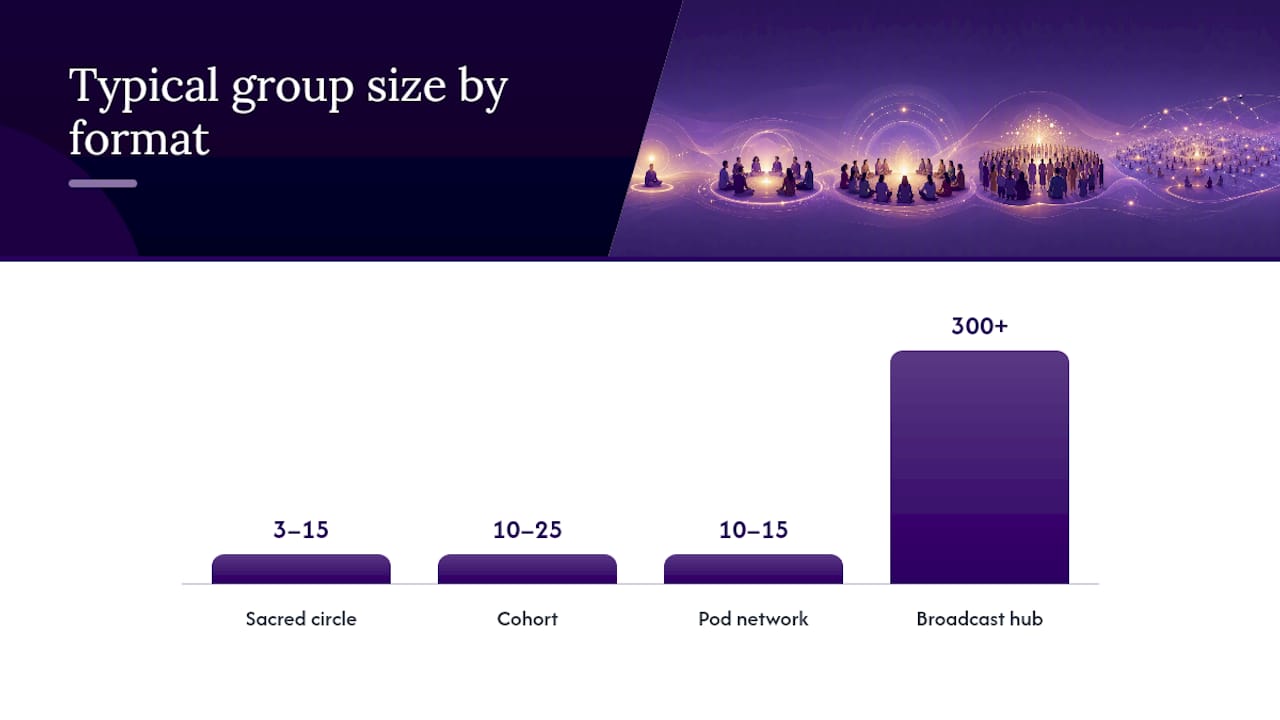
| Sacred circle (3–15) | Deep ritual work, grief, healing | Stays small by design | Highest intimacy, lowest reach |
| Cohort (10–25, time-limited) | Onboarding, courses, skill-building | Replicate cohorts, not the group | High intimacy, moderate reach |
| Pod network (10–15 per pod) | Decentralized growth with shared identity | Scales via pod replication | Moderate intimacy, high reach |
| Broadcast hub (300+) | Awareness, content distribution | High reach, fast growth | Low intimacy, low exchange quality |
| Hybrid (hub + local pods) | Communities past the tipping point | Sustainable at scale | Moderate intimacy if pods are active |

Zoom-based virtual sacred circles can preserve depth when facilitation is intentional and group size stays within the 3–15 range. Facebook groups and Reddit communities grow quickly but function as broadcast hubs: they are useful for discovery and reach, not for the kind of trust that spiritual practice requires. Hybrid models, a central digital infrastructure paired with local or topic-specific pods, are the most sustainable path for communities that have already passed 150 members.
Product and design patterns that protect what matters when you scale
These features and operational plays directly address the trilemma. Build them before you grow, not after.
- Onboarding flow: Route new members into a small cohort (10–25) before they access the full community. First impressions in a smaller space build belonging faster.
- Cohort funnels: Time-limit cohorts (6–12 weeks) so members share a defined arc. Completion rates and retention both improve with a visible endpoint.
- Subgroup creation: Let members self-organize around practices (astrology, tarot, journaling). Specialized groups retain better, as digital religion research confirms.
- Ritual scheduling: Publish a recurring ritual calendar. Predictability builds habit and reduces facilitator load.
- Matching algorithms: Pair new members with an existing member who shares a practice or sign. One connection in the first week reduces early dropout.
- Privacy-first defaults: Default rooms to private. Make recordings opt-in, not opt-out. Minimize notifications to reduce noise and protect attention.
- Async ritual pathways: Journaling prompts, meditation stubs, and reflection questions let members engage between live sessions without requiring synchronous presence.
- Clear member path: A visible growth journey showing where a member is and what comes next outperforms feed-driven engagement for retention.
Pro Tip: Set privacy defaults to "closed" for every new subgroup. Members share more honestly in spaces they know are not public, and that honesty is what makes spiritual community feel real.
FaithTech design principles argue that spiritual platforms should be built as infrastructure, prioritizing privacy, restraint, and governance, rather than feed mechanics that optimize for attention. That principle applies directly to product decisions: resist the urge to add a public feed before your community has the governance to manage it.
How to handle trust, safety, and spiritual care at scale
The Care Loop model, developed from stakeholder interviews (N = 22) and a survey (N = 1,010), provides a practical governance pattern for online spiritual care communities. It integrates peer support with formal care referral while preserving legitimacy on both sides.
Referral and escalation checklist:
- Define the boundary between peer support and pastoral or clinical care in writing, and share it with all facilitators
- Create a named escalation path: facilitator contacts a designated community lead, who routes to a licensed professional or crisis line when needed
- Train facilitators to recognize distress signals (isolation language, repeated crisis themes) without diagnosing
- Keep referral resources (988 Suicide and Crisis Lifeline, local chaplaincy, licensed therapists) pinned and visible in every group space
Governance essentials:
- Publish moderation policies publicly and update them when rules change
- Separate the pastoral care role from the peer support role; one person should not hold both
- Document facilitator accountability: who supervises facilitators, and how often
- Collect consent for any recording, data use, or content sharing before it happens
Pro Tip: In U.S.-based communities, facilitators who become aware of imminent harm may have mandatory reporting obligations depending on their professional license. Make this explicit in facilitator training so no one is surprised.
What to measure, how long phases take, and what they cost
Core KPIs:
- Retention at 30 days and 90 days per cohort
- Facilitator hours per active cohort per week
- First-time sharer rate (new members who post at least once in 30 days)
- Supportive-reply ratio (affirming or extending replies as a share of total replies)
- Escalation rate (members routed to formal care per month)
| Phase | Duration | Key milestone |
|---|---|---|
| Pilot | 8–12 weeks | One cohort, defined format, baseline metrics collected |
| Replicate | 3–6 months | Two to four parallel cohorts, facilitator training documented |
| Decentralize | 6–12 weeks | Pod network live, governance policies published, escalation path tested |
Cost buckets (qualitative ranges):
- Facilitator training: Low to moderate; scales with cohort count
- Moderation staffing: Moderate; rises sharply past 300 active members
- Platform features: Variable; privacy and subgroup tools are typically lower cost than custom matching
- Marketing: Low in pilot phase; increase only after retention metrics are stable
Gate each phase on metrics, not on a calendar date. If 90-day retention is below your baseline after the pilot, pause and diagnose before replicating.
A step-by-step checklist to scale your spiritual community responsibly
- Decide your primary goal. Depth, reach, or curated information exchange. Pick one. Your format follows from this choice.
- Define your pilot format. Choose one format (sacred circle, cohort, or pod). Set a cap on membership and a defined end date (90 days).
- Set up baseline metrics. Before launch, record your expected 30-day retention, sharer rate, and supportive-reply ratio targets.
- Run the pilot. Enable only the features your format needs. Resist adding complexity mid-pilot.
- Measure at 30 and 60 days. Compare actuals to targets. If two or more signals are off, adjust the format before the 90-day mark.
- Choose your path at 90 days. Limit size and deepen, decentralize into pods, or centralize with governance safeguards.
- Document rollback criteria. If member wellbeing indicators worsen (escalation rate rises, sharer rate collapses), return to the previous format. Define this threshold before you start.
Assign ownership: the community manager owns signal tracking, the product lead owns feature gating, and the facilitator owns member experience within each cohort.
How Tarosyn supports responsible scaling
Tarosyn's feature set maps directly to the patterns above. Here is how to use them:
- Private circles and friend groups: Use these to run sacred-circle pilots (3–15 members). Keep them closed by default and assign a named facilitator.
- Journaling and ritual content: Tarosyn's daily horoscope and personalized readings serve as async ritual anchors between live sessions, reducing the pressure on synchronous formats.
- Spirituality topic pages: Route new members to the spirituality topic to self-select into a practice area before joining a cohort. This improves cohort cohesion from day one.
- Community sharing tools: Use Tarosyn's social features for the hub layer of a hybrid model, keeping pods private and the hub public-facing for discovery.
- Responsible AI principles: Tarosyn's responsible AI guidelines inform privacy-first defaults across the platform, which aligns with the infrastructure-over-content design principle.
Pilot checklist for Tarosyn community leads:
- Enable private circles for your first cohort (cap at 15)
- Assign one facilitator per circle
- Pin a weekly journaling prompt as the async ritual anchor
- Review sharer rate and reply ratio at week four
- Expand to a second cohort only after the first reaches 90-day retention targets
Adapt these steps to your community's norms. What works for an astrology cohort may need adjustment for a grief support circle.
The hard choice most community leaders avoid
The most common mistake in spiritual community building is treating growth as the default goal. It is not. Depth is a legitimate goal. A community of 20 people who show up consistently and support each other through real life events creates more value, for members and for the platform, than a community of 2,000 passive followers.
The evidence supports restraint. Rapid scaling tends to standardize spiritual experience into something closer to a brand than a practice, flattening the nuance that makes spiritual community worth joining. The Care Loop research confirms that legitimacy depends on trust, and trust depends on consistency of facilitation and governance, not on headcount.
Test small. Measure honestly. Choose depth when the signals point that way. The communities that thrive long-term are the ones that made that choice deliberately, not the ones that grew fastest.
Tarosyn: explore the platform

Tarosyn brings together AI-powered tarot readings, astrology, numerology, and a social community designed for real connection. Start with a personalized tarot reading or explore the daily horoscope to find your entry point. The platform is built to support the kind of intentional, privacy-first community design this guide describes.
Sources
- Communities, audiences and scale (essay)
- Digital religion and networked infrastructures (chapter)
- Toward the development of online spiritual care communities: stakeholder design preferences (HSCC article)
- Virtual sacred circles and small-group coherence (chapter)
- Creating digital communities (Leading Ideas)
- Why FaithTech must be built as infrastructure, not content (Medium)