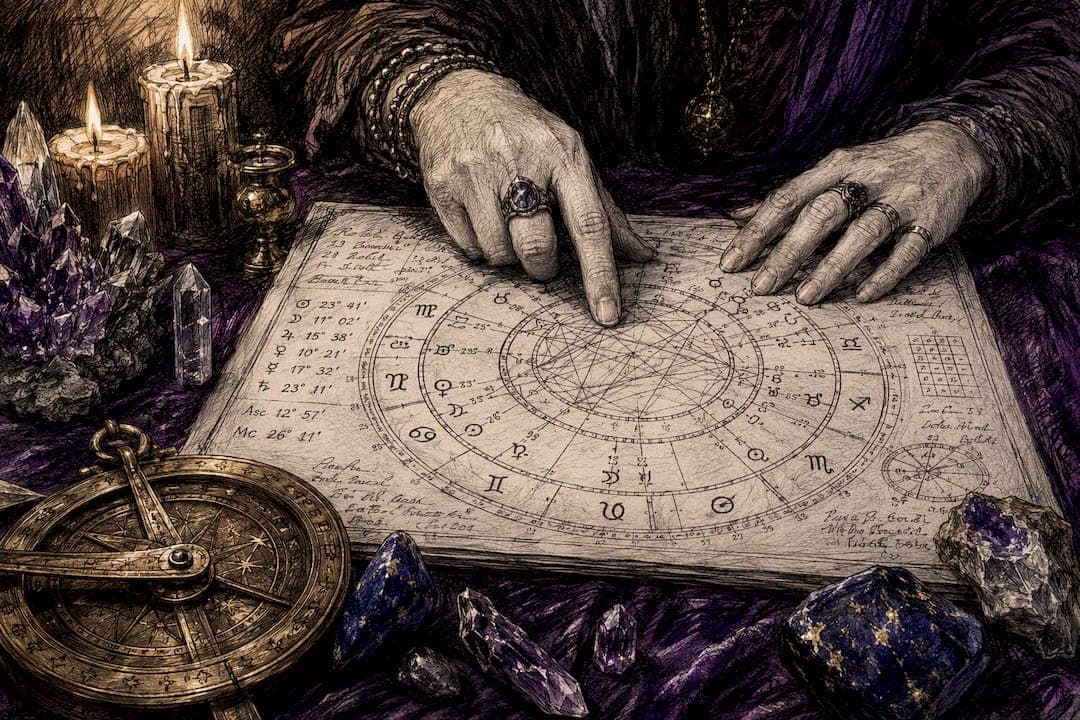
An AI birth chart is an automated natal-chart reading built from your birth date, time, and place. Astronomical calculation produces the raw placements. AI interpretation turns those placements into readable guidance.
To get one, do this now:
- Enter your birth date, exact time, and place.
- Review the raw placements before reading any interpretation.
- Ask one focused follow-up question instead of a vague "tell me everything."
- Check for calculation transparency, an inspectable chart, and a data deletion option before you trust the tool with personal details.
Key Takeaways
An AI birth chart pairs deterministic astronomical calculation with AI-generated interpretation, and the quality of a reading depends on keeping those two layers visibly separate.
| Point | Details |
|---|---|
| Gather exact inputs first | Birth date, precise time, and place are all required; a guessed time skews your rising sign and houses. |
| Separate math from interpretation | Deterministic placements should stay visible and unaltered by the generative text layered on top. |
| Validate unusual claims | Cross-check any surprising interpretive statement against the raw placement and aspect table before trusting it. |
| Protect your data | Look for session-only charts, export options, and a clear delete workflow before entering birth details. |
| Try Tarosyn for ongoing guidance | Tarosyn shows calculation-first placements, saves your chart, and lets you ask follow-up chat questions anytime. |
Table of Contents
- What Is an AI Birth Chart, Exactly?
- How Do AI Tools Actually Build a Natal Chart?
- What Does an AI Birth-Chart Reading Actually Look Like?
- How Accurate Is AI Birth Chart Analysis, Really?
- Is Your Birth Data Safe With an AI Astrology App?
- How Do You Try an AI Birth Chart Today?
- How Tarosyn Approaches AI Birth Chart Readings
- Do AI Astrology Models Get Better Over Time?
- A Publisher's Note on AI and Natal Charts
- Try Your Birth Chart on Tarosyn
- Sources
What Is an AI Birth Chart, Exactly?
An AI birth chart runs on two separate layers, and understanding the split matters more than anything else in this article.
The first layer is math. An astronomy engine takes your birth date, time, and place and calculates the position of every planet, the zodiac degree of each house cusp, and the angles (aspects) between planets. This output is deterministic. Two different tools using the same ephemeris data and the same birth details will produce the same placements.
The second layer is language. A trained model reads those placements and writes interpretive text: personality summaries, relationship advice, timing suggestions. This part is generative, not deterministic, which means wording and emphasis can shift between tools or even between requests.
You need all three inputs for an accurate chart:
- Birth date — sets the zodiac positions of the planets.
- Exact birth time — determines your rising sign and house cusps; even a 15-minute error can shift a house boundary.
- Birth place — needed for the latitude and longitude the engine uses to calculate houses.
Pro Tip: If you don't know your exact birth time, ask for a sunrise chart or a house-agnostic reading, and flag that uncertainty every time you ask for interpretation. A guessed time produces a wrong rising sign, and a wrong rising sign cascades into every house placement above it.
How Do AI Tools Actually Build a Natal Chart?
The path from your birth details to a finished reading runs through five distinct stages, and knowing them helps you spot which tools are being straight with you.
- Calculation. An ephemeris-based astronomy engine converts your date, time, and place into planetary positions and house cusps. This step is pure astronomy, no AI involved.
- Normalization. The system standardizes time zones, adjusts for daylight saving at the historical date, and validates coordinates. A tool that skips this step produces charts that are subtly wrong for people born near a time-zone change.
- Structure extraction. The engine derives aspects (conjunctions, squares, trines) and flags major configurations like stelliums, building a fact-based chart surface.
- AI interpretation. A language model maps those chart structures to human-readable text. This is where wording varies, and where some models fall back on generic, templated phrasing rather than chart-specific insight.
- Delivery. You get the output as a chart wheel with a short chat response, a full written report, ongoing transit alerts, or a synastry comparison against another person's chart.
| Pipeline stage | What happens | What to check for |
|---|---|---|
| Calculation | Astronomy engine computes planetary positions and house cusps | Uses a named ephemeris method, not a black box |
| Normalization | Time zone, daylight saving, and coordinates get standardized | Asks for a city/place, not just a country |
| Structure extraction | Aspects and configurations are derived from raw positions | Placements are shown as numbers/degrees, not just prose |
| AI interpretation | A model turns structure into readable text | Text references specific placements, not generic traits |
| Delivery | Output arrives as wheel, chat, report, or transit feed | You can ask follow-up questions tied to your chart |
Some tools now build around this exact separation, showing deterministic placements before any generated text appears, which is the pattern worth favoring when you're comparing options.
What Does an AI Birth-Chart Reading Actually Look Like?
Most AI birth chart apps deliver output in one of a few recognizable formats, and knowing them ahead of time helps you judge quality fast.
- A chart wheel with numeric placements (Sun in Leo, 10th house; Moon in Pisces, 4th house).
- A short personality paragraph summarizing your Sun, Moon, and Rising combination.
- A chat-style Q&A where you ask follow-up questions about specific placements.
- Transit alerts that flag when a moving planet activates a natal placement.
- A synastry report comparing two charts for compatibility.
Good AI interpretation ties its language directly to a placement instead of speaking in generalities. Here's the kind of line a well-built tool should produce when it explains Mars in the 7th house:
Mars in your 7th house means partnerships tend to bring out your drive and your temper in equal measure. You likely attract assertive partners, and conflict in relationships shows up early rather than staying buried.
That sentence names the placement and explains the mechanism. A weaker tool would just say "you value strong partners," which could apply to almost anyone. When you're comparing an AI natal chart reading against another, check whether the text cites specific placements or just recycles zodiac-sign generalities.
How Accurate Is AI Birth Chart Analysis, Really?
AI is fast and consistent at the calculation layer. It's less reliable, and needs your scrutiny, at the interpretation layer.
What AI does well: it generates text instantly, produces the same tone and structure across repeated requests, and gives beginners a low-pressure way to start learning chart vocabulary. Cross-checking a batch of placements that would take a human astrologer several minutes to look up happens in seconds.
Where it falls short: generative models can hallucinate details that sound plausible but aren't in your actual chart. Community threads have documented cases where an AI tool invented a full birth chart reading with placements that didn't match the person's actual birth data. Models that lack curated astrological rules also tend to flatten nuance, turning a complex aspect pattern into a single bland trait description.
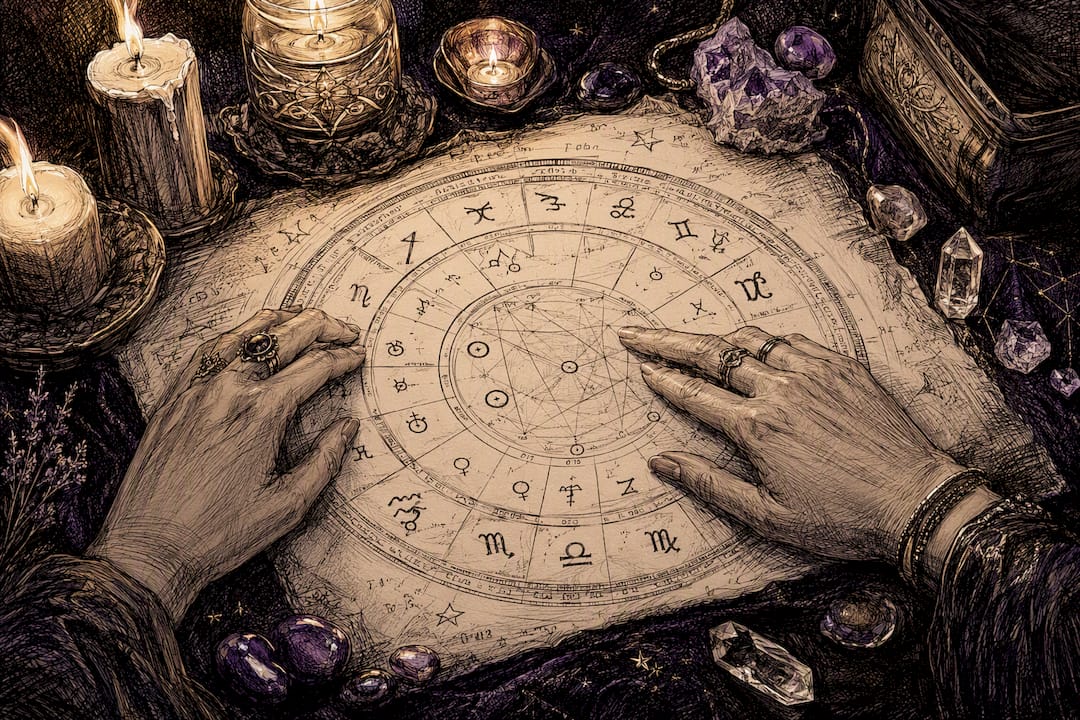
Validate before you trust: pull up the raw placement table, compare the aspect list, and only then read the interpretive paragraph. If a claim seems oddly specific or contradicts the visible placements, that's your signal to double check.
Pro Tip: Treat AI interpretation as a primer, not a verdict. Verify any unusual or emotionally loaded claim against the calculation-first chart data, or run it past a Tarosyn-style tool that separates facts from generated text before you act on it.
Astrology apps have become a real category, not a novelty. Horoscope and astrology apps now generate measurable revenue in the U.S. mobile market, which tells you the demand for app-based chart tools is established and growing, not a passing trend.
Is Your Birth Data Safe With an AI Astrology App?
An AI birth chart tool typically collects your birth date, time, and place, plus a name or user ID, and often your chat history or journal entries if the app includes those features. Each piece serves a purpose, but not every app needs to keep all of it forever.
Before you commit personal details, look for these controls:
- Session-only charts that don't persist your raw birth data after you close the app.
- Redaction options that let you strip identifying details from saved readings.
- Clear export and delete functions, so you can pull your chart data out or wipe it entirely.
- A readable privacy policy that states retention periods in plain language, not legal boilerplate.
Create your account with an email you actually control, check the deletion workflow before you need it, and avoid typing sensitive personal details into an open chat prompt just to test a feature.
Pro Tip: Favor platforms that keep your raw astronomical facts separate from the generative text and let you export the chart data on its own. That way, deleting your account doesn't erase the one part of the reading that's actually just math.
How Do You Try an AI Birth Chart Today?
Getting your first reading takes five steps: gather your birth date, time, and place; pick a calculation-first tool; generate the raw chart; read the placements before anything else; then ask a targeted follow-up question instead of a broad one.
Free and paid tiers usually split along predictable lines. A free tier typically gives you the chart wheel and a short summary paragraph. Paid tiers add depth: full written reports, chat memory across sessions, ongoing transit tracking, and downloadable PDFs. Some apps charge per report; others run a subscription for continuous access to transits and saved chat history.
Before you upgrade to a paid plan, run this checklist:
- Confirm the tool normalizes time zones and daylight saving correctly for your birth date.
- Check whether you can export your chart data, not just screenshot it.
- Review the privacy settings and confirm you can delete your data later.
- Test the free tier's interpretation quality against the raw placements before paying for more.
How Tarosyn Approaches AI Birth Chart Readings
Tarosyn builds its birth chart feature around the calculation-first principle this article keeps coming back to: your placements are computed first, shown clearly, and kept separate from the AI-generated interpretation layered on top.
From there, Tarosyn works as a conversational guide. You get your Sun, Moon, and Rising summary, planetary placements by house, and a chat interface for follow-up questions instead of a static report you read once and forget. Readings save to your account, so you can revisit a placement months later instead of regenerating the chart from scratch. Tarosyn's synastry tools extend the same approach to compatibility readings between two charts.
If you want to go deeper on the mechanics before you generate a chart, Tarosyn's guide to how a birth chart works walks through houses, aspects, and placements in plain language.
Pro Tip: Generate your raw chart first, save it to your account, then run follow-up chat prompts on one placement at a time. You'll get sharper, more specific interpretation than asking for a full-life reading in one shot.
Do AI Astrology Models Get Better Over Time?
AI birth chart tools improve the same way most consumer AI products do: through periodic model updates, expanded training data, and feedback loops built from how people actually use the tool.
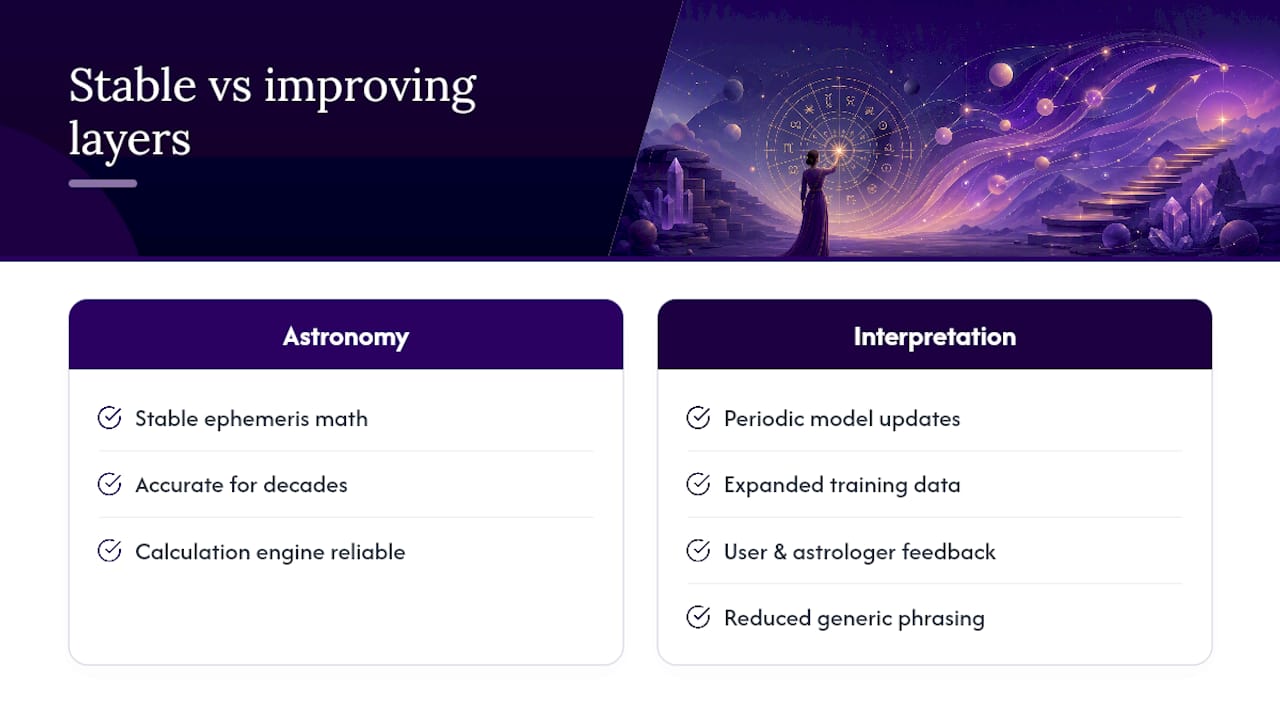
The astronomy layer barely changes. Ephemeris calculations are based on well-established orbital mechanics, so the math behind your placements was accurate a decade ago and will still be accurate a decade from now. What evolves is the interpretation layer, the language model that turns those placements into readable text.
Developers retrain or fine-tune these models periodically, often incorporating corrections flagged by users or professional astrologers who review sample outputs for accuracy. National reporting on generative AI notes that general-purpose GPT-style models are increasingly adapted to specialized domains like astrology, and each new model generation tends to reduce the generic, one-size-fits-all phrasing that plagued earlier versions.
Retraining also expands what a tool can do. Early AI astrology apps mostly handled basic Sun-sign summaries. Newer versions handle full natal charts, synastry between two people, and running transit interpretation, because the underlying models got better at holding structured astrological data in context across a longer conversation.
The practical upshot for you: an app that felt shallow a year or two ago may have meaningfully sharper interpretation today, since the calculation engine was never the weak link. If you tried an AI birth chart tool early on and found the readings generic, it's worth trying again. The interpretation layer is the part most likely to have changed.
A Publisher's Note on AI and Natal Charts
AI birth charts are genuinely useful primers, not replacements for real astrological nuance. Use one to learn the vocabulary and see your placements fast, then validate anything that matters against the raw chart facts, and lean on resources like Tarosyn's self-analysis guide to go deeper than a chatbot ever will on its own.
Try Your Birth Chart on Tarosyn
Most AI astrology apps hand you a chart and a static report, then charge you again for the next question. Tarosyn keeps the conversation going instead: your placements stay saved to your account, and you can return to ask a new follow-up question anytime rather than regenerating a fresh chart or reading through a report you already paid for once.
That structure suits you if you want to build understanding gradually, checking one placement, then another, instead of absorbing an entire report in one sitting. Tarosyn also connects your natal chart to daily context through its daily horoscope feature, so the placements you learned about stay relevant instead of sitting static after the first read.
Enter your birth date, time, and place to generate your chart, save it to your account, and start with one question about a placement that's been on your mind.
Sources
- GPT tools now available — even for astrology
- Top horoscope apps in the U.S. by market revenue
- Make an astrology birth chart with AI? Here's how