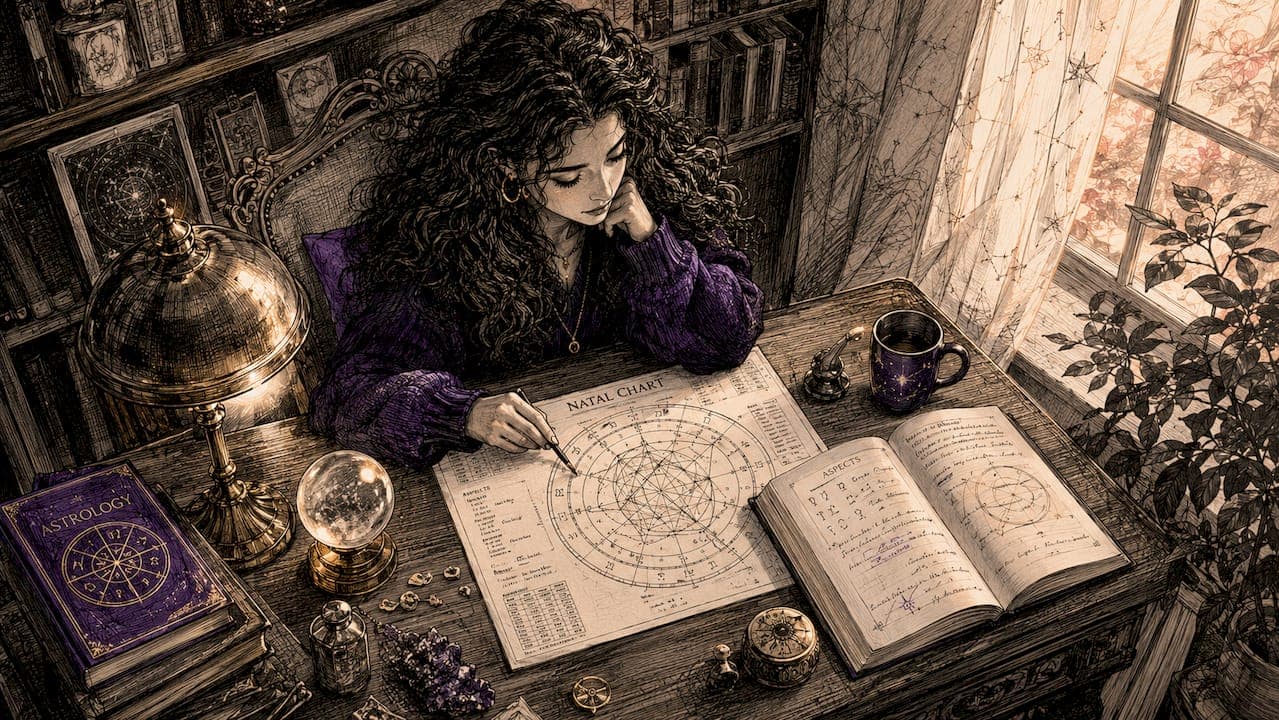
A natal chart reading is the practice of interpreting the exact positions of the planets at the moment and place you were born to reveal your personality, emotional patterns, and life themes. Also called a birth chart reading in professional astrology, it uses your birth date, exact time, and location to generate a circular map of the sky. That map becomes a personal reference for understanding who you are and how you operate. The Rising sign alone changes approximately every 2 hours, which shows how precise the birth time needs to be for an accurate reading.
What is a natal chart reading made of?
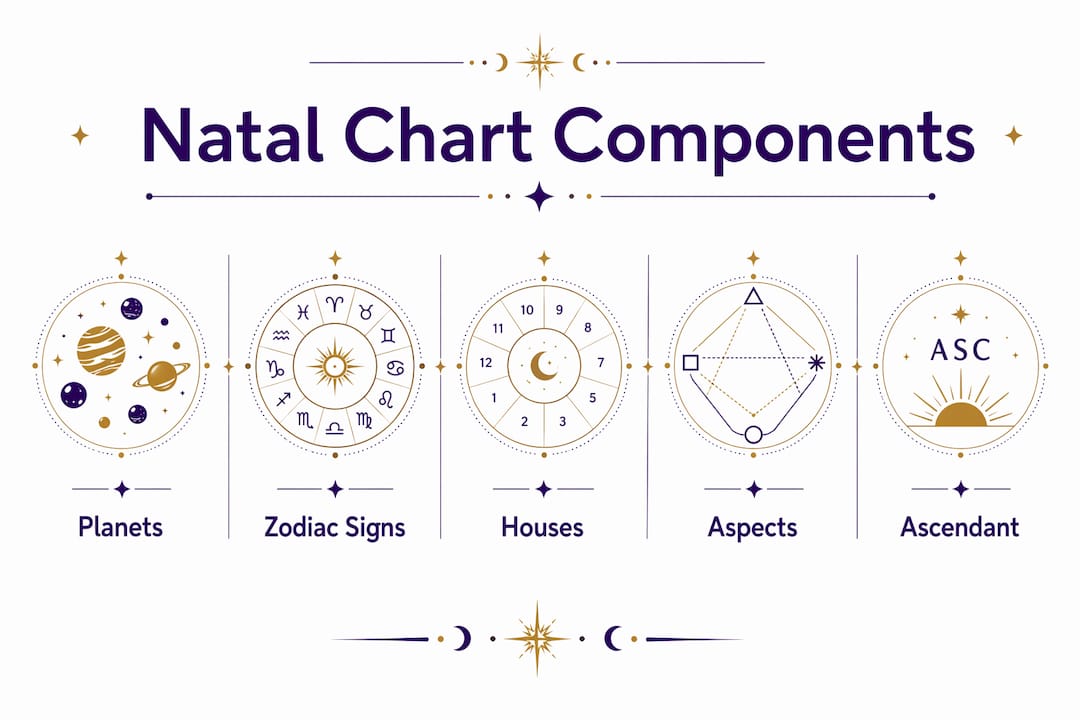
A natal chart is built from four core components: planets, zodiac signs, houses, and aspects. Each layer adds a different dimension to the picture.
Planets represent psychological drives and functions. The Sun shows your core identity. The Moon reflects your emotional needs. Venus governs how you relate to others. Each planet acts as a distinct force in your personality.
Zodiac signs describe how each planet expresses itself. Mars in Aries acts fast and directly. Mars in Libra weighs options before moving. The sign does not change what the planet does. It changes how the planet does it.
Houses divide the chart into 12 life areas. The first house covers self-image and physical appearance. The seventh house covers partnerships. The tenth house covers career and public reputation. Planets placed in houses show which life domains carry the most energy and focus.
Aspects are the geometric angles between planets. Seven major aspects are used in standard interpretation: conjunction, opposition, square, trine, sextile, and two others. A trine between Venus and Jupiter suggests ease in attracting abundance. A square between Mars and Saturn suggests friction between drive and discipline.
One element that ties everything together is the Ascendant, or Rising sign. The chart ruler is the planet that governs the Rising sign, and it connects the Ascendant to the rest of the chart. Astrologers treat the chart ruler as a key interpretive focus because it colors the entire chart's expression.
| Component | What it represents |
|---|---|
| Planets | Psychological drives and functions |
| Zodiac signs | Style of expression for each planet |
| Houses | Specific life areas affected |
| Aspects | How planets interact with each other |
| Ascendant/Rising | Outward personality and chart ruler anchor |
Pro Tip: If you do not know your exact birth time, you can still get meaningful natal astrology insights from planetary sign positions. Just know that your Ascendant and house placements will be unreliable until you confirm the time.
How do astrologers read a natal chart step by step?
Reading a birth chart effectively means building your interpretation in layers, not all at once. Here is the sequence that works.
-
Confirm your birth data. You need your birth date, exact time, and location. Pull your birth certificate if possible. Without exact birth time, your Ascendant and house placements may be inaccurate. Many astrologers use noon as a fallback, but treat those results as approximate.
-
Start with the Big Three. Your Sun sign, Moon sign, and Rising sign form the foundation of your chart. The Sun shows your core identity and life purpose. The Moon shows your emotional world and instinctive reactions. The Rising sign shapes how others perceive you and how you approach new situations.
-
Find the chart ruler. Once you know your Rising sign, identify the planet that rules it. That planet's sign, house, and aspects become especially significant. A Scorpio Rising, for example, makes Pluto the chart ruler. Pluto's placement then carries extra weight in the reading.
-
Examine the personal planets. Mercury, Venus, and Mars explain everyday behavior. Mercury governs how you think and communicate. Venus shows what you value and how you connect with others. Mars reveals how you pursue goals and handle conflict.
-
Place planets in their houses. Each planet occupies one of the 12 houses. A planet in the second house focuses its energy on money and personal resources. A planet in the ninth house connects its energy to travel, philosophy, and higher learning. This step shows where each drive plays out in real life.
-
Analyze major aspects. Look at the angular relationships between planets. Tight aspects, especially those within a few degrees, carry the most influence. A conjunction merges two planetary energies. An opposition creates tension that demands balance.
-
Look for patterns. Count which elements (fire, earth, air, water) and modalities (cardinal, fixed, mutable) appear most often. Repeated signs, elements, and modalities point to dominant operating styles and central life themes.
-
Synthesize into a few connected themes. Avoid listing isolated traits. Pull the threads together. A chart heavy in earth signs with Saturn prominent and several planets in the sixth house tells a coherent story about practicality, discipline, and work.
Pro Tip: Use a birth chart beginner's guide to generate your chart for free before you start interpreting. Having the visual in front of you makes the layered reading process much easier to follow.
What beginners get wrong when reading their natal chart
The most common mistake is trying to interpret every symbol at once. Attempting to decode all chart symbols simultaneously leads to overload and confusion. The result is a list of contradictory traits with no coherent meaning.
A layered approach fixes this. Start with the Big Three. Add the chart ruler. Then move to personal planets, houses, and aspects. Each layer builds on the last. You end up with a reading that feels like a person, not a personality quiz result.
Pay special attention to angular planets. Planets near the Ascendant, Descendant, Midheaven, or IC are especially dominant in personality expression. If Saturn sits right on your Midheaven, themes of responsibility and structure will show up clearly in your public life and career. These placements deserve extra attention before you move to subtler parts of the chart.
Watch for stelliums too. Planets clustered in the same house or sign form a stellium, which creates a major life theme. Three or more planets in the fifth house, for example, make creativity, romance, and self-expression central to who you are.
The chart is a system, not a checklist. When you read it as a set of connected patterns rather than isolated traits, the interpretation becomes accurate and useful. One repeated theme across multiple chart factors carries far more weight than a single placement read in isolation.
Missing birth time is another real limitation. If you do not have it, focus on planetary sign positions and skip house-based conclusions. The Sun, Moon, and planetary signs still yield meaningful natal astrology insights even without a confirmed Ascendant.
How can you use natal chart insights for personal growth?
A natal chart reading is most useful when you treat it as a self-awareness tool, not a fixed script. The chart shows tendencies and potentials. What you do with them is up to you.
Here are the most practical ways to apply natal chart meanings to your life:
- Recognize your strengths and vulnerabilities. A strong Jupiter in the first house suggests natural optimism and opportunity. A challenged Moon in Capricorn may point to emotional restraint that benefits from conscious attention.
- Use house placements to focus your energy. If your seventh house is heavily occupied, relationships are a central life theme. If your tenth house is active, career and reputation demand consistent attention.
- Track recurring patterns. A chart dominated by mutable signs (Gemini, Virgo, Sagittarius, Pisces) suggests adaptability as a core trait. Recognizing this helps you understand why you thrive in flexible environments and struggle with rigid structures.
- Connect chart insights to decisions. Understanding that your Mercury is in Virgo tells you that you process information analytically and in detail. That knowledge shapes how you communicate, study, and make choices.
- Work with the North Node. The North Node points to life growth directions and deeper lessons. It shows where you are meant to stretch beyond your comfort zone. Many astrologers treat it as the most forward-looking point in the chart.
- Combine natal insights with other tools. Pairing your birth chart with tarot or a daily horoscope adds a real-time layer to the static natal picture. The natal chart shows your baseline. Current planetary transits show what is being activated right now.
For a structured approach to applying these insights, a birth chart self-analysis guide can help you move from raw chart data to practical self-understanding.
Key Takeaways
A natal chart reading delivers its full value only when you interpret it as a layered system of connected patterns, not a list of isolated traits.
| Point | Details |
|---|---|
| Birth data accuracy matters | Exact birth time is required for a correct Ascendant and house placements. |
| Start with the Big Three | Sun, Moon, and Rising sign form the foundation before any other interpretation. |
| Angular planets carry extra weight | Planets near chart angles are dominant and should be read before subtler placements. |
| Synthesis beats trait-listing | Connecting repeated themes across signs, houses, and aspects produces accurate readings. |
| North Node guides growth | The North Node points to life lessons and the direction of conscious personal development. |
What I have learned from years of reading natal charts
Astrology is a tool for self-discovery, not a fixed destiny. That distinction matters more than any single placement in your chart.
When I first started working with natal charts, I made the same mistake most beginners make. I tried to read everything at once. The result was a jumble of contradictions that felt more confusing than clarifying. The shift happened when I started treating the chart as a story with a main character (the Sun), an emotional undercurrent (the Moon), and a social mask (the Rising). Everything else became supporting detail.
The most useful thing a natal chart does is confirm what you already sense about yourself. You probably already know you overthink decisions, or that you feel things more intensely than others do, or that you are drawn to roles that carry public responsibility. The chart gives that self-knowledge a structure. That structure makes it easier to work with, not just observe.
One thing I push back on is the idea that a single reading gives you everything you need. The chart is a living reference. You will read it differently at 25 than at 40, because you have more life experience to match against it. Pairing your natal chart with ongoing transits, using something like an astrology calendar, adds the time dimension that a static chart cannot provide on its own.
Astrology works best when you bring curiosity and a willingness to sit with complexity. The chart will not tell you what to do. It will tell you who you are working with.
— Joseph
Tarosyn's tools for your natal chart reading
Tarosyn brings natal astrology and tarot together in one place, so you can move from chart interpretation to personalized readings without switching platforms.
Tarosyn's AI-powered platform generates personalized insights based on your birth data and pairs them with tarot spreads that reflect your current themes. If your chart points to relationship patterns as a central focus, a three-card tarot spread can add immediate, practical perspective to what the chart reveals. The community on Tarosyn also connects you with others working through the same questions, so your learning does not happen in isolation. You can access natal chart readings, daily horoscopes, and tarot spreads through a single subscription.
FAQ
What information do I need for a natal chart reading?
You need your birth date, exact birth time, and birth location. The birth time is especially critical because the Rising sign changes approximately every 2 hours.
What does a natal chart show about your personality?
A natal chart shows your core identity through the Sun sign, emotional patterns through the Moon sign, and outward personality through the Rising sign, along with drives, communication style, and relationship tendencies through the personal planets.
Can I read my natal chart without knowing my birth time?
Yes, but with limits. Planetary sign positions remain accurate without a birth time. Ascendant and house placements, however, will be unreliable, so those parts of the interpretation should be set aside.
What is the difference between a natal chart and a horoscope?
A natal chart is a fixed map of the sky at your birth and stays the same throughout your life. A horoscope reflects current or upcoming planetary movements and changes regularly.
What is the North Node in a natal chart?
The North Node points to your life growth direction and the deeper lessons you are here to work through. Astrologers treat it as one of the most forward-looking points in the entire chart.