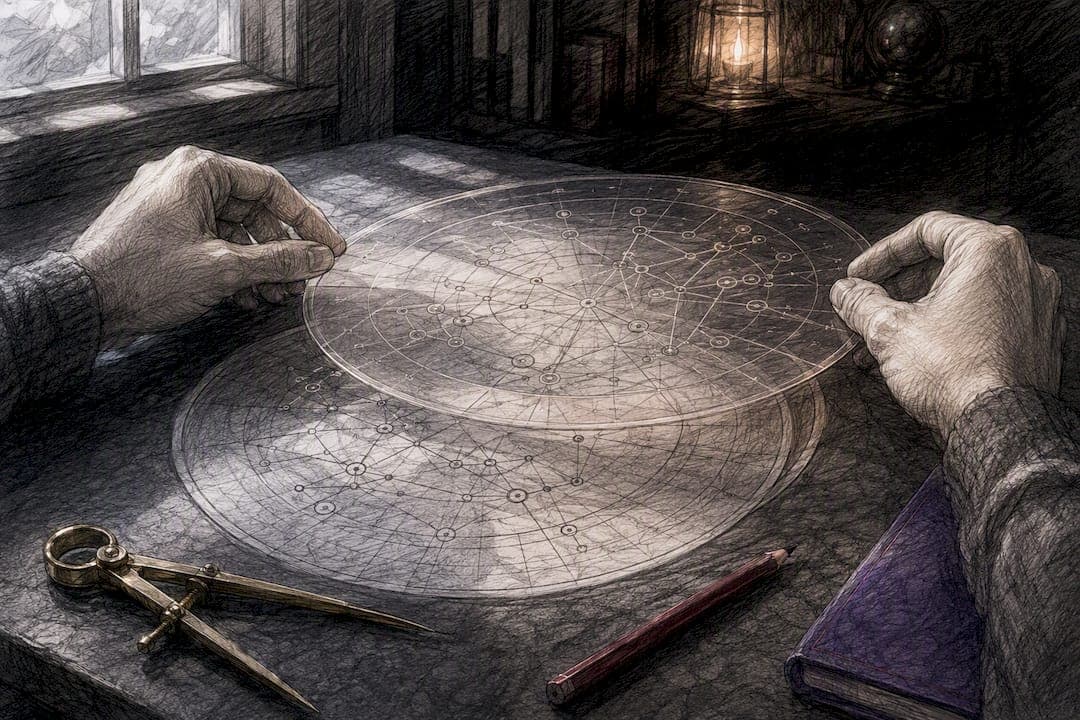
An AI synastry reading compares two birth charts, plots the planet-to-planet aspects between them, and turns those angles into a written explanation of relationship chemistry. It works best as a quick chemistry map and a conversation starter, not a verdict on your relationship's future. Use it when you want a structured, judgment-free look at where you and a partner naturally align and where you'll need to work harder.
TL;DR:
- Accurate planetary aspects are consistently calculated, but interpretation quality varies and can be overly generic without contextual nuance.
- Birth time significantly affects house overlays and angles, but core planet aspects remain reliable even with missing or approximate birth times.
- Trustworthy tools show the exact aspects found, have validated chart math, and explain what influences their scores rather than giving a single compatibility number.
- AI synastry is best for initial insights or early relationship assessments, while human astrologers are better for nuanced, long-term relationship understanding.
- Protect personal data by checking privacy policies, requesting data deletion, and avoiding sharing unnecessary information before inputting birth details into any app.
Table of Contents
- What an AI synastry reading reports: aspects, overlays, and the core building blocks
- How AI analyzes synastry: chart math, deterministic rules, and generative interpretation
- What birth data you need and how to handle missing times
- Accuracy, common limits, and how to read AI synastry output critically
- Privacy and data-handling: what to check before uploading birth details
- How to get the most from an AI synastry reading: a simple workflow
- Comparing AI synastry readings with traditional human astrologer interpretations
- Practical applications of AI synastry readings in relationship advice and decision-making
- Reading the chart honestly: an editorial take on AI and synastry
- Start Your AI Synastry Reading With Tarosyn
- Sources
- FAQ
What an AI synastry reading reports: aspects, overlays, and the core building blocks
Every synastry reading is built from the same raw material: two sets of planetary positions, compared point by point. The output looks different depending on the tool, but the underlying components stay consistent.
Planet-to-planet aspects carry most of the interpretive weight. A Sun conjunct Moon between two charts often points to a sense of being "seen" by the other person. Venus-Mars contacts describe physical and romantic pull. Moon-Moon aspects reveal emotional pacing, whether you soothe each other or trigger each other's moods. Saturn overlays, where one person's Saturn lands on another's personal planets, tend to show up as either grounding stability or a sense of restriction, depending on the rest of the chart.
House overlays add a second layer. This is where one partner's planets fall into the other's houses, which shows which areas of life get activated. A partner's Venus landing in your seventh house often intensifies partnership themes. Their Mars in your tenth house can show up as ambition friction or as someone pushing your career forward.
It helps to know what synastry is not. A few quick distinctions:
- Synastry versus composite charts: synastry compares two individual charts side by side; a composite chart blends them into a single, third chart representing the relationship itself.
- Synastry versus sun-sign matching: sun-sign compatibility looks at one placement each; synastry examines dozens of planetary contacts, angles, and house placements.
- Aspects versus overlays: aspects measure the angle between two planets; overlays measure which house a partner's planet falls into.
Tarosyn's synastry and relationship compatibility tools walk through these layers individually rather than compressing them into a single score, which matters more than it sounds. A compatibility percentage hides exactly the nuance that makes synastry useful in the first place.
How AI analyzes synastry: chart math, deterministic rules, and generative interpretation
An AI synastry reading runs on two distinct layers, and understanding the split helps you judge whether a reading is trustworthy or just confident-sounding text.
The first layer is pure calculation. The system pulls ephemeris data (precise historical planetary positions), calculates each person's chart, then detects aspects between the two charts based on orb allowances, typically a few degrees of separation for major aspects like conjunctions and oppositions. This part of the process is deterministic. Given the same two birth details, it produces the same angles every time. Some astrology projects even publish this calculation logic as open code, like the bazi-mcp repository, which shows how algorithmic chart math can be built as an auditable, versioned component rather than a black box.
The second layer is interpretive. Once the aspects are computed, the system generates language to explain what they mean. This can range from simple templated text (fixed sentences for each aspect type) to large language models that shape the phrasing dynamically based on which aspects are present, how tight the orbs are, and how many contacts stack in a given theme. Industry coverage of astrology apps has tracked this shift toward hybrid tools that run exact calculations first and layer AI-generated explanation on top.
Pro Tip: *Ignore compatibility scores that reduce a relationship to a single number. Ask instead which specific aspects drove that score.
When evaluating a tool, look for:
- Whether it shows the actual aspects it found, not just a summary
- Whether the chart math is described as fact-checked or validated against ephemeris data
- Whether scores come with an explanation of what's driving them
What birth data you need and how to handle missing times
Synastry accuracy depends heavily on input quality, but not every field carries equal weight. Here's what matters most:
- Birth date (required for both people). This determines all planetary positions and is non-negotiable.
- Birth location (required for both people). Location affects house calculations and adjusts for time zone shifts in historical records.
- Birth time (ideally exact, but not always required). This is the field people most often can't provide, and it matters more for some features than others.
Exact time drives house overlays, Ascendant, and Midheaven placements. Without it, the system can't place planets into houses accurately, and angle-based aspects become unreliable. Planet-to-planet aspects, on the other hand, don't depend on time at all. A Venus-Mars conjunction between two charts stays fixed regardless of what hour either person was born, since it's based purely on date and location. That means a meaningful chemistry and dynamic analysis is still possible even when one partner's birth time is a mystery.
If you're missing a time, three workarounds help. Ask family members or check a birth certificate, since many US states include exact time on the original document. Try chart rectification, a method that estimates birth time using major life events, though this works better with a skilled practitioner than an automated tool. Or simply request a reading focused on planet aspects only, skipping house-based claims entirely. Tarosyn's AI birth chart guide covers how time precision affects natal interpretation, and the same logic carries over directly into synastry.
Accuracy, common limits, and how to read AI synastry output critically
AI synastry tools are genuinely reliable at one thing: math. Aspect detection, orb calculation, and house placement are computational tasks, and computers don't get tired or misplace a Mercury retrograde like a rushed manual chart reading might. Where AI struggles is nuance. It can tell you that your Mars squares your partner's Saturn, but it can't know that you both grew up in households where conflict was handled by silence, and that this square might play out very differently than the textbook description suggests.
Common weak points to watch for:
- Canned language that could apply to almost any couple with a similar aspect, regardless of orb tightness or supporting contacts
- Overgeneralized claims presented with more certainty than the aspect actually supports
- No acknowledgment of conflicting signals elsewhere in the chart
- Zero context about life stage, culture, or circumstances that shape how an aspect actually shows up
Consumer research on personalized digital services consistently finds that people trust tools more when the system explains its reasoning rather than just delivering a polished conclusion. That principle applies directly here. A reading that says "we found a Venus trine Jupiter aspect, which tends to support ease and generosity between partners" earns more trust than one that says "you two are meant to be." Treat every AI-generated narrative as a prompt for a conversation with your partner, not a settled fact about your relationship's fate.
Privacy and data-handling: what to check before uploading birth details
Birth data is more sensitive than people assume. A full birth chart requires your exact date, time, and location, which combined can function almost like an identifying fingerprint tied to deeply personal information you might not want stored indefinitely.
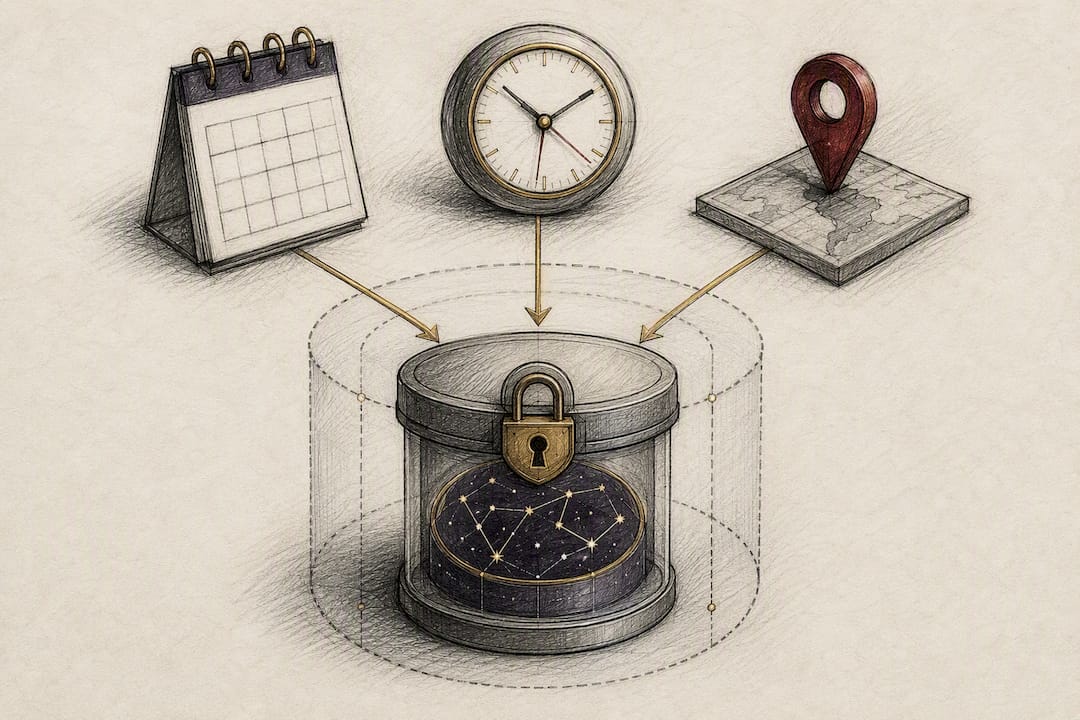
Independent privacy research on astrology apps has flagged real concerns about how some apps handle and share this data, including permissions and third-party sharing practices that go beyond what the reading itself requires.
Before you enter your birth details anywhere, check for a few things:
- A privacy policy you can actually read, not one buried in legal boilerplate with no clear data-retention terms
- An option to delete or export your data on request
- Clarity on whether the service processes your data through third-party cloud APIs, since platforms like Google's privacy documentation show how data sent to external services may be handled differently once it leaves the app itself
- A stated policy of collecting only what's needed for the reading, not extra profiling data
Practical protections that cost you nothing: use a nickname instead of your legal name where the field allows it, opt out of marketing data sharing, and delete saved readings once you've gotten what you need from them.
How to get the most from an AI synastry reading: a simple workflow
A synastry reading is only as useful as the process around it. Follow this sequence to get output worth acting on:
- Gather exact birth data for both people, prioritizing accurate time and location over guesswork.
- Set a specific question before you start. "Are we compatible" is too broad. "How do we handle conflict" or "what draws us together" gives the AI something concrete to focus on.
- Run the reading and read the full aspect breakdown, not just the summary paragraph.
- Verify the chart facts by checking that the aspects listed match what a basic ephemeris lookup would show for your two birth details.
- Journal or discuss the two or three aspects that felt most accurate, and use them as a starting point for a real conversation.
Pro Tip: If a reading feels too vague to be useful, ask a sharper follow-up question. Instead of "tell me more about our Venus-Mars aspect," try "how might this aspect show up during a disagreement" or "what's a good way to talk about this tension out loud."
Readings work best as reflection tools, not scripts, especially when paired with guidance on their interpretive limits and responsible use to handle personal data thoughtfully. Use them to notice patterns you'd otherwise miss, bring up topics you've been avoiding, or simply understand why a particular dynamic with your partner feels familiar.
Comparing AI synastry readings with traditional human astrologer interpretations
The honest comparison isn't AI versus human, it's speed and consistency versus depth and adaptability. A human astrologer brings years of pattern recognition, can ask you follow-up questions in real time, and adjusts their interpretation based on what you tell them about your actual relationship. If you mention that your partner just lost a parent, a skilled astrologer will weave that into how they read a heavy Saturn transit. An AI tool generally won't, unless you explicitly prompt it to.
AI wins on accessibility and consistency. It's available at any hour, costs far less than a session with a professional astrologer, and calculates chart math without the occasional human error that comes from manual chart drawing. It also never gets fatigued or lets personal bias creep into an aspect interpretation the way a tired or opinionated human reader might.
The practical answer for most people is to use both, at different moments. An AI synastry reading works well as a first pass, something you run before a first date or early in a relationship to get oriented. A human astrologer earns their fee when you need someone to sit with the complexity of a long-term relationship, ask you clarifying questions, and hold space for a conversation that a generated paragraph can't replicate. Neither replaces the other so much as they serve different moments in a relationship's timeline.
Practical applications of AI synastry readings in relationship advice and decision-making
People reach for synastry readings at very specific moments, and the tool serves each moment a little differently.
Early dating is the most common use case. Before investing serious time, an AI synastry reading gives you a fast, low-stakes way to understand potential friction points, whether that's a communication mismatch (Mercury square Mercury) or a strong attraction pull (Venus conjunct Mars) worth paying attention to.
Established couples use readings differently, often to name a dynamic they've already noticed but haven't put into words. If you and your partner keep circling the same argument about independence versus togetherness, a Moon-Saturn or Sun-Uranus contact in your synastry might give you shared language for what's actually happening, separate from blame.
Some people use readings before major decisions, like moving in together or getting engaged, treating the AI output as one input among several rather than a deciding factor. This is where responsible use matters most. A reading showing challenging aspects shouldn't end a relationship any more than a smooth reading should paper over real, practical incompatibilities. Used well, synastry becomes a mirror for conversations you were already going to need to have.
Reading the chart honestly: an editorial take on AI and synastry
The biggest misconception about AI synastry readings is that accuracy lives in the interpretation. It doesn't. Accuracy lives in the math, and the math has been solvable with precision for decades. What's changed is that natural language generation can now turn a list of aspects into something readable without a human writer on the other end.
That's worth taking seriously, and worth being skeptical about in equal measure. A reading is only as good as its willingness to show its work. If a tool tells you your compatibility score without telling you which aspects produced it, you're being asked to trust a conclusion with no visible reasoning.
Tarosyn builds its astrology tools around a chart-first approach: the calculation happens before a single word of interpretation gets generated, and the personalization layer explains what it found rather than just what it concluded. Readers can compare notes with others working through similar charts inside Tarosyn's community, which adds a layer of shared context no single AI model can generate alone.
— Joseph Calitoy
Start Your AI Synastry Reading With Tarosyn
Some AI synastry tools give you the full aspect breakdown, not a single compatibility score with no way to check the work behind it. The chart math runs first, fact-checked against precise planetary calculations, and the AI explanation builds on top of that foundation rather than replacing it.
You can start with the free tier and get a real synastry reading without committing to anything. Head to Tarosyn's public readings and community insights to see how others are interpreting their own charts, or explore a themed spread like The Chariot in a relationship context if you want a tarot angle alongside your astrology results. Whether you're checking compatibility with someone new or trying to understand a long-term pattern, start by entering both birth details and see what the aspects actually show. Try an AI synastry reading on Tarosyn today and see how the chemistry between two charts reads when it's laid out in full.
Sources
- The New Wave of Astrology Apps Personalize Your Horoscope (Time)
- Astrology apps privacy research (Surfshark)
- openfate-ai/bazi-mcp (GitHub)
- Google Privacy & Terms
- PwC: Voice of the Consumer survey
FAQ
Does an AI synastry reading need my exact birth time?
Exact time matters most for house overlays and angle placements like the Ascendant. Core planet-to-planet aspects can be calculated accurately from just your birth date and location.
Are AI synastry readings as accurate as a human astrologer's?
The chart math is equally accurate since both rely on the same ephemeris data. The difference is nuance: a human astrologer can adapt to your specific circumstances in ways a generated narrative typically can't.
What should I check before entering my birth data into an AI astrology tool?
Look for a clear privacy policy, an option to delete your data, and disclosure of whether the tool processes information through third-party cloud APIs.
Can AI synastry tools generate a synastry reading between two people?
Yes, some AI synastry tools compare two full birth charts and break down the aspects and overlays behind compatibility results rather than showing a single score with no context.
How much does an AI synastry reading typically cost compared to a professional astrologer?
AI synastry tools are generally free or low cost through a subscription, while a session with a professional astrologer usually runs significantly higher per reading.