
Synastry astrology compares two natal birth charts to show how the planets and angles of one person interact with those of another. The result is a map of relational dynamics: where chemistry flows naturally, where tension tends to surface, and which life areas each person activates in the other. Synastry moves well beyond basic sun-sign comparisons by examining geometric angles between planets (aspects), house overlays, and the full range of personal and outer planets. It does not predict outcomes. What it does is describe the texture of a connection, giving you a clearer picture of the patterns at play.
The three core inputs are:
- Planets and points: Sun, Moon, Mercury, Venus, Mars, Jupiter, Saturn, Uranus, Neptune, Pluto, Ascendant, and Midheaven from both charts
- Aspects: the angular relationships formed between one person's planets and the other's (conjunction, trine, square, opposition, sextile)
- House overlays: where each person's planets land inside the other's house structure, showing which life areas are activated
Table of Contents
- What does a synastry chart actually show you?
- What synastry astrology uses as its raw data
- How to read a synastry chart step by step
- What do the major synastry aspects mean in relationships?
- Key planet-to-planet pairings worth watching
- How house overlays change what you see in a synastry chart
- What synastry can and can't tell you
- When should you get a professional or AI-assisted synastry reading?
- Key Takeaways
- Synastry as a tool, not a verdict
- Get a guided synastry reading with Tarosyn
- Further reading and tools
What does a synastry chart actually show you?
A synastry chart is typically displayed as a bi-wheel: one person's natal chart forms the inner ring, and the second person's planets are placed around the outside. The visual immediately shows which of Person B's planets fall close to Person A's planets or angles, and which houses of Person A they occupy.
Synastry applies to any interpersonal bond: romantic partnerships, friendships, business relationships, and parent-child dynamics. A couple checking romantic chemistry, two business partners assessing working compatibility, or an adult child trying to understand a complicated parental dynamic can all use the same technique with different interpretive lenses.
The key distinction to keep in mind is between synastry and a composite chart. Synastry places one person's planets into the house structure of the other to show interaction and chemistry. A composite chart midpoint-averages the two charts to describe the relationship itself as a separate entity, with its own purpose and direction. They answer different questions. Synastry tells you how two people affect each other; the composite tells you what the relationship is built to do.
A quick self-read using a free calculator is reasonable for a first look. When you want synthesis across all contacts, timing context, or a composite reading layered in, a professional or AI-assisted reading adds real value.
What synastry astrology uses as its raw data
A full synastry reading typically examines 14 or more cross-chart contacts, combining an aspect grid with house overlays and often a composite or Davison chart for timing questions. Understanding what goes into that grid helps you read it more confidently.
Planets and points
Personal planets (Sun, Moon, Mercury, Venus, Mars) move quickly and describe individual personality, emotion, communication, desire, and drive. They carry the most immediate relational weight in synastry. Jupiter and Saturn move more slowly and describe expansion, structure, and longer-term themes. The outer planets (Uranus, Neptune, Pluto) move so slowly that their contacts often reflect generational patterns or transformational themes rather than day-to-day chemistry. The Ascendant and Midheaven, when birth times are known, add precision around identity presentation and public-life activation.

If you need a primer on how these points are placed in a natal chart, Tarosyn's guide to reading a natal chart covers the basics clearly.
Aspects
Aspects are the angular distances between two planets measured in degrees. The major aspects used in synastry are:
- Conjunction (0°): planets occupy the same degree, creating fusion and intensity
- Opposition (180°): planets face each other across the chart, creating magnetic pull and the need for balance
- Trine (120°): natural harmony and easy energy flow
- Square (90°): built-in friction that can drive growth or repeated conflict
- Sextile (60°): cooperative opportunity that needs some activation to work
Orbs
An orb is the allowable margin of degrees on either side of an exact aspect. Tighter orbs (within 3°–5°) carry more weight. Wider orbs (6°–10°) are sometimes included but interpreted with less emphasis. Cross-chart aspects generally use slightly tighter orbs than single-chart readings, since you are already working with a large number of contacts.
How to read a synastry chart step by step
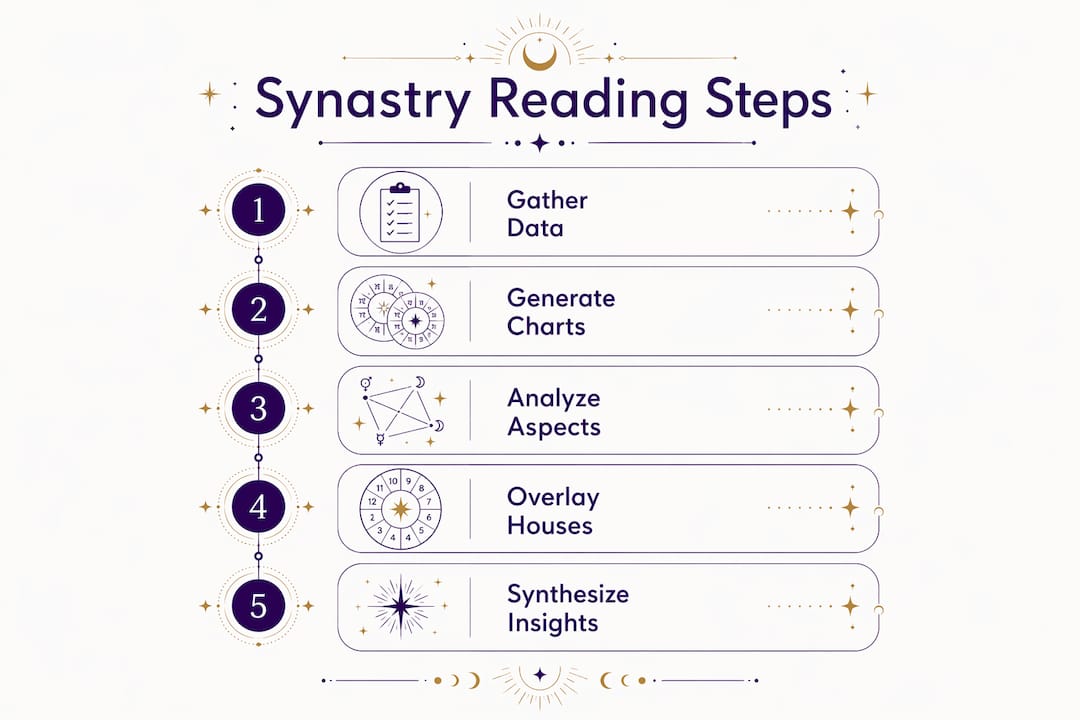
Astrologers read synastry in layers, moving from the broadest signals to the finer details. Here is a practical reading order you can follow.
- Check the big three across charts. Compare each person's Sun, Moon, and Ascendant against the other's. These three points describe core identity, emotional nature, and outward presentation. Strong cross-contacts here (especially Sun-Moon or Moon-Ascendant) signal a fundamental temperamental fit or friction.
- Scan personal-planet cross-aspects. Look at Mercury-to-Mercury and Mercury-to-other-personal-planets for communication style. Check Venus and Mars contacts for attraction and desire. Sun-to-Sun and Sun-to-Moon contacts show how core identities relate.
- Note Saturn and outer-planet contacts. Saturn contacts indicate structure, restriction, or karmic lessons; Uranus contacts bring disruption or excitement; Neptune can idealize or blur; Pluto intensifies and transforms. These contacts describe longer-term or deeper-pattern dynamics.
- Map the house overlays. Note which house of Person A each of Person B's planets falls into, and vice versa. This tells you which life areas each person activates in the other.
- Identify the dominant pattern. Where do most of the strong contacts cluster? If you see many trines and sextiles, energy flows easily. A chart heavy in squares and oppositions describes a relationship with built-in friction that can be productive or exhausting depending on how both people work with it.
- Synthesize, don't isolate. A single difficult aspect does not define a relationship. Look for the overall pattern before drawing conclusions.
Pro Tip: The most common beginner mistake is over-weighting one dramatic aspect, such as a Pluto square, while ignoring a cluster of supportive Venus and Moon contacts nearby. Read the whole chart before focusing on any single contact.
What do the major synastry aspects mean in relationships?
Major cross-aspects carry distinct relational meanings: conjunctions often indicate deep fusion or intensity, trines represent harmony, squares signify friction that can drive growth, and oppositions suggest magnetic attraction requiring balance. The table below gives you a quick reference.
| Aspect | Degrees | Relational meaning | Typical emotional tone |
|---|---|---|---|
| Conjunction | 0° | Fusion, intensity, shared focus | Powerful, can feel consuming |
| Trine | 120° | Natural ease, rapport, flow | Comfortable, supportive |
| Square | 90° | Tension, challenge, growth pressure | Activating, sometimes frustrating |
| Opposition | 180° | Magnetic pull, need for balance | Compelling, requires negotiation |
| Sextile | 60° | Cooperative opportunity | Friendly, needs engagement to activate |
The planets involved shift the meaning significantly. A Sun-Moon trine reads very differently from a Saturn-Moon trine. The first suggests emotional ease and mutual recognition; the second can indicate that one person feels emotionally restricted or heavily responsible around the other. Always read the aspect and the planets together, not the aspect alone.
For a deeper look at how astrology explains compatibility issues in practice, including how specific aspect patterns play out in real relationships, that resource covers the topic in useful detail.
Key planet-to-planet pairings worth watching
Some cross-chart contacts come up in almost every compatibility question. Here is what each one typically signals.
- Venus-Mars contacts: The classic attraction indicator. When one person's Venus aspects the other's Mars (especially by conjunction or trine), there is usually strong romantic and physical chemistry. A square between them can still produce attraction but with more friction around desire and pacing.
- Sun-Moon contacts: Astrologers often weight Sun-Moon and Moon-Ascendant contacts heavily because they describe how core identity and emotional nature meet. A Sun-Moon conjunction or trine across charts tends to feel like recognition: "this person just gets me." An opposition can create a push-pull dynamic that is magnetic but requires ongoing negotiation.
- Mercury contacts: Mercury-to-Mercury and Mercury-to-personal-planet aspects describe communication style compatibility. A Mercury trine or sextile between charts usually means conversations feel natural and ideas land easily. A Mercury square can mean frequent misunderstandings even when both people mean well.
- Saturn contacts: Saturn touching another person's personal planets (especially Moon, Venus, or Sun) introduces themes of structure, responsibility, and sometimes limitation. Saturn contacts can create lasting bonds, but they often come with a sense of duty or restriction that both people need to acknowledge consciously.
- Outer-planet contacts (Uranus, Neptune, Pluto): These tend to describe transformational or destabilizing dynamics rather than day-to-day chemistry. A Neptune conjunction to someone's Venus can feel like idealized, almost otherworldly attraction, but it can also blur realistic perception. Pluto contacts intensify whatever planet they touch, often bringing power dynamics or deep psychological themes into the relationship.
A short example: Suppose Person A's Venus conjuncts Person B's Mars (strong attraction), and Person B's Saturn squares Person A's Moon (emotional restriction or felt responsibility). Reading both together, you see a relationship with real chemistry that also carries a weight of obligation or emotional caution. Neither contact cancels the other; both are part of the picture.
How house overlays change what you see in a synastry chart
House overlays answer a specific question: in which area of your life does this person's energy show up? When Person A's planet falls into one of Person B's houses, it activates that house's themes in Person B's experience of the relationship.
A quick reference by house:
- 1st house: identity, appearance, first impressions. A planet here makes a strong immediate impact on how Person B sees themselves around Person A.
- 4th house: home, family, emotional roots. Planets here activate domestic life and deep emotional security.
- 5th house: creativity, romance, play. Venus or Jupiter here often signals fun, affection, and romantic energy.
- 7th house: partnership, contracts, one-on-one relating. This is the house of committed relationship; planets here tend to feel significant in a partnership context.
- 10th house: career, public life, reputation. Planets here can mean one person influences the other's professional direction or public image.
The same planet in different houses tells a very different story. Person A's Venus in Person B's 7th house feels like a natural partnership pull, a sense that this person fits the role of partner. Person A's Venus in Person B's 4th house feels more like warmth and comfort at home, a domestic ease rather than a formal partnership signal. The planet's nature stays the same; the life area it activates changes everything about how it is experienced.
House overlays require accurate birth times for both people. Without a birth time, houses cannot be calculated reliably, and this layer of the reading is unavailable.

What synastry can and can't tell you
No synastry chart is entirely harmonious or entirely tense. Every reading describes texture: where energy flows easily and where friction lives. That framing is the right one to hold when you are interpreting results.
A few common questions, answered directly:
- Does a "high synastry score" mean a good relationship? Numeric scores from calculators are a simplification. A chart full of trines can describe a comfortable but stagnant connection. A chart with squares and oppositions can describe a relationship that pushes both people to grow. The pattern matters more than the score.
- Which contacts are considered strongest? Practitioners generally treat Sun-Moon, Moon-Ascendant, and Venus-Mars contacts as the highest-priority signals. Saturn contacts are weighted heavily for long-term or karmic themes.
- Can synastry predict whether a relationship will last? It describes dynamics, not outcomes. Free will, timing, and context all shape how the patterns in a chart actually play out. Carl Jung conducted chart-comparison studies in the 1950s that increased mainstream interest in synastry, though the methodology was debated. The technique has remained a tool for insight, not a deterministic system.
- How does transit timing relate to synastry? Current planetary transits can activate or quiet specific synastry contacts. A composite chart adds another layer by describing the relationship's shared direction. Synastry alone gives you the chemistry; composite and transit work add timing and purpose.
- What if I don't have an exact birth time? You can still read planetary aspects between the two charts. House overlays and Moon placements (which shift sign roughly every two and a half days) require accurate birth times to be reliable.
When should you get a professional or AI-assisted synastry reading?
A free calculator gives you the raw data: a list of aspects and house overlays. What it does not do is synthesize those contacts, weight them by importance, or tell you how they interact with each other. That synthesis is where a professional or AI-assisted reading adds real value.
A professional astrologer brings several things a calculator cannot: the ability to weigh which contacts dominate the chart, read the composite alongside the synastry, frame findings ethically (without telling you what to do), and answer follow-up questions in context. They can also read timing, noting when transits are activating key synastry contacts.
AI-assisted tools like those at Tarosyn add speed and repeatable report generation. You get a structured interpretation quickly, often with interactive visualizations, and you can revisit the report as the relationship develops. The limit of any AI tool is that it works from pattern recognition rather than lived interpretive experience, so nuanced or contradictory chart patterns may need a human reader to untangle.
Pro Tip: Before any reading, write down two or three specific questions about the relationship. "What does the communication dynamic look like?" or "Where is the main source of tension?" gives the reader or tool a clear frame and produces a much more useful session than a general "tell me everything."
To prepare well, gather accurate birth data for both people: date, city, and time of birth. The more precise the birth time, the more complete the reading. If one birth time is unknown, say so upfront; a good reader will adjust the interpretation accordingly.
For a broader look at how AI personalizes astrological readings, Tarosyn's overview of AI-assisted astrology explains what these tools do and where their limits are.
Key Takeaways
Synastry astrology describes relational dynamics through planetary aspects and house overlays, not outcomes. The most reliable reading starts with the big three, moves through personal planets, and synthesizes the full pattern before drawing conclusions.
| Point | Details |
|---|---|
| Start with the big three | Compare Sun, Moon, and Ascendant across charts before looking at any other contacts. |
| Personal planets carry the most weight | Venus-Mars, Sun-Moon, and Mercury contacts describe chemistry, emotion, and communication most directly. |
| Saturn and outer planets show long-term themes | Saturn contacts indicate structure or karmic patterns; Uranus, Neptune, and Pluto describe transformation. |
| House overlays need birth times | Accurate birth times for both people are required to read which life areas are activated. |
| Tarosyn offers guided synastry readings | Tarosyn's AI-assisted and professional readings synthesize aspects, overlays, and composite charts in one place. |
Synastry as a tool, not a verdict
Most people come to synastry looking for a yes or no: is this relationship good or not? That is the wrong question to bring to the chart. What synastry actually offers is a description of dynamics, a map of where energy flows and where it gets complicated. Two people with a chart full of squares can build something lasting if they understand the friction and work with it. Two people with nothing but trines can drift into comfortable stagnation.
The more useful frame is curiosity rather than judgment. What does this chart tell me about how we communicate? Where might we need to be more patient with each other? What strengths can we lean on? Those questions produce insight. "Is this relationship good?" produces anxiety.
Combining synastry with other tools deepens the picture further. Tarot, for instance, can surface the emotional or intuitive layer of a situation that a chart describes structurally. Tarosyn's guide on combining tarot with astrology shows how to use both together without one overriding the other. Synastry gives you the map; how you move through the territory is always your choice.
Get a guided synastry reading with Tarosyn
Synastry charts contain a lot of data. Knowing which contacts to prioritize, how house overlays modify aspect meanings, and what the composite chart adds to the picture takes time to learn on your own.
Tarosyn's relationship compatibility readings give you a synthesized, personalized interpretation without the guesswork of reading a raw aspect list alone. Each reading includes:
- Weighted analysis of your highest-priority cross-contacts (Sun-Moon, Venus-Mars, Saturn placements)
- House overlay interpretation showing which life areas are activated
- Composite chart context for relationship direction and shared purpose
- Personalized guidance framed around your specific relationship type and questions
To get the most complete reading, have the date, city, and time of birth ready for both people. When you are ready to go deeper, start your custom reading at Tarosyn.
Further reading and tools
These resources are useful for hands-on practice and deeper study.
- AstroLibrary Free Synastry Report: Generates a detailed compatibility report with or without birth times. Includes synastry aspects, house overlays (when birth times are provided), and an aspect grid. One of the most complete free tools available.
- PsychicScience Astrological Compatibility Calculator: A straightforward Western-system calculator that covers Ascendant, Sun, Moon, and personal planets. Useful for a quick first read.
- Skyscript Synastry Glossary: A concise, historically grounded definition of synastry with context on traditional chart-comparison practice going back to Ptolemy's Tetrabiblos.
- Synastry chart readings (Clarity Insight Wellness): A professional synastry reading service for those who want a human practitioner to interpret their charts.
- Tarosyn's natal chart guides: If you need to build your understanding of individual chart basics before reading synastry, start with Tarosyn's birth chart guide as a foundation.
One practical note: birth time accuracy matters more in synastry than almost anywhere else in astrology. Even a 15-minute difference can shift house cusps and change which house a planet falls into. If you are unsure of a birth time, check a birth certificate rather than relying on family memory.