You can balance your personal energy by mapping your natal chart's element mix and applying small, consistent practices from the complementary elements. Start today: look up your Sun, Moon, and Rising signs, identify which element appears least, and add one practice from that element's list this week.
Quick reference for complementary pairings:
- Fire (Aries, Leo, Sagittarius) pairs with Earth or Water to cool and ground excess drive
- Earth (Taurus, Virgo, Capricorn) pairs with Fire or Air to loosen rigidity and spark movement
- Air (Gemini, Libra, Aquarius) pairs with Earth or Water to anchor scattered thinking
- Water (Cancer, Scorpio, Pisces) pairs with Fire or Air to lift and energize emotional depth
This guide walks you through each step: identifying your chart's element mix, choosing the right practices, timing your efforts with lunar cycles, and building a 7-day routine you can start immediately.
Table of Contents
- How do you find your dominant and missing elements?
- What practices actually rebalance each element?
- What do you do when your sun sign doesn't match your chart's energy?
- How do transits and lunar cycles affect your rebalancing timing?
- A 7-day micro-routine to rebalance a weak element
- Common misconceptions about balancing energy with astrology signs
- Key Takeaways
- Why astrology energy balance rewards patience over perfection
- Tarosyn makes elemental balance practical and personal
- Useful sources and further reading
How do you find your dominant and missing elements?
Practitioners recommend identifying missing or under-represented elements in your birth chart and using complementary element practices rather than trying to change who you are. The process takes about 15 minutes with a free chart tool.
Follow these steps:
- List your Sun, Moon, and Rising signs. These three carry the most weight in your chart. Note the element for each (Fire, Earth, Air, or Water).
- Tally your personal planets by element. Add Mercury, Venus, and Mars to your list. Count how many fall in each element. Write it as a simple shorthand: Fire 3 / Earth 2 / Air 1 / Water 2.
- Note empty houses and clusters. If a whole element has zero placements, that is a missing element. If five or more planets sit in one element, that is a dominant element.
- Record your modalities. For each planet, note whether its sign is Cardinal (Aries, Cancer, Libra, Capricorn), Fixed (Taurus, Leo, Scorpio, Aquarius), or Mutable (Gemini, Virgo, Sagittarius, Pisces). A chart heavy in Fixed signs tends toward persistence but can resist change; heavy Cardinal charts initiate easily but may not follow through; heavy Mutable charts adapt well but can scatter energy.
A missing element usually shows up in daily life as a noticeable gap. Missing Fire often feels like low motivation or difficulty starting things. Missing Earth can look like trouble with routines, money, or physical self-care. Missing Air may show up as difficulty communicating or thinking through problems clearly. Missing Water tends to surface as emotional disconnection or trouble reading others.
Pro Tip: Track your shorthand score (e.g., Fire 4 / Earth 1 / Air 3 / Water 2) for two weeks. Note which days feel most draining and which feel steady. Patterns usually confirm your chart's element gaps faster than analysis alone. Use Tarosyn's birth chart self-analysis guide to run through this checklist step by step.
What practices actually rebalance each element?
Element-dominant recharge strategies differ clearly by element: Fire recharges through action and creativity, Earth through grounding and routine, Air through mental stimulation and connection, and Water through rest, emotional expression, and water-based activities. The table below maps each element to its common imbalance signs and three practical practices.

| Element | Common imbalance signs | Practice 1 | Practice 2 | Practice 3 |
|---|---|---|---|---|
| Fire | Burnout, aggression, impatience | Dynamic cardio (running, cycling) | Sun-facing yoga (Warrior I, Sun Salutations) | Creative project with a clear deadline |
| Earth | Rigidity, over-caution, stagnation | Barefoot grounding walk outdoors | Tactile routine (cooking, gardening, clay) | Breathwork: slow 4-count inhale, 6-count exhale |
| Air | Scattered thinking, anxiety, indecision | Journaling (free-write for 10 minutes) | Structured conversation or debate | Pranayama: alternate nostril breathing |
| Water | Emotional overwhelm, withdrawal, fatigue | Epsom salt bath or cold shower | Expressive writing or art | Gentle movement: yin yoga, slow swimming |
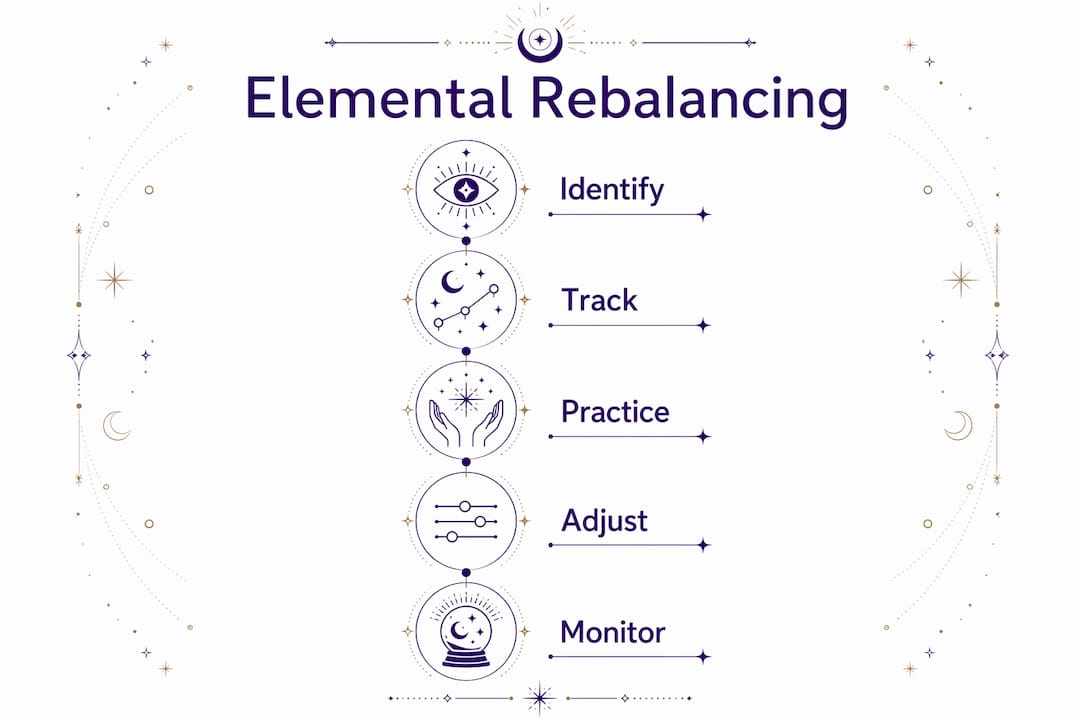
Fire element practices
Fire signs and charts heavy in Fire tend to push hard and burn out fast. Dynamic cardio works well here, but pace it: three moderate sessions per week outperform daily high-intensity workouts for sustained energy. If you are trying to add Fire to a weak chart, short bursts of creative work (even 10 minutes of drawing or writing) can activate that energy without overwhelming your system. For sign-specific yoga poses tied to Fire, Warrior sequences and backbends are the most commonly recommended.
Earth element practices
Earth energy stabilizes, but too much of it creates inertia. Grounding walks, especially barefoot on grass or soil, are a direct physical anchor. Tactile routines like cooking from scratch or working with plants engage the senses in a way that screens and abstract tasks do not. For charts missing Earth, adding one physical routine at the same time each day (even a 5-minute morning stretch) builds the regularity that Earth energy provides.
Air element practices
Air imbalance often looks like mental overload or, on the other end, mental flatness. Journaling works because it externalizes the mental chatter and gives it structure. Alternate nostril breathing (Nadi Shodhana) is a well-documented pranayama technique that calms the nervous system while keeping the mind alert. If your chart is Air-heavy and you feel scattered, grounding practices from the Earth column above are the complement to reach for.

Water element practices
Water-dominant charts absorb emotional input from the environment, which can lead to fatigue that looks like laziness but is actually overstimulation. Boundaries matter here: limit emotionally intense media and conversations during high-stress periods. For charts missing Water, expressive writing or a short creative art session opens emotional channels without requiring deep vulnerability. A 15-minute yin yoga session before bed is a low-barrier entry point.
Pro Tip: Pick one practice per day, not one per element. In week one, choose the practice from your missing element and do it for 5–10 minutes. In week two, extend to 20 minutes or add a second practice from the same element. Scale gradually over a month rather than trying to address all gaps at once.
What do you do when your sun sign doesn't match your chart's energy?
The Sun sign is your public role, not the full picture of your energy. A Gemini Sun with a Taurus Moon, Scorpio Rising, and four planets in Water signs will not feel like the breezy, Air-dominant Gemini the horoscope column describes. Conscious focus on empty houses and strengthening weak areas with routine attention awakens dormant parts of the chart, but the process starts with accepting that the Sun sign is one layer, not the whole.
Common reasons for mismatch:
- A strong Moon or Rising sign in a different element than the Sun
- Three or more personal planets clustered in one element that differs from the Sun's element
- A dominant house (like the 8th or 12th) pulling attention toward Water themes regardless of Sun sign
A practical integration plan looks like this: identify the Sun sign's core need (Fire: expression and recognition; Earth: security and productivity; Air: connection and ideas; Water: depth and meaning). Then schedule one Sun-sign activity and one chart-dominant-element activity each day. Keep both short at first, 10–15 minutes each, so neither crowds out the other.
Pro Tip: If you notice the same energy pattern repeating across multiple life areas (chronic fatigue, recurring relationship friction, persistent creative blocks), that is a signal to go deeper than a self-guided checklist. A full chart reading or a structured self-analysis session, like the one available through Tarosyn's birth chart guide, can surface the underlying planetary dynamics driving the pattern.
How do transits and lunar cycles affect your rebalancing timing?
Aligning rebalancing efforts with supportive transits rather than forcing balance during heavy or conflicting astrological weather produces better results. Trying to build a new Earth routine during a Mercury retrograde in an Earth sign, for example, often leads to false starts and frustration.
Here is a simple decision flow to use before starting a new practice:
- Is there an active transit touching the houses ruled by your weak element? If yes, use gentle practices from that element (short walks, brief journaling, a single breathing exercise). The transit is already activating that area; you do not need to force it.
- Is there a retrograde or a challenging aspect (square, opposition) involving your dominant element's ruling planet? If yes, focus on stabilizing your dominant energy rather than pushing into new territory.
- What lunar phase are you in? New Moon: start new practices. Waxing Moon: build intensity gradually. Full Moon: observe and adjust. Waning Moon: release what is not working.
Chakra mapping adds another layer. Energy astrology links birth-chart placements to chakra centers and uses awareness and behavior change to address challenging aspects. A rough mapping: Fire signs (Aries, Leo, Sagittarius) connect to the Solar Plexus and Sacral chakras; Earth signs (Taurus, Virgo, Capricorn) to the Root and Throat chakras; Air signs (Gemini, Libra, Aquarius) to the Heart and Crown chakras; Water signs (Cancer, Scorpio, Pisces) to the Sacral and Third Eye chakras. For a full breakdown of these connections, Tarosyn's guide on chakra and astrology connections covers each sign in detail.
Pro Tip: Check your daily horoscope each morning for a quick read on the day's dominant transit energy. Use it as a one-line prompt: if the day's energy supports your weak element, do the practice. If it conflicts, do a maintenance practice from your dominant element instead.
A 7-day micro-routine to rebalance a weak element
Use this plan for whichever element appears least in your chart. Substitute the specific practice from the element table above; the structure stays the same regardless of which element you are working with.
| Day | Focus | Practice | Time | Outcome |
|---|---|---|---|---|
| 1 | Awareness | Identify your weak element; write down three ways it shows up as a gap | 10 min | Clear starting point |
| 2 | Physical anchor | One body-based practice from your weak element (movement or grounding) | 15 min | Physical connection to the element |
| 3 | Breath or sensory | Breathwork or sensory activity tied to the element | 10 min | Nervous system engagement |
| 4 | Rest and observe | Light journaling: what felt different on days 2–3? | 10 min | Pattern recognition |
| 5 | Deepen the practice | Repeat day 2's practice, extend by 5 minutes | 20 min | Building consistency |
| 6 | Add a mental layer | Journaling prompt or creative activity from the element | 15 min | Cognitive and emotional integration |
| 7 | Review and plan | Rate energy (1–10) vs. day 1; note what to keep next week | 15 min | Measurable baseline for week 2 |
Follow these steps each day to stay on track:
- Set a consistent time (morning works best for Fire and Air practices; evening for Earth and Water).
- Write one sentence before you start: "Today I am working on [element] because I notice [gap]."
- Do the practice without interruption.
- Write one sentence after: "What shifted, even slightly?"
- Rate your overall energy on a 1–10 scale and note your sleep quality and mood in two words.
Daily journal prompts to use across the week:
- Day 1: "Where in my life do I feel the absence of [element] most clearly?"
- Day 3: "What did my body do during the practice? What resisted?"
- Day 5: "Is this practice sustainable? What would make it easier?"
- Day 7: "What is one thing I will carry into next week from this experiment?"
Track energy changes through three simple signals: subjective energy rating (1–10 each evening), sleep quality (restful / broken / deep), and mood in two words. After seven days, compare your day 1 and day 7 ratings. A shift of even one or two points in the right direction confirms the practice is working.
Common misconceptions about balancing energy with astrology signs
Misconception 1: Your Sun sign tells you everything about your energy. The Sun sign is one placement out of many. The energy balance chart treats the full birth chart as a balance of forces; dominant elements create default energy patterns and missing elements represent gaps. A Scorpio Sun with five Air placements will not behave like a typical Water-dominant chart.
Misconception 2: A missing element is a flaw. It is not. The elemental and modality distribution across all planetary placements is the true gauge for energetic balance, and a missing element points toward a growth direction, not a deficiency. Many people with no Earth placements build remarkably stable lives precisely because they have learned to consciously cultivate grounding habits.
Misconception 3: You should try to make all four elements equal. Equal distribution is rare and not the goal. The goal is complementary integration: using practices from under-represented elements to offset imbalances, not erasing the dominant ones. A chart with Fire 5 / Water 3 / Air 2 / Earth 0 does not need to become Fire 2.5 / Water 2.5 / Air 2.5 / Earth 2.5.
Misconception 4: Balancing means doing more. Experienced practitioners emphasize managing dominant, high-output energies before attempting to boost weak ones. Overcompensating for weak elements, especially by adding too many new practices at once, can cause energetic burnout. Start with one practice, not four.
Misconception 5: Retrogrades block all progress. Retrogrades slow and internalize energy; they do not stop it. A Mercury retrograde is actually a useful period for reviewing and refining existing practices rather than launching new ones. Work with the cycle, not against it.
Misconception 6: Astrology energy balance is the same as your personality type. Astrology signs and energy types overlap but are not identical. Your birth chart is a map of potential, not a fixed destiny. The goal is flow between energies, such as Sun-driven action balanced with Moon-driven nourishment, rather than a static label.
Key Takeaways
Balancing your personal energy with astrology signs works by identifying your chart's dominant and missing elements, then applying one consistent complementary practice at a time.
| Point | Details |
|---|---|
| Identify before you act | Tally Sun, Moon, Rising, and personal planets by element before choosing any practice. |
| Complement, don't erase | Add practices from your missing element; do not try to suppress your dominant one. |
| Time your efforts | Align new practices with supportive transits and lunar phases; use retrogrades for review, not new starts. |
| One practice at a time | Start with a single 10–15 minute daily practice and scale over four weeks to avoid burnout. |
| Tarosyn for guided work | Use Tarosyn's birth chart tools, daily horoscopes, and community journal to track elemental shifts over time. |
Why astrology energy balance rewards patience over perfection
The most common mistake people make with elemental balancing is treating it as a problem to solve rather than a practice to maintain. You will not close a missing-element gap in a week. What you will do, if you stay consistent, is notice small shifts: a little more steadiness if you have been adding Earth practices, a little more ease in conversation if you have been working with Air.
The birth chart is a map of potential, not a verdict. Astrology works best as a self-discovery tool when you use it to observe patterns rather than to judge yourself. If you try a Fire practice and it feels forced, that is useful information. If an Earth routine clicks immediately, that tells you something too. Treat the 7-day plan as an experiment, not a prescription.
For readers who want to go further, connecting with others on the same path accelerates the process. Astrology groups near you offer in-person community for those who learn better with others. And for anyone who wants a structured, personalized tool rather than a self-guided checklist, Tarosyn brings together birth chart analysis, daily horoscopes, and a community journal in one place.
Tarosyn makes elemental balance practical and personal
Most people who want to balance energy with astrology signs hit the same wall: they understand the concept but do not have a consistent, personalized way to track it. Tarosyn gives you that structure directly.
With Tarosyn, you get a birth chart breakdown that shows your elemental distribution at a glance, daily horoscopes that flag the day's transit energy so you know whether to push or hold, and a community journal where you can log your 7-day routine and see how others are working with the same cycles. The Temperance reading spread is a strong starting point if you want to see how tarot and elemental balance work together in a single session. For ongoing daily guidance, the daily horoscope gives you a one-line transit read every morning.
Start by visiting Tarosyn and running your birth chart. From there, follow the elemental breakdown, pick your first practice, and use the community journal to track your week.
Tarosyn provides tools for self-exploration and personal reflection. This article is general information, not professional medical or psychological advice. Confirm any health-related practices with a qualified professional.
Useful sources and further reading
These resources support the practices and frameworks covered in this guide.
| Resource | Purpose | Type |
|---|---|---|
| Astrolibrary: Elements, Qualities, and Polarities | Clear primer on the four elements and three modalities | Learn |
| Inspire & Guide: Astrology Energy Balance Chart | Explains dominant and missing element concepts | Learn |
| Inspire & Guide: How to Balance Your Birth Chart | Practical steps for strengthening weak houses and timing | Practice |
| Cabanabandana: Recharge by Element Dominance | Element-specific self-care and recharge strategies | Practice |
| Ahmad Free Tools: Zodiac Sign Energy Balance | Quick sign-to-element mapping tool with complementary suggestions | Practice |
| Energy Astrology: Phong Thuy BTA | Chakra-to-planet framework for somatic energy work | Learn |
| Tarosyn: Chakra and Astrology Connections | Full chakra-to-zodiac mapping with practical exercises | Practice |
| Tarosyn: Birth Chart Self-Analysis Guide | Step-by-step chart analysis for identifying elemental gaps | Practice |
| Tarosyn: Astrology Signs Yoga Compatibility | Element- and sign-specific yoga pose recommendations | Practice |
| Llewellyn: Tap Into the Energy of Each Astrological Sign | Sign-by-sign energy descriptions from a long-standing astrology publisher | Learn |