Birth chart houses are the 12 life-area sectors that divide your natal chart, each governing a distinct part of your life, from identity to career to relationships. Their exact positions depend entirely on your birth time and location, since the Ascendant sets where House 1 begins. This guide gives you quick meanings for all 12 houses plus the calculation steps and interpretation tools to use them.
TL;DR:
- Most birth charts will have empty houses, and interpreting them relies on analyzing their ruling planets and placements, not the presence of planets within.
- The accuracy of house calculations heavily depends on having an exact birth time, ideally verified from a birth certificate, as small time differences shift house cusps significantly.
- Placidus, Whole Sign, and Equal House systems can produce different house placements, especially in high-latitude locations, so choosing the right system affects interpretation.
- Angular houses (1, 4, 7, 10) carry more emphasis in a chart because they align with the primary axes, but planets in stable or well-aspected rulers can outweigh house position.
- Understanding how house themes combine with sign and planet placements provides a more nuanced reading, especially when interpreting house intercepts and ruling planets.
Table of Contents
- What Do the 12 Houses in a Birth Chart Mean?
- How Are Houses Calculated, and Why Does Birth Time Matter So Much?
- Placidus vs. Whole Sign vs. Equal Houses: Which Should You Use?
- What Does Each House Actually Mean in a Reading?
- Why Angular Houses Carry More Weight Than Succedent or Cadent Ones
- What If a House Has No Planets in It?
- Reading a Placement: Planet, Sign, and House Together
- What Should You Collect Before Running Your Chart?
- Why the Midheaven and Imum Coeli Matter as Much as the Ascendant
- What Are House Intercepts and Why Do They Matter?
- Common Mistakes People Make Reading Their Houses
- How to Read Multiple Placements as One Cohesive Story
- Why Houses Are the Most Personal Part of a Chart
- Get Your Houses Interpreted With Tarosyn
- Sources
- FAQ
What Do the 12 Houses in a Birth Chart Mean?
Every house governs a specific slice of life, and scanning them side by side is the fastest way to get oriented before you dig into your own chart. These one-line meanings follow the shorthand many astrology reference sources use to teach the system.
Personal houses (1 through 6):
- House 1 — Self, identity, first impressions. Ruled by the Ascendant; linked to Aries and Mars energy.
- House 2 — Money, possessions, self-worth.
- House 3 — Communication, siblings, short trips.
- House 4 — Home, family, roots. Anchored by the Imum Coeli.
- House 5 — Creativity, romance, pleasure.
- House 6 — Daily routine, health, service.
Interpersonal and transpersonal houses (7 through 12):
- House 7 — Partnerships, marriage, one-on-one relationships. Sits opposite House 1.
- House 8 — Intimacy, shared resources, transformation.
- House 9 — Higher learning, travel, philosophy.
- House 10 — Career, public reputation, life direction. Marked by the Midheaven.
- House 11 — Friendships, community, long-term goals.
- House 12 — Subconscious, endings, solitude.
The first six houses tend to describe your inner world and daily life. The last six describe how you connect with others and the wider world. Once you know which house a planet sits in, you have "where" the story plays out. The next step is figuring out exactly where those house lines fall in your own chart.
How Are Houses Calculated, and Why Does Birth Time Matter So Much?
Houses are calculated from your Ascendant, the zodiac sign rising on the eastern horizon at your exact birth moment, which becomes the cusp of House 1. Everything else follows from there, dividing the sky into 12 sectors using math that varies slightly by house system.
Here's the part most beginners underestimate: the Ascendant shifts roughly one degree every four minutes. That means two babies born 20 minutes apart in the same hospital can have noticeably different house cusps, even though their planets sit in nearly identical zodiac signs. Getting the birth time wrong can shift planets between houses, altering your chart's interpretation.
Time zone errors cause more miscalculations than people realize, especially for anyone born near a time zone boundary, during a daylight saving transition, or in a country with historical time zone changes. A calculator needs your birth time converted to the correct standard time for that exact date and location, not just today's time zone rules.
When an exact birth time isn't available, astrologers use rectification: working backward from known life events to estimate a probable Ascendant. It's a specialized skill and not something a calculator alone can do.
To get an accurate house calculation, gather this before you start:
- Your exact date of birth.
- Your exact time of birth, down to the minute, ideally from a birth certificate.
- Your birth location: city, state, or the latitude and longitude if the city is small or historic.
- Confirmation of which time zone and daylight saving rule applied on that date, in that place.
Pro Tip: If you only have an approximate birth time, run your chart with a Whole Sign fallback first. It avoids inventing false house cusps and gives you a stable starting point until you can rectify with more precision.
Placidus vs. Whole Sign vs. Equal Houses: Which Should You Use?
House systems are different mathematical methods for slicing the ecliptic into 12 sectors, and they don't always agree. Different systems can shift where a planet lands), sometimes moving it into an entirely different house.
- Placidus divides houses by time, based on the diurnal motion of the sky. It's the most widely used quadrant system in modern Western astrology.
- Whole Sign assigns one entire zodiac sign to each house, starting with the Ascendant's sign as House 1. It's the oldest documented method and remains popular for its simplicity.
- Equal House splits the zodiac into 12 equal 30 degree segments starting from the Ascendant, regardless of the sky's actual motion.
- Topocentric is a lesser known quadrant variant, similar in spirit to Placidus but calculated with a different mathematical model.
A planet at 29 degrees of a sign can sit in House 5 under Whole Sign but slide into House 6 under Placidus. High latitude birth locations make this worse. Placidus can produce badly distorted, oversized, or even mathematically undefined houses above the Arctic Circle, which is why many astrologers switch systems for those charts. If you're new to this, Whole Sign or Equal House tends to be the easiest starting point.
What Does Each House Actually Mean in a Reading?
Reading a house well means combining its theme with whatever sign sits on the cusp and any planets inside it. Here's how each one plays out in practice.
-
House 1: Self and identity. This is your Ascendant house, and it governs how you present yourself to the world. Keywords: appearance, instinct, first impressions. A Mars placement here often produces someone direct and quick to act; a Venus placement softens the approach and adds charm. This house forms an axis with House 7, so your sense of self and your approach to partnership constantly inform each other.
-
House 2: Money and self-worth. This sector covers income, possessions, and how you value yourself beyond appearances. A cluster of planets here often points to someone who builds security through steady accumulation rather than risk. Its opposite, House 8, governs shared resources, so debt, inheritance, and joint finances show up there instead.
-
House 3: Communication and immediate environment. Siblings, short trips, early education, and the way you process information all live here. Mercury feels at home in this house. Someone with an active House 3 tends to talk fast, think out loud, and keep several conversations running at once.
-
House 4: Home and roots. Anchored by the Imum Coeli, this house covers family, ancestry, and your emotional foundation. The Moon fits naturally here. A packed House 4 often signals someone whose sense of security is tied closely to their household or upbringing, for better or worse.
-
House 5: Creativity and romance. This is the house of pleasure, self-expression, children, and lighthearted love affairs, distinct from the committed partnerships of House 7. The Sun and Leo energy both resonate here. Someone with the Sun in House 5 often needs a creative outlet to feel fully themselves.
-
House 6: Routine and health. Daily work, physical health, and acts of service belong here. This is a succedent house but one people underestimate. A Virgo influence in House 6 often produces someone meticulous about habits and health routines.
-
House 7: Partnership. The Descendant sits here, and this house governs marriage, business partners, and any formal one-on-one bond. It sits opposite House 1. Venus and Libra energy both suit this house. A stacked House 7 often means relationships shape someone's identity more than solo ambition does.
-
House 8: Intimacy and transformation. Shared resources, intimacy, death, and rebirth all fall under this house. Pluto and Scorpio energy fit naturally here. Someone with several planets in House 8 often has a complicated but powerful relationship with change and vulnerability.
-
House 9: Philosophy and expansion. Higher education, long distance travel, and belief systems belong here. Jupiter and Sagittarius energy resonate strongly. A well-populated House 9 often signals a restless mind that needs new ideas or new places to feel alive.
-
House 10: Career and public life. Marked by the Midheaven, this is the house of reputation, ambition, and how the world sees you professionally. Saturn placements here can indicate someone who earns success slowly but durably. This house forms an axis with House 4, so public ambition and private roots are always in dialogue.
-
House 11: Friendship and community. Long-term goals, social networks, and group affiliations live here. Uranus and Aquarius energy fit this house well. Someone with planets here often finds their identity partly through the causes and communities they belong to.
-
House 12: The subconscious. Endings, solitude, spirituality, and hidden patterns all belong to this final house. Neptune feels most at home here. A crowded House 12 can point to someone deeply intuitive but prone to escapism if left unchecked.
When a planet lands in any of the four angular houses, House 1, 4, 7, or 10, treat that placement as carrying extra weight in the overall chart story.
Why Angular Houses Carry More Weight Than Succedent or Cadent Ones
The 12 houses split into three groups of four, based on how directly they connect to the chart's main axes. That grouping shapes how strongly a house tends to express itself.
- Angular houses (1, 4, 7, 10) sit directly on the chart's four primary points: the Ascendant, Imum Coeli, Descendant, and Midheaven. Traditional practice treats these as the most active houses in the chart.
- Succedent houses (2, 5, 8, 11) follow each angular house and tend to represent stability, resources, and follow-through.
- Cadent houses (3, 6, 9, 12) fall right before each angle and are linked to learning, adjustment, and transition.
A planet parked in an angular house tends to announce itself more loudly in someone's personality or life events than the same planet sitting in a cadent house. But loud isn't the same as strong. To judge a house's real strength, check three things: whether planets occupy it, where its cusp ruler sits elsewhere in the chart, and what transits are currently activating it. A quiet House 9 with a well-placed ruler can matter just as much as a crowded angular house.
What If a House Has No Planets in It?
An empty house is completely normal. With 10 major planets spread across 12 houses, at least two houses will usually come up empty in most charts, and that absence doesn't mean the life area goes unaddressed.
To read an empty house, find the sign on its cusp, identify that sign's ruling planet, then look at where that ruler sits elsewhere in the chart. An empty House 7 with Venus ruling the cusp, and Venus placed in House 10, suggests relationships get filtered through career ambitions or public image.
Intercepted signs complicate this further. An interception happens when a sign gets fully swallowed inside one house without ever touching a cusp, usually in quadrant systems like Placidus at higher latitudes. It suggests some part of that house's theme feels delayed or harder to access until later in life.
- Trace the cusp ruler's sign and house placement first.
- Then note any transits or progressions currently touching that empty house.
- If your birth time is uncertain, treat planets near a cusp with caution. A shift of even a few minutes can move them into the neighboring house.
Pro Tip: When a planet sits within three degrees of a house cusp, don't commit to an interpretation until you've confirmed your birth time is accurate to the minute. That's exactly the zone where rectification changes the story.
Reading a Placement: Planet, Sign, and House Together
The interpretive rule practitioners rely on is simple: the planet is what happens, the sign is how it happens, and the house is where it happens. Skip any one part and the reading falls apart.
Mars in Aries in the 1st House describes assertive energy (what), expressed impulsively (how), showing up in someone's identity and first impressions (where). Venus in Libra in the 7th House shows a need for harmony (what), pursued diplomatically (how), centered on committed partnership (where). Saturn in Capricorn in the 10th House points to disciplined ambition (what), expressed through patient structure (how), aimed squarely at career and public standing (where).
Working through examples like these repeatedly is how the method starts to feel intuitive instead of mechanical.
- Start with the house, since it tells you where the story unfolds.
- Layer in the sign to see the behavioral style.
- Finish with the planet to name the underlying drive.
For readers who want a guided walk-through rather than a solo project, Tarosyn's birth chart self-analysis guide breaks this sequence down step by step, and pairing that practice with journaling tends to surface patterns a one-time reading misses. If your birth time is approximate, treat any house-based conclusion as provisional until you rectify it.
What Should You Collect Before Running Your Chart?
A clean chart calculation depends on gathering the right inputs before you touch a calculator, not fixing mistakes after the fact.
- Exact birth date. Confirm it against a birth certificate if there's ever been family disagreement about it.
- Precise birth time, down to the minute. Hospital records are more reliable than family memory.
- Birth location, ideally city and state, or latitude and longitude for small towns, historic addresses, or locations that have changed names.
- Time zone confirmation, including whether daylight saving was active on that date in that location.
Once you have those four pieces, look for a calculator that lets you toggle between house systems, flags when your birth time is too uncertain to trust the houses, and exports a chart you can revisit later. Tarosyn's beginner's guide to how a birth chart works is a useful primer if you want the planet, sign, and house basics explained before you dive into a live reading.
Why the Midheaven and Imum Coeli Matter as Much as the Ascendant
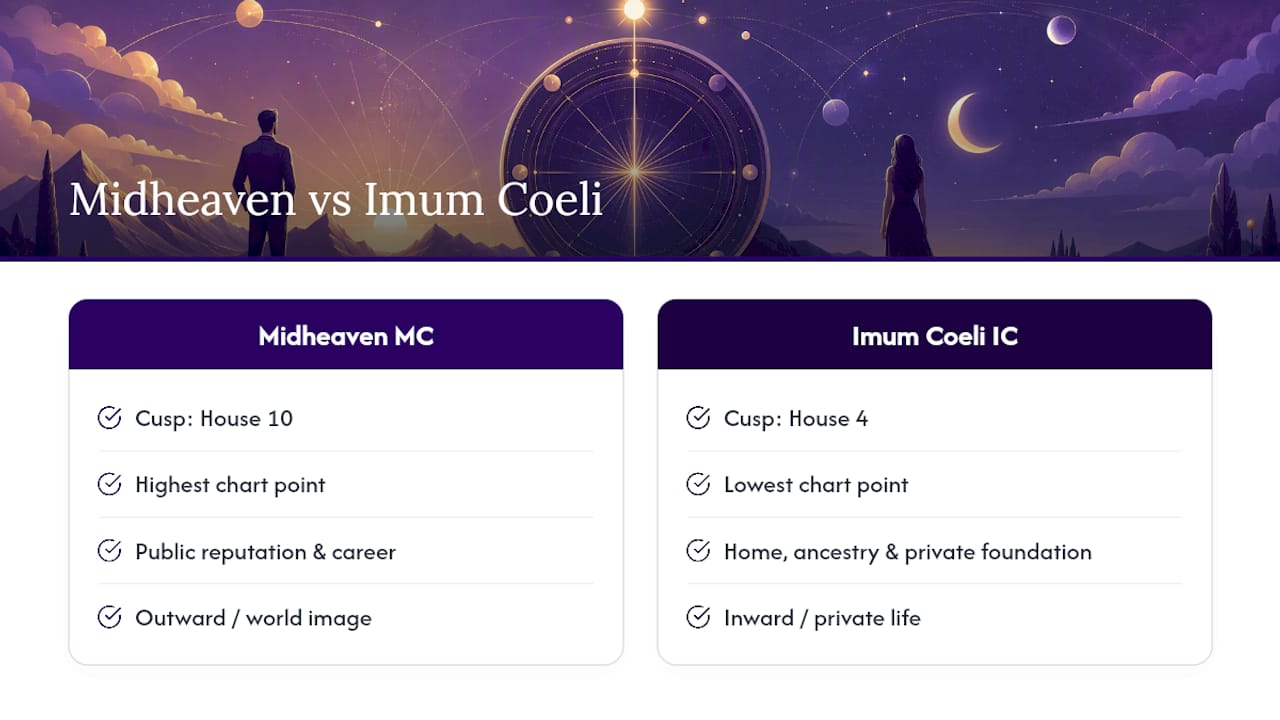
The Midheaven (MC) and Imum Coeli (IC) form the vertical axis of your chart, running perpendicular to the Ascendant/Descendant line, and together they anchor two of the four angular houses.
The Midheaven marks the cusp of House 10 and represents the highest point the sun reaches in its daily arc as seen from your birth location. It governs public reputation, career direction, and the image you project into the world. Astrologers read the sign on the Midheaven as a strong clue toward vocational calling, sometimes even before looking at any planets in House 10 itself.
The Imum Coeli sits exactly opposite the Midheaven, marking the cusp of House 4. It represents the lowest point of the chart and governs home, ancestry, and private emotional foundation. Where the Midheaven is public and outward facing, the IC is private and inward facing. The two points form a constant dialogue: public ambition on one end, private roots on the other.
Both points are highly sensitive to birth time, arguably even more than the Ascendant in some calculation methods, since they depend on precise sidereal time calculations tied to the moment and location of birth. A birth time that's off by 15 or 20 minutes can shift the Midheaven's sign entirely, changing the entire career narrative a reading would suggest. That sensitivity is one more reason accurate birth records matter as much as they do throughout this whole system.
What Are House Intercepts and Why Do They Matter?
An interception happens when a full zodiac sign gets trapped entirely inside one house without ever touching a cusp on either side. It's a byproduct of quadrant house systems like Placidus, particularly at higher latitudes, where house sizes can stretch unevenly across the ecliptic.
When a sign is intercepted, the opposite sign is intercepted too, always in the house directly across the chart. This tends to signal that whatever life area that house governs feels harder to access consciously. Some astrologers describe intercepted house themes as needing extra time, effort, or maturity before they express fully, compared to themes tied to a house's leading cusp sign.
A practical way to spot an interception is checking whether two full signs appear back to back on the same house cusp line, with no sign change between two adjacent houses. That's the visual tell most chart software will flag automatically once you know to look for it.
Interceptions don't apply under Whole Sign or Equal House systems, since every house there is assigned exactly one sign by design. This is one more reason your choice of house system meaningfully changes what your chart appears to say, not just cosmetically, but in terms of which life themes get flagged as complicated versus straightforward.
Common Mistakes People Make Reading Their Houses
The most common error is treating an empty house as an empty life area. As covered earlier, an empty house still functions through its ruling planet. Dismissing it entirely means missing a real piece of the interpretive puzzle.
A second mistake is over-weighting angular houses simply because they're labeled as more active. Angular placement is one signal among several, not a verdict. A planet in a cadent house with a strong, well-aspected ruler can outweigh a poorly aspected planet sitting in an angular house.
People also frequently confuse house system differences for chart errors. Two accurate charts built from the same identical birth data can show a planet in different houses simply because one uses Placidus and the other uses Whole Sign. That's not a mistake; it's a difference in method, and it's worth knowing which system a reading uses before comparing notes with a friend's chart.
Finally, many beginners skip the sign entirely and jump straight from planet to house, missing the "how" in the middle of the sequence. A Mars in the 7th House reads very differently depending on whether it sits in Cancer or Aries. Skipping the sign step flattens a nuanced placement into something generic.
How to Read Multiple Placements as One Cohesive Story
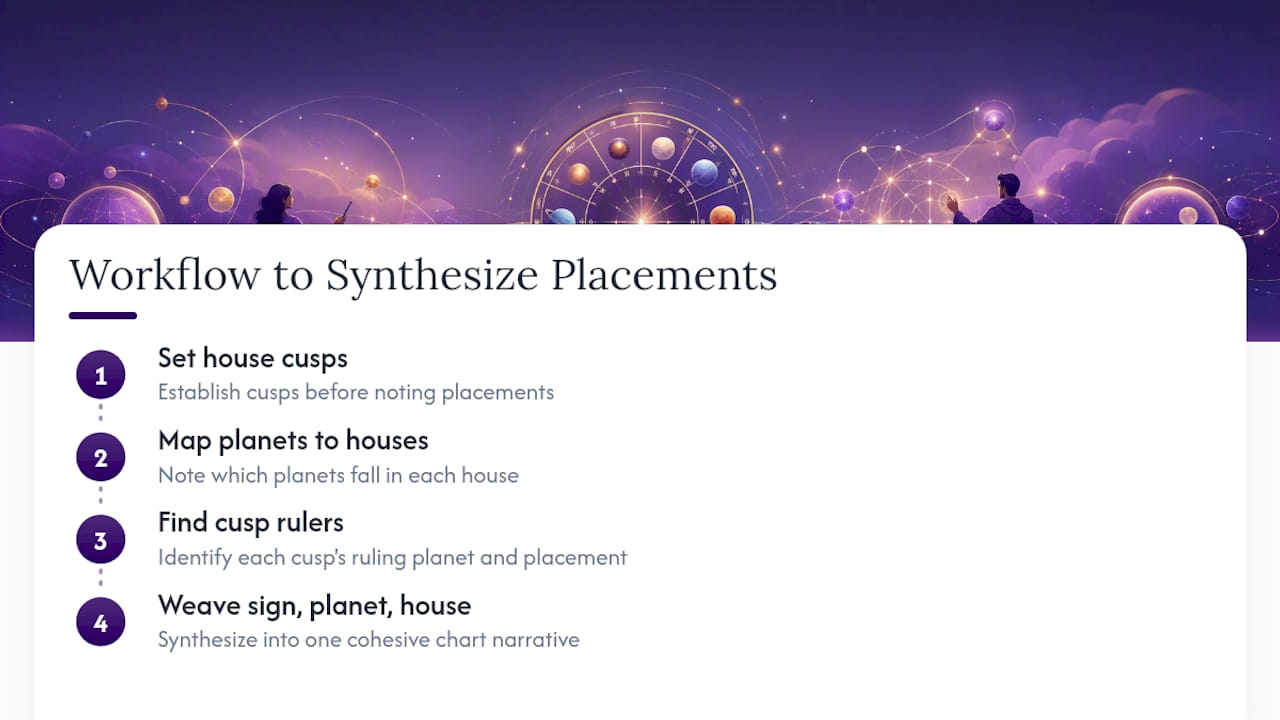
A chart isn't a list of isolated facts; it's a set of placements that need to be synthesized into one coherent narrative. The practical workflow astrologers follow is consistent: establish the house cusps first, note which planets fall in which houses, identify each cusp's ruling planet and where that ruler sits, and only then start weaving sign, planet, and house together into a full picture.
Start by grouping planets that cluster in the same house or sign, since clusters usually point to a dominant life theme. Someone with three or more planets in House 10 is likely to have career and public identity as a central thread running through the whole chart, regardless of what else appears elsewhere.
Next, look at the axis pairs: House 1 against House 7, House 4 against House 10, and so on. Planets on opposite ends of an axis often describe an internal tension the person has to balance rather than two unrelated facts. Someone with the Sun in House 4 and Saturn in House 10 might feel a genuine pull between staying rooted at home and pushing hard toward public achievement.
Finally, weigh angular placements a little more heavily, check cusp rulers for the houses that came up empty, and note any intercepted signs that might complicate the timeline. There's no shortcut that replaces sitting with your own chart repeatedly. Patterns that seem confusing on a first pass usually clarify the second or third time you walk through it with a specific question in mind.
Why Houses Are the Most Personal Part of a Chart
Houses are where a birth chart stops being abstract and starts describing an actual life. Signs and planets exist for everyone born in a given window, sometimes a whole month or more, but houses are calculated from a specific place at a specific minute. That's what makes them personal in a way the rest of the chart isn't.
Some chart tools build around that idea, pairing house-based readings with journaling prompts so insights don't just sit in a report and get forgotten. A house placement means more once you've written down how it actually shows up in your week.
If you take one thing from this guide, let it be this: run your own chart and sit with the houses that feel oddly accurate. That discomfort is usually where the useful information lives.
— Joseph Calitoy
Get Your Houses Interpreted With Tarosyn
Calculating your house cusps is only half the work. Making sense of what a stacked House 8 or an empty House 7 actually means for your life is where most people get stuck, and that's exactly where AI-assisted chart readings can pick up where a static calculator leaves off.

Some services combine birth chart with tarot and journaling tools, so a house placement doesn't stay theoretical. A reading can turn your Midheaven sign into a concrete journaling prompt about career direction, or flag when a transit is about to activate a house that's been quiet. Readings may save to profiles, allowing tracking how a house's themes evolve as real transits move through a chart over time.
If relationships and House 7 themes are what brought you here, Tarosyn's synastry and compatibility tools apply the same house-based logic to comparing two charts side by side. To get started with your own interpretation, browse Tarosyn's readings marketplace and request a personalized birth chart reading built around your exact houses.
Sources
FAQ
How Do I Find the Houses in My Birth Chart?
You need your exact birth date, time down to the minute, and birth location, then run those through a chart calculator that lets you choose a house system such as Placidus, Whole Sign, or Equal House.
What Are the 12 Houses in a Birth Chart?
They run from House 1 (self and identity) through House 12 (subconscious and endings), each governing a distinct life area like money, communication, home, romance, partnership, career, and community, calculated from your Ascendant.
What Are the 1st, 4th, 7th, and 10th Houses Called?
They're called the angular houses, marking the chart's four primary points: the Ascendant, Imum Coeli, Descendant, and Midheaven, and they're traditionally treated as the most active houses in a chart.
What Is the Most Powerful House in a Birth Chart?
There's no single house that's universally the strongest; angular houses often feel the loudest, but a house's real strength depends on whether planets occupy it, how its cusp ruler is placed, and what transits are currently activating it.