Your rising sign, or ascendant, is the zodiac sign that was climbing the eastern horizon at your exact moment of birth. It sets your first house and shapes how people read you before you say a word: your style, your instinct in new situations, your default social mask. Finding it requires your precise birth time, date, and place, since the ascendant shifts roughly every two hours.
TL;DR:
- Your ascendant shifts roughly every two hours, making exact birth time, date, and location crucial for accurate calculation.
- The rising sign influences your first impression, outward style, and approach to new situations more than your core personality or emotions.
- When unsure of your birth time, use a range of possible signs and compare which description feels more authentic to your lived experience.
- Your chart ruler adds personalized detail by linking your rising sign to a specific planet, shaping how its themes manifest in your life.
- The rising sign's influence remains fixed, but its outward expression can change over time as you learn to control or integrate its traits.
Table of Contents
- What Is a Rising Sign in Astrology?
- How to Find Your Rising Sign (and What to Do Without an Exact Birth Time)
- Sun, Moon, and Rising: How the "Big Three" Work Together
- Your Chart Ruler: The Detail Most Beginners Skip
- What Each Rising Sign Looks Like at First Meeting
- Where Beginners Go Wrong Reading Rising Signs
- About This Guide and How Tarosyn Approaches Astrology
- Does Your Rising Sign Change as You Age?
- Rising Sign, Life Path, and the Idea of Destiny
- What Rising Signs Look Like in Real Life
- Beyond Sun and Moon: Other Chart Elements That Shape Your Rising Sign
- Using Your Rising Sign Without Overthinking It
- Get a Reading Built Around Your Exact Chart
- Sources
- FAQ
What Is a Rising Sign in Astrology?
The ascendant is the zodiac sign that sat on the eastern horizon the moment you took your first breath. Astrologers use it to anchor the entire birth chart. Once the ascendant is fixed, everything else, planets, houses, aspects, gets placed relative to that single point on the horizon.
This matters because the ascendant defines your first house, the section of the chart tied to self-presentation, physical vitality, and how you approach new experiences. Think of the chart as a clock face frozen at the instant of birth. The rising sign marks 9 o'clock, the eastern point where the sun was about to climb. Everything else rotates from there.
In Vedic astrology, this same point is called the Lagna, and it carries even more weight in that tradition, often treated as the single most important marker in the whole chart because it governs physical appearance and first-house rulership so directly.
Beginners often confuse the rising sign with the sun sign, and it's an easy mix-up because pop astrology treats sun sign as shorthand for "your sign." But the two describe completely different things:
- Sun sign: calculated from your birth date alone, it reflects your core identity, ego, and the general life themes you're working through. It's what horoscope columns talk about.
- Moon sign: tied to the moon's position at birth, it governs emotional instinct, comfort needs, and how you process feelings privately.
- Rising sign: tied to the exact time and place of birth, it governs outward presentation, the vibe strangers pick up in the first ten seconds, and the lens through which you approach unfamiliar situations.
A person can have a Sun in Scorpio (intense, private, all-or-nothing) but a Sagittarius rising, which means they walk into a room loud, curious, and disarmingly blunt before anyone gets close enough to see the Scorpio underneath. That gap between how you present and who you are underneath is exactly why rising sign astrology exists as its own discipline instead of getting folded into the sun sign conversation.
How to Find Your Rising Sign (and What to Do Without an Exact Birth Time)
Calculating your ascendant takes three specific pieces of information: your birth date, your birth time down to the minute if possible, and your birth location, including city and country. Skip any one of these and the calculation gets shaky, because the ascendant moves through roughly one zodiac sign every two hours, meaning small errors in birth time can flip your entire result.
Here's the practical process:
- Pull your exact birth time. Check your birth certificate first. Hospital records or a baby book are solid backups if the certificate only lists an approximate time.
- Confirm your birth location. Use the city and country where you were born, not where you currently live. Time zone and latitude both factor into the math.
- Run the numbers through a birth chart calculator. Most calculators ask for date, time, and place, then generate a full chart including your ascendant automatically.
- Choose a house system. Placidus is the most common default and works fine for most beginners. Whole Sign and Koch are the other frequent options, and they can shift which planets land in which house, though your rising sign itself stays the same regardless of house system.
- Cross-check the result. If two different calculators give you different rising signs, your birth time is probably close to a sign boundary, and that's worth investigating further.
If you genuinely don't know your birth time, don't guess and move on. Astrologers use a process called rectification, working backward from major life events (a marriage, a career change, a big move) to narrow down a probable birth window. It's not exact, but it can shrink a "sometime in the afternoon" guess into a two-hour range that's usable.
When you're stuck with a range instead of a precise answer, treat the two or three candidate signs as a shortlist rather than a single verdict. Read the descriptions for each candidate and notice which one feels closer to how people actually describe you when they first meet you. That reaction is data.
Pro Tip: If your birth certificate lists a rounded time like "3:00 PM" instead of an exact minute, call the hospital's records office directly. Many hospitals keep delivery logs with more precise timestamps than what ends up on the official certificate.
Sun, Moon, and Rising: How the "Big Three" Work Together
Astrologers call the sun, moon, and rising signs your "big three" because together they cover the three angles that matter most: identity, emotion, and presentation. None of them tells the full story alone, and reading only one is where most beginners go wrong.
- Sun answers "who are you at your core?" It's your identity, drive, and the general shape of your ego.
- Moon answers "what do you feel and need privately?" It governs emotional reflexes, comfort habits, and how you self-soothe.
- Rising answers "how do you show up?" It's the first impression, the outward style, and the instinctive approach you take toward anything new.
The interesting cases show up when these three don't obviously match. Take a Capricorn sun with Leo rising: the core identity is disciplined, cautious, and quietly ambitious, but the outward presentation is warm, expressive, and magnetic. People meet the Leo rising first, assume they know the person, and get surprised months later by how guarded and structured the Capricorn sun actually is underneath.
Or a Gemini sun with Pisces rising: the identity is quick, verbal, and endlessly curious, but the first impression is soft, dreamy, and hard to pin down. New acquaintances often expect someone quiet and imaginative, then get thrown off when the Gemini wit shows up in full force once the person feels comfortable.
Neither combination is a contradiction. It's layering. Use your own chart the same way: read your sun sign for what drives you, your moon sign for what comforts you, and your rising sign for what people notice first. If your rising and sun feel wildly different, that's not a flaw in the system. It just means you present one way and operate another, which is worth knowing about yourself regardless of whether you believe astrology predicts anything.
Your Chart Ruler: The Detail Most Beginners Skip
Every rising sign has a chart ruler, the planet that traditionally governs that sign, and that planet's placement in your chart adds real texture to what your ascendant means on its own. Finding your chart ruler is simple once you know your rising sign: Mars rules Aries, Venus rules Taurus and Libra, Mercury rules Gemini and Virgo, the Moon rules Cancer, the Sun rules Leo, Pluto (or traditionally Mars) rules Scorpio, Jupiter rules Sagittarius and Pisces, Saturn rules Capricorn and Aquarius, and Neptune (or traditionally Jupiter) rules Pisces.
Once you've identified your ruler, look at where it sits in your chart. A chart ruler's house placement links your ascendant to a planet that carries central themes into your presentation and life cycles, which is what turns a generic sign description into something specific to you.
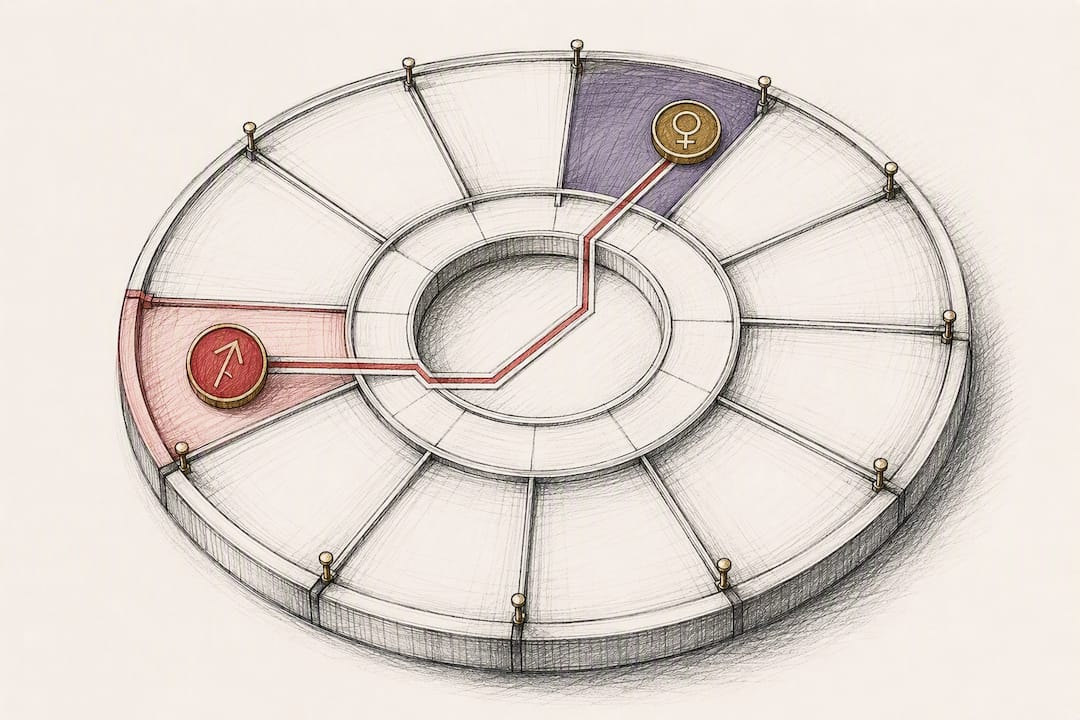
A Libra rising with Venus in the 10th house, for example, tends to channel that diplomatic, aesthetic first impression directly into career and public reputation. That person might end up in design, law, or anything requiring visible fairness and polish. A Libra rising with Venus tucked into the 12th house instead often channels the same charm inward, toward private relationships or creative solitude, rather than public visibility.
Reading your chart ruler takes a bit more digging than reading a sign summary, but it's the fastest way to move past a generic ascendant description and toward something that actually reflects your specific chart.
What Each Rising Sign Looks Like at First Meeting
These are tendencies, not verdicts. Your moon, sun, and chart ruler all color how strongly each trait shows up, but here's what each rising sign typically projects in the first few minutes of meeting someone.
Aries rising walks in fast, talks fast, and doesn't linger in small talk. There's a directness to the eye contact and a restless energy in the body, like they're already thinking about the next thing. What to notice: they tend to take up space immediately, sometimes interrupting without meaning to.
Taurus rising moves slower and settles into a room rather than entering it. The vibe is calm, grounded, and quietly sensory, good posture, deliberate gestures, an ease with silence. What to notice: they warm up gradually and rarely rush a first conversation.
Gemini rising talks. A lot, and well. There's a quick wit and a curiosity that shows up as rapid-fire questions or observations about everything in the room. What to notice: they mirror your energy fast, which can make them seem like a different person in different settings.
Cancer rising reads the emotional temperature of a room before saying much. The first impression is softer, sometimes shy, with a protective quality that shows in body language, arms crossed, a slight physical distance until trust builds. What to notice: they ask caretaking questions early ("are you okay?" "do you need anything?").
Leo rising has presence. Not necessarily loud, but noticeable, good posture, expressive face, a warmth that reads as confidence even when the person feels nervous underneath. What to notice: they tend to perform slightly in new settings, then relax once they feel seen.
Virgo rising comes across observant and a little reserved, taking mental notes before jumping into conversation. There's a neatness to how they present, in dress, in word choice, in how they organize their space. What to notice: they'll often point out small details others missed.
Libra rising aims for likability fast, smiling, asking about you, smoothing over any awkward pause. The presentation is polished and socially aware, sometimes to the point of mirroring what they think you want to see. What to notice: they're uncomfortable with visible conflict, even in a first meeting.
Scorpio rising holds back information and reads people closely before revealing much. The first impression is intense, magnetic, and a little guarded, direct eye contact but few unnecessary words. What to notice: they ask pointed questions but deflect personal ones about themselves.
Sagittarius rising shows up open, blunt, and often funny, with body language that's expansive rather than closed off. There's an enthusiasm that reads as friendliness even to total strangers. What to notice: they'll say something surprisingly honest within the first ten minutes.
Capricorn rising presents composed and a little formal, even in casual settings. The vibe is competent and slightly reserved, careful word choice, minimal oversharing, an air of already being in control. What to notice: humor tends to arrive dry and understated rather than expressive.
Aquarius rising feels a bit unpredictable on first meeting, friendly but detached, like they're observing the interaction as much as participating in it. Style often has an unconventional detail, an odd accessory, an unexpected reference. What to notice: they resist small talk and gravitate toward bigger, stranger topics fast.
Pisces rising comes across dreamy and soft-spoken, sometimes hard to read because the responses feel intuitive rather than direct. There's an adaptability in how they mirror the room's mood. What to notice: eye contact can drift, not from disinterest, but from genuinely processing on a different track.
Where Beginners Go Wrong Reading Rising Signs
The most common mistake is reading the rising sign as the whole personality instead of one layer of it. Popular astrology outlets consistently warn against overinterpreting a single chart point; the rising sign works best alongside your sun, moon, and the placements of other planets.
- Reading rising in isolation. A Leo rising doesn't guarantee an extroverted personality if the sun and moon both sit in quieter signs. It describes surface presentation, not the whole engine underneath.
- Ignoring birth-time uncertainty. Someone calculating their chart with a guessed birth time might be reading a completely wrong sign and not realize it.
- Overfitting examples. Reading a celebrity's rising sign and assuming every trait listed for that sign applies identically to you skips the nuance of chart ruler placement and aspects unique to your birth.
If your birth time is uncertain, don't force a single answer. Work with the two or three candidate signs your possible birth window suggests, and weigh which description matches your lived experience more closely. Rectification with a professional astrologer can narrow this further if you want more confidence in the result.
Practical next steps once you've got your rising sign: compare it against your sun and moon to see where the layers agree or conflict, look up your chart ruler's house placement for extra nuance, and consider a short professional reading if you want a second opinion beyond a calculator's raw output.
Pro Tip: Write down your rising sign's description before you calculate your chart, then compare it to how three different people would describe meeting you for the first time. The overlap (or lack of it) tells you a lot about how accurate your birth time really is.
About This Guide and How Tarosyn Approaches Astrology
This piece was written by Joseph Calitoy for Tarosyn, drawing on established astrological references and calculation methods rather than any single practitioner's interpretation. Tarosyn builds its daily horoscope content and chart tools around the same foundational principles covered here: exact birth data, house-system standards, and the sun, moon, and rising layering described throughout this guide.
If you want to go deeper than a general rising-sign summary, Tarosyn's guide on how a birth chart works walks through houses and planetary placements in more detail, and the breakdown of how zodiac signs are determined covers the mechanics behind sign boundaries.
For anything involving an uncertain birth time, a complex rectification question, or a nuanced synastry comparison between two charts, a professional astrologer or a detailed personalized reading will get you further than a generic calculator result.
Does Your Rising Sign Change as You Age?
Your rising sign itself never changes. It's fixed at the moment of birth and stays that way for life. What does shift is how strongly it shows up, and that's a personality development question, not an astrological one.
Younger people often lean harder into their rising sign because first impressions matter more when you're still building a social identity, in school, in early jobs, in dating. A Scorpio rising in their twenties might guard information intensely because they're still figuring out who's trustworthy. By their forties, that same Scorpio rising might soften outwardly while still processing internally the same way.
The mechanism here isn't mystical. It's practical. Your rising sign describes a default mode, a style your nervous system reaches for automatically in unfamiliar situations. Over decades, most people gain more control over when they deploy that default versus when they consciously override it. A naturally reserved Capricorn rising can learn to be more expressive in professional settings without the underlying chart changing at all.
What tends to happen is integration rather than transformation. The rising sign's traits get folded into a more complete sense of self as the sun sign's core identity strengthens with age and life experience. The mask doesn't disappear. It just stops feeling like a mask.
Rising Sign, Life Path, and the Idea of Destiny
Astrology treats the rising sign as an influence on trajectory, not a fixed script. It shapes the kinds of doors that open easily and the situations where you have to work harder to be understood, which over a lifetime can nudge someone toward certain paths.
A Gemini rising tends to encounter more social opportunities early, invitations, introductions, chance conversations that turn into something, simply because the first impression reads as approachable and curious. That doesn't cause a specific career. It creates more raw material to work with in fields that reward quick connection: sales, media, teaching, anything conversational.
A Capricorn rising, by contrast, often gets taken seriously faster in professional contexts, sometimes mistaken for older or more senior than they are. That can accelerate career trust but also create pressure to perform competence before feeling ready for it internally.
None of this locks anyone into a single outcome. The chart ruler's placement, the sun sign's core drives, and plain circumstance (where you grew up, what opportunities existed) all matter as much or more than the rising sign alone. Where the ascendant genuinely earns its reputation is in explaining friction: why a naturally private person keeps getting pulled into public roles, or why someone driven and ambitious underneath keeps being underestimated because they read as easygoing. That friction, tracked over years, is closer to what astrologers mean by "destiny" than anything resembling fate.
What Rising Signs Look Like in Real Life
Public figures make useful case studies because their rising sign and their public persona are both visible for comparison. A person with Sun in a quiet, private sign but a highly expressive rising sign often becomes known for a public image that doesn't match interview answers or private reporting about their actual temperament, exactly the Capricorn sun, Leo rising pattern described earlier, playing out at scale.
You don't need celebrity charts to see this pattern, though. Look at your own friend group. The friend who seems endlessly social and high-energy at parties but turns out to need long stretches of solitude to recharge is a plausible Leo or Sagittarius rising layered over an introverted sun and moon. The quiet coworker who turns out to be sharply funny once you're one-on-one might be a Cancer or Virgo rising warming up past an initial guarded presentation.
The real-life pattern to watch for is the gap between month one and month six of knowing someone. Rising sign governs the month-one impression. Sun and moon govern what you learn by month six. When those two pictures diverge sharply, that's usually the rising sign doing exactly what it's supposed to do: managing the door before you decide whether to walk through it.
Beyond Sun and Moon: Other Chart Elements That Shape Your Rising Sign
The rising sign doesn't operate alone, and its interaction with the rest of the chart goes well past the big three. Any planet sitting close to your ascendant, within a few degrees, gets pulled into how you present, sometimes overriding the sign itself.
Mercury near the ascendant sharpens verbal presentation regardless of rising sign, making even a quiet Cancer or Pisces rising come across more talkative in person than the sign alone would suggest. Mars near the ascendant adds intensity and physical energy to any rising sign, an otherwise mellow Libra rising might read as surprisingly assertive if Mars sits right on that horizon point.
Aspects matter too. A rising sign square to Saturn often produces a more cautious, self-conscious first impression than that sign typically gives, while a rising sign trine to Jupiter tends to add ease and warmth on top of whatever the base sign suggests.
The houses adjacent to the first house, the 12th and the second, also color the ascendant. Planets in the 12th house can make even an outgoing rising sign carry a private, slightly withheld undertone, while a busy second house often adds a practical, resource-focused edge to first impressions regardless of sign. None of this replaces the basic rising sign reading. It layers on top of it, which is exactly why a full chart reading captures more than any sign-by-sign summary ever can.
Using Your Rising Sign Without Overthinking It
Your rising sign is a starting point for noticing patterns, not a personality verdict. Once you know yours, watch how it shows up: the clothes you gravitate toward on a first date, the tone you default to in a job interview, the way you introduce yourself at a party you didn't want to attend.
Try one small experiment. For a week, notice a moment where your first-impression instinct clashed with what you actually wanted to communicate, then journal a sentence about it. That's more useful than memorizing trait lists.
Hold all of this loosely. A rising sign description is a lens, not a diagnosis, and it works best read alongside your full chart rather than as a standalone label.
— Joseph Calitoy
Get a Reading Built Around Your Exact Chart
A generic rising sign summary can only take you so far, since your chart ruler, nearby planets, and aspects all shift what your ascendant actually means for you specifically. Some astrology services offer AI-assisted readings that work from your real birth details rather than a one-size-fits-all sign description, so the insight reflects your chart, not just your rising sign in a vacuum.

If you've already worked out your rising sign using the steps above, a personalized reading is the natural next move for connecting it to the rest of your chart, your chart ruler's house, your moon's influence, the aspects that add friction or ease. Tarosyn's platform pairs that kind of chart-based reading with daily horoscopes so you're not just getting a one-time snapshot but ongoing, personalized guidance. Try The World in a Three Card Spread for a quick, focused reading, or explore the full subscription options if you want continuous access to personalized chart insight. Either way, start by generating your chart on Tarosyn and see how your rising sign connects to everything else in it.
Sources
For readers who want to verify the basics or go deeper, these sources cover the technical definition and practical interpretation behind this guide:
- Ascendant - Wikipedia
- Rising sign: HowStuffWorks
- Rising Sign Astrology: All About Your Ascendant - Astrostyle
FAQ
What Is the Difference Between a Rising Sign and a Sun Sign?
Your sun sign reflects core identity and comes from your birth date alone, while your rising sign reflects outward presentation and requires your exact birth time and location to calculate.
Can My Rising Sign Change?
No, your rising sign is fixed at birth and never changes, though how strongly it shows up can shift as you gain more control over your default social presentation over time.
What If I Don't Know My Exact Birth Time?
Check your birth certificate or hospital records first; if neither gives an exact time, work with a probable range of candidate rising signs or consider a professional rectification consultation.
Is the Rising Sign More Important Than the Sun Sign?
Neither is more important. They describe different things: the sun sign covers core identity while the rising sign covers first impressions, and both work best read together with your moon sign.
How Do I Find My Chart Ruler?
Identify your rising sign first, then look up which planet traditionally rules that sign; a birth chart calculator or a personalized reading through a platform like Tarosyn can map that placement automatically.