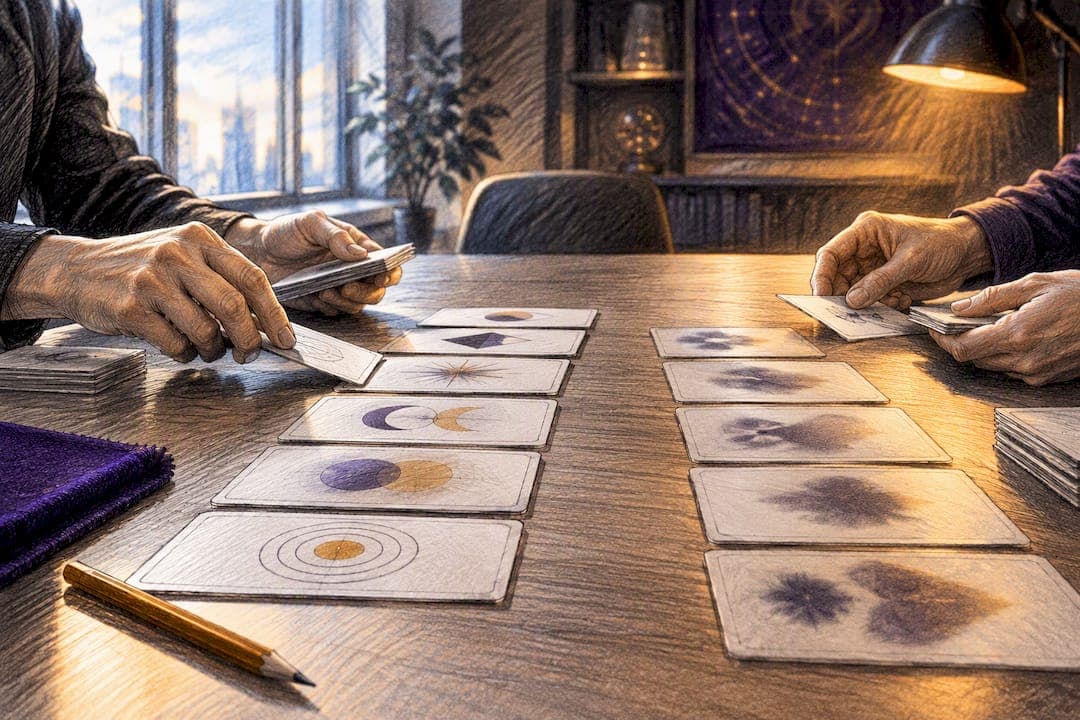
Daily sun-sign horoscopes do not reliably predict specific events. Controlled tests have found astrologers performing no better than random chance on real-life outcomes. Personalized readings can feel more relevant because they use your actual birth data, but that relevance is not the same as proven accuracy. The rest of this guide breaks down why, and gives you a way to check it yourself.
TL;DR:
- Sun-sign horoscopes lack predictive accuracy and perform no better than chance when tested against real-life outcomes or personal data.
- Personalization through natal charts increases perceived relevance but does not improve the ability to forecast specific events accurately.
- The Barnum effect explains why vague horoscope statements feel true, thanks to confirmation bias and positive framing, even when predictions are untestable or false.
- Tracking concrete, specific predictions over time, with transparent sourcing and pre-defined success criteria, reveals most horoscopes are not verifiable predictors.
- Responsible use involves viewing horoscopes as self-reflection prompts rather than reliable forecasts, emphasizing pattern recognition rather than expecting accuracy.
Table of Contents
- How Daily Horoscope Accuracy Depends on What You're Reading
- What the Research Actually Shows About Horoscope Prediction Accuracy
- Why a Horoscope Can Feel Right Even When It Isn't
- A Simple Checklist for Testing Daily Horoscope Accuracy Yourself
- Does a Personalized Birth Chart Change the Accuracy Picture?
- What Responsible Horoscope Use Actually Looks Like
- Try Tarosyn's Daily Horoscopes With Real Personalization
- Sources
- FAQ
How Daily Horoscope Accuracy Depends on What You're Reading
Not all horoscopes work the same way, and that difference matters when you're judging daily horoscope accuracy. A sun-sign blurb written for 1/12th of the planet cannot say anything specific about you as an individual. A chart built from your exact birth time and location is a different kind of claim entirely, even if it faces the same testing problems.
Here's what's actually behind most horoscope content you read:
- Generic sun-sign horoscopes use only your birth month, applied to roughly 650 million people who share that sign worldwide.
- Transit-based forecasts track where planets sit today relative to a fixed reference point (often the first degree of each sign), producing a slightly more dynamic but still broad message.
- Natal-chart readings map planetary positions at your exact birth moment and location, adding real personal data to the calculation.
- AI-generated horoscopes blend transit data with your stated preferences, journal history, or past readings to shape tone and focus.
The broader the input, the broader the output has to be. A sun sign covers a twelfth of humanity, so any prediction attached to it has to stay vague enough to technically apply to all of them. That vagueness is exactly what makes it hard to test. You can't score a prediction as a "hit" or "miss" if it never commits to anything specific in the first place. Scientific American adds another wrinkle: because of a slow astronomical shift called precession, most people's sun sign doesn't even match the constellation the sun was actually in front of on their birthday. The math behind the label is already loose before the prediction is written.
What the Research Actually Shows About Horoscope Prediction Accuracy
The most direct test of horoscope prediction accuracy comes from a large recent study, and the results were not close. Clearerthinking ran experiments with 152 professional astrologers, asking them to match natal charts to the correct person out of a set of candidates. Their accuracy was statistically indistinguishable from guessing at random. The same research also tested whether sun signs could predict any of 37 real, checkable life facts, things like relationship status, health history, or career path, and found no sign that outperformed chance on any of them.
The core finding: Across 37 tested life facts, sun signs showed no predictive power beyond random chance, and experienced astrologers matched charts to people at rates no better than a coin flip. Source: ClearerThinking.org
A Psychology Today summary of that work adds a detail worth sitting with: years of professional experience did not improve an astrologer's accuracy. If chart reading were a learnable skill that tracked real information, you'd expect veterans to outperform beginners. They didn't.
This isn't a new problem for astrology. Older double-blind matching experiments produced the same pattern decades earlier: astrologers asked to match charts to personality profiles scored no better than chance once the test was properly blinded.
None of this proves astrology has zero possible value in every form. ClearerThinking's own researchers are careful to note that a null result in one well-designed study doesn't amount to absolute disproof. What it does show, consistently, across different teams and decades, is that the specific predictive claims tested so far haven't held up. That's a meaningfully different statement than "horoscopes are useless," and it's the one the evidence actually supports.

Why a Horoscope Can Feel Right Even When It Isn't
Here's the part that trips up even skeptical readers: a horoscope can score zero on scientific accuracy and still feel eerily personal. That gap has a name, and it's been studied since 1949.
The Barnum effect (sometimes called the Forer effect, after psychologist Bertram Forer) describes how people rate vague, generally positive statements as uniquely accurate descriptions of themselves. Forer gave the same personality description to every student in his class and asked them to rate its accuracy on a personal level. The average rating was 4.26 out of 5, even though every single student had received identical text. Later research on horoscope columns specifically found the same pattern: readers rated horoscope predictions as highly accurate regardless of whether the prediction actually matched their zodiac sign.
A few things stack on top of that effect to make horoscopes feel more convincing than they are:
- Confirmation bias pulls your attention toward the one line that fits your day and lets the other nine slides by unnoticed.
- Selective memory means you remember the horoscope that predicted your good news, not the dozen that predicted nothing that happened.
- Positive framing matters too. Statements phrased as opportunities ("a chance for growth") get rated as more accurate than neutral or negative phrasing, even when describing the same event.
- Authority and repetition play a role as well. A prediction printed in a familiar app or under a trusted name gets less scrutiny than the identical line from an unknown source.
Pro Tip: Try reading a friend's horoscope instead of your own for one week. If it feels just as personally accurate, that's the Barnum effect at work, not astrology.
A Simple Checklist for Testing Daily Horoscope Accuracy Yourself
You don't need a research grant to evaluate a horoscope credibility claim. You need a system that stops your memory from cheating on your behalf.
- Check specificity first. A prediction like "communication improves today" is unfalsifiable. A prediction like "you'll receive an unexpected message from someone you haven't spoken to in over a year" can actually be scored.
- Write the prediction down before the day starts. Copy the exact wording somewhere you'll check later. This step alone prevents the memory drift that makes horoscopes feel more accurate in hindsight than they were in real time.
- Define a hit and a miss in advance. Decide what counts as confirmation before the day happens, not after, so you're not stretching the definition to make it fit.
- Check provenance. Ask whether the horoscope discloses its method, sun-sign only, full natal chart, or algorithmic blend. Transparent sourcing is a basic credibility marker that most generic horoscope columns skip entirely.
- Score misses, not just hits. Track every prediction across 2 to 4 weeks, including the ones that clearly didn't happen. A fair accuracy rate has to include your failures.
- Note the personalization level. A reading based only on your sun sign should score no better on your test than a reading pulled at random for a different sign.
If you run this test honestly, you'll likely find that most daily predictions land somewhere between "too vague to score" and "wrong." That doesn't mean the exercise was pointless. A horoscope read as a reflective prompt, something to journal against, rather than a literal forecast, still has value as a daily check-in with yourself.
Pro Tip: Test two different horoscope sources side by side for the same two weeks. Comparing their hit rates against each other, not just against your memory, is the fastest way to see whether either one is doing better than a coin flip.
Does a Personalized Birth Chart Change the Accuracy Picture?
A natal chart built from your exact birth time, date, and location carries real personal data that a generic sun-sign column simply doesn't have. That added input can make the interpretation feel more relevant to your actual life, referencing your specific planetary placements rather than a shared monthly forecast. Personalization increases perceived fit, the sense that a reading is speaking to you specifically, even when it hasn't been shown to increase predictive accuracy in controlled testing.
That caveat matters. The same double-blind matching studies that undercut sun-sign predictions have also tested natal-chart interpretation directly, and chart-based matching hasn't scored better than chance either. The honest way to think about a personalized reading is as an interpretive and reflective tool, not a verified forecasting instrument.
That doesn't make it worthless. It changes what you should ask before trusting one:
- Does the provider explain which method it's using (transits, natal chart, or a blend) rather than hiding behind vague "energy" language?
- Can you track past readings over time to see whether the interpretations stay consistent with your actual experience?
- Does the service treat the reading as a prompt for reflection, or does it oversell certainty about specific outcomes?
What Responsible Horoscope Use Actually Looks Like
The evidence is clear that literal predictive claims don't hold up under testing, but that finding doesn't erase what draws people to astrology in the first place. A daily horoscope can work as a structured moment of reflection, a prompt to check in with your mood, your relationships, your goals, without needing to be a verified forecast to have that value. The mistake isn't reading horoscopes. It's treating a Barnum-effect blurb as evidence of something it was never designed to prove.
Some horoscope apps offer personalization drawn from birth details, combined with journaling memory to track patterns over time, shifting the exercise from "did this come true" to "what does this help me notice." Trying a free reading and logging reactions can help users learn about themselves in the process rather than about the future.
— Joseph Calitoy
Try Tarosyn's Daily Horoscopes With Real Personalization
Most horoscope apps give everyone born in the same month the same paragraph. Tarosyn builds its daily horoscope around your actual birth chart and remembers your reading history. So, the reflection you get today connects to what you journaled last week instead of starting from zero every morning.
The AI-assisted approach pulls from your natal chart and past entries to shape tone and focus, then saves everything so you can look back and judge for yourself whether a pattern is real or just felt real in the moment. That's the same test this article just walked you through, applied to your own life instead of a research sample. Free readings get you started; the Mystic monthly plan runs $7.99 a month, and the Annual circle plan runs $59.99 a year for readers who want the full journaling and history features unlocked. Luna packs are also available for a more focused, product-based option. Start with a free daily horoscope today and see what two weeks of tracked reflection actually shows you.
Sources
- Does astrology work? We put 152 astrologers to the test
- Can Astrologers Actually Tell Us Anything About Ourselves? | Psychology Today
- Popular Horoscopes and the 'Barnum Effect' (1983)
- Your zodiac sign is likely wrong. Here’s how to find the correct one | Scientific American
FAQ
Which Horoscope Site Is Most Accurate?
No horoscope site has demonstrated measurable predictive accuracy in controlled testing, since even professional astrologers scored no better than chance in the ClearerThinking study. Instead of chasing accuracy, look for sites that disclose their method and let you track readings over time, which is where Tarosyn's personalized approach focuses its value.
Is There Any Accuracy to Horoscopes?
Sun-sign horoscopes have not shown predictive accuracy beyond random chance across the life facts tested so far. Their felt accuracy comes largely from the Barnum effect, where vague, positive statements feel personally true to nearly anyone who reads them.
Where Can I Get an Accurate, Free Daily Horoscope?
No free daily horoscope can guarantee predictive accuracy, since that standard hasn't been met in controlled studies. Tarosyn offers a free daily horoscope built on your personal birth details, which won't outperform chance on hard predictions but does give you a consistent, trackable reflection tool.
Which Horoscopes Are the Least Reliable?
Generic sun-sign columns that give the same message to everyone born under one of 12 signs are the least specific and hardest to verify, since they can't account for the roughly 650 million people who share any given sign. The vaguer and more universally flattering the language, the more likely it's relying on the Barnum effect rather than any real predictive claim.
How Do I Know if a Horoscope's Predictions Are Testable?
A prediction is testable if it names a concrete event with a clear timeframe, something you could mark "happened" or "didn't happen" the next day. If the statement could apply to almost anyone regardless of what actually occurs, it's reflective language, not a checkable forecast.