AI wins on speed, math, and scale. Human astrologers win on emotional nuance, in-session correction, and specificity that feels true. Use AI for daily check-ins, chart calculations, and quick answers; hire a human for grief, major life decisions, or relationship readings that need a real conversation. Most people get the best results from both.
TL;DR:
- AI excels at delivering rapid, mathematically precise chart calculations and multilingual outputs at a significantly lower cost than human services.
- Humans outperform AI in providing personalized interpretation, emotional nuance, and real-time adjustment during readings, especially for sensitive topics.
- AI's language tends to be vague or generalized, making it less reliable for high-stakes decisions that require specific, context-aware insights.
- Combining AI for technical tasks and humans for interpretation offers a practical, efficient approach without fully replacing either.
- Platforms like Tarosyn demonstrate a hybrid model that delivers instant calculations alongside personalized, community-driven insights for a balanced experience.
Table of Contents
- AI vs. Human Astrology: A Quick Comparison
- Where AI Astrology Outperforms Humans
- Where Human Astrologers Still Have the Edge
- Where AI Astrology Falls Short
- When to Choose AI, When to Hire a Human, and How to Combine Them
- How Tarosyn Applies a Responsible Hybrid Model
- How Did AI End Up in Astrology?
- Why Human Intuition Still Shapes the Best Readings
- What Do Real Comparisons Between AI and Human Readings Show?
- A Pragmatic Take on Using Both
- Try a Hybrid Reading With Tarosyn
- Sources
AI vs. Human Astrology: A Quick Comparison
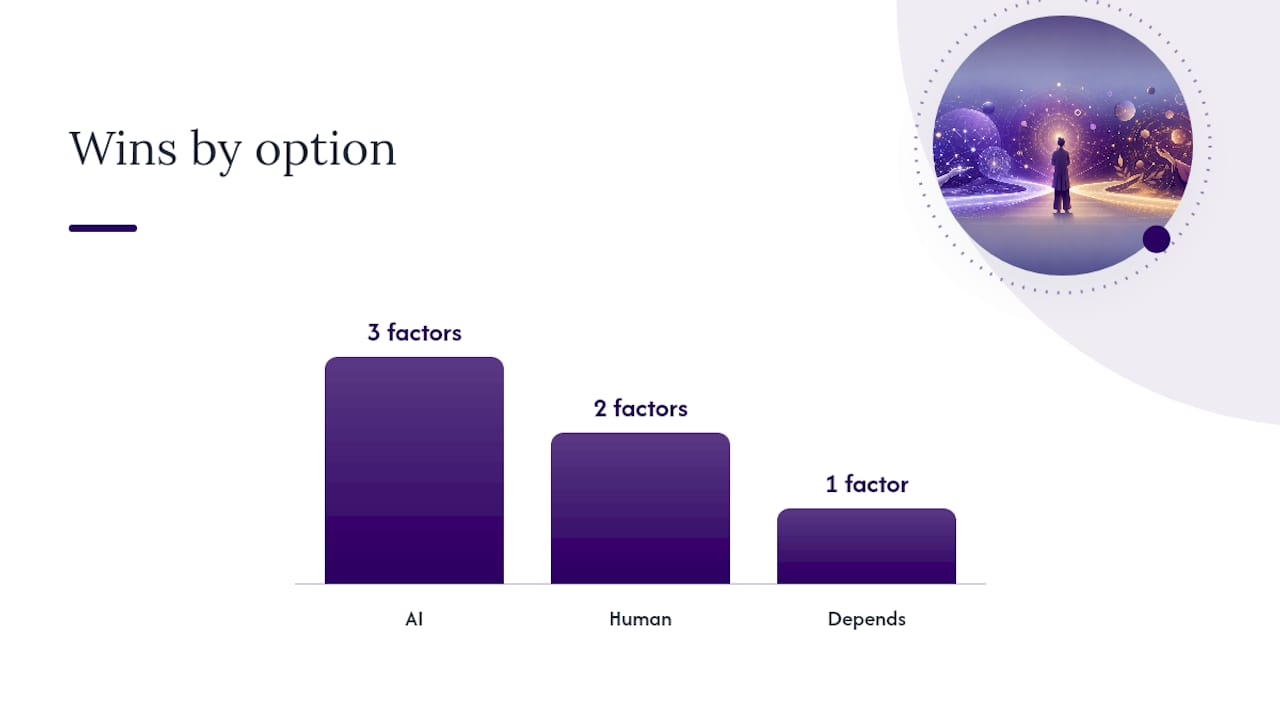
Neither option wins across the board, and that's the point. Astrology algorithms handle math with total consistency, while human intuition handles the parts of a reading that math can't touch. Here's how the two stack up on the factors that actually matter to someone deciding where to spend time or money.
- Specificity and voice: Humans win. A side-by-side comparison of manual and AI-generated readings found manual readings scored higher on specificity and voice in most cases.
- Empathy and rapport: Humans win, clearly. A human astrologer reads your face, your pauses, and your follow-up questions. AI reads your prompt.
- Availability: AI wins. It's there at 3 a.m., during a layover, or the moment anxiety spikes.
- Cost at scale: AI wins. A subscription that delivers unlimited daily horoscopes costs a fraction of hourly consultation rates.
- Privacy: It depends. A human session leaves no digital trace beyond your memory; an AI tool leaves data on a server, so transparency about that server matters.
Use AI for: daily horoscope check-ins, birth chart generation, quick compatibility snapshots, translation into another language, or a first pass before a bigger decision.
Use a human astrologer for: grief, breakups, career pivots, family conflict, or any reading where you need someone to adjust their interpretation based on how you react in real time.
Where AI Astrology Outperforms Humans
The technical layer of astrology is just math: planetary positions, house cusps, aspect angles, all calculated against a fixed point in time and space. This is where artificial intelligence in astrology has already won, decisively. Software built on standardized ephemerides produces near-zero calculation error, something even a skilled human astrologer can't promise when working by hand or cross-referencing multiple tables under time pressure.
Speed compounds that advantage. An AI-powered platform generates a full natal chart in seconds, translates it into several languages, and repeats the process for the next person without any drop in quality. A human astrologer doing the same volume of readings will get tired, rush the fifth chart of the day, or simply not offer service in a language they don't speak.
By the Numbers: A survey cited by the New York Post found that roughly 40% of Gen Z respondents had used ChatGPT for horoscope-style guidance, though only about 20% rated the results as accurate. That gap between adoption and trust is exactly why understanding what AI does well, and where it falls short, actually matters.
Consistency is the other quiet advantage. AI applies the same interpretive logic to chart number one and chart number ten thousand. No fatigue, no mood swings, no "I've read too many Scorpio charts today." That consistency shows up in a few practical ways:
- Instant natal chart generation with no scheduling wait.
- Multilingual output for readers who don't want to translate astrological terminology themselves.
- Cheap repeat readings, useful for daily or weekly check-ins rather than a single paid session.
- Bulk triage: sorting which questions are simple (transit timing, basic compatibility) versus which need a human's attention.
- Automated follow-up summaries after a human session, so nothing gets forgotten between appointments.
Specialized AI astrology platforms lean hard into this efficiency, and it's a legitimate strength, not a gimmick. A birth chart generated instantly gives you a technically sound starting point you can bring to a human astrologer later, which saves that person time and saves you money.
Pro Tip: Run your birth chart through an AI tool before booking a paid consultation. Arrive with the technical layer already done so the astrologer can spend the full session on interpretation instead of chart-drawing.
Where Human Astrologers Still Have the Edge
Ask an AI a follow-up question mid-reading, and watch what happens. It generates a plausible answer, but it can't sense that your voice cracked when you mentioned your ex, or that you flinched at the word "career." A human astrologer catches that. They adjust the reading in real time, a skill sometimes called bet-correction: making an interpretive claim, watching how you respond, and revising it before you even finish your sentence.
This is a structural limitation, not a training gap AI will close with a better model. Analysts describe AI as a static text generator that can't be corrected mid-session the way a person can, which limits its usefulness for anything requiring a risky, specific interpretive call rather than a safe, general one.
That gap shows up most clearly in a few situations:
- Grief counseling. A reading after a death needs pacing, silence, and judgment about what to say and when. No algorithm manages that timing.
- Complex relationship readings. Synastry between two people involves reading the room, not just the charts. A human notices when one partner is uncomfortable saying something the chart implies.
- Long-term mentorship. Astrologers who work with the same client for years build a mental model of that person beyond any single chart. They remember what happened the last time Saturn transited this house for you specifically.
- Cultural and ceremonial guidance. Traditions like Mayan astrology carry ritual context that lives in lineage and practice, not in a training dataset.
The same side-by-side comparison that found AI ahead on coverage and consistency also found manual readings ahead on voice, the intangible sense that the words were written for you specifically, not generated from a pattern that fits thousands of other people born in the same window.
Pro Tip: If a reading needs to feel personally true rather than statistically plausible, that's your signal to book a human. AI can support the conversation; it shouldn't replace it.
Where AI Astrology Falls Short
Generalized language dressed up as personal insight has a name: the Barnum effect, sometimes called the Forer effect. It's the reason horoscopes that could apply to almost anyone still feel accurate. AI is especially good at producing Barnum-style text because it's trained to generate broadly applicable, low-risk phrasing, and that's precisely the problem when you need something specific.
AI also tends to hedge. Because it can't correct itself mid-conversation the way a human can, it defaults to safe, defensible interpretations rather than committing to a specific, riskier read. That caution makes it less useful exactly when you need a clear answer, like a high-stakes yes-or-no question about a relationship or a job offer.
- Watch for language so general it could describe anyone born in a three-week window.
- Notice when an AI response avoids committing to a clear interpretation and instead lists possibilities.
- Check whether the platform publishes a data policy explaining what happens to your birth details and chat history.
- Never treat AI output as authoritative for health, legal, or financial decisions. It's not a substitute for a doctor, lawyer, or financial advisor.
By the Numbers: The same survey found that many Gen Z respondents who had tried AI for horoscope guidance rated it as less than fully accurate, even though a notable portion had used it. Adoption is outrunning trust, which is a fair reason to stay skeptical of any single AI answer treated as gospel.
Data privacy deserves real attention here. Birth charts require your exact birth time, date, and location, which is more personal data than most apps ask for. Before trusting a platform with it, check whether the company publishes a clear, responsible AI policy covering training data and bias reporting. Platforms that hide this information are telling you something.
When to Choose AI, When to Hire a Human, and How to Combine Them
You don't have to pick a side. The most realistic path forward, and the one most industry analyses point to, is hybrid: AI handles calculation, personalization, and logistics, while humans handle the conversation that actually changes how you think about your life.
Run through this checklist before deciding:
- Is this a daily or low-stakes question? Use AI. Daily transits, quick compatibility checks, and routine chart lookups don't need a human's time.
- Do you need someone to adjust the reading based on your reaction? Book a human. Bet-correction only happens in a live conversation.
- Is this a first look before a bigger decision? Start with AI to get the technical layer sorted, then bring it to a human for interpretation.
- Do you need ongoing support over months or years? A human mentor relationship builds context an AI restarts every session.
Three workflows cover most situations. First: AI triage into a human session, where you run a quick AI reading to identify what's actually bothering you, then book a focused consultation on that specific issue. Second: a human session followed by an AI summary, useful when you want a written recap of what was discussed without asking the astrologer to type notes. Third: AI for daily check-ins paired with a quarterly human review, which keeps you engaged day to day while reserving deeper interpretation for a scheduled cadence.
Pro Tip: Treat your AI reading like a rough draft and your human session like the edit. You'll get more out of the conversation, and pay for less of it, if the groundwork is already done.
How Tarosyn Applies a Responsible Hybrid Model
What that looks like in practice:
- AI-generated birth charts and synastry compatibility readings, calculated instantly and available on demand.
- Daily horoscopes for every sign, built for the low-stakes, high-frequency check-ins where AI genuinely excels.
- AI tarot readings alongside astrology, so users can cross-reference guidance from more than one system.
- A social community layer where users compare readings and share interpretations, adding a human dimension AI alone can't provide.
This is the hybrid model in product form: AI for the calculation and daily habit, community and human perspective for the depth.
How Did AI End Up in Astrology?
Astrology and computation have a longer relationship than most people assume. Astrologers were using computer-generated ephemerides to calculate charts decades before generative AI existed. Punch-card systems in the 1970s and desktop software in the 1990s already automated the math, the same technical layer AI now handles.
What changed recently is the interpretive layer. Early astrology software could calculate a chart but couldn't write about it. It spat out planetary positions and left the human to interpret every placement by hand. Large language models changed that by generating readable, personalized-sounding text from those same calculations, collapsing calculation and interpretation into a single instant output for the first time.
That shift explains both the appeal and the skepticism around AI astrology predictions today. The math was never the hard part. Software solved that problem before most current users were born. The interpretation, the part that requires judgment, cultural context, and emotional read, is the part generative AI is still learning to approximate. Multiple industry analyses now frame the future of astrology as hybrid rather than a replacement story, which tracks with how the technology actually evolved: automate the math first, approach the meaning second.
Why Human Intuition Still Shapes the Best Readings
Intuition isn't mysticism dressed up as a skill, it's pattern recognition built from thousands of prior readings, refined by a person who remembers what worked and what didn't. A seasoned astrologer doesn't just apply a rule about Mars in the seventh house; they weigh it against everything else in your chart and everything you've just told them, then make a judgment call.
That judgment is where creativity enters. Two astrologers looking at the same chart will emphasize different things, not because one is wrong, but because interpretation is an art layered on top of the math. A good astrologer decides which placement matters most for you, right now, in this conversation, and that decision changes depending on what you need to hear.
AI can't replicate that because it doesn't accumulate lived judgment the way a person does. It generates text based on patterns across a large dataset, not a personal history of watching how specific advice landed with specific people over time. The manual readings in that side-by-side comparison scored higher on voice for exactly this reason: a human astrologer's phrasing carries the weight of their own accumulated intuition, not just statistical likelihood.
This is also why the best astrologers train for years, apprenticing under others, building a mental library of how certain placements tend to play out in real lives. That's not a dataset. It's closer to craft.
What Do Real Comparisons Between AI and Human Readings Show?
The clearest evidence comes from a direct side-by-side test where the same charts were interpreted once by AI and once by a human astrologer, then compared. The result wasn't a clean win for either side. AI scored better on coverage, meaning it addressed more chart elements without skipping details, and on consistency across repeated readings. Manual readings scored better on specificity and voice, the qualities that make a reading feel like it was written for one specific person.
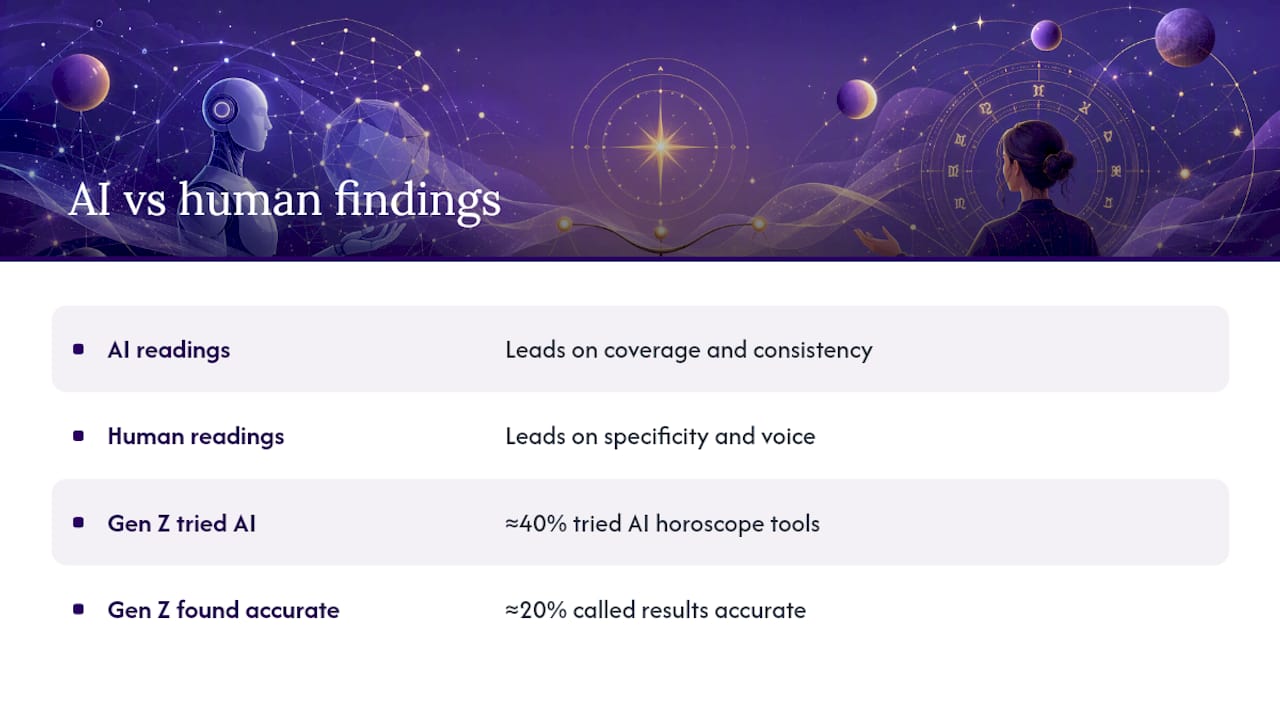
That split matters more than a single winner would. It confirms that AI vs. human astrology isn't a competition with one champion, it's a tradeoff between completeness and personalization. A reader who wants every technical detail covered accurately gets more value from AI. A reader who wants to feel understood gets more value from a human who can read between the lines of what they're actually asking.
The Gen Z survey data adds a real-world layer to the lab-style comparison. With roughly 40% of that group having tried AI tools for horoscope guidance but only about 20% calling the results accurate, the gap between trying AI and trusting it is wide. That gap tends to close when people use AI for what it's actually good at (calculation, daily guidance, translation) rather than treating it as a substitute for a trusted advisor's judgment on something that matters.
A Pragmatic Take on Using Both
Start with AI. It's faster, cheaper, and good enough for the vast majority of astrology questions people actually have day to day. Save paid human sessions for the moments that genuinely need a person: grief, a major decision, a relationship reading where tone matters as much as content.
A few rules worth keeping in mind. Don't trust AI output that feels vague enough to apply to anyone; that's the Barnum effect at work, not insight. Do check whether a platform is transparent about its data and training practices before handing over your birth details. Don't expect an astrologer, human or otherwise, to replace a doctor, therapist, or lawyer. Do treat a human astrologer's willingness to adjust their reading based on your reaction as a sign of real skill, not uncertainty.
The tools have changed. The judgment about when to use which one still belongs to you.
— Joseph Calitoy
Try a Hybrid Reading With Tarosyn
Tarosyn is built for exactly the workflow this article recommends: fast AI calculation for the daily stuff, layered with enough personalization and community depth that it doesn't feel like a generic printout.
Instead of choosing between a slow, expensive human session and a flat AI chatbot answer, you get instant AI birth charts, synastry compatibility readings, and daily horoscopes built on the same ephemeris-based accuracy discussed earlier, plus a social layer where other users' readings and interpretations add the human context a solo AI tool can't. If you've been putting off getting a real chart done, browse public tarot and astrology readings to see the kind of personalized output Tarosyn generates, then start your own free reading and see where the technical layer takes your next conversation with a human astrologer.
Sources
- Astrology AI vs Manual Reading: a Side-by-Side Comparison | Astrolium
- Will AI Take Over Astrology? Future of AI in Horoscope Predictions