
A solar return chart is the horoscope cast for the exact moment the transiting Sun returns to the precise degree it occupied when you were born. It marks the start of a new solar year, one that runs from birthday to birthday, and it maps out the themes, activated life areas, and the planet set to govern the next twelve months. Treat it as a weather report for the year ahead, not a forecast of specific dates.
TL;DR:
- Accurate solar return charts require precise birth time, location, and a high-quality ephemeris to prevent misinterpretation of house placements.
- Casting the chart for either birthplace or current residence significantly affects the reading, making location choice essential for relevance.
- The most meaningful insights come from focusing on dominant planets, angular planets, and the Lord of the Year rather than analyzing every minor aspect.
- Combining solar return charts with profections and transits offers a more reliable yearly outlook, especially when signals converge on the same theme.
- Using dedicated astrology platforms can streamline chart calculation and help translate complex data into actionable insights for the year ahead.
Table of Contents
- Solar Return Explained: The Astronomy Behind the Chart
- How to Calculate a Solar Return Chart Without Guessing
- How to Read a Solar Return Chart Step by Step
- Solar Returns, Profections, and Transits Working Together
- Getting Your Solar Return Chart Right: A Practical Checklist
- An Astrologer's View on Reading Solar Returns Responsibly
- Explore solar return chart readings using a dedicated astrology platform
- Sources
Solar Return Explained: The Astronomy Behind the Chart
The solar return happens the instant the Sun crosses the exact ecliptic longitude it held at your birth, down to the degree, minute, and second. Because a calendar year runs slightly longer than 365 days in most cases, that exact moment can land up to 24 hours before or after your actual birthday, depending on leap years and your birth time.
That gap matters. Your natal chart works like a lifelong blueprint, fixed the moment you took your first breath. A solar return chart is different. It resets every year and captures only the conditions of that single astronomical instant, then expires the following birthday.
Precision drives everything here. Move the calculation by even a few minutes and the ascendant can shift into a different sign or house. Since even small timing errors can change which houses your solar return planets fall into, getting the timing right is not optional. It is the difference between a chart that speaks to your actual year and one that misleads you entirely.
How to Calculate a Solar Return Chart Without Guessing
Building an accurate solar return chart starts with the same three inputs every serious astrology calculation needs: your exact birth date, your birth time down to the minute, and your birthplace with correct coordinates and time zone. Skip any of these and the chart drifts off target before you even get to interpretation.
Software handles the heavy lifting by scanning a narrow window, typically 24 to 48 hours around your birthday, until it finds the precise second the Sun returns to your natal degree. The quality of the underlying ephemeris matters here. Programs built on Swiss Ephemeris data are considered the standard for this kind of second-level accuracy, since weaker ephemeris sources can throw off placements by enough to change house rulerships.
You also have to choose a location convention, and this decision changes the reading. Solar returns must be cast for a specific place because the ascendant and houses depend entirely on location. Astrologers generally use one of two approaches:
- Birthplace method: cast the chart for your city of birth regardless of where you currently live, useful for tracking long-term patterns tied to your roots.
- Current residence method: cast the chart for wherever you are living when your birthday arrives, which many practitioners favor since it reflects your lived environment.
Before you trust any online calculator's output, check three settings: the house system it defaults to (Placidus is most common), whether it lets you confirm your exact coordinates, and whether the time zone conversion is accounting for daylight saving rules at your birth location.
How to Read a Solar Return Chart Step by Step
Reading a solar return chart in the wrong order is how people end up with a scattered, contradictory forecast. A synthetic approach, one that prioritizes the strongest signals instead of cataloging every minor aspect, produces a clearer read. Astrologers favor identifying dominant planets and angular emphases over listing every weak configuration, and that principle should guide your entire process.
Work through the chart in this sequence:
- Start with the SR Ascendant and its ruler. This sets the tone for how you will approach the year, your posture, energy, and default mode of engaging with life.
- Move to the SR Midheaven. This points to public direction, career emphasis, and reputation themes for the twelve months ahead.
- Find your Lord of the Year. This is the planet ruling the SR Ascendant sign, and it colors the year's dominant narrative more than almost any other single factor.
- Note which planets sit on the angles. Planets conjunct the SR Ascendant, Midheaven, Descendant, or IC carry outsized weight, especially within a tight orb of one degree, with looser configurations up to two or three degrees still worth noting.
- Check the SR Sun and SR Moon. The Sun by house shows where vitality and focus concentrate; the Moon reveals the emotional texture of the year.
- Overlay the SR chart onto your natal chart. See which natal houses get activated by the solar return angles. This is where checking which natal houses are "brought to the angles" turns an abstract chart into something personally specific.
- Look for repetition and agreement. When multiple factors, the Lord of the Year, an angular planet, and a house overlay, all point the same direction, that theme deserves your attention. When they conflict, weight the angular and tightest-orb factors more heavily.
Pro Tip: Don't try to interpret every aspect in the chart. Pull the five or six strongest signals first, write them down, then check whether they tell a coherent story before adding anything else.
Solar Returns, Profections, and Transits Working Together
A solar return chart doesn't operate alone, and treating it that way is where a lot of readings go wrong. Annual profections tell you which house of your natal chart is thematically active this year. Your solar return then shows how that theme actually expresses itself, in what tone, through which people or circumstances. Transits supply the timing, pointing to specific weeks or months when something shifts.
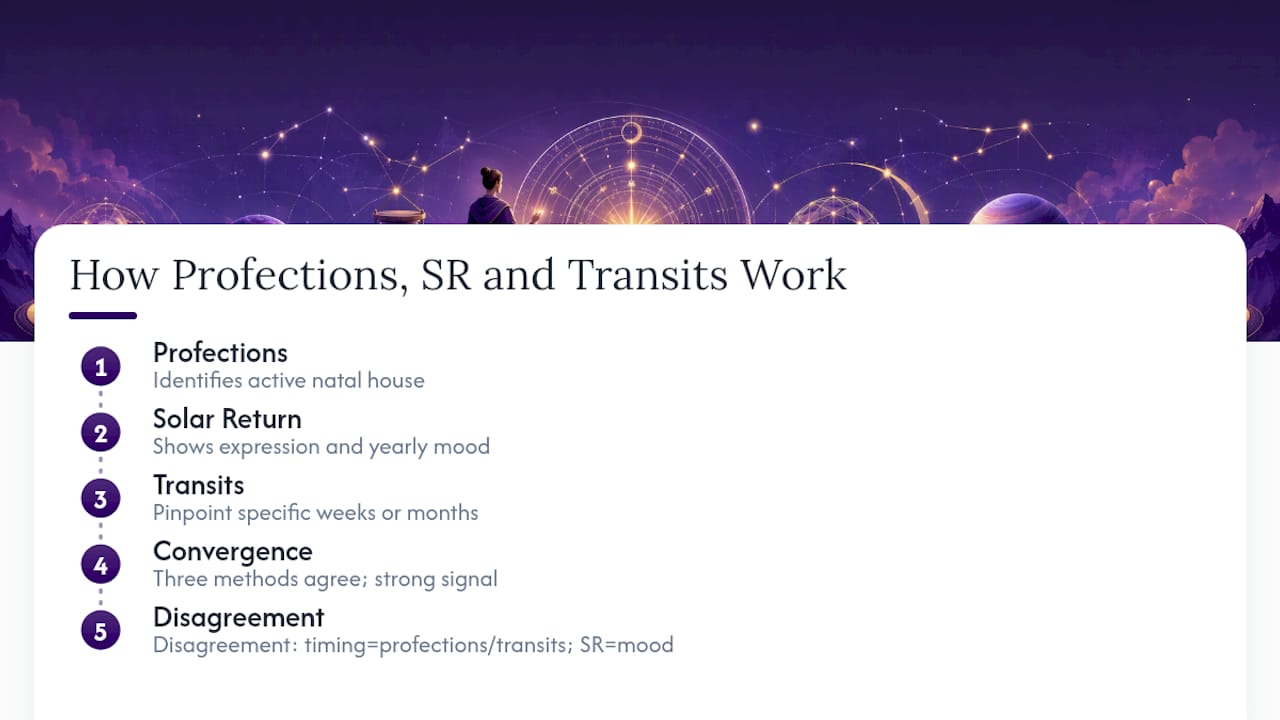
Solar returns give you atmosphere rather than exact event dates, so pairing all three techniques produces a more grounded picture than any one alone. Say your profected year activates the tenth house of career, your solar return shows the Lord of the Year sitting in that same house, and transiting Saturn is also making contact with your natal Midheaven. That's convergence, three independent methods agreeing on the same story, and it's a far stronger signal than any single chart taken in isolation. When the methods disagree instead, lean on profections and transits for the actual timing question, and let the solar return describe the mood surrounding it.
Getting Your Solar Return Chart Right: A Practical Checklist
Before you pull up a solar return calculator, gather your exact birth time (check your birth certificate, not memory), your birthplace coordinates, and decide whether you're using the birthplace or current-residence convention. Then confirm the calculator's house system, time zone handling, and ephemeris source.
Once you have your chart, pull three headline takeaways: the general tone set by your SR Ascendant, one life area getting activated based on your house overlay, and one timing cue from wherever transits and profections agree with the chart. Solar returns are widely used exactly this way, as a preparation tool rather than a fixed script.
- If your birth time is uncertain (no exact minute on record), a professional astrologer can rectify it before you rely on house placements.
- For major decisions, career moves, relationships, relocations, treat your solar return as one input among several, not a verdict.
An Astrologer's View on Reading Solar Returns Responsibly
Solar returns are one of the more satisfying techniques in a working astrologer's toolkit, precisely because they reward precision. A chart calculated to the exact second tells a coherent story. One calculated loosely, using an approximate birth time or a low-quality ephemeris, tends to produce contradictory signals that lead people toward false confidence in the wrong conclusion.
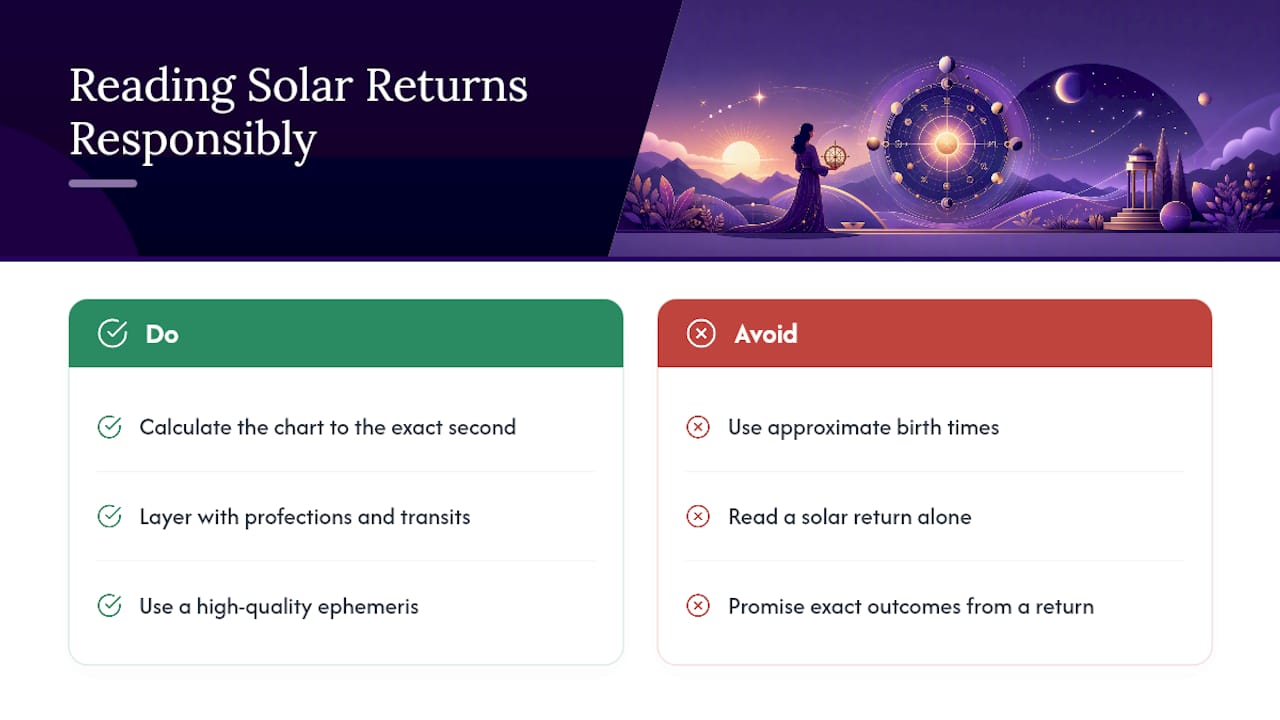
The technique earns its keep when it's layered with profections and transits rather than read alone, much like the spiritual programs offered on Abundant Pathways that complement personal development in astrology. A solar return without that context is atmosphere without a timeline. Combined, the three methods correct for each other's blind spots, profections anchor the theme, transits anchor the timing, and the solar return fills in the texture.
What solar returns should never become is a deterministic script. They describe likely emphasis, not certainty. Anyone promising exact outcomes from a solar return chart alone is overstating what the technique can actually deliver.
— Joseph Calitoy
Explore solar return chart readings using a dedicated astrology platform
Calculating a solar return chart by hand, then cross-referencing it against profections and transits, takes real time even for someone who already knows the mechanics. Certain astrology platforms can generate your chart automatically and translate the technical layer, angular planets, Lord of the Year, house overlays, into language you can actually act on, instead of leaving you to decode raw degrees and orbs yourself.

The Cosmic Calendar tracks your return moment alongside the transits and celestial events unfolding around it, so you can see how your solar return year interacts with what's happening in the sky in real time. Pair that with Tarosyn's daily horoscope to keep tracking the year's themes as they unfold week to week, or browse public readings from the Tarosyn community to see how others are interpreting their own charts. If you want to go deeper on your natal foundation first, Tarosyn's subscription plans unlock expanded reports and saved readings, so your solar return insight builds on a chart you've already refined. Start by getting your solar return read on Tarosyn and see what the year ahead actually looks like on your chart.
Sources
- Solar Return: Definition and Principles — Astrotheme
- Interpreting Solar Returns: Predictions — Cafe Astrology
- What Is a Solar Return? What It Signifies for Your Future — People