Astrology predicts life themes by interpreting the positions of planets in your natal chart and tracking how current planetary movements interact with those positions over time. This practice, formally called natal astrology combined with predictive astrology, does not promise fixed events. It reveals probable timing and symbolic patterns in areas like love, career, health, and personal growth. Astrologers analyze exact planetary degrees and aspects to build a picture of which life themes are likely to intensify and when. The result is a map for self-awareness, not a script for fate.
How astrology predicts life themes through the natal chart
The natal chart, also called a birth chart, is the starting point for every astrological prediction. It is a snapshot of the sky at the exact moment and location of your birth. Every placement in a natal chart exists in dynamic relationship to all others, which means no single planet or sign tells the full story.
Four components work together to shape the chart's meaning:
- Planets represent specific energies and drives. The Sun governs identity, Venus governs love and values, Saturn governs discipline and limitation, and Pluto governs deep transformation. Each planet colors the life area it touches.
- Houses divide the chart into 12 sections, each representing a domain of life experience. The 7th house covers partnerships and marriage. The 10th house covers career and public reputation. The 6th house covers daily health and routines.
- Signs describe the style in which a planet expresses its energy. Mars in Aries acts boldly and directly. Mars in Libra acts diplomatically and sometimes indecisively. The sign shapes the how, not the what.
- Aspects are the angular relationships between planets. A trine between Venus and Jupiter suggests ease and abundance in love or finances. A square between Mars and Saturn creates friction between drive and restriction.
Context shapes every placement's meaning. A Moon in the 8th house square Saturn reads very differently from a Moon in the 8th house trine Venus, even though both share the same house placement. The chart functions as a connected ecosystem, and reading it in pieces produces misleading results.
Pro Tip: When you first read your natal chart, focus on the three placements that form your core identity: your Sun sign, Moon sign, and rising sign. These three alone reveal the dominant themes of your personality and life approach.

How do planetary transits and progressions predict timing?
Transits are the engine of predictive astrology. A transit occurs when a planet moving through the sky today forms an angle to a planet in your natal chart. Timing methods such as progressions, transits, and returns are combined with natal chart context to interpret likely themes rather than fixed events.
The speed of a planet determines how long its influence lasts and how significant the theme becomes:
- Moon transits last roughly 2.5 days and affect daily mood, emotional tone, and minor shifts in focus. They are the short-term weather of your chart.
- Mercury and Venus transits last days to a few weeks and influence communication, social life, and short-term decisions.
- Mars transits last a few weeks and activate energy, ambition, or conflict in whatever house they move through.
- Jupiter transits last roughly one year per house and bring expansion, opportunity, and growth to that life area.
- Saturn transits last two to three years and demand restructuring, commitment, and maturity in the areas they touch.
- Pluto, Neptune, and Uranus transits last years and mark entire chapters of transformation, dissolution, or sudden change.
| Planet | Transit duration | Primary theme |
|---|---|---|
| Moon | 2–3 days | Daily mood and emotional tone |
| Mercury | 2–3 weeks | Communication and decisions |
| Jupiter | ~1 year per house | Growth and opportunity |
| Saturn | 2–3 years | Restructuring and discipline |
| Pluto | 10–20 years | Deep transformation |
Slower-moving planets like Jupiter, Saturn, and the lunar Nodes mark longer life chapters that signify significant growth, restructuring, and directional shifts. A Saturn return, which happens around age 29 and again at 58, is one of the most recognized examples. It consistently correlates with major life restructuring, such as career changes, relationship commitments, or significant endings.
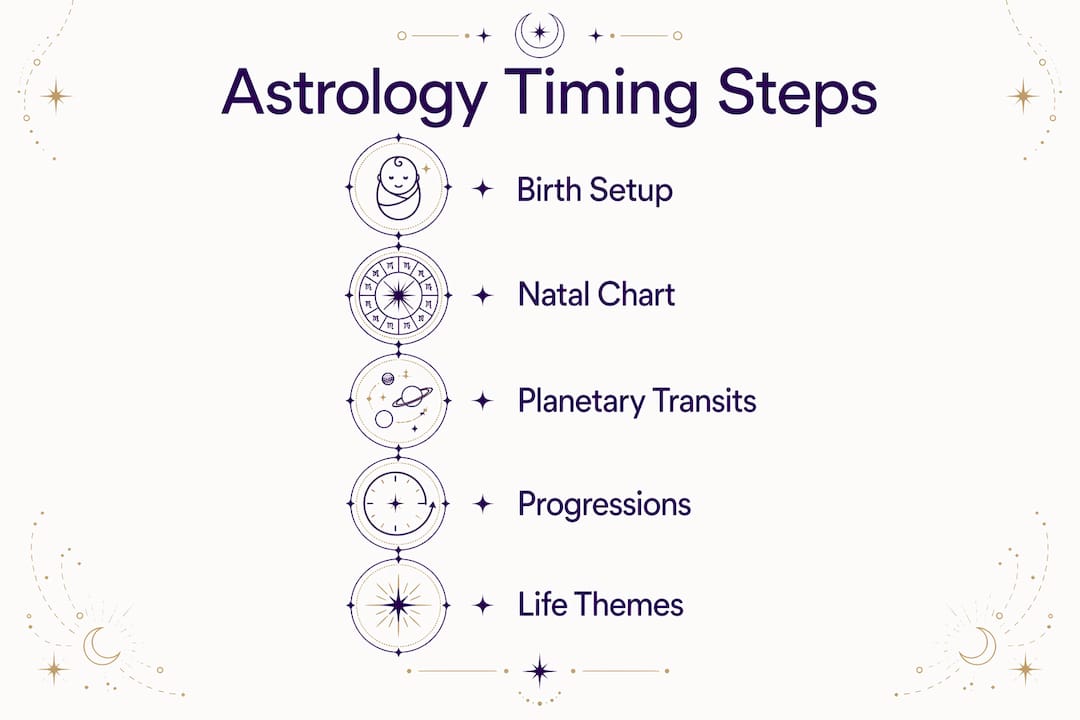
Progressions work differently. They advance your natal chart symbolically, with one day after birth representing one year of life. A progressed New Moon, for example, marks the start of a new 30-year personal cycle. This technique reveals inner development rather than external events.
What life themes does astrology commonly predict?
Astrology predicts themes across love, career, health, and transformation, each tied to specific planetary placements and houses. These are the most common areas and how they show up:
- Love and relationships. Venus and the 7th house govern partnership themes. A Venus return each year marks a fresh cycle in how you attract and relate. Saturn transiting the 7th house often brings serious relationship commitments or the end of relationships that no longer serve growth. You can explore relationship compatibility through chart overlays to see how two charts interact.
- Career and ambition. The Midheaven (10th house cusp) and Saturn describe your public role and professional path. Saturn transiting the 10th house often coincides with major career milestones, increased responsibility, or a complete professional pivot. Jupiter crossing the Midheaven frequently marks a period of recognition or advancement.
- Health and daily life. The 6th house and its ruling planet describe health tendencies and daily routines. Planetary activations to this house do not predict illness directly. They signal periods where attention to physical wellbeing and sustainable habits becomes especially relevant.
- Spiritual growth and transformation. Pluto and the 8th house govern deep psychological change. A Pluto transit to a personal planet rarely feels comfortable in the moment. It strips away what is no longer authentic and forces a reckoning with deeper truths. People often describe these periods as the most difficult and most meaningful of their lives.
Pro Tip: Track which house Jupiter currently transits in your chart. That house represents the area of life most likely to expand and offer opportunity over the next 12 months. Align your goals with that area for best results.
Why context, choice, and chart wholeness matter in predictions
Astrological prediction is probabilistic, not guaranteed. Predictions show probable timing and energetic themes, similar to a weather forecast showing pressure systems without specifying exactly where each raindrop falls. The same Saturn transit can manifest as a career loss, a necessary boundary, or a period of emotional maturity, depending on the full chart, life stage, and choices made.
Astrology describes energetic themes and recurring patterns. It cannot predict specific, irreversible outcomes. The moment a prediction moves from probable themes to fixed events, it crosses into harmful territory and loses its symbolic integrity. Predictions should empower self-awareness and preparation, not fatalism.
Isolated placements mislead. A Mars in Scorpio placement sounds intense, but if it trines Jupiter and sextiles Venus in that chart, the intensity channels productively into passion and drive rather than destructive conflict. Reading one placement without the full picture is like reading one sentence from a book and claiming you understand the plot.
Life stage also shapes how themes manifest. A Saturn transit to the 4th house at age 25 might bring a move away from the family home. The same transit at age 55 might bring the responsibility of caring for an aging parent. The theme is the same: home, roots, and family structure. The expression differs entirely based on where you are in life.
Astrology works best as a self-discovery tool that reveals repeating inner patterns and probable external influences. It does not remove your agency. It gives you better information to work with.
How to use astrology in daily life to align with your themes
Applying astrological knowledge daily does not require constant chart analysis. Small, consistent practices create real awareness over time.
- Track the Moon's sign and phase. The Moon moves through a new sign every 2.5 days, shifting the emotional tone of each day. A Moon in Capricorn favors focused work. A Moon in Pisces favors rest, creativity, and reflection. New Moons are ideal for setting intentions. Full Moons are ideal for releasing what no longer serves you.
- Use planetary day rulerships. Each day of the week carries a planetary ruler. Wednesday belongs to Mercury, making it ideal for writing, negotiations, and important conversations. Friday belongs to Venus, making it well-suited for social plans, self-care, and creative work. Moon phases and planetary day rulerships provide practical measures to align daily actions with cosmic energy.
- Anticipate Mercury retrograde periods. Mercury stations retrograde three to four times per year for roughly three weeks each time. Communication errors, travel delays, and technology issues are more common during these windows. Use the period for review and revision rather than launching new projects.
- Align monthly goals with your chart's elemental makeup. If your chart is heavily fire-dominant, high-energy periods under Aries, Leo, or Sagittarius transits will feel natural for bold action. Earth-dominant charts thrive during Taurus, Virgo, and Capricorn seasons for practical building.
- Check your daily horoscope as a brief transit summary. A well-written daily horoscope translates current planetary positions into practical guidance for your sign, giving you a quick read on the day's energetic tone without requiring deep chart analysis.
The astrology calendar for 2026 maps out key planetary ingresses, retrogrades, and eclipses for the year. Reviewing it at the start of each month helps you anticipate which life themes are likely to intensify and plan accordingly.
Key Takeaways
Astrology predicts life themes by mapping natal chart placements and planetary transits to reveal probable timing and symbolic patterns across love, career, health, and transformation.
| Point | Details |
|---|---|
| Natal chart as foundation | Planets, houses, signs, and aspects work together to define your core life themes. |
| Transits activate timing | Slower planets like Saturn and Jupiter mark multi-year life chapters of growth or restructuring. |
| Prediction is probabilistic | Astrological forecasts show likely themes, not fixed events, and depend on full chart context. |
| Daily practice builds awareness | Tracking Moon phases and planetary day rulerships aligns daily actions with current cosmic energy. |
| Agency shapes outcomes | Life stage and personal choices determine how astrological themes actually manifest in your life. |
Astrology as a mirror, not a verdict
I have spent years reading charts, and the single most common mistake I see is treating a prediction as a sentence. Someone hears "Saturn is transiting your 7th house" and immediately assumes their relationship is doomed. That is not how this works, and it is not what the chart says.
What I have found, consistently, is that astrology functions best as a mirror. It shows you the patterns you are already living, often ones you have not consciously named yet. When a client sees their Pluto square Mars transit and recognizes it as the exact period they stopped tolerating situations that diminished them, something clicks. The chart did not cause that shift. It named it.
The charts I find most revealing are never the ones with dramatic placements. They are the ones where a person finally sees why the same theme keeps returning in different forms. A 12th house Saturn person who keeps feeling invisible in groups. A Venus square Neptune person who keeps idealizing partners until reality sets in. The pattern is in the chart. The work is in the life.
My caution is always the same: avoid any reading that tells you something is fixed, inevitable, or beyond your influence. That crosses from symbolic insight into fear-based prediction, and it does real harm. Astrology should leave you feeling more prepared and more self-aware. If it leaves you feeling trapped, the reading was wrong.
— Joseph
Tarosyn's tools for reading your life themes
Astrology gives you the map. A personalized reading helps you read it clearly.
Tarosyn combines AI-powered astrology, tarot, and numerology in one place, so you can explore your natal chart themes alongside card-based guidance that speaks to your current moment. A three-card tarot spread can reflect the themes your chart is currently activating, giving you a second lens on the same period. Tarosyn's daily horoscope translates current transits into plain, practical language for every sign. Whether you are tracking a Saturn return or simply trying to understand a recurring pattern in your relationships, Tarosyn gives you the tools to read your life with more clarity.
FAQ
What does a natal chart reveal about life themes?
A natal chart maps planetary positions at your birth to reveal core personality traits and recurring life themes across love, career, health, and growth. It serves as the foundation for all astrological predictions.
How do transits predict timing in astrology?
Transits track current planetary positions against your natal chart to identify when specific life themes are likely to intensify. Slower planets like Saturn and Jupiter mark the most significant multi-year periods.
Can astrology predict specific events?
Astrology predicts probable themes and timing, not specific fixed events. Predictions function like weather forecasts, showing energetic pressure without determining exact outcomes.
What is the difference between a transit and a progression?
A transit tracks a real planet moving through the sky today relative to your natal chart. A progression advances your natal chart symbolically, with one day after birth representing one year of life, revealing inner development over time.
How does astrology guide daily life practically?
Tracking the Moon's sign, using planetary day rulerships, and noting Mercury retrograde periods are direct examples of astrology daily use that align your actions with current cosmic energy without requiring deep chart analysis.