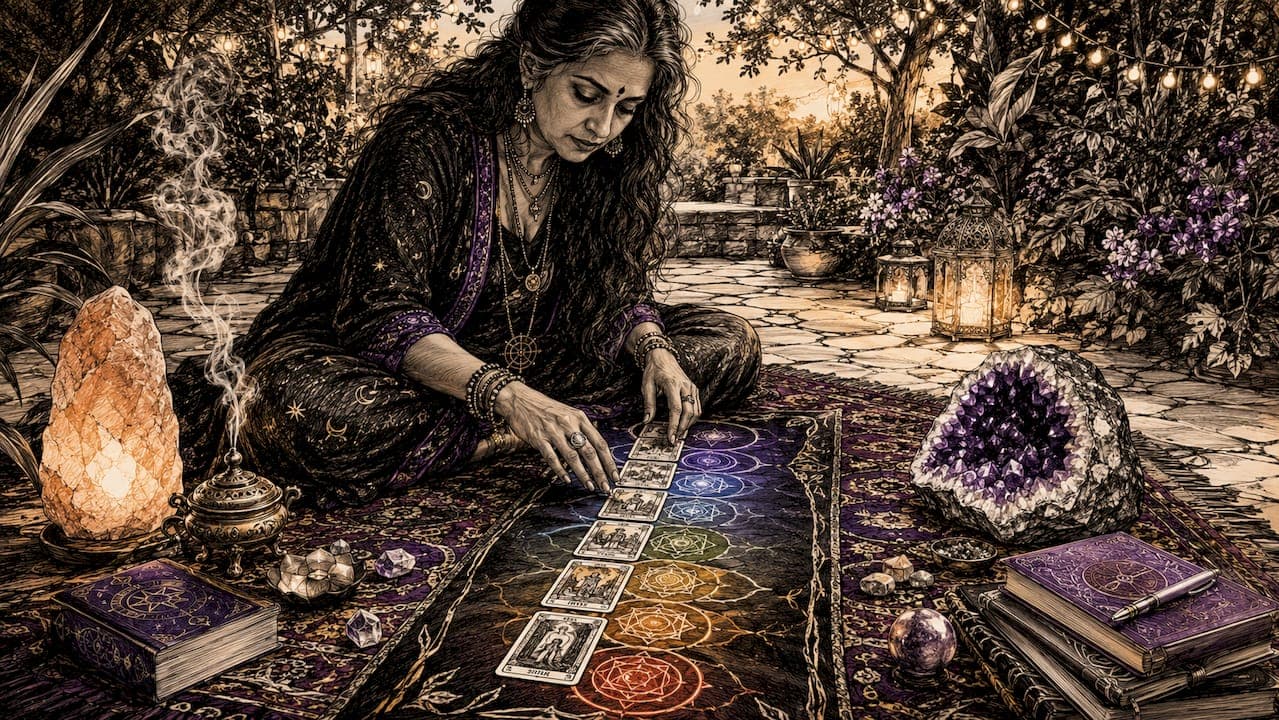
To align chakras with tarot cards means using a structured seven-card spread to read the energetic state of each of your body's seven energy centers, from root to crown. Each card you draw reflects whether that chakra flows freely or holds a blockage. This practice, formally called a chakra tarot spread, gives you a concrete diagnostic tool rather than a vague sense of being "off." You get a card-by-card snapshot of your energy, and you get specific guidance on where to focus your healing. Tarosyn brings this kind of personalized reading into a format you can work with daily.
How to align chakras with tarot cards: tools and preparation
The right setup makes a real difference before you draw a single card. You need a full tarot deck, a quiet space, and a clear intention. Optional items like incense, candles, or crystals help signal to your mind that this is intentional, focused time. None of these extras are required, but they do help you shift out of daily mental noise.
Before you start, you need a basic working knowledge of two systems:
- The seven chakras: Root (survival, grounding), Sacral (creativity, emotion), Solar Plexus (confidence, will), Heart (love, compassion), Throat (communication, truth), Third Eye (intuition, clarity), Crown (spiritual connection, awareness)
- Tarot suits and their elements: Pentacles correspond to earth, Cups to water, Wands to fire, and Swords to air. Major Arcana connect with the upper chakras, especially Third Eye and Crown.
Understanding these correspondences is not optional. They are the interpretive framework that makes each card meaningful in its position.
The standard chakra spread uses seven cards laid vertically, mirroring the spine from base to top. Card one sits at the bottom for the Root chakra. Card seven sits at the top for the Crown. This physical layout reinforces the energetic logic of the reading.
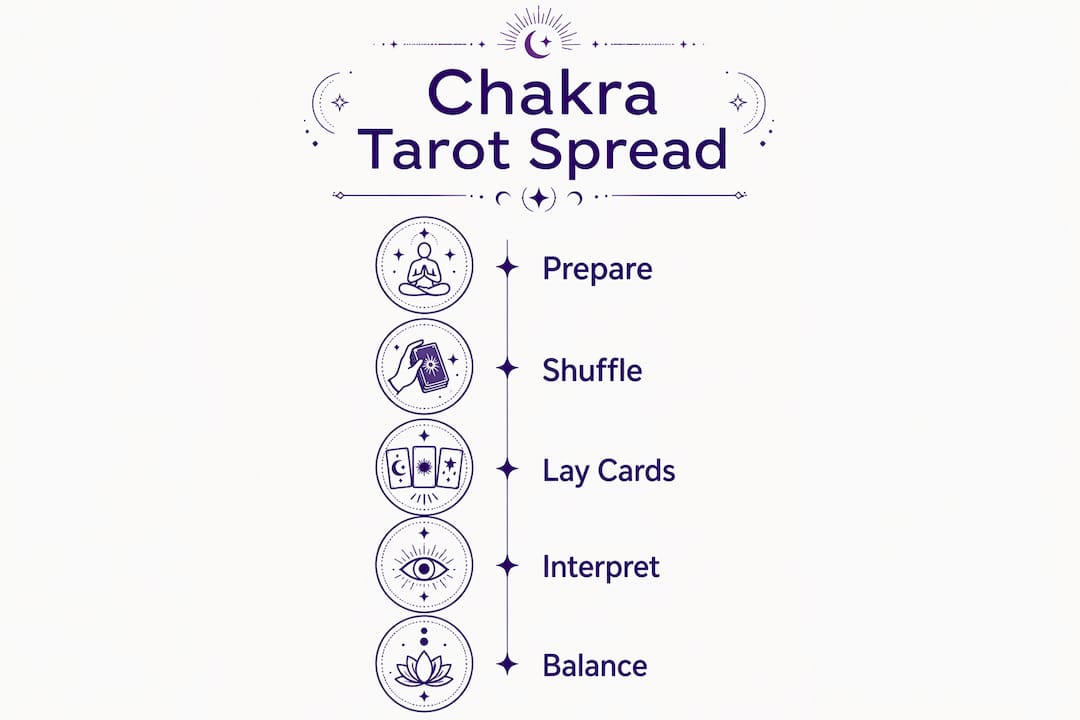
Pro Tip: Ground yourself before shuffling. Stand barefoot on the floor for 60 seconds, breathe slowly, and state your intention aloud. Something simple works: "Show me the state of my energy centers."

| Chakra | Position | Element | Tarot Suit |
|---|---|---|---|
| Root | 1 (bottom) | Earth | Pentacles |
| Sacral | 2 | Water | Cups |
| Solar Plexus | 3 | Fire | Wands |
| Heart | 4 | Air | Swords |
| Throat | 5 | Air | Swords |
| Third Eye | 6 | Light | Major Arcana |
| Crown | 7 (top) | Cosmic | Major Arcana |
Step-by-step guide to performing a chakra tarot spread
Follow these steps in order. Each one builds on the last.
- Set your intention. Hold the deck in both hands. Breathe slowly. State clearly, either silently or aloud, that you want to see the current state of each chakra.
- Shuffle with focus. Shuffle the deck while thinking about your energy body as a whole. Do not rush. Stop when it feels right.
- Lay out seven cards vertically. Place card one at the bottom (Root), then work upward through Sacral, Solar Plexus, Heart, Throat, Third Eye, and Crown. Keep them face down until all seven are placed.
- Flip and read from Root to Crown. Turn each card face up one at a time, starting at position one. Pause at each card before moving to the next.
- Note your immediate reaction. Your gut response to each card carries real information. Write it down before you analyze the card's formal meaning.
- Assess the full spread. Step back and look at all seven cards together. Notice which suits dominate. Notice where Major Arcana appear. Notice which positions feel heavy or light.
- Draw clarifier cards where needed. For any chakra position that shows a challenging card, draw a clarifier card to specify what healing action is needed. This eighth card turns a diagnosis into a direction.
Pro Tip: If three or more challenging cards cluster in the lower three positions, focus your healing work on the Root chakra first. Stabilizing foundational chakras before working on upper ones prevents feeling mentally scattered or emotionally overwhelmed.
Look for these patterns across the full spread:
- Suit clusters: Four or more cards from one suit signal a dominant element in your energy system right now.
- Major Arcana concentration: Multiple Major Arcana cards suggest significant life themes are active.
- Upper vs. lower split: Strong cards in positions 5–7 with weak cards in positions 1–3 points to a grounding gap.
How to interpret each chakra position and identify blockages
A chakra spread acts as an energetic map of your emotional, physical, and spiritual health. Reading it well requires you to hold two things at once: the card's standard meaning and the chakra's specific domain.
Upright vs. challenging cards in context
An upright card in a chakra position generally signals that energy flows well there. A reversed or challenging card signals restriction, excess, or a growth edge. Challenging cards are not bad news. They are invitations to healing that point to where your attention is most needed right now.
Elemental resonance as an interpretive tool
Elemental resonance between suits and chakra positions adds a layer of nuance that most readers miss. A Pentacles card in the Root position reinforces earth energy. That is a strong grounding signal. A Swords card in the Root position, however, suggests mental activity is overriding physical stability. You may be overthinking your sense of security rather than building it. This suit-to-chakra mismatch is one of the most useful signals in the entire spread.
Reading patterns between upper and lower chakras
Patterns of imbalance between lower and upper chakras reveal key life dynamics. Strong upper chakras with weak lower ones often describe someone spiritually aware but financially or physically unstable. The reverse, strong lower chakras with weak upper ones, describes someone materially grounded but disconnected from intuition or meaning. The Heart chakra at position four acts as the pivot point between these two zones. A strong card there often compensates for imbalances on either side.
Here is a quick reference for each chakra's core interpretive focus:
- Root (1): Safety, money, body, home. Look for stability or fear.
- Sacral (2): Creativity, pleasure, relationships. Look for flow or suppression.
- Solar Plexus (3): Confidence, boundaries, personal power. Look for agency or self-doubt.
- Heart (4): Love, grief, forgiveness. Look for openness or armor.
- Throat (5): Truth, expression, listening. Look for clarity or silence.
- Third Eye (6): Intuition, perception, discernment. Look for trust or confusion.
- Crown (7): Connection, purpose, surrender. Look for peace or disconnection.
Use tarot archetypes to deepen your reading of each position. The symbolism in Major Arcana cards, in particular, often speaks directly to the chakra's core theme.
Practical techniques to balance each chakra after your reading
Your tarot reading gives you a map. These techniques give you the tools to act on it. Match each technique to the chakra positions that showed challenging cards.
- Root chakra: Walk barefoot outside. Eat grounding foods like root vegetables. Practice a body scan meditation. Physical movement, especially yoga poses like Mountain or Warrior, reconnects you to the earth element.
- Sacral chakra: Create something with your hands. Dance, paint, cook, or write without a goal. Spend time near water. Journaling about what brings you genuine pleasure also activates this center.
- Solar Plexus chakra: Practice saying no to one thing this week. Set a boundary you have been avoiding. Core-strengthening exercises and breathwork that engages the diaphragm directly stimulate this chakra's fire energy.
- Heart chakra: Write a forgiveness letter you do not send. Practice loving-kindness meditation, directing compassion first to yourself, then outward. Time with people or animals you love also opens this center.
- Throat chakra: Sing, even badly. Read aloud. Record a voice note about something you have been holding back. Honest conversation, even a short one, activates this chakra more than any silent practice.
- Third Eye chakra: Spend 10 minutes in silence each morning before checking your phone. Keep a dream journal. Practice noticing your first instinct in small decisions and following it. This builds the trust that opens this center.
- Crown chakra: Sit in meditation without an agenda. Spend time in nature without your phone. Read or listen to teachings that expand your sense of meaning. This chakra responds to surrender, not effort.
Pro Tip: After completing your healing work for a week, pull a single clarifier card for each chakra you worked on. Compare it to the original card. Shifts in tone or suit often confirm that your energy has moved.
Tarosyn's healing tarot resources connect card meanings directly to these kinds of practical actions, making it easier to translate a reading into a daily practice.
Practitioners recommend performing chakra spreads seasonally, or monthly when you feel stuck. Regular use turns a one-time reading into a progress-tracking tool. You start to see which chakras consistently show up as challenged, and that pattern tells you more than any single reading can.
Key Takeaways
Using tarot for chakra alignment works because the seven-card spread maps each energy center directly, giving you a specific, card-by-card guide to where you are blocked and what to do about it.
| Point | Details |
|---|---|
| Seven-card layout mirrors the spine | Place cards from Root to Crown to reflect each chakra's position in the body. |
| Elemental suit matching deepens interpretation | A mismatched suit in a chakra position reveals subtle imbalances most readers overlook. |
| Challenging cards signal growth edges | Difficult cards show where healing is needed, not where you have failed. |
| Stabilize lower chakras first | Address Root, Sacral, and Solar Plexus blockages before working on upper centers. |
| Regular spreads track real progress | Monthly or seasonal readings show whether your energy work is creating lasting shifts. |
What I have learned from years of chakra tarot readings
The most useful thing I have found about this practice is that it removes the guesswork from self-care. Before I started using a chakra spread, I would meditate or journal without knowing which area actually needed attention. The spread changed that. It gave me a specific address for the work.
What surprised me early on was how often the Heart chakra card acted as a hinge. When the cards above and below it were in conflict, the Heart position almost always explained why. A blocked Heart chakra does not just affect love. It affects how freely energy moves between your grounded self and your spiritual self.
I also learned to stop dreading challenging cards. A reversed Tower in the Solar Plexus position once felt alarming. What it actually pointed to was a pattern of avoiding conflict to keep the peace, which was draining my confidence quietly. That card gave me something specific to work on. That is the real value here.
My advice: do not perform this spread when you are in acute emotional distress. Wait until you are calm enough to read with some detachment. The personal growth insights you get from a grounded reading are far more useful than anything you pull when you are reactive. And repeat the spread. One reading is a photograph. A series of readings is a film.
— Joseph
Tarosyn: go deeper with personalized tarot readings
Tarosyn brings together AI-powered tarot readings, astrology, and a live spiritual community in one place. If your chakra spread pointed to specific cards or positions you want to understand more fully, Tarosyn's reading tools let you pull focused spreads and get detailed interpretations right away.

Start with a three-card tarot spread to zoom in on a specific chakra theme your reading surfaced. Tarosyn also offers daily spiritual insights and a community of readers who share their own chakra work and interpretations. Whether you are new to this practice or refining a regular ritual, Tarosyn gives you the tools and the context to make each reading count.
FAQ
What is a chakra tarot spread?
A chakra tarot spread is a seven-card layout where each card corresponds to one of the seven chakras, arranged from Root to Crown. It acts as an energetic map that shows where your energy flows freely and where it is blocked.
Which tarot cards correspond to which chakras?
The four Minor Arcana suits align with elements and chakras: Pentacles with the Root, Cups with the Sacral, Wands with the Solar Plexus, and Swords with the Heart and Throat. Major Arcana cards most often connect with the Third Eye and Crown chakras.
How often should I do a chakra tarot reading?
Practitioners recommend performing chakra spreads monthly or seasonally, especially during transitions or when you feel persistently off-balance. Regular readings let you track shifts in your energy over time.
What do challenging cards in a chakra position mean?
Challenging cards signal areas that need conscious attention and healing. They are invitations to growth, not negative judgments, and they point you toward specific work rather than general discomfort.
Should I work on all blocked chakras at once?
Start with the lower chakras if your reading shows distress in positions 1–3. Opening upper chakras without a stable foundation can leave you feeling scattered or emotionally unsteady. Work from the ground up.