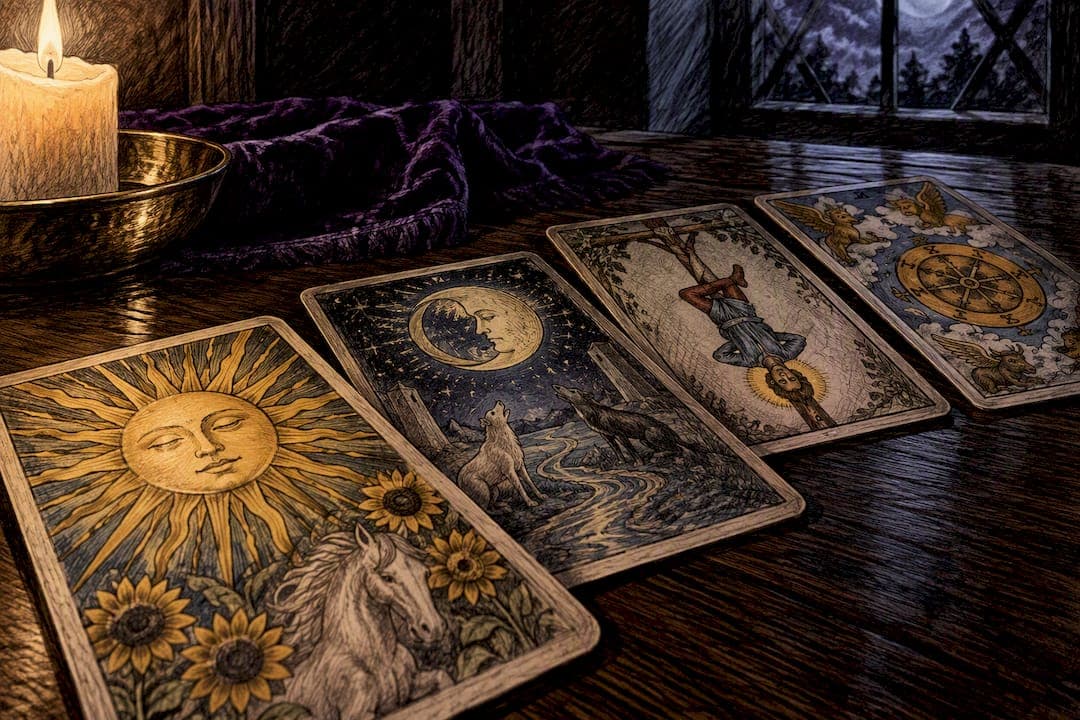
The Major Arcana are the 22 numbered tarot trumps, running from 0 (The Fool) to 21 (The World), and they name the life-scale themes a reading points to. This guide gives you a one-line meaning for each card, plus practical rules for reading orientation, density, and sequence in an actual spread.
TL;DR:
- The Major Arcana reflect large, archetypal themes and are better indicators of life patterns than daily specifics, especially when multiple cards appear.
- While most spreads contain 2 to 3 majors by chance, more suggest a focus on identity or transition, requiring interpretation of long-term patterns.
- Reversals can indicate blocked energy, internalized themes, or lessons from a different perspective; consistency in handling orientation improves accuracy.
- The sequence from The Fool to The World tells a story of development, crisis, and integration, aiding narrative understanding of a spread.
- Major Arcana symbols and colors reinforce their meanings, linking visual motifs directly to the card’s core lesson and emotional tone.
Table of Contents
- Major Arcana Meanings: The Complete List of All 22 Cards
- What a Major Arcana card actually signals in a reading
- Upright vs. reversed: how to handle Major Arcana orientation
- The Fool's Journey: reading card order as a story
- Practice prompts to internalize Major Arcana meanings
- Where to go for deeper Major Arcana study
- Where the Major Arcana came from
- What the Major Arcana symbols actually mean
- The life lessons behind each Major Arcana card
- How the same card shifts across love, career, health, and spirituality
- Reading Major Arcana and Minor Arcana together
- Spreads that lean on Major Arcana strength
- A closing note on reading the majors well
- Practice these meanings with a spiritual guidance app
- Sources
- FAQ
Major Arcana Meanings: The Complete List of All 22 Cards
The Major Arcana are 22 cards in a standard 78-card deck, and they carry more interpretive weight than the 56 Minor Arcana because they describe archetypal patterns rather than daily specifics. Learn each card as a short keyword prompt first. Full sentences come later, once the keyword sticks.
Here are the major arcana card meanings in traditional numbered order, upright:
- 0. The Fool — New beginnings; leap before you feel ready.
- 1. The Magician — Willpower; you already have the tools.
- 2. The High Priestess — Intuition; trust what you sense but can't prove.
- 3. The Empress — Abundance; nurture what you're growing.
- 4. The Emperor — Structure; build the framework first.
- 5. The Hierophant — Tradition; a system or mentor guides you.
- 6. The Lovers — Union; a values-aligned choice or partnership.
- 7. The Chariot — Willpower in motion; push through by staying focused.
- 8. Strength — Quiet courage; calm control beats force.
- 9. The Hermit — Solitude; answers come from withdrawing, not asking around.
- 10. Wheel of Fortune — Cycles; a turn in luck you didn't engineer.
- 11. Justice — Cause and effect; a fair outcome catches up with you.
- 12. The Hanged Man — Suspension; pause and see it from a new angle.
- 13. Death — Ending; something must close for the next thing to start.
- 14. Temperance — Balance; blend, don't choose one extreme.
- 15. The Devil — Bondage; a habit or attachment you've normalized.
- 16. The Tower — Sudden upheaval; a foundation gives way fast.
- 17. The Star — Hope; renewal after the wreckage settles.
- 18. The Moon — Illusion; trust your gut over what looks obvious.
- 19. The Sun — Vitality; clarity, success, and things working out plainly.
- 20. Judgment — Reckoning; a final accounting or wake-up call.
- 21. The World — Completion; a cycle closes and integrates.
This is the backbone of every major arcana tarot guide worth using. Once these one-liners feel automatic, you can move to layering context, position, and neighboring cards.
What a Major Arcana card actually signals in a reading
A Major Arcana card marks scale. It says the situation is bigger than a single event; the Minor Arcana handle the day-to-day texture, timing, and logistics around it. When a spread pulls mostly minors, you're likely looking at a practical, situational question. When majors dominate, the querent is dealing with a larger, archetypal pattern rather than a quick fix.
A rough count helps you calibrate:
- 0 to 2 majors in a standard spread usually points to a grounded, practical question, like timing or a specific decision.
- 3 or more majors suggests an archetypal pattern is running the show, often tied to identity, transition, or a recurring life theme.
- A spread that's nearly all majors means step back from tactics entirely. The reading is about stance, not strategy.
Some readers note that a typical 10-card spread turns up roughly 2 to 3 majors by chance, so noticeably more than that is worth flagging out loud. Prioritize the querent's posture and long-term pattern over pinpointing exact timing when majors cluster.
Pro Tip: Ask your querent, "What part of life does this feel like?" It surfaces the real theme faster than any card-by-card breakdown.
Upright vs. reversed: how to handle Major Arcana orientation
Reversals are optional. Some readers never flip a card; others treat orientation as core information. Pick one approach and stay consistent within a reading.
Three frameworks work well for Major Arcana reversals:
- Shadow or inner work: the theme is present but turned inward, unprocessed, or unconscious.
- Blocked energy or delay: the card's upright meaning is trying to happen but something is stalling it.
- Mirrored lesson: the reversal shows the same lesson from the opposite angle, not a simple "no."
Death upright in a career spread often means a role, project, or way of working needs to end cleanly. Death reversed can mean the querent is resisting that ending, dragging out something that's already over.
Pro Tip: Note reversals in shorthand (Rx) as you go so you're not second-guessing your own layout later.
The Fool's Journey: reading card order as a story
The Fool's Journey treats the sequence from 0 to 21 as a single narrative arc: innocence, trial, breakdown, and integration. Early cards (The Fool through The Chariot) map development and choice. Middle cards (Strength through Temperance) map internal testing and adjustment. Late cards (The Devil through The World) map crisis, collapse, and repair.
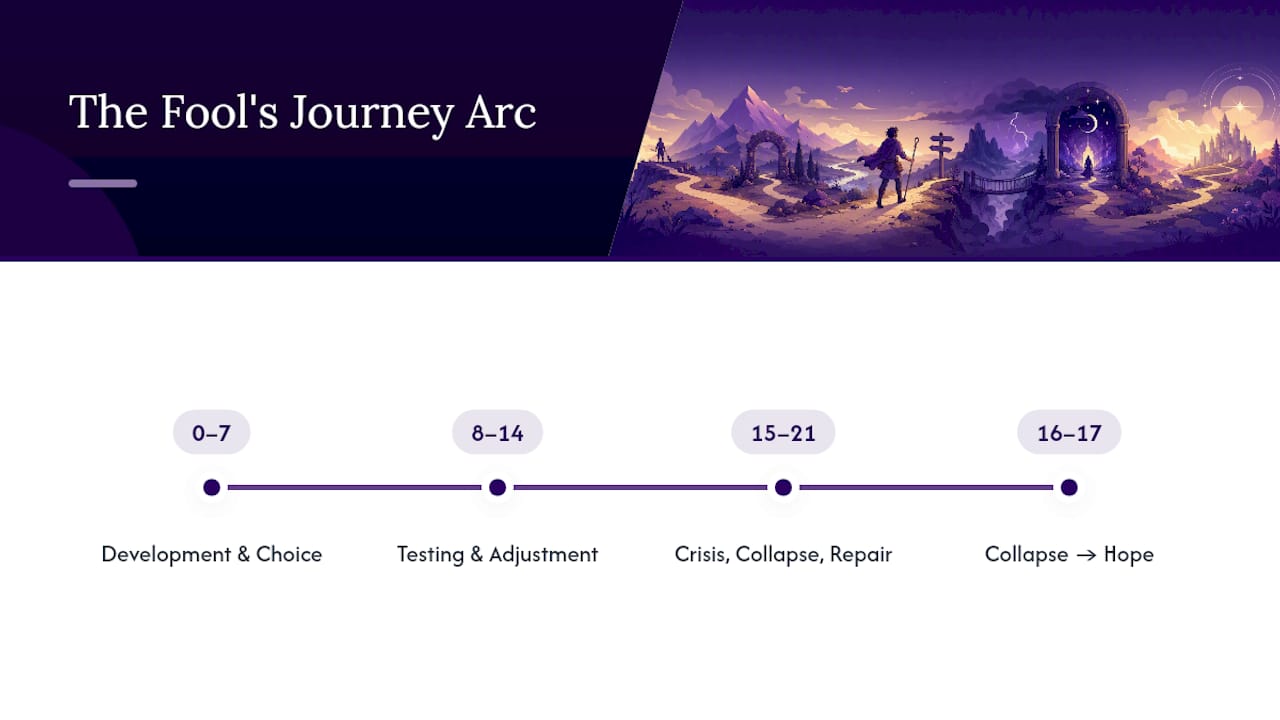
Reading two adjacent majors as a mini-arc reveals movement. The Tower next to The Star, for example, reads as sudden collapse followed by the first real sign of hope; the story isn't the wreckage, it's what comes right after it.
Practice prompts to internalize Major Arcana meanings
Memorizing 22 cards sticks faster with repetition than with rereading definitions.
- Pull one card each morning and ask only, "What does this ask of me today?"
- Match a recent life event to a Major Arcana keyword and journal why it fits.
- Reread an old spread looking only at the majors to spot the pattern you missed the first time.
Pro Tip: Write the one-line keyword on a sticky note before you look up the full meaning. Recall beats recognition every time.
Where to go for deeper Major Arcana study
Joseph Calitoy contributes tarot symbolism and card-meaning coverage for the Tarosyn blog, including a closer look at how symbolism shapes card interpretation and a guide to the Minor Arcana for readers ready to combine both. Tarosyn's saved-reading history also lets you track which majors keep resurfacing across your own pulls over time.
Where the Major Arcana came from
Tarot didn't start as a fortune-telling tool. The 22 trumps originated as playing cards for 15th-century Italian card games, part of a deck used for a trick-taking game called tarocchi. The esoteric, divinatory framing that most readers know today developed later, largely in the 18th and 19th centuries, when occult writers began attaching symbolic and mystical meaning to what had been game pieces.
That history matters for how you use the cards now. Knowing the Major Arcana started as playing cards helps you treat them as a symbolic language rather than a fixed, deterministic system that predicts outcomes on its own. The images accumulated meaning through centuries of interpretation, not through some original hidden code.
Numbering also varies by deck tradition. Most modern readers follow Rider-Waite-Smith numbering, where Strength is card VIII and Justice is card XI. Some older and esoteric decks swap that order, placing Justice at VIII and Strength at XI. If you're working with a nontraditional deck, check its numbering before you assume the keyword lines up with what you learned first. The imagery might carry a different weight even under the same card name.
What the Major Arcana symbols actually mean
Every Major Arcana card builds its meaning through repeated visual motifs, not just its title. The Sun shows a bright, unclouded sky because clarity and vitality are the point. The Moon shows a hazy, dreamlike shoreline because it represents illusion and instinct over hard fact. These aren't decorative choices. They're a visual shorthand that lets an experienced reader glance at a card and grasp its tone before reading a single keyword.
Color, posture, and setting carry weight too. The Hanged Man's calm expression while suspended upside down signals voluntary surrender, not punishment. The Wheel of Fortune's four corner figures reference stability amid constant change. The Empress surrounded by lush growth ties her directly to abundance and creative fertility.
Numbers reinforce the story as well. Zero (The Fool) suggests limitless potential before a path is chosen. Ten and its multiples (Wheel of Fortune, Judgment) mark completion points within the sequence. Learning to read the symbols alongside the keyword, rather than memorizing keywords in isolation, is what separates a mechanical recitation from a reading that actually lands for the person sitting across from you.
The life lessons behind each Major Arcana card
Each Major Arcana card points to a specific developmental lesson, and recognizing that lesson is often more useful than reciting the card's keyword. The Emperor's lesson is about claiming structure and authority without becoming rigid. The Hermit's lesson is that some answers only surface in solitude, away from outside opinions.
Grouped by theme, the lessons cluster naturally. Cards like The Magician, The Chariot, and The Sun teach agency: you have more control over the outcome than you think. Cards like The Hanged Man, Death, and The Tower teach surrender: some things end regardless of what you do, and resisting only prolongs the discomfort. Cards like Temperance, Justice, and The Star teach balance: extremes rarely serve you as well as a measured middle path.
Reading the lesson instead of the label also keeps you from flattening a card into good or bad. The Devil isn't "evil." It's the lesson that unexamined habits and attachments quietly run your choices until you name them. The Tower isn't just disaster. It's the lesson that some structures were never going to hold, and the collapse, however sudden, clears space for something sturdier.
How the same card shifts across love, career, health, and spirituality
A Major Arcana card doesn't change meaning by category so much as it changes focus. The Lovers in a love reading usually points to a values-aligned partnership or a real choice between two paths. The Lovers in a career reading points to a values fit with a job, a collaborator, or a company culture rather than romance at all.
The Tower in a health context often flags a sudden diagnosis, injury, or the abrupt end of a habit that wasn't sustainable anyway. The Tower in a spiritual context points to a belief system or worldview collapsing so a more honest one can take its place. Same card, same core theme of sudden upheaval, different arena.
Justice in career questions often signals a fair outcome catching up, like a promotion, review, or consequence that's been building. Justice in a spiritual reading leans toward karma or the sense that your actions and your inner alignment are finally squaring up. Always anchor the card's core keyword first, then ask which life area the querent named, and let that context narrow the interpretation rather than guessing blind.
Reading Major Arcana and Minor Arcana together
Major Arcana cards set the theme; Minor Arcana cards fill in the details around it. A reading built entirely from majors tells you what's happening at a life-pattern level but says almost nothing about timing, specific people, or immediate next steps. That's where the Minor Arcana earns its place.
If The Tower shows up next to the Five of Pentacles, the upheaval likely involves financial strain or job loss specifically, not just generalized chaos. If The Lovers appears beside the Two of Cups, you're looking at a genuine mutual connection rather than a one-sided infatuation. The suits narrow the domain (cups for emotion, pentacles for material concerns, swords for conflict and thought, wands for action and ambition), while the majors confirm the weight of what's at stake.
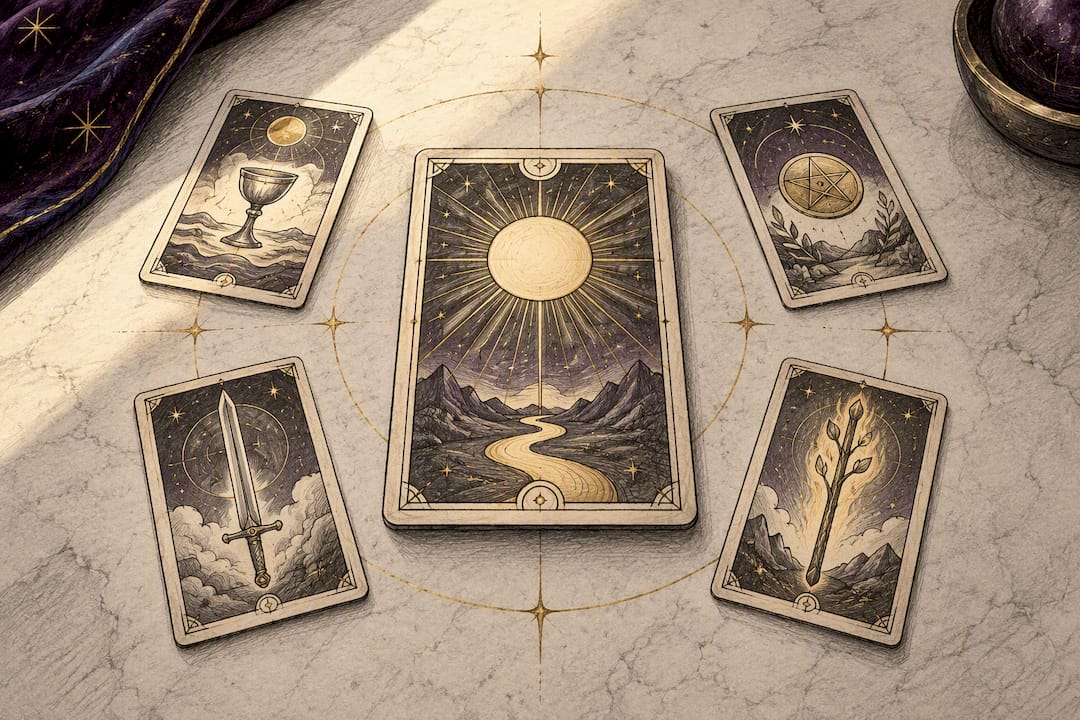
A practical approach: read the majors first to name the theme, then scan the minors for the specifics that support or complicate it. Readers who treat majors as prompts for posture and choice rather than a fixed timeline tend to give more useful guidance, because the minors are what actually carry the day-to-day sequencing. Skipping the minors entirely leaves a querent with an accurate diagnosis and no map for what to do this week.
Spreads that lean on Major Arcana strength
Certain spreads are built around drawing out archetypal, life-scale themes rather than granular detail, which makes them a natural fit for Major Arcana-heavy interpretation. The Celtic Cross is the most common example. Its ten positions cover present influence, obstacles, foundation, and outcome, and a Celtic Cross with four or more majors usually signals that the entire question sits at the identity or life-pattern level rather than a simple yes-or-no.
The three-card past-present-future spread also highlights majors well, since it's compact enough that even one major in the "present" position tends to dominate the read. A Year Ahead spread, drawing one card per month, uses majors to flag which months carry the heaviest thematic weight, while months pulling minors point toward comparatively routine stretches.
Single-card daily pulls are the simplest major-friendly format of all: draw one card each morning specifically from the shuffled deck and treat whatever comes up (major or minor) as the day's lens. Over weeks, a pattern of recurring majors in that daily pull often reveals a theme you hadn't consciously named yet. A Tarosyn reading like The Fool in a Celtic Cross shows how a single major functions within a full ten-card layout, if you want to see the mechanics in practice.
A closing note on reading the majors well
The Major Arcana name the pattern; they don't script the outcome. Pull a card today, journal the keyword against your own situation, and treat the result as a prompt for better choices, not a forecast.
— Joseph Calitoy
Practice these meanings with a spiritual guidance app
Such apps can turn this list into an ongoing practice instead of a one-time lookup. Some build each reading around your saved history and birth chart context, so when a Major Arcana theme like The Tower or Temperance resurfaces, you can actually see the pattern instead of relying on memory.
Subscription options include the Annual circle plan at $59.99 per year, the Mystic monthly plan at $7.99 per month, and Luna packs for deeper practice. Saved readings and reflective journaling let you track which majors keep showing up across weeks or months, turning a single card pull into a record you can actually learn from. If you want to see how a major plays out inside a full spread first, browse an example like The Tower in a Custom Canvas reading, then head to the subscription page to compare plans and start tracking your own patterns.
Sources
For verified history, The Met's overview of tarot's origins covers the deck's shift from Italian playing cards to esoteric tool. For numbering variations across traditions, the Major Arcana entry on Wikipedia is a solid practical reference.
- Before Fortune-Telling: The history and structure of tarot cards — The Met
- HowStuffWorks — Tarot primer and Major Arcana interpretation
FAQ
What are the 22 Major Arcana and their meanings?
The 22 Major Arcana run from 0 (The Fool) to 21 (The World), each representing a distinct archetypal theme like new beginnings, structure, endings, or completion. The full one-line list appears earlier in this guide, covering every card in traditional numbered order.
What is the rarest Arcana number?
There's no single "rarest" Major Arcana card in a standard 78-card deck. Each of the 22 majors appears exactly once, so every card is equally likely on a given draw; what varies is how often a specific card shows up across your personal reading history over time.
What is the most powerful Arcana?
Tarot doesn't rank the Major Arcana by power. Cards like Death, The Tower, and The World often feel weightier because they mark major transitions, but each major represents a distinct, equally significant life theme rather than a hierarchy of strength.
How do I know what is my Major Arcana?
Some readers calculate a "birth card" by reducing your birth date to a number between 0 and 21, which corresponds to one Major Arcana. That's a numerology-adjacent exercise, though; it's separate from what cards actually turn up in a live reading, which is what matters most for interpretation.
Do I need to memorize the Minor Arcana too?
Not right away. The Major Arcana carry more thematic weight, so learning these 22 cards first gives you a strong foundation; the Minor Arcana add situational detail once you're comfortable naming the bigger pattern.