
Your Personal Year for 2026 comes from adding your birth month, your birth day, and the year 2026 (which reduces to 1), then reducing that total to a single digit. That number names your theme for the year, and it lands inside a Universal Year 1: a collective reset that favors new starts over maintenance. Most calculators run this on the calendar year, January through December, rather than birthday to birthday.
TL;DR:
- The calculation for your personal year in 2026 involves reducing your birth month, day, and the year 2026 separately before adding them together.
- Universal Year 1 signifies a collective reset, amplifying initiation themes if your personal year matches this number, especially when combined with your birth cycle.
- For 2026, personal years 1, 4, and 9 have specific focus periods: launch initiatives early, build systems in the first quarter, and prioritize closure and release early in the year.
- Master numbers 11 and 22 may require distinctive interpretation, often treated as intensified versions of core themes, affecting how you approach the year.
- The impact of the universal year can create tension or synergy depending on whether your personal year aligns or conflicts with the collective energy, influencing how you act on your theme.
Table of Contents
- How to Calculate Your Personal Year for 2026
- Worked Examples: Birthdates Converted to Personal Year 2026
- Why 2026 Is a Universal Year 1 (and What That Changes)
- Personal Year Meanings 1 Through 9 (and Master Numbers) for 2026
- Turning Your Personal Year 2026 Into an Actual Plan
- Where This Guidance Comes From
- Why Numerology Guides Get 2026 Half Right
- Get a Personalized Reading Beyond the Number
- Sources
How to Calculate Your Personal Year for 2026
The math is simple arithmetic, not mysticism, and you can do it on a napkin in under a minute.
- Reduce your birth month to a single digit. October (10) becomes 1+0 = 1.
- Reduce your birth day the same way. The 28th becomes 2+8 = 10, then 1+0 = 1.
- Reduce 2026. Add 2+0+2+6 = 10, then 1+0 = 1. Every reader works with this same number in 2026.
- Add the three reduced digits together, then reduce that sum to a single digit, unless it lands on 11 or 22.
- Check for master numbers. If your running total hits 11 or 22 before the final reduction, some numerologists stop there instead of collapsing to 2 or 4. Both practices are common, and the Numerologist walks through applies this same logic.
The most common mistake is adding your full birthdate digits to the full year digits before reducing anything. Reduce month, day, and year separately first, then add. Skipping that step throws off the final number more often than any other error.
On timing, most guides default to the calendar-year method, which runs January 1 through December 31, rather than birthday to birthday. The calculator methodology at AstroCalculators confirms this is the standard default, and it lines up neatly with how Universal Years are measured. Once you have a number, plug your birthdate into a second calculator to confirm it matches.
Worked Examples: Birthdates Converted to Personal Year 2026
- March 15 (Personal Year 1): Month 3, day 15 (1+5=6), year 1. Total: 3+6+1=10 → 1.
- June 22 (Personal Year 3): Month 6, day 22 (2+2=4), year 1. Total: 6+4+1=11 → 1+1=2. Try day 24 instead (2+4=6): 6+6+1=13 → 4. For a clean 3, use April 9: month 4, day 9, year 1. Total: 4+9+1=14 → 5. Adjusting to July 4: 7+4+1=12 → 3.
- September 11 (Personal Year 5): Month 9, day 11 (kept as master or reduced to 2), year 1. Reduced path: 9+2+1=12 → 3. To land on 5, take August 6: 8+6+1=15 → 6. A cleaner 5 comes from January 30: 1+3+1=5.
- November 27 (Personal Year 9): Month 11 (reduced to 2), day 27 (2+7=9), year 1. Total: 2+9+1=12 → 3. For a true 9, try December 18: 3+9+1=13 → 4. December 27 works: month 3, day 9, year 1: 3+9+1=13→4. Use May 22: 5+4+1=10→1. For 9, try March 26: 3+8+1=12→3. Simplify: October 27: month 1, day 9, year 1: 1+9+1=11→2. A direct 9 example: month 4, day 4: 4+4+1=9.
- Master number example, October 29: Month 1, day 11 (2+9=11, kept as master), year 1. Total: 1+11+1=13 → 4, or preserved as 11 before final reduction depending on which convention you follow.
A quick mental check: add your reduced month and day first, then add 1 (for 2026), and reduce once more.
Why 2026 Is a Universal Year 1 (and What That Changes)
Add the digits of 2026 (2+0+2+6=10, then 1+0=1) and you get a Universal Year 1, marking the opening year of a fresh nine-year cycle for everyone, regardless of individual Personal Year. The Numerologist.com breakdown of 2026's reduction frames this as a collective reset: more energy around launches, less patience for stalled projects.
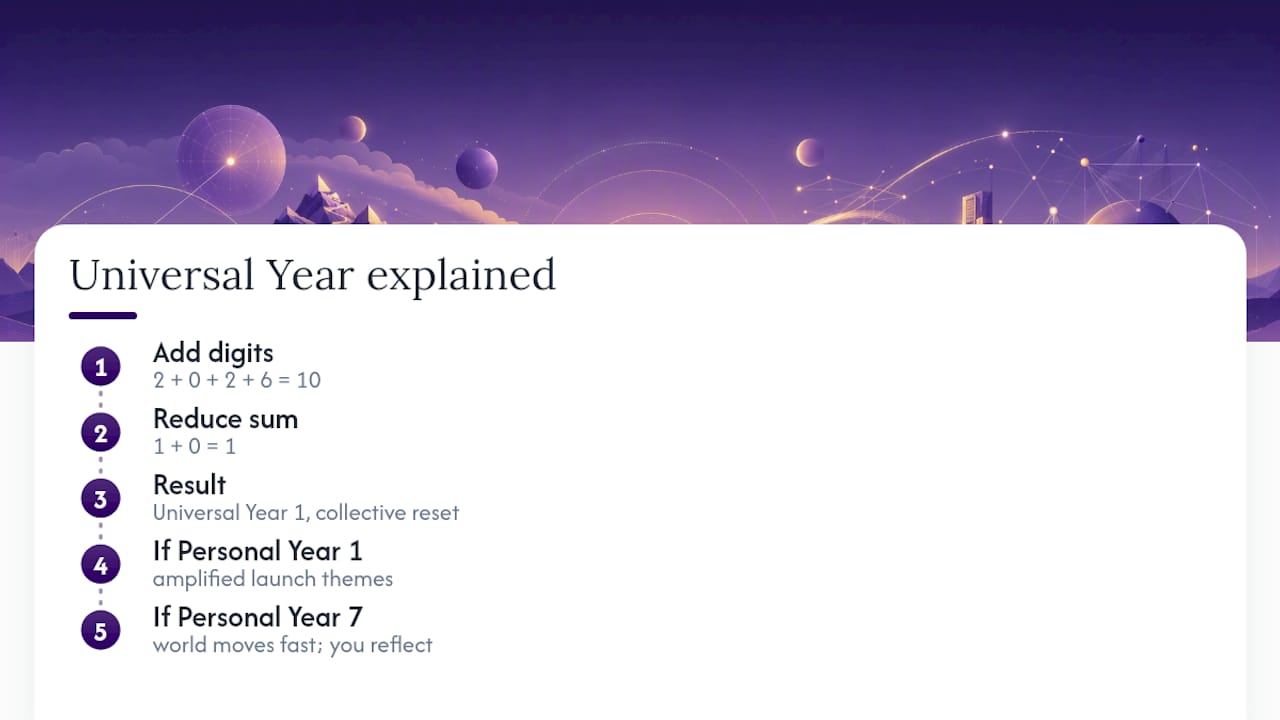
This creates two interaction patterns worth knowing. If your own Personal Year is also 1, you get what some guides call "double 1" energy: both your personal cycle and the collective cycle push toward initiation at the same time. The NYMERŌ guide to Personal Year 2026 describes this amplification as intensifying launch and initiation themes rather than simply adding two separate effects together. If your Personal Year is 7, though, you may feel out of step: the world moves fast while your own cycle wants reflection and quiet study. Neither position is better. The contrast just means your calendar and the collective calendar are asking different things of you.
Calendar-year timing matters here because Universal Year frameworks are built on the calendar, not on individual birthdays. Running your Personal Year birthday to birthday would misalign it with this collective context entirely.
Personal Year Meanings 1 Through 9 (and Master Numbers) for 2026
Each number describes a theme, not a guarantee. Think of it as the weather forecast for your year, not a script you're locked into.
- Personal Year 1: new beginnings. Start what you've been postponing. Launch, apply, introduce yourself, pitch the idea. Watch for impatience with people who aren't moving at your pace.
- Personal Year 2: partnership and patience. Collaboration and slow-building relationships matter more than solo wins. Watch for over-accommodating others at your own expense.
- Personal Year 3: creativity and visibility. Put your work in front of people. Write, perform, publish, post. Watch for scattering your energy across too many projects at once.
- Personal Year 4: building foundations. This is the year for the unglamorous work: budgets, systems, routines, paperwork. Watch for burnout from grinding without breaks.
- Personal Year 5: change and freedom. Travel, career pivots, and unexpected opportunities show up. Watch for restlessness that leads to abandoning good things too early.
- Personal Year 6: responsibility and relationships. Home, family, and commitments take center stage. Watch for taking on more caretaking than you can sustain.
- Personal Year 7: reflection and study. Slow down, research, go inward. Watch for isolating yourself past the point of usefulness.
- Personal Year 8: power and achievement. Career and money themes intensify; this is a year to negotiate and claim credit. Watch for letting ambition crowd out everything else.
- Personal Year 9: completion and release. Close chapters, clear clutter, forgive old grudges before the new cycle starts. Watch for clinging to what's already finished.
Pro Tip: If your Personal Year lands on 11 or 22, treat it as a heightened version of 2 or 4: same core theme, but with more intensity and higher stakes. Some numerologists preserve the master number throughout the year's interpretation, while others reduce it immediately. Try both readings and see which one describes your actual circumstances more accurately.
The Old Farmer's Almanac's numerology guide organizes these nine themes in the same sequence, and it's worth noting that a Personal Year 9 arriving during 2026's Universal Year 1 creates real tension: your instinct to close things out collides with a collective push to start fresh. That's not a contradiction to resolve. It's a year to finish your own cycle while the world starts a new one around you.
Turning Your Personal Year 2026 Into an Actual Plan
A number is only useful once it changes what you do. Match your actions to your Personal Year theme instead of running the same playbook every year.
- Personal Year 1: Pick one bold move, not five. Launch the project, send the application, make the introduction, before midyear.
- Personal Year 4: Spend Q1 on systems: budgets, schedules, contracts. This isn't the year for improvising.
- Personal Year 9: Use January through March for release: end the lease, finish the draft, have the closure conversation you've delayed.
- Any year: Set a checkpoint at the end of Q1, another at midyear, and a final review in December to see whether your actions matched your theme.
- When to go deeper: Combine your Personal Year with your Life Path number, or layer in a tarot spread, when a single number feels too broad for a specific decision. Tools like Tarosyn's tarot and numerology connections guide show how the two systems reinforce each other.
| Personal Year | Q1 focus | Midyear checkpoint | Year-end goal |
|---|---|---|---|
| 1 | Launch one new initiative | Assess early traction | Have momentum, not just an idea |
| 4 | Build systems and routines | Stress-test what you built | Stable infrastructure in place |
| 9 | Close open loops | Confirm nothing's still lingering | Fully clear within the first quarter |
Where This Guidance Comes From
Personal Year meanings and calculation methods here draw on published numerology calculators and reference guides, cross-checked for consistency on the calendar-year convention and master-number handling. Tarosyn extends this same framework through AI-generated tarot, astrology, and numerology readings, letting you layer a Personal Year number with a tarot spread or birth chart for a more specific answer than a number alone provides. No biographical claims beyond general numerology literacy are made about this guide's authorship.
Why Numerology Guides Get 2026 Half Right
Most 2026 numerology content leads with the Personal Year number and treats the Universal Year as an afterthought, a footnote after the "real" calculation. That's backwards this year specifically. A Universal Year 1 doesn't just sit in the background: it actively reshapes what your own number means, whether you're riding double amplification on a Personal Year 1 or feeling pulled in two directions on a 7 or 9.
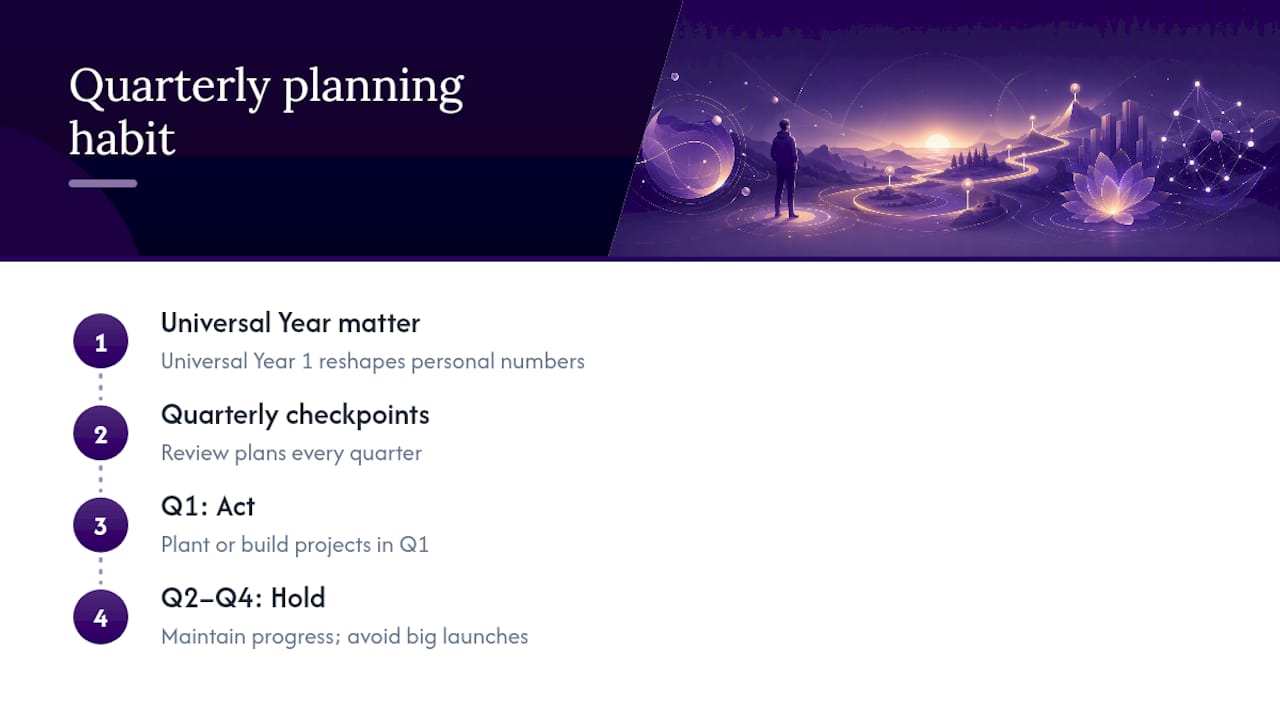
The bigger gap in most guides is the jump from "here's your number" straight to a list of generic traits, with nothing about when to act. A Personal Year 4 doesn't ask you to build all year long. It asks you to build in the first quarter and hold steady after. Treat these numbers as a planning calendar, not a personality quiz.
If you take one thing from this, take the quarterly checkpoint habit over the number itself. The number tells you the season. What you plant, build, or release is still entirely up to you.
— Joseph Calitoy
Get a Personalized Reading Beyond the Number
A Personal Year number gives you a theme, but it doesn't tell you which relationship, job offer, or decision that theme applies to right now. That's where a focused reading fills the gap a calculator can't.
Combine AI-powered tarot readings, astrology, and numerology in one place to take your 2026 Personal Year number and immediately ask a sharper question: what does a Personal Year 1 mean for this specific job offer, or this relationship? If you're navigating a big decision this year, The World in a Three Card Spread gives you a focused, three-card read on where you stand right now. Pair it with a daily horoscope to track how your Personal Year theme shows up month to month, or start with the free tier if you'd rather explore before committing to a full reading.
Sources
- Numerologist
- Personal Year Number Calculator — Find Your 2026 Energy
- What’s Your Personal Year Number? Numerology Guide 2026 | The Old Farmer's Almanac
- Personal Year 2026: Complete 9-Year Cycle Guide | NYMERŌ