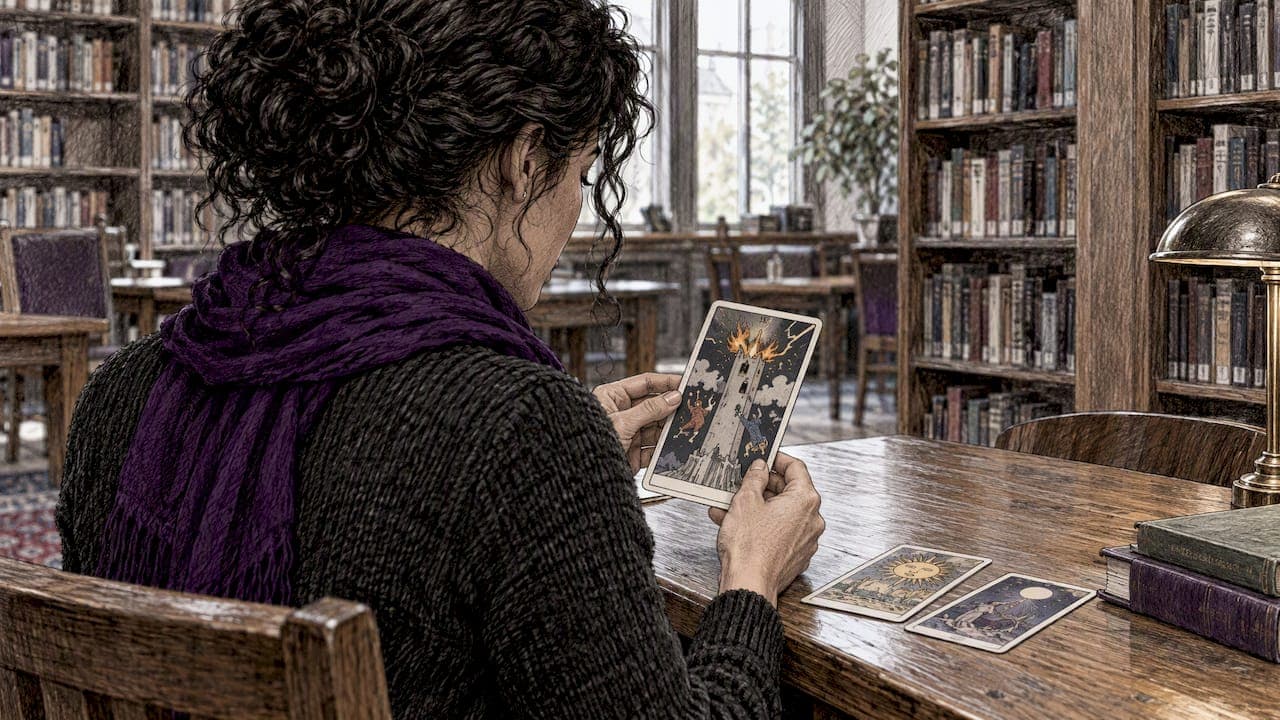
AI tarot meanings are AI-generated, reflective interpretations of card symbols meant to prompt self-understanding, not guaranteed predictions. Use them for insight and journaling, not as a fixed forecast. We point you to resources like the Tarosyn blog and author Joseph Calitoy when you want a deeper read on symbols and practice.
TL;DR:
- Name the deck, card orientation, spread position, and a specific question; niche artwork and text only prompts rely more heavily on your description.
- A one card draw suits daily checks, three cards fit past, present, or future questions, and the ten position Celtic Cross calls for a layered answer.
- Commercial systems may retain prompts for 30 to 90 days and use them for training unless the provider guarantees zero retention; use placeholders and disable history.
- AI can miss cultural context, family dynamics, or niche deck symbolism; consult qualified professionals, not readings, for medical, legal, or financial concerns.
- Record your first reaction before consulting AI, then compare the interpretations; disagreement can reveal missing context or an instinct worth examining.
Table of Contents
- How AI figures out what a tarot card means
- Reading tarot symbols before you open an AI tool
- How to write a prompt that gets a useful AI tarot reading
- Keeping your tarot prompts and data private
- How Tarosyn applies AI to tarot meanings
- What AI-generated tarot meanings actually look like
- Blending AI readings with your own intuition
- Where AI tarot readings fall short
- Customizing AI tarot readings to your own context
- Spotting patterns across multiple readings over time
- Keep the reflection yours, not the AI's
- Try an AI-assisted tarot reading with Tarosyn
- FAQ
- Sources
How AI figures out what a tarot card means
AI builds a tarot meaning by matching the card you describe against a large vocabulary of symbols, themes, and traditional associations learned from text during training. It does not see the card the way you do. It reads your words, or in some apps a scanned image, and maps them to patterns it has seen before.
The deck you use matters. A Rider-Waite-Smith deck gives the AI familiar visual cues: the Hanged Man's calm face, the Wheel of Fortune's spinning symbols. A niche or hand-illustrated deck gives it less to work with, so your own description carries more weight. Text-only prompts depend entirely on how clearly you name the card, its orientation, and its position in your spread.
Context changes everything. The same card means something different in a relationship spread than in a career spread, and upright versus reversed shifts the tone again.
- A clear card name and orientation keeps the AI grounded in the correct base meaning.
- A specific question narrows the interpretation instead of leaving it generic.
- Naming the spread position tells the AI whether the card describes the past, an obstacle, or an outcome.
Pro Tip: Always name the deck and the exact spread position in your prompt. Vague inputs produce vague, generic readings.
Reading tarot symbols before you open an AI tool
Tarot works as a visual language. Learning to read it yourself gives any AI interpretation something real to build on, instead of letting the tool do all the thinking for you.
Start with your own eyes before consulting anything else. Try this short method:
- Look at the card for a few seconds and name what draws your attention first, a color, a gesture, an object.
- Write down that detail in one sentence, before checking any meaning reference.
- Consult an AI tool or a symbol reference to see how your observation lines up with traditional meaning.
This two-step habit, observe first and then consult, keeps your intuition active instead of letting a glossary replace it, a practice recommended by practitioners who treat symbols as flexible vocabulary rather than fixed codes.
The Major Arcana carries life-stage themes: the Fool's new beginnings, the Tower's sudden change, the Star's quiet hope. The minor suits split by domain: Wands for action and ambition, Cups for emotion and relationships, Swords for thought and conflict, Pentacles for money and the body. Recurring motifs, water for feeling, swords for clarity or tension, towers for structure, repeat across cards and carry weight wherever they appear.
You can read a card archetypally, as a universal pattern tied to psychology, or literally, as a comment on a specific event. Our archetype reference lays out both frames side by side.
How to write a prompt that gets a useful AI tarot reading
A good AI reading depends more on your prompt than on the tool itself. Follow a simple sequence each time:
- Name the spread you pulled, one card, three card, or Celtic Cross, and list each card with its orientation.
- State your question in one or two plain sentences, specific enough to matter but without private identifying details.
- Mention the deck or describe any unusual artwork, since this helps the AI calibrate tone.
- Use a placeholder for sensitive names or situations, such as "a family member" instead of a real name.
Once you have an interpretation, push it further. Ask for an alternative reading, ask whether the meaning is symbolic or practical, or ask for three journaling questions based on the card. A one-card draw works well for a quick daily check. A three-card spread suits past-present-future or situation-action-outcome questions. A Celtic Cross asks more of the AI since it has ten positions interacting, so expect a longer, layered answer rather than a single tidy line.
Pro Tip: Ask the AI to separate its symbolic interpretation from any practical suggestion. Keeping those two threads apart makes the reading easier to apply.
Keeping your tarot prompts and data private
Treat your prompts the way you would treat a journal entry you don't want a stranger reading. Academic work on divination GenAI found that ritual-style interfaces can pressure people into disclosing more than they intend, and that privacy-by-design needs specific adjustments for this kind of tool rather than generic settings.
Commercial AI systems commonly retain prompts for 30 to 90 days and may use that data for training unless the provider guarantees zero retention. Local, on-device models avoid that exposure but take more setup.
Protect yourself with a few habits:
- Swap real names for placeholders like "a close friend" or "a coworker."
- Turn off chat history or training permissions where the app allows it.
- Choose a tool with a stated zero-retention policy when you're discussing something sensitive.
- Skip details that aren't needed for the reading to make sense.
Minimal disclosure isn't just safer. It also keeps the ritual focused on the symbols rather than on the specifics of your life, which is often where the real reflection happens.
How Tarosyn applies AI to tarot meanings
We built our platform to connect AI-generated tarot readings with astrology, numerology, and journaling in one place, so a card meaning doesn't stand alone. A reading can draw on your birth chart context and your saved history, which gives repeat questions more continuity than a one-off prompt elsewhere.
Author Joseph Calitoy's symbolism breakdown on our blog walks through how card imagery carries meaning, a useful companion if you want to read symbols yourself before checking an AI interpretation. If you're working through a recurring question, our saved-reading feature lets you track how a card's meaning shifts for you over time, which supports the kind of self-discovery work that a single disconnected reading can't offer.
What AI-generated tarot meanings actually look like
A Major Arcana example: pull the Tower reversed in a "what should I expect this month" question, and an AI reading will typically frame it as avoided collapse or delayed change rather than outright disaster, noting that the upheaval the card usually signals is being held off or processed internally instead of erupting outward.
A minor arcana example: the Three of Swords in a relationship spread often gets read as grief or a difficult conversation that needs to happen, while in a career spread the same card might point to a disappointing piece of feedback that still carries useful information.
Court cards get treated as personality notes rather than literal people. The Queen of Pentacles in a one-card draw might come back as a prompt to be more grounded and practical today, while the Knight of Wands could surface as a nudge toward impulsive energy worth noticing before acting on it.
You can see this style in practice on a public Temperance one-card reading or a communication-focused spread, where the interpretation ties directly to the question asked rather than offering a generic card definition. The pattern across all of these: AI output leans on the question and position to shape tone, while the core card meaning stays anchored to tradition.

Blending AI readings with your own intuition
An AI interpretation works best as a starting point, not the final word. Read the AI's output, then ask yourself whether it matches what you felt when you first saw the card. If it doesn't, that gap is worth sitting with rather than dismissing.
A useful sequence: pull your card, write your gut reaction in one line, generate the AI interpretation, then compare the two. Where they agree, you've got a reading you can trust more. Where they diverge, the disagreement itself is often the more interesting signal, since it means either the AI missed context you have, or your instinct is avoiding something the symbol is pointing at.

Research connecting tarot to narrative therapy supports this approach, treating cards as prompts for personal narrative reflection rather than literal forecasts. That framing suggests the AI's job is to open a door, and your job is to decide what's actually behind it. Journaling after a reading, rather than just reading and moving on, is one of the simplest ways to turn a card pull into real reflection.
Where AI tarot readings fall short
AI interpretations tend to generalize. A card meaning trained on broad patterns can miss the specific nuance of your situation, especially when your question involves cultural context, family dynamics, or a niche deck the model has little data on.
Responsible AI tarot guidance recommends framing outputs as subjective reflection, not authoritative fact, and disclosing clearly that the interpretation is generated rather than received through any other means. Good tools follow that boundary and avoid definitive language like "this will happen."
There are also lines an AI reading should never cross. Guidance in this space is clear that AI tarot should avoid inferring diagnoses or sensitive states, including health conditions, pregnancy, or legal trouble, and should never stand in for a doctor, lawyer, or financial advisor. If a reading touches on any of those areas, treat it as a prompt to seek a qualified professional, not as an answer.
Finally, an AI has no memory of your life unless the platform is built to store it. A single prompt, answered in isolation, will always miss the thread that a longer relationship with your own readings can catch.
Customizing AI tarot readings to your own context
A generic prompt gets a generic answer. If your spiritual practice draws on a specific tradition, folk magic, a particular astrological framework, ancestor work, say so directly in your prompt rather than assuming the AI will infer it.
Naming your deck matters too. A Marseille-style deck carries different visual cues than a Thoth deck, and telling the AI which one you're using helps it avoid defaulting to Rider-Waite-Smith imagery that may not match what you're looking at.
You can also shape tone. Ask for a reading grounded in psychological or archetypal language if that resonates with you, or ask for a more direct, plain-spoken interpretation if symbolism-heavy language feels distant. Naming the life area, career, relationships, creative work, keeps the AI from defaulting to a one-size-fits-all read.
Our spreads reference outlines common layouts and what each position is meant to capture, which is a useful starting point if you want to build a custom spread around a specific tradition or ritual you already practice.
Spotting patterns across multiple readings over time
A single card pull tells you about one moment. A series of readings, tracked over weeks or months, can show you something closer to a pattern, which cards keep showing up, which suits dominate during certain periods of your life, and whether your intuitive reactions are shifting.
This is where saved history becomes genuinely useful rather than a nice-to-have. If Swords keep appearing in your weekly draws, that's worth noticing as a theme around decision-making or conflict, not just a coincidence to brush past. A 2025 study on tarot paired with mindfulness journaling found that participants who logged their readings over four weeks reported a reduced sense of anxiety and an increase in their perceived sense of control, suggesting that the tracking itself, not just the individual readings, carries some of the benefit.
An AI tool with reading history can help surface these trends by referencing past pulls when you ask a new question, which is different from treating each session as a blank slate.
Keep the reflection yours, not the AI's
Use an AI tarot reading as a mirror, not an oracle. Write down your own reaction before you read the AI's interpretation, and stay a little skeptical of any answer that feels too neat.
Cross-check a reading that touches a big decision against a second source, your own judgment, a trusted person, or a professional. For medical, legal, or financial questions, talk to someone qualified instead of a card.
Try an AI-assisted tarot reading with Tarosyn
If you want a reading that remembers your history instead of starting fresh every time, our platform pairs AI-generated tarot with your birth chart, numerology, and a journaling space to track how your interpretations shift over time.
Draw a card and see how the interpretation holds up against your own first impression. Our Mystic monthly plan runs $7.99 per month, and the Annual circle is $59.99 per year if you want the full set of tools without re-subscribing each month. Start a reading at Tarosyn and see where the cards take your reflection.
FAQ
What does a tarot card symbolize?
A tarot card symbolizes a theme, emotion, or life pattern through its imagery, colors, and figures rather than a fixed literal event. Meaning shifts with context: the question asked, the spread position, and whether the card is upright or reversed.
How do I pick a good online tarot tool?
Look for a tool that discloses its output is AI-generated, avoids absolute predictions, and lets you add context like your question and spread position. Our guide to choosing an AI spirituality app covers what transparency and reasoning should look like in practice.
Which tarot card represents intelligence or clarity?
The Swords suit as a whole is tied to thought, clarity, and intellect, with the King and Queen of Swords often read as sharp, clear-minded figures. The Hermit also carries a reflective, wisdom-seeking theme that readers associate with insight.
Can AI actually do a tarot reading?
AI can generate a reflective interpretation of a card or spread based on the symbols and context you provide, but it is not performing divination in any traditional sense. Treat the output as a prompt for your own reflection rather than a definitive answer, especially for serious decisions.
Is my information private when I use an AI tarot app?
Privacy depends on the platform's retention policy. Many commercial tools keep prompts for 30 to 90 days unless they state a zero-retention guarantee, so using placeholders for identifying details is a reasonable precaution.
Sources
- Tarot's Influence on Mindfulness, Well-Being, and Perceived Control | Spiritual Healing: Jurnal Tasawuf dan Psikoterapi
- Authority-driven disclosure escalation and privacy-by-design challenges in divination GenAI | ACM Proceedings