This guide gives you a ready-to-use yoga pose for every zodiac sign, plus simple steps to time and personalize your practice with lunar and planetary cycles. Use it as a direct reference: pick your sign's pose, try a 5–10 minute micro-practice today, and check the timing section to schedule your next session.
Quick start:
- Pick your pose. Find your sun sign in the chart below and try that pose for 5 minutes.
- Time it. Match your practice to the current moon phase or planetary weekday.
- Personalize it. Read the birth chart section to layer in your moon and rising signs.
For deeper sign-by-sign asana notes, see the astrology and yoga compatibility guide. For timing and chart work, the planetary and personalization sections below walk you through each step.
Table of Contents
- Your astrology guide for yoga practice: the pose-by-sign chart
- How the four elements shape your practice style
- How to time your practice with moon phases, planetary days, and retrogrades
- How to personalize your practice using your birth chart
- Short sequences you can use right now
- Safety notes and modifications for astrology-informed yoga
- What the research and practitioners say
- Key takeaways
- Why this approach works better than a generic routine
- Tarosyn brings your birth chart into your daily practice
- Useful sources and further reading
Your astrology guide for yoga practice: the pose-by-sign chart
Yoga Journal and other mainstream outlets have published sign-specific asana recommendations for years, confirming that pairing poses with zodiac traits is a widely accepted starting point. The table below gives you one pose per sign, a short rationale, a beginner modification, and a breath cue to anchor a 3–7 minute micro-practice.
Which sign to use first: Start with your sun sign for general energy. Use your moon sign when you feel emotionally off-balance. Use your rising sign when you want to work on physical constitution and how you carry yourself in the world.
| Sign | Pose | Rationale | Modification / Prop | Breath Cue |
|---|---|---|---|---|
| Aries | Warrior I (Virabhadrasana I) | Channels Aries drive into grounded forward momentum | Shorten stance; use blocks under hands | Inhale to rise, exhale to hold; 5 breaths |
| Taurus | Bridge Pose (Setu Bandhasana) | Opens the throat and heart, areas Taurus rules; grounds through the feet | Place a block under the sacrum for support | Slow 4-count inhale, 6-count exhale; 6 breaths |
| Gemini | Cat-Cow (Marjaryasana-Bitilasana) | Mobilizes the spine and coordinates breath with movement, satisfying Gemini's need for variety | Keep movement small if the neck is sensitive | Inhale to cow, exhale to cat; 8 cycles |
| Cancer | Child's Pose (Balasana) | Nurturing, inward, and safe; supports Cancer's emotional processing | Wide-knee version with a bolster under the chest | Long exhale through the mouth; 5 breaths |
| Leo | Camel Pose (Ustrasana) | Big heart opener that lets Leo express confidence and warmth | Hands on lower back instead of heels | Inhale to lift the chest, exhale to release; 4 breaths |
| Virgo | Standing Forward Fold (Uttanasana) | Quiets the analytical mind; releases tension Virgo holds in the hamstrings and lower back | Bend the knees generously; use blocks | Exhale fully on the fold; hold 6 breaths |
| Libra | Tree Pose (Vrksasana) | Builds the balance and symmetry Libra seeks | Foot at the ankle or calf, not the knee | Even 4-count inhale and exhale; 5 breaths per side |
| Scorpio | Pigeon Pose (Eka Pada Rajakapotasana) | Deep hip opener that releases stored emotional tension, Scorpio's specialty | Supported reclined pigeon (on the back) | Slow 5-count exhale; hold 6–8 breaths per side |
| Sagittarius | Low Lunge (Anjaneyasana) | Opens the hips and thighs, areas Sagittarius rules; creates a sense of expansive freedom | Back knee on a folded blanket | Inhale to lengthen, exhale to sink deeper; 5 breaths |
| Capricorn | Mountain Pose (Tadasana) | Reinforces Capricorn's natural discipline and structural alignment | Stand with feet hip-width apart; use a wall for feedback | Steady 4-count breath cycle; hold 8 breaths |
| Aquarius | Eagle Pose (Garudasana) | Challenges conventional balance and asks for unconventional focus, matching Aquarius energy | Wrap one arm only; keep the second foot on the floor | Inhale to center, exhale to compress; 5 breaths per side |
| Pisces | Legs Up the Wall (Viparita Karani) | Restorative and deeply inward; supports Pisces' need for rest and intuitive connection | Folded blanket under the hips for comfort | Natural breath; stay 5–10 minutes |
How the four elements shape your practice style
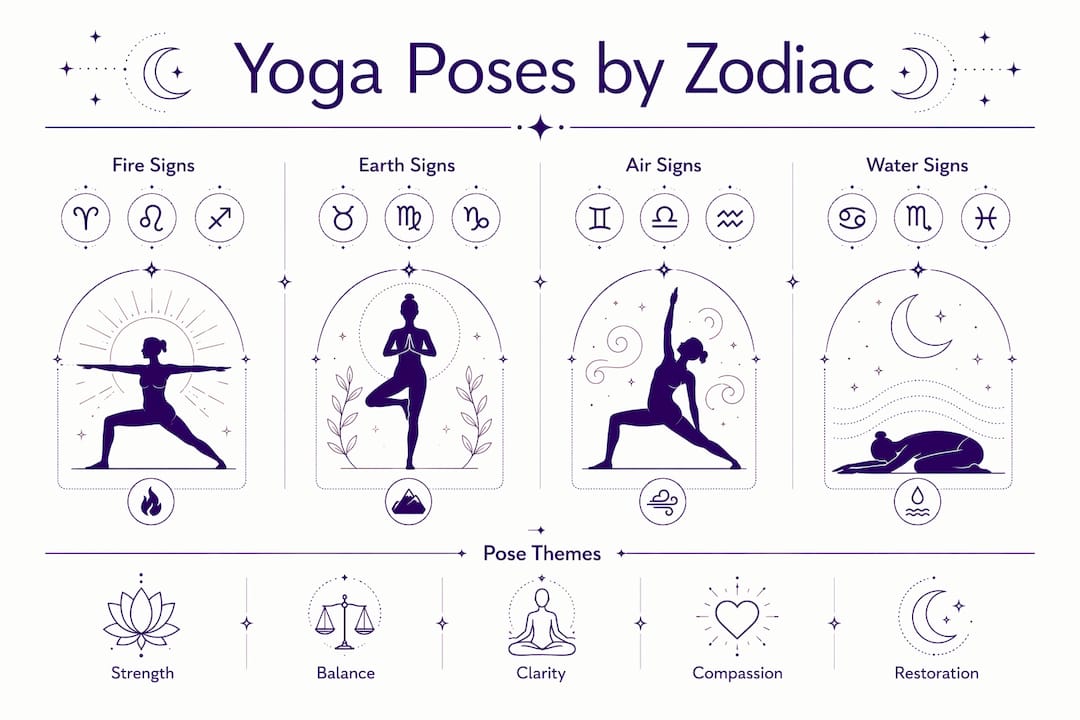
Elemental mapping is one of the most practical tools in astrology-informed yoga. Teachers use it to structure whole class formats, not just individual poses. Matching your dominant element to a practice style reduces resistance and builds consistency faster than picking a style at random.
Fire signs (Aries, Leo, Sagittarius)
- Emphasize: Heat-building flows, standing poses, sun salutations, strong backbends.
- Avoid overdoing: Excessive intensity without a cool-down; fire signs tend to skip Savasana.
- Best class styles: Power Vinyasa, Ashtanga, outdoor flow.
- Breathwork: Kapalabhati (skull-shining breath) to build energy; Sitali (cooling breath) to balance after intense sessions.
Earth signs (Taurus, Virgo, Capricorn)
- Emphasize: Grounding standing poses, long holds, structural alignment work.
- Avoid overdoing: Rigid repetition that becomes mechanical; earth signs benefit from occasional spontaneity.
- Best class styles: Iyengar, Hatha, Ashtanga with attention to alignment details.
- Breathwork: Nadi Shodhana (alternate nostril breathing) to stabilize and center.
Air signs (Gemini, Libra, Aquarius)
- Emphasize: Breath-linked movement, inversions, creative sequencing, transitions.
- Avoid overdoing: Scattered multi-style hopping that never builds depth.
- Best class styles: Vinyasa, Anusara, Jivamukti.
- Breathwork: Ujjayi (victorious breath) to anchor the wandering mind during movement.
Water signs (Cancer, Scorpio, Pisces)
- Emphasize: Hip openers, restorative holds, yin postures, moon salutations.
- Avoid overdoing: Passive practice that avoids challenge entirely; water signs need occasional heat to move stagnation.
- Best class styles: Yin Yoga, Restorative, Kundalini, Yoga Nidra.
- Breathwork: 4-7-8 breathing or long exhale techniques to support emotional release.
| Element | Signs | Primary Style | Secondary Style | Key Breathwork |
|---|---|---|---|---|
| Fire | Aries, Leo, Sagittarius | Power Vinyasa / Ashtanga | Outdoor flow | Kapalabhati |
| Earth | Taurus, Virgo, Capricorn | Iyengar / Hatha | Slow Vinyasa | Nadi Shodhana |
| Air | Gemini, Libra, Aquarius | Vinyasa / Anusara | Jivamukti | Ujjayi |
| Water | Cancer, Scorpio, Pisces | Yin / Restorative | Kundalini / Yoga Nidra | 4-7-8 / long exhale |
For a deeper look at how planets connect to energy centers, the chakra and astrology guide maps each planet to its corresponding chakra, which is useful when you want to add mudras or focused breathwork to an elemental practice.
How to time your practice with moon phases, planetary days, and retrogrades
Simple timing choices can make a real difference in how a practice feels and how well you stick with it. Moon-phase sequencing and planetary weekday themes are the two easiest places to start.
Lunar phase sequencing
| Moon Phase | Practice Focus | Example Poses |
|---|---|---|
| New Moon | Intention-setting; gentle forward bends; go inward | Child's Pose, Seated Forward Fold, gentle Pranayama |
| Waxing Moon | Build heat and strength; increase intensity gradually | Sun Salutations, Warrior series, core work |
| Full Moon | Release and heart-opening; connect with others | Camel, Wheel, Supported Fish, group practice |
| Waning Moon | Twists and letting go; detox and simplify | Seated Twists, Supine Twists, Yin holds |
Planetary weekday themes
Practitioners schedule theme-based practices by matching the day's ruling planet to a corresponding practice style. Here is a simple weekly map:
| Day | Planet | Practice Theme | Suggested Style |
|---|---|---|---|
| Sunday | Sun | Vitality and self-expression | Sun Salutations, backbends |
| Monday | Moon | Emotional flow and intuition | Yin, lunar yoga, restorative |
| Tuesday | Mars | Strength and power | Power Vinyasa, warrior flows |
| Wednesday | Mercury | Breath and communication | Pranayama focus, breath-linked Vinyasa |
| Thursday | Jupiter | Expansion and wisdom | Long holds, hip openers, meditation |
| Friday | Venus | Heart-opening and beauty | Backbends, heart openers, gentle flow |
| Saturday | Saturn | Discipline and structure | Ashtanga, alignment-focused Hatha |
Retrogrades and eclipse windows
During Mercury retrograde, reduce complex sequencing and avoid learning new inversions for the first time. Stick to familiar poses, use more props, and add an extra 5 minutes of Savasana. Eclipse windows call for a similar approach: Om Yoga Magazine recommends deepening pranayama and meditation during eclipse periods rather than pushing physical intensity, since the energetic environment tends to amplify internal states.
Daily timing window
Traditional Vedic sources recommend Brahma Muhurta, roughly 90 minutes before sunrise, as a high-potency window for practice. If that is not realistic for your schedule, any consistent early-morning slot works well. For a 40-day sadhana, start during a waxing moon to build momentum from the first session.
Pro Tip: Schedule your first sadhana session on a Thursday (Jupiter's day) during a waxing moon. The expansive, growth-oriented energy of Jupiter pairs well with building a new habit, and the waxing phase naturally supports increasing effort over time.
How to personalize your practice using your birth chart
Jyotish (Vedic astrology) treats the birth chart as a spiritual blueprint for tailoring practice. You do not need to read every placement to get started. Three signals give you most of what you need.
Start here: which placement to use first
- Sun sign: Use this for your general practice style and energy level. It reflects your core vitality and what kind of movement feels natural.
- Moon sign: Use this when your emotional state is the main concern. The moon governs your inner life, so moon-sign poses and styles tend to feel soothing or cathartic.
- Rising sign: Use this to address your physical body and constitution. As Jessamyn Stanley notes in her yoga and astrology writing, the rising sign is "the heartbeat of your yoga practice" and the most direct guide to what your body needs on the mat.
Quick signals to read from your chart
- Dominant element: Count how many personal planets (Sun, Moon, Mercury, Venus, Mars) fall in fire, earth, air, or water signs. The element with the most planets is your dominant one. Match your primary practice style to that element using the table above.
- Saturn placement: A prominent Saturn (in the 1st, 6th, or 10th house, or conjunct a personal planet) suggests the body benefits from long holds and grounding practices. In Vedic practice, yoga functions as an active remedial tool, and long holds are specifically recommended for Saturn-heavy charts to build endurance and release restriction.
- Mars placement: Strong Mars calls for regular physical release through power flows. Weak or afflicted Mars benefits from building heat gradually rather than pushing hard.
- Jupiter placement: Jupiter in a fire or air sign supports expansion-focused practices. Jupiter in earth or water signs responds well to grounding and restorative work.
Checklist: questions to answer from your chart
- What is my dominant element, and does my current practice style match it?
- Which body areas does my sun sign rule, and am I addressing them?
- Do I have a prominent Saturn or Mars that needs a specific practice adjustment?
- Is my moon sign asking for more emotional release or more stability right now?
When to seek a professional reading: if you have three or more chart placements you cannot interpret, or if you are dealing with a major life transit (Saturn return, Pluto opposition), a session with a Vedic astrologer or a tool like Tarosyn's birth chart analysis can clarify which adjustments matter most.
Short sequences you can use right now
These sequences are plug-and-play. Read the breath cues, gather any props listed, and start.
Sign-specific micro-practices (10–12 minutes each)
1. Aries micro-practice (fire, 10 minutes)
- Mountain Pose (Tadasana) — 1 minute, steady breath, set an intention.
- Sun Salutation A — 3 rounds, Ujjayi breath throughout.
- Warrior I — 5 breaths per side.
- Warrior II — 5 breaths per side.
- High Lunge with a twist — 4 breaths per side.
- Savasana — 2 minutes minimum. Props: none required.
2. Pisces micro-practice (water, 12 minutes)
- Seated breathing — 2 minutes, 4-7-8 breath pattern.
- Supine Twist — 6 breaths per side.
- Reclined Pigeon — 8 breaths per side.
- Supported Fish (bolster under the spine) — 3 minutes.
- Legs Up the Wall — 5 minutes. Props: bolster or folded blanket.
Element-based short sequences (15–20 minutes each)
3. Fire sequence (Aries, Leo, Sagittarius)
- Kapalabhati breathing — 2 minutes.
- Sun Salutation B — 4 rounds.
- Warrior III — 5 breaths per side.
- Camel Pose — 4 breaths, two rounds.
- Sitali breath cool-down — 2 minutes.
- Savasana — 3 minutes. Total: ~18 minutes.
4. Earth sequence (Taurus, Virgo, Capricorn)
- Nadi Shodhana — 3 minutes.
- Mountain Pose — 2 minutes.
- Standing Forward Fold — 8 breaths.
- Bridge Pose — 6 breaths, three rounds.
- Supine Bound Angle — 5 minutes.
- Savasana — 3 minutes. Total: ~17 minutes. Props: blocks, blanket.
5. Water sequence (Cancer, Scorpio, Pisces)
- 4-7-8 breathing — 3 minutes.
- Child's Pose — 2 minutes.
- Pigeon Pose — 8 breaths per side.
- Yin Dragon Pose — 3 minutes per side.
- Yoga Nidra or guided body scan — 5 minutes.
- Savasana — 3 minutes. Total: ~20 minutes. Props: bolster, blanket.
Beginner progression: Start with the sign-specific micro-practice for two weeks. Once it feels comfortable, move to the full element sequence. Add the planetary weekday themes in week three.
Safety notes and modifications for astrology-informed yoga
Astrological timing does not override physical limits. These notes apply regardless of what the chart or the moon is doing.
Common contraindications to keep in mind:
- Backbends (Camel, Wheel, Cobra): Avoid or modify with a strong heart condition, recent spinal surgery, or pregnancy beyond the first trimester. Use a supported version with a bolster or rolled blanket.
- Inversions (Legs Up the Wall, Headstand, Shoulder Stand): Skip during active menstruation if that is your practice tradition, postpartum for at least six weeks, or with unmanaged high blood pressure. Legs Up the Wall is the gentlest inversion and is generally safe for most people.
- Deep hip openers (Pigeon, Dragon): Avoid with acute knee injuries. Use the reclined version (Supta Kapotasana) instead.
- Twists: Approach carefully with disc herniation. Keep twists gentle and initiate from the thoracic spine rather than the lumbar.
- Intense transits (eclipses, Saturn return): During high-stress astrological periods, reduce intensity by one level. If you normally practice Power Vinyasa, switch to Hatha. If you practice Hatha, try Yin.
Practical modifications during intense transits:
Use more props than usual: blocks under the hands in forward folds, a bolster under the sacrum in Bridge, a blanket under the knees in any kneeling pose. Shorten hold times by 30–40% and add an extra 5 minutes of Savasana.
When to scale back or skip advanced poses:
- You have a chronic condition (heart disease, osteoporosis, recent surgery) and have not cleared the pose with a healthcare provider.
- You are in the first trimester of pregnancy and are new to yoga.
- You feel sharp (not dull) pain during any pose. Stop immediately.
- You are practicing during an eclipse window and feel unusually anxious or disoriented.
For additional class-style references and practitioner resources, the Wellness Gallery offers teaching materials that address modifications in detail.
What the research and practitioners say
The evidence base for astrology-informed yoga is still developing, but the practitioner data and consistency findings are worth noting.
A longitudinal study tracking practitioners found that those following an astrology-informed yoga practice showed higher consistency than those following general routines. The same source reports that practitioners describe improved physical balance and reduced anxiety when using sign-specific poses and moon-phase-aligned sequencing. These are anecdotal reports rather than controlled clinical data, but the pattern of improved adherence is consistent across multiple practitioner communities.
"Once we know more about ourselves through the lens of our birth chart, it becomes easier to find a practice that supports our journey, a practice contributing to our uniqueness. Jyotish can help individualize our yoga practice." — Om Yoga Magazine
The Vedic framework goes further. Yoga as an active Upaya means it functions as a targeted remedial tool, not just general wellness. A practitioner with a Saturn-heavy chart, for example, would use long holds and grounding sequences specifically to address that planetary imbalance, rather than choosing poses at random.
The honest limitation: most of the evidence is observational. Controlled studies on astrology-informed yoga specifically are limited. The practical recommendation is to treat this as a self-experiment: track your practice and mood for 30–40 days using a journal or a tracking app, then assess whether the sign-specific and timing adjustments made a noticeable difference for you personally.
Key takeaways
Matching your yoga practice to your zodiac sign, dominant element, and current moon phase is the fastest way to build a consistent, personalized routine.
| Point | Details |
|---|---|
| Start with one sign | Use your sun sign's pose for a 5–10 minute daily micro-practice before adding moon or rising sign layers. |
| Element drives style | Match your dominant element (fire, earth, air, water) to a class style for the best fit between temperament and practice. |
| Moon phase sets intensity | New moon for gentle intention work; full moon for heart-opening; waning moon for twists and release. |
| Safety first, always | Reduce intensity during eclipses and retrogrades; use props and skip advanced poses if a health condition applies. |
| Tarosyn for daily timing | Use Tarosyn's daily horoscope and birth chart tools to track transits and schedule your practice each week. |
Why this approach works better than a generic routine
The most common mistake beginners make is treating astrology-informed yoga as a novelty rather than a diagnostic tool. They read their sun sign, try the recommended pose once, and move on. The practitioners who actually see results use it the other way: they let the chart tell them what is out of balance, then use the practice to address it directly.
That shift in framing changes everything. Instead of asking "what pose suits a Scorpio?" you ask "what does my chart say is under-resourced right now, and which practice addresses that?" A Scorpio with a strong Saturn in the 6th house needs grounding and endurance work, not just hip openers. A Pisces with a prominent Mars needs heat and structure, not more Yoga Nidra.
The consistency data supports this. When a practice feels personally relevant, people return to it. Astrology gives that relevance a framework, which is why astrology as a self-discovery tool tends to improve follow-through in ways that generic wellness advice does not.
The other thing most guides skip: the shadow side of your sign is where the real work happens. Aries benefits most from stillness and long Savasanas, not more warrior poses. Virgo needs to practice surrendering the sequence, not perfecting it. Build that into your routine from the start, and the practice becomes genuinely transformative rather than just a comfortable habit.
Tarosyn brings your birth chart into your daily practice
Your birth chart contains more timing and practice signals than any single article can cover. Tarosyn's AI-powered platform gives you daily horoscopes, full birth chart readings, and a community journal where you can log practice notes alongside astrological events.
Here is how practitioners use Tarosyn to implement this guide:
- Daily horoscope check: Pull up your sign-specific daily horoscope each morning to see the day's planetary weather before choosing a practice style.
- Birth chart reading: Run a full chart to identify your dominant element, Saturn and Mars placements, and the houses that need attention in your practice.
- Community journal: Log your 40-day sadhana in the public journal, track which moon phases felt most productive, and read how other practitioners are adapting their routines.
- Tarot for intention-setting: Pair a three-card spread with your new moon practice to clarify the intention before you step on the mat.
Tarosyn's freemium tier gives you access to daily horoscopes and basic chart tools at no cost. Premium features unlock deeper birth chart analysis and personalized ritual guidance. Start with the free tier at tarosyn.com and add the tools that fit your practice as you go.
Useful sources and further reading
- Yoga Journal: Astro Yoga — Align Your Practice with Your Birth Chart — Sign-by-sign asana recommendations from a mainstream yoga publication; used to validate the pose-by-sign chart.
- Om Yoga Magazine: Deepening Your Yoga Practice with Vedic Astrology — Detailed Jyotish framework for aligning practice with birth chart and planetary transits; used for moon-phase and eclipse guidance.
- Om Yoga Magazine: Yoga and Astrology — Practical overview of Astro Yoga including sign-body correspondences and elemental practice design.
- Mystical Digits: Astrology Yoga Benefits — Source for consistency findings, moon-phase sequencing, and planetary weekday themes.
- Yoga Moha: Astrology-Informed Yoga — Birth chart as yoga guide; Brahma Muhurta timing and Jyotish-as-blueprint framework.
- Anahita Rao: Jyotish Is Good Medicine — Vedic practitioner perspective on yoga as active Upaya and Saturn/Mars-specific practice adjustments.
- Psyche and Salt: Astro-Yoga — Elemental mapping and class-style recommendations used in the elements section.
- Jessamyn Stanley: The Astrology of Your Yoga Practice — Sign-by-sign yoga style guide with light/shadow framing; used for rising sign and shadow practice notes.
- Astrology Juno: Yoga and Astrology — Overview of planetary influences on yoga and practical integration tips.
- Tarosyn Birth Chart Guide — Step-by-step self-analysis resource for applying chart findings to your practice.
- Tarosyn Daily Horoscope — Daily planetary weather for scheduling and adjusting your practice.